From March 23 to March 29, UK wind turbines were producing almost no electricity. Wind power production Wind power production as a percentage Boris Johnson says UK homes will be 100% wind powered by 2030. The UK relies on natural … Continue reading →
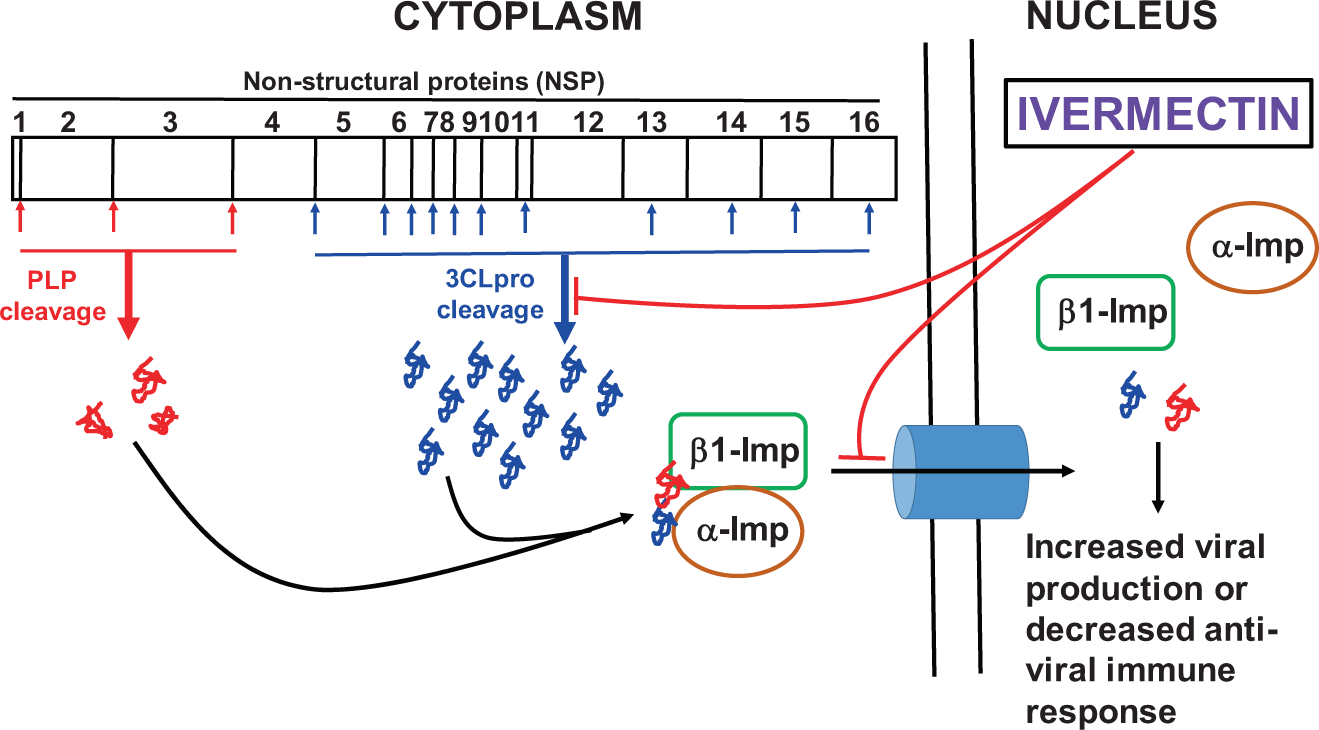
Hypothetical model illustrating the inhibition of SARS-CoV-2 replication by ivermectin mediated through the blocking of α/β1-importin (imp) as well as 3CLpro enzymatic activity. Mody et al (2021)
The Medical Pharmaceutical Industrial complex waged psy-ops warfare against effective and safe generic medicines, including hydroxychloroquine and ivermectin. Now FDA approves pills from Pfizer and Merck for “emergency use”, and in Quebec where I live, they follow along like lemmings rolling out Paxlovid, claiming the pill is a “game changer.” All this ignores that once again trials have been compressed so that longer term side effects are unknown, and Pfizer and Merck have no liability while expecting billions in profits.
As the background post below shows in some detail, these pills are not only pale substitutes for the proven generic therapeutics, they risk stimulating further viral mutations and prolonging the infectious activity in vaccinated and pill-popping developed societies. Fortunately, Africa and much of Asia and South America will be spared this latest public health experiment, as they have natural covid immunity from the virus itself with HCQ and IVM protecting people from severe illnesses.
IVM Beats Pfizer and Merck One-Trick-Pony Pills
John Campbell explains in the video below how the new Pfizer pill copies one trick from Ivermectin, without IVM’s other anti-viral mechanisms, resulting in an inferior and dangerous medicine. I have transcribed the basic message along with excerpts and links to several papers to which he refers. Excerpts are in italics with my bolds.
Pfizer’s new antiviral drug PAXLOVID shows very high levels of efficacy in preventing serious disease hospitalization and people dying. And that drug works in a particular way, what we call a pharmacodynamic action.
But there’s another generic drug called Ivermectin that you might have heard of that works in exactly the same way as that. Now no one’s saying that information has been deliberately suppressed for years while millions of people have died but what we are going to show on this video is conclusive proof from the literature that this modality of action is the same.
How Coronavirus Infects Its Host
Before we crack into that we need to look at what’s happening so when a virus, in this case coronavirus2 gets into a cell. What happens is it makes lots of proteins. It starts off making these long proteins, out of hundreds of amino acids sometimes. A few thousand amino acids all strung together.
The problem is they’re too long for the job that’s required. So it’s a bit like a building site and when a big log of wood arrives it needs to be trimmed down into bits that fit in your door frames and your window frames. So these proteins need to be trimmed down and it has to be done in a biochemical way.
In the case of coronavirus two, there’s an enzyme called 3CL protease which breaks down protein into smaller pieces. it’s what we call proteolytic and it will take these long proteins and it will chop them into shorter proteins it’s what we call an endopeptidase. So now instead of having one long protein we’ve got two short ones and these fit together just nicely for the new virus that we’re we’re trying to make.
These new drugs are what we call protease inhibitors because they stop the protease from working. If the protease is like this scissor, the inhibitor is like this tape stopping the cutting up of long proteins.
When there’s another long protein that needs to be processed the 3CL protease comes along ready to chop this up. But now these drugs have bounded up the active site of the protease and they stop the protease from chopping up the big proteins into smaller strings of amino acids. Since they can’t build the virus, it inhibits viral replication.
This is the new Pfizer drug which is designed to block the activity of the sars coronavirus2 3CL, so that 3CL protease now won’t work. It won’t open so i can’t chop my proteins into the correct length to build a nice new virus. And of course a 3CL protease inhibitor will stop it from making sars coronavirus2 and is therefore anti-viral.
Everyone in human biology has heard of chymotryptin. It’s an enzyme released by the pancreas to digest protein. It’s a protein chopping up enzyme so this chymotryptin-like protease inside the virus is working in a very similar way to the chimbotryptin that your pancreas produces to digest your proteins.
PAXLOVID (PF-07321332; ritonavir) was found to reduce the risk of hospitalization or death by 89% compared to placebo in non-hospitalized high-risk adults with COVID-19
In the overall study population through Day 28, no deaths were reported in patients who received PAXLOVID as compared to 10 deaths in patients who received placebo
Pfizer plans to submit the data as part of its ongoing rolling submission to the U.S. FDA for Emergency Use Authorization (EUA) as soon as possible.
If approved or authorized, PAXLOVID, which originated in Pfizer’s laboratories, would be the first oral antiviral of its kind, a specifically designed SARS-CoV-2-3CL protease inhibitor. Upon successful completion of the remainder of the EPIC clinical development program and subject to approval or authorization, it could be prescribed more broadly as an at-home treatment to help reduce illness severity, hospitalizations, and deaths, as well as reduce the probability of infection following exposure, among adults. It has demonstrated potent antiviral in vitro activity against circulating variants of concern, as well as other known coronaviruses, suggesting its potential as a therapeutic for multiple types of coronavirus infections.
Evidence for 3CL protease inhibitors from September 2020
Viral protease is a valid antiviral drug target for RNA viruses including coronaviruses. (13) In response to the COVID-19 pandemic, great efforts have been made to evaluate the possibility of repurposing approved viral protease inhibitor drugs for the clinical treatment of the disease. Unfortunately, the combination of lopinavir and ritonavir, both approved HIV protease inhibitors, failed in a clinical trial without showing benefit compared to the standard of care. (14) To address this unmet need, several virtual screens and a drug repurposing screen were performed to identify SARS-CoV-2 3CLpro inhibitors.
In conclusion, this study employed an enzymatic assay for qHTS that identified 23 SARS-CoV-2 3CLpro inhibitors from a collection of approved drugs, drug candidates, and bioactive compounds. These 3CLpro inhibitors can be combined with drugs of different targets to evaluate their potential in drug cocktails for the treatment of COVID-19. In addition, they can also serve as starting points for medicinal chemistry optimization to improve potency and drug-like properties.
Ivermectin Emerges as Top Antiviral Candidate for CV2
Fig. 4: Ivermectin exhibited complete inhibition of SARS-CoV-2 3CLpro enzymatic activity whereas micafungin partially inhibited the enzyme.
The off-target drugs that are being used to treat non-viral ailments selected by in silico studies were screened for their inhibitory activity against SARS-CoV-2 3CLpro enzyme.
Interestingly, one of the OTD (Off Target Drugs), ivermectin was able to inhibit more than 85% (almost completely) of 3CLpro activity in our in vitro enzymatic assay with an IC50 value of 21 µM. These findings suggest the potential of ivermectin to inhibit the SARS-CoV-2 replication. In support of this, a recent finding suggested that ivermectin (5 µM) inhibited the replication of live SARS-CoV-2 isolated from Australia (VIo1/2020) in Vero/hSLAM cells23. They found that >5000-fold viral counts were reduced in 48 hr in both culture supernatant (release of new virion: 93%) as well as inside the cells (unreleased and unassembled virion: 99.8%) when compared to DMSO treated infected cells.
Earlier studies have demonstrated that the possible anti-viral mechanism of ivermectin was through the blockage of viral-protein transportation to the nucleus by inhibiting the interaction between viral protein and α/β1 importin heterodimer, a known transporter of viral proteins to the nucleus especially for RNA viruses19,20,21,22,23. However, in this study, we have reported that ivermectin inhibits the enzymatic activity of SARS-CoV-2 3CLpro and thus may potentially inhibit the replication of RNA viruses including SARS-CoV-2. These studies suggest that ivermectin could be a potential drug candidate to inhibit the SARS-CoV-2 replication and the proposed anti-viral mechanism of ivermectin presented in Fig. 8 and in vivo efficacy of ivermectin towards COVID-19 is currently been evaluated in clinical trials (ClinicalTrials.gov Identifier: NCT04438850).
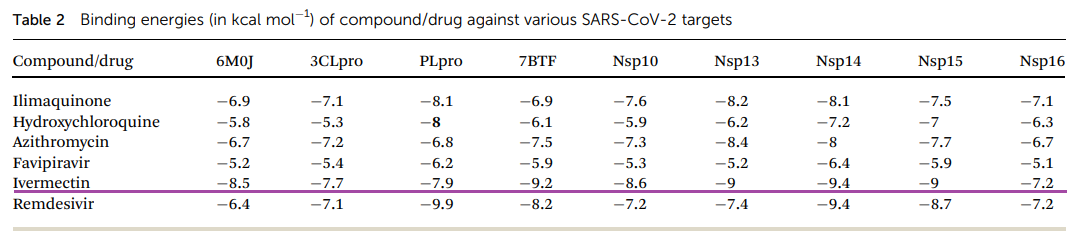
In conclusion, both ivermectin and remdesivir could be considered potential drugs for the treatment of COVID-19. Ivermectin efficiently binds to the viral S protein as well as the human cell surface receptors ACE-2 and TMPRSS2; therefore, it might be involved in inhibiting the entry of the virus into the host cell. It also binds to Mpro and PLpro of SARS-CoV-2; therefore, it might play a role in preventing the post-translational processing of viral polyproteins. The highly efficient binding of ivermectin to the viral N phosphoprotein and nsp14 is suggestive of its role in inhibiting viral replication and assembly. Remdesivir may be involved in inhibiting post-entry mechanisms as it shows high binding affinity to N and M proteins, PLpro, Mpro, RdRp, and nsp14. Although the results of clinical trials for remdesivir are promising (Beigel et al., 2020; Wang Y. et al., 2020), similar clinical trials for ivermectin are recommended. Both these drugs exhibit multidisciplinary inhibitory effects at both viral entry and post-entry stages. Source: Molecular Docking Reveals Ivermectin and Remdesivir as Potential Repurposed Drugs Against SARS-CoV-2
Conclusion from John Campbell
So whereas the Pfizer drug is only working as far as we’ve been told in the proviso press release against one biochemical modality of viral replication, the Ivermectin mechanism is working at many different levels. The fact that the the the Pfizer medicine is only working against one particular biochemical pathway means to me that the virus could learn to avoid that. It could evolve to be drug resistant as indeed the early antiretrovirals did with HIV.
With ivermectin, because it’s working on so many different levels, it is improbable, to put it mildly,that a virus would mutate in a dozen different ways to avoid all those different mechanisms. We’ve talked about six mechanisms today. It’s very unlikely that we get six mutations that could dodge all of those all at the same time.
So I’ve a brief message to world leaders, people that are making the decisions about this. Come on you all, you’re not a horse and you’re not a cow. You’ve got a human intellect. Let’s use it to follow the scientific evidence to save human pain, suffering and death.
Live Cam Kuredu Island Resort | SkylineWebcams In 1989, experts said the Maldives would drown by the year 2018, unless global governance was implemented. “MALE, Maldives: A gradual rise in average sea level is threatening to completely cover this Indian … Continue reading →
“Consistent with President Biden’s whole-of-government approach to climate change, Treasury will work with other stakeholders, including the National Climate Task Force and other agencies and regulators.”
“Treasury will focus on the broad range of its climate-related policy work connected to 1) climate transition finance, 2) climate-related economic and tax policy, and 3) climate-related financial risks…. Treasury is also creating a new Climate Hub and appointing a Climate Counselor to coordinate and lead many of its efforts to address climate change.”
This 788-word press release below speaks for itself. An intellectual/political elite is all-in to assume the ‘commanding heights’ of the U.S. energy industries, just as is the case in the UK and EU.
It was once said that “war is the health of the state.” In our time, climate change policy (Al Gore’s ‘central organizing principle‘) is the health of the State at home and abroad. Economic freedom hangs in the balance with the commoners fighting against the elite.
Make no mistake: the recent “drill, baby, drill” out of Washington, DC (typified by DOE Secretary Granholm at CERAWeek22) is window dressing. “We are going to get rid of fossil fuels,” an unscripted Joe Biden himself stated.
The climate alarmist agenda of Biden’s puppeteers is being rushed into play to create what Milton Friedman once warned against, “the tyranny of the status quo.” Elections are coming, and citizen-voters know the real Biden agenda.
The U.S. Department of Treasury press release of April 19, 2021, follows:
WASHINGTON — Today, the U.S. Department of the Treasury announced a coordinated climate policy strategy that will:
Bring to bear the full force of the Treasury Department on domestic and international policymaking, leveraging finance and financial risk mitigation to confront the threat of climate change. These actions will position the economy for strong and sustainable growth consistent with a net-zero emissions future.
To implement this strategy, Treasury will focus on the broad range of its climate-related policy work connected to 1) climate transition finance, 2) climate-related economic and tax policy, and 3) climate-related financial risks. As part of this strategy, Treasury is also creating a new Climate Hub and appointing a Climate Counselor to coordinate and lead many of its efforts to address climate change.
Treasury’s unique responsibilities to lead on a range of programs related to climate change – including economic, financial sector, and government policies – will be reflected in the expanded climate strategy work program. The Treasury Climate Hub will coordinate and enhance existing climate-related activities by harnessing the tools, capabilities, and expertise from across the Department – including from Domestic Finance, Economic Policy, International Affairs, and Tax Policy. With a view of all Treasury climate initiatives, the Hub will enable Treasury to move nimbly and efficiently in prioritizing climate action.
Treasury’s first Climate Counselor is John E. Morton, a recognized leader in the field of climate finance. Mr. Morton brings to Treasury more than 25 years of experience in emerging markets, investment finance, and economic and environmental policy. As Climate Counselor, he will lead the Climate Hub, report directly to and advise the Secretary on a broad range of climate matters, and focus in particular on Treasury’s efforts to facilitate and unlock the financing needed for investments to achieve a net-zero economy at home and abroad.
“Climate change presents new challenges and opportunities for the U.S. economy. The steep consequences of our actions demand that the Treasury Department make climate change a top priority,” said Secretary Janet L. Yellen. “Climate change requires economy-wide investments by industry and government as well as actions to measure and mitigate climate-related risks to households, businesses, and our financial sector.
Finance and financial incentives will play a crucial role in addressing the climate crisis at home and abroad and in providing capital for opportunities to transform the economy. I look forward to working with John and our team to leverage their expertise and ensure that Treasury is doing everything it can to respond to climate change while creating opportunities that strengthen our economy.”
Treasury’s climate policy strategy will support the Biden-Harris Administration’s critical climate-related goals by:
Mobilizing financial resources for climate-friendly investments at home and abroad, and prioritizing the expedited transition of high-emitting sectors and industries;
Leveraging economic and tax policies to support building climate-resilient infrastructure and ensuring the transition to a net-zero decarbonized economy;
Ensuring that environmental justice considerations feature centrally in programs, policies, and activities given the disproportionate impacts that climate change has on disadvantaged communities;
Ensuring that policies designed and implemented to assist with the transition to a lower-carbon economy are broadly just and equitable and support well-paying jobs;
Helping household, businesses, workers, and investors analyze, stay informed about, and adapt to the economic and financial risks and opportunities associated with climate change;
Promoting globally consistent approaches to climate-related financial risks; and
Understanding and mitigating the risks that climate change poses to the stability of the U.S. and global financial system and economy.
Consistent with President Biden’s whole-of-government approach to climate change, Treasury will work with other stakeholders, including the National Climate Task Force and other agencies and regulators. The efforts across the Department will support engagement by the Secretary, senior officials, and staff in related independent processes, including at the Financial Stability Oversight Council.
This description of the leader of Treasury’s effort, John Morton, follows. An elitist/Statist he is:
John E. Morton was most recently a Partner at Pollination, a specialist climate change advisory and investment firm. Morton was a Presidential Appointee in the Obama Administration and served as White House Senior Director for Energy and Climate Change at the National Security Council. In this role, he had overall responsibility for coordinating the Obama Administration’s policies and strategies on international energy and climate change issues.
Earlier in the Administration, he served for six years as Vice President for Investment Policy, Chief of Staff, and Chief Operating Officer of the Overseas Private Investment Corporation (OPIC). Before his Government service, Morton was Managing Director of Economic Policy at The Pew Charitable Trusts and a private equity investor with Global Environment Fund. He began his career as a strategy consultant with Mercer and managing World Bank projects in environmental infrastructure sectors in the former Soviet Union.


 shows very high levels of efficacy in preventing serious disease hospitalization and people dying. And that drug works in a particular way, what we call a pharmacodynamic action.

 Iowa Climate Science Education