
Friday Funny (by Josh) and Anthony Watts
On Earth Day 2022, today, it is a good idea to reflect on the upcoming 50th anniversary of the release of the eco-apocalypse movie Soylent Green. Here is my viewpoint on the movie:
It’s the year 2022. Cumulative effects of overpopulation, pollution, and a “climate catastrophe” are causing severe worldwide shortages of food, water, and housing. Scientists confirm oceanographic reports saying the oceans are dying. The food chain is disrupted. Food is becoming scarce, and heat waves have become year-round events thanks to climate change aka “global warming.”
Homeless people are everywhere; only half the workforce is employed while the other half is barely making it. Many people are illiterate and few factories are producing new goods.
The homes of the elite are barricaded, with private security. Only the elite can afford air conditioning. Strawberries are now a delicacy at $150 a jar. The situation with food has gotten so bad that people are being harvested off the streets and “recycled protein” is being distributed to the population.
Yes, it’s the ecological disaster movie Soylent Green released in 1973, describing life in 2022. Some of the movie was predicated on the 1968 book The Population Bomb. According to Wikipedia:
“…written by Stanford University Professor Paul R. Ehrlich and his wife, Anne Ehrlich. It predicted worldwide famine in the 1970s and 1980s due to overpopulation, as well as other major societal upheavals, and advocated immediate action to limit population growth. The book has been criticized since its publication for its alarmist tone, and in recent decades for its inaccurate predictions. The Ehrlichs stand by the book despite its flaws stating in 2009 that “perhaps the most serious flaw in The Bomb was that it was much too optimistic about the future” and believe that it achieved their goals because “it alerted people to the importance of environmental issues and brought human numbers into the debate on the human future.”
The premise of the movie generally plays off the ideas of Paul Ehrlich, the father of alarmism, expounded in his 1968 book “The Population Bomb.” As in the movie, virtually all his predictions failed. And his solution for over-population — to poison the water supply of high fertility countries with “temporary sterilants”, was about as creepy and immoral as Soylent Green’s mass murders for the purpose of providing the raw material of their green “soy” bars, to appease the starving masses. About the only prediction the movie got right was that soybeans would be the basis of so much of our food today.
Eerily, today’s environmental alarmists seem to have copied, virtually verbatim, the failed predictions made by the producers, screenwriters and director of Soylent Green. Let’s look at all the predications which so completely failed to materialize after 50 years.
POPULATION: This is the first prediction that bombed. The movie forecasts 40 million people, but today NYC has 8,804,190 as of April 1, 2020. True, the world’s population has doubled since 1973, growing by 3.9 billion, but it has done so while increasing the world’s standard of living materially.
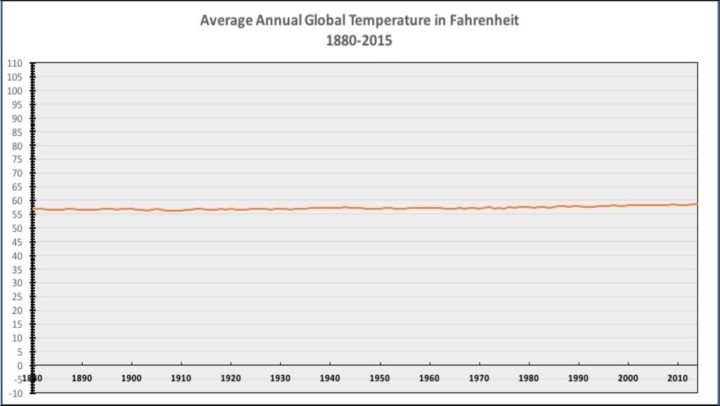
GLOBAL WARMING: New York City was forecast to be cooking at a sizzling 90 degrees year-round. But the current annual average daily MEAN temperature in Central Park is 55.8 F or 13.2 C. Even the annual average daily HIGH temperature is a comfortable 62.6 F or 17.0 C. And, these temperatures are imperceptibly different from the year 1850 when viewed on the scale of human experience with temperature, Seen in Figure 0.
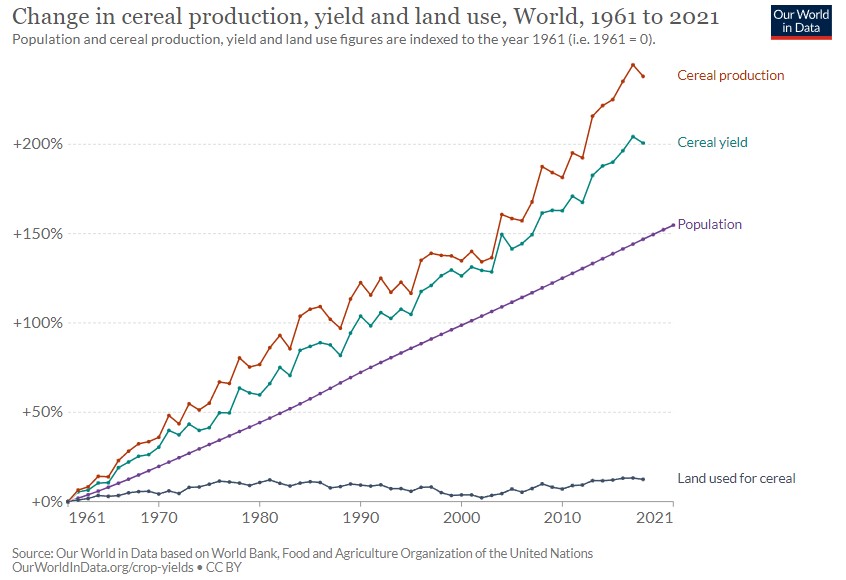
FOOD PRODUCTION: Soylent Green painted a picture of global starvation by the year 2020. Fortunately, this was laughingly wrong. Today, 50 years later, food production is at an all-time high, with virtually every category showing dramatically increased yields and production since 1973. And, this has more than kept up with rising population, with a material decrease in global poverty since 1973.
LACK OF ENERGY RESOURCES: The NYC of Soylent Green lacks a steady source of reliable electricity, whereas the last major blackout that occurred in NYC was in 2003, almost 20 years ago. The world has built the modern civilization on reliable, affordable energy, which has only become more prevalent around the world since 1973 as its cost has decreased as a percentage of personal income.
NATURE DESTROYED: In Soylent Green’s 2022, nature is so destroyed by anthropogenic activities that beautiful ocean shores are a thing of the past, deer no longer frolic in our forest and farmland is so precious that they are kept behind fence walls. In reality, since 1973, the wealthier the world has become, the more it has been able to focus on the preservation of the environment. I live in the suburbs of a metropolitan area of more than 6 million people, and we are overrun with deer, as is most every suburban area in the US. More importantly, global forest acreage has grown 7% since 1982. Our skies, our water and land are cleaner than 1973 and people have more free time and income to take the time to enjoy the nature around them.
The world does in fact face high inflation and shortages today. In the U.S., these are partly the result of two decades of policies substituting ever more intermittent sources of electric power for reliable fossil fuels and nuclear power onto the electric grid, and, more recently, the Biden administration’s limits on fossil fuel production.
Despite this, as pointed out above, the worst of Soylent Green’s vision of the future is still far from coming to pass. Most importantly, the climate itself is not a catastrophe when you look at real-world data.
As seen in figures 1A and 1B below, March 2022 global temperatures measured by satellite are 0.27°F (0.15°C) and U.S. temperature measured by the U.S. Climate Reference Network, is just 0.38°F (0.21°C) above average; nearly undetectable fractions of a degree, with little change measured in the U.S. in 17 years. (Sidenote: you can get this data as images for your own website by getting insertable code from our new climate widget on the right sidebar)

And, when we look at other real-world data, such as crop production and lives lost to non-optimal temperatures, we find things are even less like the predictions of the movie for 2022. In reality today, there is less hunger and fewer lives lost to extreme heat or cold than ever throughout history.
Global Crop production is actually up significantly according to the U.N. Food and Agriculture Organization, as seen in Figure 2:
The Earth has actually become greener according to NASA, thanks to increased carbon dioxide in the atmosphere. This is something proven in the fossil record by a peer-reviewed study. Also, as seen in Figure 3, air pollution is down 50% or more since 1990 according to the Environmental Protection Agency.
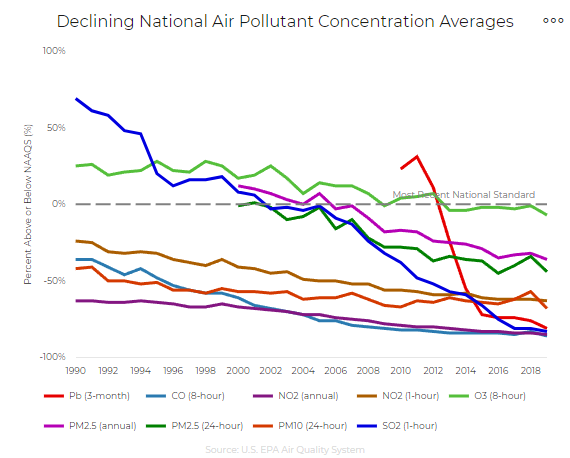
The EPA added this note to their graph:
During this same period, the U.S. economy continued to grow, Americans drove more miles, and population and energy use increased.
But the most significant climate related data in 2022 is the fact the climate related deaths have plummeted since the movie came out, seen in Figure 4. Using data from The International Disaster Database, climate scientist Bjørn Lomborg found striking drops in the data. He notes:
If we look at the death risk for an individual, the risk reduction is even bigger – dropped almost 99% since the 1920s.
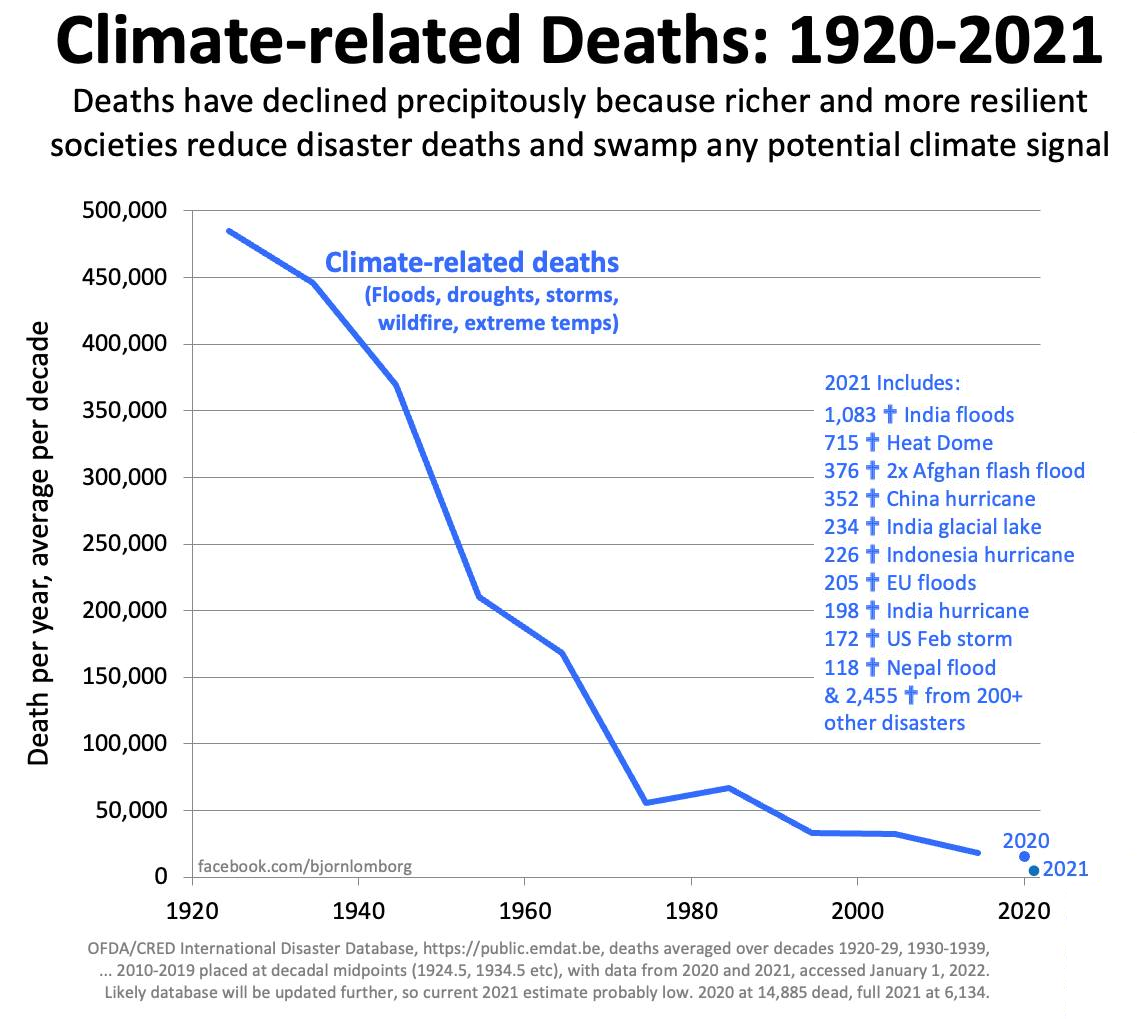
In the Figure 3 graph, the 2021 datapoint shows climate related deaths are approaching zero on the scale, and Lomborg estimates that in 2021, they could be 99.7% lower than in 1920.
In 1973, Soylent Green forecast a “climate catastrophe” and a grim future for 2022 that clearly hasn’t happened. You can add Soylent Green to the list of failed predictions since the first Earth Day in 1970.
Here are 18 examples of the spectacularly wrong predictions made around 1970 when Earth Day started:
1. Harvard biologist George Wald estimated that “civilization will end within 15 or 30 years unless immediate action is taken against problems facing mankind.”
2. “We are in an environmental crisis that threatens the survival of this nation, and of the world as a suitable place of human habitation,” wrote Washington University biologist Barry Commoner in the Earth Day issue of the scholarly journal Environment.
3. The day after the first Earth Day, the New York Times editorial page warned, “Man must stop pollution and conserve his resources, not merely to enhance existence but to save the race from intolerable deterioration and possible extinction.”
4. “Population will inevitably and completely outstrip whatever small increases in food supplies we make,” Paul Ehrlich confidently declared in the April 1970 issue of Mademoiselle. “The death rate will increase until at least 100-200 million people per year will be starving to death during the next ten years.”
5. “Most of the people who are going to die in the greatest cataclysm in the history of man have already been born,” wrote Paul Ehrlich in a 1969 essay titled “Eco-Catastrophe! “By…[1975] some experts feel that food shortages will have escalated the present level of world hunger and starvation into famines of unbelievable proportions. Other experts, more optimistic, think the ultimate food-population collision will not occur until the decade of the 1980s.”
6. Ehrlich sketched out his most alarmist scenario for the 1970 Earth Day issue of The Progressive, assuring readers that between 1980 and 1989, some 4 billion people, including 65 million Americans, would perish in the “Great Die-Off.”
7. “It is already too late to avoid mass starvation,” declared Denis Hayes, the chief organizer for Earth Day, in the Spring 1970 issue of The Living Wilderness.
8. Peter Gunter, a North Texas State University professor, wrote in 1970, “Demographers agree almost unanimously on the following grim timetable: by 1975 widespread famines will begin in India; these will spread by 1990 to include all of India, Pakistan, China, and the Near East, Africa. By the year 2000, or conceivably sooner, South and Central America will exist under famine conditions….By the year 2000, thirty years from now, the entire world, with the exception of Western Europe, North America, and Australia, will be in famine.”
9. In January 1970, Life reported, “Scientists have solid experimental and theoretical evidence to support…the following predictions: In a decade, urban dwellers will have to wear gas masks to survive air pollution…by 1985 air pollution will have reduced the amount of sunlight reaching earth by one half….”
10. Ecologist Kenneth Watt told Time that, “At the present rate of nitrogen buildup, it’s only a matter of time before light will be filtered out of the atmosphere and none of our land will be usable.”
11. Barry Commoner predicted that decaying organic pollutants would use up all of the oxygen in America’s rivers, causing freshwater fish to suffocate.
12. Paul Ehrlich chimed in, predicting in 1970 that “air pollution…is certainly going to take hundreds of thousands of lives in the next few years alone.” Ehrlich sketched a scenario in which 200,000 Americans would die in 1973 during “smog disasters” in New York and Los Angeles.
13. Paul Ehrlich warned in the May 1970 issue of Audubon that DDT and other chlorinated hydrocarbons “may have substantially reduced the life expectancy of people born since 1945.” Ehrlich warned that Americans born since 1946…now had a life expectancy of only 49 years, and he predicted that if current patterns continued this expectancy would reach 42 years by 1980 when it might level out. (Note: According to the most recent CDC report, life expectancy in the US is 78.6 years).
14. Ecologist Kenneth Watt declared, “By the year 2000 if present trends continue, we will be using up crude oil at such a rate…that there won’t be any more crude oil. You’ll drive up to the pump and say, `Fill ‘er up, buddy,’ and he’ll say, `I am very sorry, there isn’t any.’” (Note: Global production of crude oil last year at 82.275M barrels per day (bpd) was just slightly below the record output in 2018 of 82.9M bpd, and about 50% higher than the global output of 55.7M bpd around the time of the first Earth Day).
15. Harrison Brown, a scientist at the National Academy of Sciences, published a chart in Scientific American that looked at metal reserves and estimated the humanity would totally run out of copper shortly after 2000. Lead, zinc, tin, gold, and silver would be gone before 1990.
16. Sen. Gaylord Nelson wrote in Look that, “Dr. S. Dillon Ripley, secretary of the Smithsonian Institute, believes that in 25 years, somewhere between 75 and 80 percent of all the species of living animals will be extinct.”
17. In 1975, Paul Ehrlich predicted that “since more than nine-tenths of the original tropical rainforests will be removed in most areas within the next 30 years or so, it is expected that half of the organisms in these areas will vanish with it.”
18. Kenneth Watt warned about a pending Ice Age in a speech. “The world has been chilling sharply for about twenty years,” he declared. “If present trends continue, the world will be about four degrees colder for the global mean temperature in 1990, but eleven degrees colder in the year 2000. This is about twice what it would take to put us into an ice age.”
And finally, here is a big one:
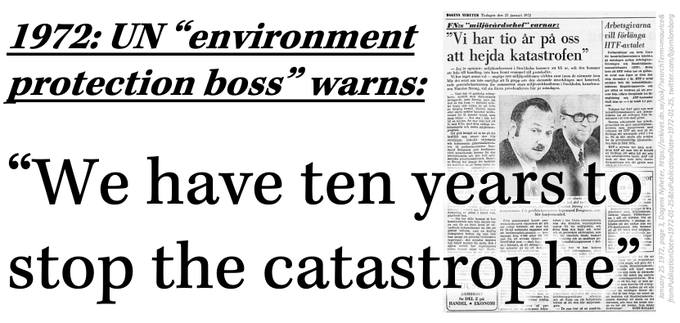
So much for the doomsayers predicting the future. They weren’t just wrong, they were wildly wrong.
Runaway inflation and restrictive energy policies enforced by the Biden administration are the real catastrophes limiting America’s bright future, today.
Cover image: Cartoon by Josh, with additional soylent framing by Anthony. Like Joshs’ work? Buy him a pint.
via Watts Up With That?
April 22, 2022 at 04:18AM




 Iowa Climate Science Education