Month: April 2022

Resourceful Earth Day (celebrate freedom, innovation)

“What many environmentalists seem incapable of understanding is that resources are created. After all, crude oil is just sludge until you get it out of the ground and figure out how to use it as an energy source.”

“This Earth Day, we should all give two green thumbs up for human freedom and innovation.”

There is a certain fringe of the environmentalist movement whose members have almost nothing good to say about their fellow men and women. If not for humans, they sometimes explicitly argue, the Earth would be a wonderful place. The lion might not lie down with the lamb, but at least “nature” would be allowed to run its course unobstructed by humankind—which in their reckoning is somehow not a part of nature.

Admittedly, humans have a particular nature that sets them apart from the rest of the fauna on this planet. We do not just inhabit the Earth; we shape it, and far more extensively than any other species does. Beavers may build dams, but they don’t build Hoover Dams.

Yet are the actions of human beings necessarily harmful to other parts of nature? Are we truly like a cancer in the breast of Mother Earth?

The notion that nature is fragile and humans a threat dates back a lot further than 1970 and the first Earth Day chastisements. The theologian Tertullian, in his treatise On the Testimony of the Soul, was horrified by the fact that humans had “become a burden to the Earth” and that “the Earth can no longer support us.” This treatise was written over 1,800 years ago, when the global population was a mere 3% of what it is today.

Climate Fixation

Changes in the climate more specifically have also long been blamed on humans, as German researchers Hans von Storch and Nico Stehr have explained. Well before any alleged “consensus” blamed climate change on our use of fossil fuels, periods of cooling or warming were attributed to such manmade causes as witchcraft, deforestation, the invention of the lightning rod, the invention of wireless telegraphy, cannon shots in World War I, and nuclear testing.

Despite the leveling off of warming for the past decade and a half, world leaders keep jetting around the globe to talk about how to address climate change. Last September, there was the Climate Summit in New York, which was a milestone on the path to the negotiation of an agreement in principle to get together again and talk some more.

And talk more they did, for twelve days in December in Lima on the occasion of the 20th annual UN Climate Change Conference. This meeting provided the foundation and paved the way for a new international pact that is supposed to be signed this coming December when the same people gather yet again, this time in Paris.

Resourceship

It seems intuitive to some that if humans are increasingly numerous and increasingly wealthy, we must be harming our ecosystems. But there is no such necessary connection. Indeed, as we become richer and more capable of meeting our most basic needs, we start to care more about the environment, and we turn our very human ingenuity to the task of conserving it.

“More people” doesn’t just mean more mouths to feed, either; it also means more brains that can search for ways to turn waste into resources and do more with less. What many environmentalists seem incapable of understanding is that resources are created. After all, crude oil is just sludge until you get it out of the ground and figure out how to use it as an energy source.

A little over a century ago, nobody knew what to do with gasoline, which was a waste material from the production of kerosene. And horses were a source of pollution and disease for cities, with huge tracts of farmland required to feed them all. Then along came the automobile—so despised by greens today—running on gasoline and neatly dealing with the horse pollution problem.

The development of natural gas and hydroelectricity, to cite one more example, has led to a sizable reduction in demand for coal and heating wood. This has greatly improved air quality in cities, not to mention lowering pressure on our forests. Despite what you may have been led to believe, forest cover has been increasing or stable in most industrialized countries for decades.

The proposals of less radical environmentalists are often clothed as forward-thinking ways of making human lives better. And indeed, we do all benefit from a cleaner environment.

But it is not by blocking pipelines, the safest way of transporting oil, that we will improve our lot. Nor is it by opposing the responsible development of Alberta’s oil sands bitumen, which emits only marginally more greenhouse gas than conventional oil over its total lifecycle (including production and combustion).

Neither is it by subsidizing electric cars, an extremely expensive way of reducing greenhouse gas emissions. Such short-sighted actions will only impoverish us, leaving us with less surplus capacity for environmental concerns, and less capable of adapting to a changing world.

Freedom Flower

Green activists and regulators like to take the credit for improvements in the quality of our environment over the past few decades, but most of the credit goes to market actors trying to supply people’s demand for environmental quality.

The quest for profit is constantly pushing managers and technicians to find better ways of doing things, to reduce their consumption of resources per unit of output, to reuse waste rather than throwing it away into nature at a loss.

This Earth Day, we should all give two green thumbs up for human freedom and innovation.

—–

Pierre Desrochers was associate researcher, and Jasmin Guénette vice president, at the Montreal Economic Institute (MEI). This post was originally published on Earth Day 2015.

The post Resourceful Earth Day (celebrate freedom, innovation) appeared first on Master Resource.

via Master Resource

https://ift.tt/2SrdTDz

April 22, 2022 at 01:06AM

Washed Away – A Short Film About Sea Level Fall

Originally posted on Jennifer Marohasy’s blog.

April 22, 2022 By jennifer 

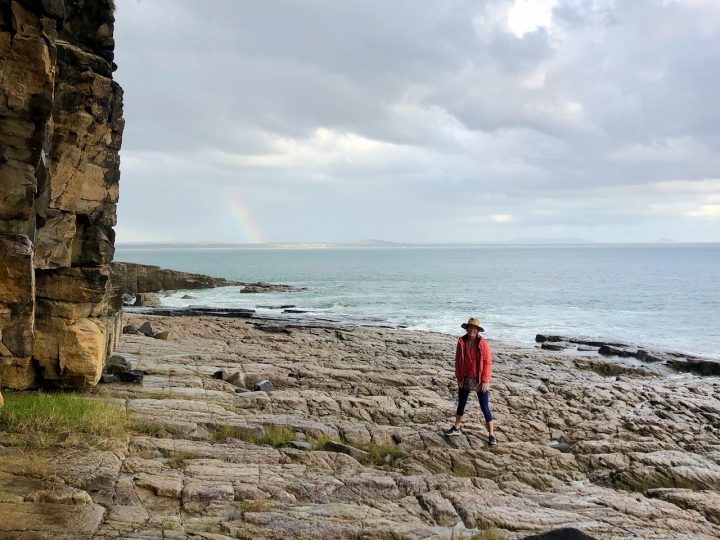
I live by the sea and like walking along the coastline including scrambling over the rock ledges in Noosa National Park. All the way from Noosa to Sydney it is possible to find wave-cut platforms etched out of the sandstone towards the bottom of the cliff faces.

The sandstone is very old, thought to date from the time of the dinosaurs, perhaps 180 million years ago, but the ledges – referred to as platforms when they are wide – are much younger. Expert geologists suggest that my favourite very wide, wave-cut platform, at the bottom of the cliff face that drops down from Boiling Pot Lookout, is about 125,000 years old.

It formed when sea levels were higher, and the cutting action of waves would have brought down great lumps of rock from above. The debris would have been removed by the wash, beyond the intertidal zone. The cliff face would have been receding landward as the sea ate into it. This is how cliffs are formed, and when they are of sandstone they sometimes leave behind ledges and wave-cut platforms as relics, showing sea levels were higher in a bygone age.

For the last few years, I’ve been standing on the wide platform at the bottom of the cliff face, below the lookout, at the time of the highest tide each year. Usually, the waves smash the rocks about a metre below, never reaching me. So, I confidently snub my nose at claims of unprecedented high sea level as repeated on the nightly news and in IPCC reports. I also use it as an occasion to agree with some geologists who argue sea levels were even higher 125,000 years ago, during that period known as the Eemian.

Except this past January the highest astronomical tide corresponded with a four metre swell from ex-cyclone Seth.   It was the first year I didn’t stand on the platform at the moment of the highest astronomical tide.  But my dear friend Jared did.   I’ve made a short film about it all, entitled ‘Washed Away’.

Australia is a good place to study sea level change. Unlike Britain, Australia wasn’t covered in an ice sheet during the last ice age. Ice sheets complicate things because when all the ice melts – as Scotland’s ice sheet did a little over 9,000 years ago – part of the landmass may gradually rebound dragging its bottom half under. So, the north of the British Isles is rising, while the south has been sinking up to 0.6mm per year for the last 1,000 years – about 60 centimetres in total since the time of William the Conqueror. The sinking of this landmass is sometimes confused with rising sea levels, and it is claimed that this is occurring due to rising carbon dioxide emissions since the Industrial Revolution.

Where I live, about halfway down the east coast of Australia, sea levels began to rise about 16,000 years ago with the melting of Antarctica. By 9,000 years ago, sea levels around the world had risen by 12,000 centimetres, or 120 metres, the equivalent of a 25-storey building! The extent of this rise dwarfs the 36-centimetre rise that occurred over the last 150 years and the subsidence in places like Lincolnshire which adds up to just a few centimetres over the same period, both of which are worrying the Intergovernmental Panel on Climate Change (IPCC).

Indeed, it is uncontroversial, at least in peer-reviewed journals, that global sea level rise at the end of the last ice age occurred at a rate 10 times faster than the modern rate of about 3mm per year – which is about how much Scotland is rising due to isostatic rebound.

After being buried under several kilometres of ice, much of Europe and North America is experiencing uplift. For example, the ice retreated from Sweden 9,900 to 10,300 years ago and large-scale uplift is still occurring to the extent that the tidal gauge in Stockholm shows sea levels have fallen by about 50 cm over the last 129 years — an average annual rate of fall of 3.9mm per year. The uplift at Juneau, in Alaska, is even more extreme: in just 80 years sea levels have fallen by 120cm at a steady rate of minus 15mm per year. This reality jars with the notion of catastrophic sea level rise, so the IPCC ‘detrends’ the measurements from these tidal gauges, until they show sea level rise.

These numbers don’t make easy reading and may seem extraordinary, but sea levels really did rise globally by 120 metres at the end of the last ice age. Yet this inconvenient fact tends to be excluded from political summaries on climate change that rely on remodelled data.

According to the latest IPCC report on climate change – Assessment Report 6, published just before the 26th Conference of Parties (COP26) in Glasgow late last year – global temperatures are the warmest they have been for at least the last 125,000 years. There is no mention that in between it got quite cold, and Scotland (where that meeting was held) was covered in a lot of ice.

Given the landmass of Australia has not sunk or risen much over this time period, if the IPCC report is correct the waves should cover my favourite 125,000-year-old platform each high tide and I should be washed away.

The highest tide for this year was forecast for Monday 3 January at 8.27am. A four-metre-high swell was also forecast because ex-tropical Seth was lingering just off-shore. That morning, I hesitated.  I didn’t go down to the platform and risk being washed away.

Instead, I positioned myself up a ledge and filmed Jared walking around to the platform to be there for the moment of the highest tide.

There are ledges at three different heights in Noosa National Park – and along the coastline all the way to Sydney. This is evidence etched in stone that there have been times in the past when sea levels were even higher than they are now. Why? Because the climate has always changed.

**********

This is a variation of an article first published in the UK edition of The Spectator magazine on 22nd January 2022 entitled ‘Aussie Life’.

via Watts Up With That?

https://ift.tt/Wv5dp8O

April 22, 2022 at 12:19AM

Germany’s tripple failure in energy policy

The failure of European energy policy has become easy to see lately although the usual suspects want to replace imported coal and gas with more green energy. They double down on the green energy policies that have failed.

None of this is surprising in the light of the failure of the German energiewende – the green energy transition that has been driven by the resurgent Greens since the 1990s.

This video from the Five Dock Climate Realists describes the German Trifecta of Failure – failure on the three sides of the energy policy triangle – price, security and emission reduction.

VISIT THE FIVE DOCK CLIMATE REALISTS VIDEO CHANNEL

Hitler learns there is no climate crisis.

0 out of 10 based on 0 rating

via JoNova

https://ift.tt/QGdYgRD

April 21, 2022 at 11:04PM

“There are countries within NATO that want the Ukraine war to continue.”

“There are countries within NATO that want the Ukraine war to continue. They see the continuation of the war as weakening Russia. They don’t care much about the situation in Ukraine.” – Turkish Foreign Minister Mevlüt Çavuşoğlu Putin ve Zelenski … Continue reading

via Real Climate Science

https://ift.tt/84qOea6

April 21, 2022 at 08:50PM