Month: April 2022

Follow the Science: But Which Results? Using Same Tree Ring Dataset, 15 Groups Come Up With 15 Different Reconstructions

From the NoTricksZone

By P Gosselin on 19. April 2022

A 2021 study appearing in Nature Communications by Buentgen et al reports on the results of a double-blind experiment of 15 different groups that yielded 15 different Northern Hemisphere summer temperature reconstructions. Each group used the same network of regional tree-ring width datasets.

Hat-tip: Klimaschau 108

What’s fascinating is that ll groups, though using the same data network, came up with a different result. When it comes to deriving temperatures from tree-rings, it has much to do with individual approach and interpretation. Sure we can follow the science, but whose results?

The 15 groups (referred to as R1–R15) were challenged with the same task of developing the most reliable NH summer temperature reconstruction for the Common Era from nine high-elevation/high-latitude TRW datasets (Fig. 1):

Cropped from Figure 1, Buentgen et al 

The 15 groups who contributed independently to this experiment all had experience in developing tree ring-based climate reconstructions. But as the study describes, each group employed a distinct reconstruction approach. In summary, the results ranged by as much as 1°C.

How could the groups come up with different results?

The paper’s abstract summarizes: “Differing in their mean, variance, amplitude, sensitivity, and persistence, the ensemble members demonstrate the influence of subjectivity in the reconstruction process. We therefore recommend the routine use of ensemble reconstruction approaches to provide a more consensual picture of past climate variability.”

via Watts Up With That?

https://ift.tt/OYiNDdU

April 19, 2022 at 04:55PM

Earth Day 2022: Gladness Expels Gloom

Cameron English explains in his ACSH article Earth Day 2022: Doomsday Isn’t Around The Corner.  Excerpts in italics with my bolds and added images.

As earth day approaches, activist groups have amplified their predictions of an impending environmental disaster. A brief survey of the evidence shows that the situation isn’t nearly as dire as they claim.

Earth Day is just around the corner. Activists outfits like Environmental Working Group (EWG) are using the run-up to this annual celebration to promote fear of pesticides and, for some reason, the musings of Michelle Pfeiffer. Let’s use the time a little more wisely and consider just two examples that illustrate how much progress we’ve made in promoting human flourishing and protecting the environment.

The point of this exercise, to plagiarize myself from this time last year, is to remind the world that doomsday isn’t inevitable. As we deploy more resources to solve the very real environmental problems we face, life on this planet gets better.

Let’s start with a well-established theory from economics known as the Environmental Kuznets Curve (EKC): economic growth is initially accompanied by increased pollution. Over time, however, we acquire enough resources to invest in technologies that promote sustainability. As the authors of a 2020 study noted:

The EKC literature suggests that economic growth may affect environmental welfare through three different channels: scale effects, composition effects and technique effects. The growth of the economic scale would result in a proportional growth in environmental pollution, and the changes in the industrial structure would lead to the reduction of pollution intensity.

Further economic growth causes technological progress through which dirty and obsolete technologies are replaced by upgraded and cleaner technologies that improve environmental quality.

That’s a foundational point worth remembering because EWG and its ideological allies would have you believe the opposite conclusion, that our “exploitation” of earth’s resources is inherently destructive.

Evidence from all over the world exposes the folly of such thinking.
Let’s consider some examples.

Cleaner air than ever before

To enlarge, double-click image or open in new tab.

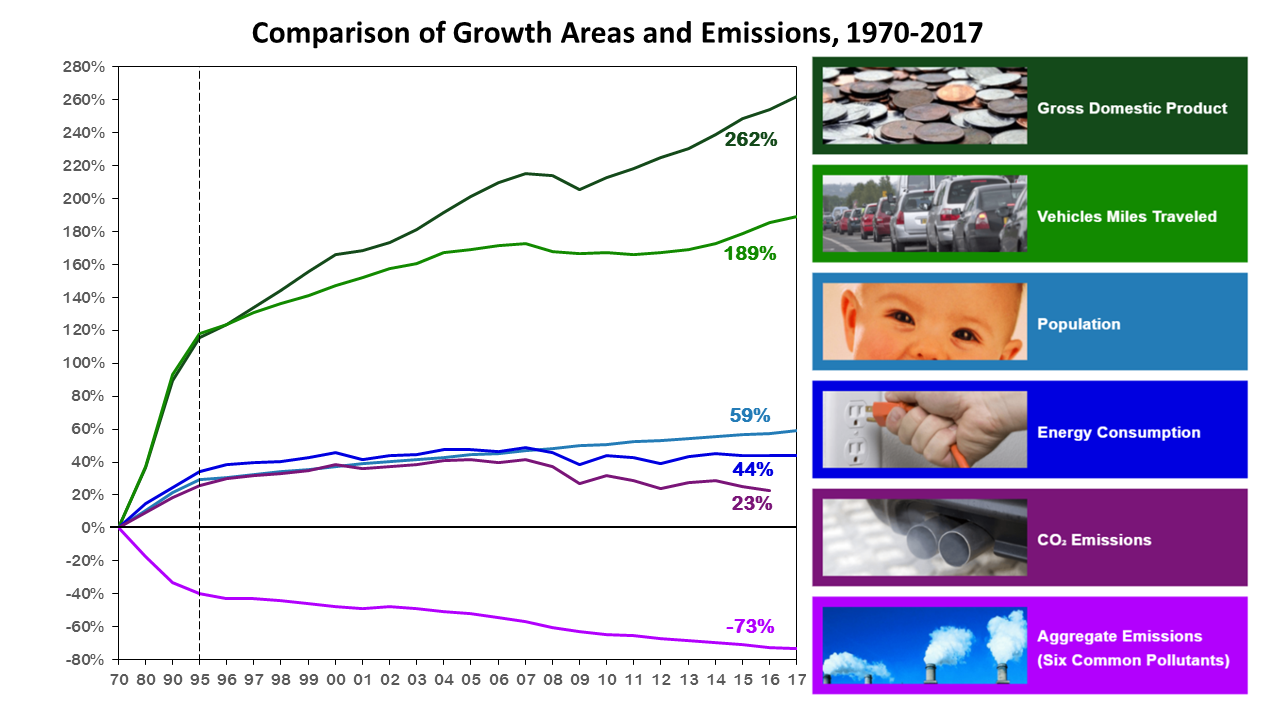
Since 1970, the EPA notes, the combined emissions of six common pollutants have plummeted by almost 80 percent, facilitating “dramatic improvements in the quality of the air that we breathe,” the agency added. To get more specific:

Between 1990 and 2020, national concentrations of air pollutants improved 73 percent for carbon monoxide, 86 percent for lead (from 2010), 61 percent for annual nitrogen dioxide, 25 percent for ozone, 26 percent for 24-hour coarse particle concentrations, 41 percent for annual fine particles (from 2000), and 91 percent for sulfur dioxide.

The EPA attempted to pat itself on the back by attributing these declines to its regulatory actions. But that analysis is incomplete. [Unmentioned was the fact consumption of clean-burning natural gas increased 23% during the same period these pollutants declined.] Meaningful environmental protection efforts don’t come cheap; wealthy countries are usually the only ones with the resources to reduce pollution. There’s a tight correlation between a nation’s GDP and the number of deaths attributed to outdoor pollution.

To enlarge, double-click image or open in new tab.

Our World in Data drew two very important observations out of these numbers; both point to the importance of economic growth as a weapon against pollution. Death rates tend to be lowest in the poorest and wealthiest countries. Nations with higher death rates, India, for instance, are often emerging economies that haven’t yet turned their attention to pollution reduction. There are some outliers to this trend, of course. Certain countries have high rates of pollution but low rates of respiratory mortality, Our World Data also explained:

Countries such as Qatar, Saudi Arabia, Oman, Kuwait, and the UAE have a comparably lower risk of premature death, despite high levels of pollution. They do, however, have a significantly higher GDP per capita than their neighbors … Overall health, wellbeing and healthcare/medical standards in these nations significantly reduce the risk of mortality from respiratory illness.

Sustainable food production increasing

In response to critics of animal agriculture, I’ve recently noted that the environmental footprint of food production is significantly smaller in developed countries. The trend is similar whether we consider the amount of land dedicated to farming or the use of inputs like fertilizers and pesticides. Even looking at agricultural carbon emissions, the ultimate boogeyman these days, we can see that economic growth fuels important reductions. Our World in Data helpfully noted that.

We see a very strong rich-poor country divide. High-income countries tend to have energy-intensive industry or service-based economies. Food systems can contribute as little as 10% to total emissions.

Another way to verify this trend is to consider the environmental impacts of local vs. global food production. The latter invites the use of technological innovations and economies of scale that offset the emissions farmers inevitably generate. Policies that unnecessarily restrict access to tools like biotech crops depress crop yields and force more land into food production, further boosting carbon emissions.

Conclusion

There are more examples of economic growth driving increases in sustainability, but the point is clear: our planet gets “greener” as we get wealthier. The warnings that we’re running out of time “to restore nature and build a healthy planet” will grow more shrill as Earth Day approaches. Just remember to take the doomsday predictions with a grain of salt and reflect on the tremendous progress we’ve made in living sustainably.


via Science Matters

https://ift.tt/hfxb4pZ

April 19, 2022 at 04:19PM

The Sands Of Time

Judging by the reporting on the BBC website, the Welsh coastline is at serious risk of worsening flooding and erosion, caused by climate change, of course.

On 20th September 2019 we were asked, pointedly, “What is climate change doing to Wales?”.i Inevitably, the answer wasn’t pretty:

Alun Williams, cabinet member for carbon management in Ceredigion, said rising sea levels were threatening its flood defences.

The local authority is trying to plan how to manage the effects of climate change along the coast.

Stood on the shingle ridge which acts as a barrier between land and sea at Tanybwlch beach near Aberystwyth, Mr Williams said: “The sea is overtopping this bank much more regularly than it used to – it’s just a matter of time before it breaks through and moves inland.”

Rising sea levels and more frequent storms mean there are fears this defence could soon be breached.

16th July 2021 saw a stark warning:

Climate change: ‘Sleepwalking into oblivion’ coastal erosion warning.ii

0n 28th September 2021 we were toldiii that:

Latest projections show 11.3% of land in Wales will be at risk from flooding from rivers or the sea – a rise from the 9.86% previously predicted.

Minister Julie James said the new advice will help protect communities from the effects of climate change.

“Flood risk and coastal erosion in Wales is increasing as a result of climate change,” she said.

Appropriately, Halloween 2021 saw another scary story, wrapped up in a bigger articleiv about climate change and Wales, its response to it and its threats. Worryingly:

Just under 12,000 properties are at high risk from coastal or river flooding. There are just under 10,000 at high or medium risk of tidal flooding alone.

This could increase by 260% by the 2080s – while 2,126 properties are likely to be at risk of coastal erosion where defences are not maintained.

Less than a fortnight later, on 12th November 2021 we were told that because of “Climate change: Size of Wales may change due to coastal erosion”.v

Clearly there doesn’t need to be any significant new development before a scare story can be repeated (ad nauseam, since this was the time when BBC climate correspondents were breathless with excitement about COP26).

History

And so it came as a bit of a surprise when, on holiday in Snowdonia last month, we visited Harlech Castle, and were confronted by a sign which said:

Today the sea is a long way off, but in 1283 it lapped at the foot of the rock. This meant that Harlech Castle could be supplied from the sea during a siege.

…Where did the sea go? Huge storms in the 14th century led to the build-up of sea dunes, pushing the sea back and creating marshland. The river estuary provided tidal access to the castle until the 17th century. Over time the marshland was reclaimed for farmland; the estuary was lost, and Harlech became landlocked.

Certainly, looking out from the castle, the sea was a good distance away – perhaps as much as half a mile off.

Soon afterwards, we visited Anglesey and took a look at Beaumaris Castle. The situation here isn’t quite so dramatic, but the sea is again some distance away from the castle, at least 200 yards, I would guess. It wasn’t always that way, however. “The gate next-the-sea entrance protected the tidal dock which allowed supply ships to sail right up to the castle.”vi

These mediaeval castles, which were once next to the sea, and are now some distance from it, set me thinking, and then I remembered Caerlaverock Castle, this time in southern Scotland (on the Solway Firth). We visited it a few years ago, and I seemed to remember something similar. A quick internet search confirmed that my recollection was not mistaken:

When built it stood at the head of a tidal inlet at a time when the sea level was higher than it is today.vii

What? Sea levels higher than today? How can this be? Didn’t the hockey stick demonstrate that tales of a Mediaeval Warm Period being warmer than today were nonsense? Aren’t sea-levels inevitably linked to CO2 emissions?

Historical information can be so inconvenient, and so can modern researchviii:

It is now also believed that changes to the coastline caused by “extreme weather events” may have helped push the Maxwells from their home.

Stefan Sagrott, Senior Cultural Resources Advisor at Historic Environment Scotland said: “Working with the University of Stirling, we are undertaking palaeoenvironmental coring and analysis at Caerlaverock Castle to better understand the events which led to the abandonment of the ‘old’ castle in favour of the ‘new’ one.”

The harbour survey will date it for the first time with [sic] it hoped waterlogged artefacts of leather and wood could help tell the story of everyday life at 13th Century Caerlaverock.

Mr Sagrott said: “It is thought that extreme weather events caused gravel ridges to be driven from the sea to the coast, which affected the castles [sic] relationship with the coast, potentially changed the water table and possibly sealed off the harbour as well.

Tidal Gauges

There is a big push to persuade us that climate change is causing stormier weather. The fact that the UK has experienced severe storms throughout its history might go some way towards suggesting that these claims are exaggerated or even plain wrong. However, even if that is the case, rapidly rising sea levels would undoubtedly be a real problem. Anyone with a building on or near the sea might well be in trouble if sea levels rise.

However, this was always the case. Whether due to greenhouse gas emissions and/or other anthropogenic factors, temperatures have been rising globally since the end of the Little Ice Age. Inevitably this must lead to ice melt, and insofar as the melting ice is not sea ice, that must lead to rising sea levels. So the problem of coastal erosion and rising sea levels is not new. It only becomes an issue, which can fairly be attributed to climate change, if the rate of sea level rise is accelerating.

Fortunately there are some fairly comprehensive records available on-line which we can study with a view to ascertaining what trends there might be with regard to sea level rise. The National Tidal and Sea Level Facility websiteix contains data for 49 locations around the UK coast, from Aberdeen to Workington, from Belfast to Whitby.

I have spent some time eye-balling these charts, and I cannot discern an accelerating trend in any of them. Admittedly, it may in some cases be that the land is rising (isostatic rebound following the last ice age seems to be generally accepted as a real phenomenon), and this might distort the extent to which sea level rise appears to be a problem, though I can’t see that it would distort the gauge readings.

In any event, the readings from the Welsh tidal gauges don’t seem to justify the hysteria on the BBC website. Perhaps I would feel differently if I lived very close to the coast.

Conclusion

The question of sea level rise relative to land is complex. As Wikipedia puts itx:

As well as the addition of melted ice water from glaciers and ice sheets, recent sea level changes are affected by the thermal expansion of sea water due to global warming, sea level change due to deglaciation of the last glacial maximum (postglacial sea level change), deformation of the land and ocean floor and other factors. Thus, to understand global warming from sea level change, one must be able to separate all these factors, especially postglacial rebound, since it is one of the leading factors.

In short, hysterical claims about climate change, rising sea levels and erosion, do little justice to a complex subject, and ignore an awful lot of inconvenient history.

Endnotes

i https://www.bbc.co.uk/news/uk-wales-49753740

ii https://www.bbc.co.uk/news/uk-wales-57852719

iii https://www.bbc.co.uk/news/uk-wales-58711041

iv https://www.bbc.co.uk/news/uk-wales-58706283

v https://www.bbc.co.uk/news/uk-wales-59223819

vi http://www.beaumaris.com/index.html

vii https://www.transceltic.com/scotland/caerlaverock-castle

viii https://www.scotsman.com/heritage-and-retro/heritage/story-of-scottish-castle-that-vanished-750-years-ago-to-be-unearthed-3301811

ix https://ntslf.org/products/sea-level-trend-charts

x https://en.wikipedia.org/wiki/Post-glacial_rebound

via Climate Scepticism

https://ift.tt/NToyV8l

April 19, 2022 at 03:58PM

United States Department of…Bloomberg?

From Government Accountability & Oversight

WEBEDITOR

Biden Treasury Dept. Tried to Hide Emails with Bloomberg NEF Official Pushing Climate Agenda With Claim That Correspondence Was Intra-governmental; is Bloomberg NEF Serving as Consultants to Biden Admin on ‘climate’?

Courtesy of government-transparency group Energy Policy Advocates (EPA), the following was obtained in Freedom of Information Act (FOIA) litigation. It represents a curious sequence. First, note a particular, heavily redacted email:

Who is this Biden Treasury official, Ethan Zindler, whose email address Treasury also felt compelled to shield, EPA asked? Well, he’s, um, not:

As the email address no doubt shows; which Treasury no doubt knows as it also very deliberately redacted said email address. For which there is no apparent compelling reason, though it’s a nice tell that they decided to hide it too. Buried in a big doc production, maybe no one will notice.

b5 protects “inter-agency or intra-agency memorandums or letters” from release and, under certain circumstances, correspondence with outside consultants. Hmm.

So, what’s with the redaction as “b5” deliberative process of a discussion between a senior, actual Treasury official and a Bloomberg New Energy Finance rep? “The Company helps corporate strategy, finance and policy professionals navigate, change, and generate opportunities.”

EPA asked just that. Treasury came back with this, upon reconsideration:

Here we see Bloomberg New Energy Finance explaining to a senior Treasury appointee how she should do her job, specifically by somewhat feverishly laying out the full-monty of a “whole of government approach” to jamming into place this death-blow of a policy agenda to reliable energy despite/because Congress never approved it.  Following up on their Zoom conversation.

Inherently, none of the hidden lobbying was eligible to be declared b5…as Treasury knew, having redacted the Bloomberg guy’s non-gov address. It’s just, eh, this is embarrassing let’s call it deliberative. Unless Bloomberg NEF is a Biden admin consultant on their shared climate agenda (or the admin thought they’d try it anyway to shield this).

And in unredacting it, Treasury then withheld some as b6, instead. FOIA’s b6 exemption protects information about individuals in “personnel and medical files and similar files” when the disclosure of such information “would constitute a clearly unwarranted invasion of personal privacy”. Ah. Except the first release, which was redacted almost in full but, again, solely as b5 “deliberative” correspondence, had no mention of such information being withheld out of necessity (just as there is no reason to conclude, from the context but now also the history of this document, the document contained is b6 information). It must be really bad?

Regardless, is Bloomberg New Energy Finance, which so breathlessly touts — as an expert outlet, a “strategic research provider” — the same agenda pushed by the Biden administration — a Treasury Department consultant?

4.7
3
votes

Article Rating

via Watts Up With That?

https://ift.tt/h6B8A3M

April 19, 2022 at 12:55PM