
It has often been remarked that in our [insert pejorative adjective here] pursuit of Net Zero, we are attempting to replace an energy system that is fossil-fuel intensive with one that is material intensive. A recent IEA report has this as one of its subheadings:
The shift from a fuel-intensive to a material-intensive energy system
Wherein it notes:
A typical electric car requires six times the mineral inputs of a conventional car and an onshore wind plant requires nine times more mineral resources than a gas-fired plant of the same capacity.
IEA, op. cit.
Their boss may not know much about energy, but perhaps some of his minions actually have studied the matter. Because the energy density of wind is so low, a lot of equipment is required to extract useful amounts of power. That equipment has a large mass and covers a large area; it has to be widely spaced so that wake effects and blocking do not make matters even worse. So much so obvious, although apparently not to the important people, those whose responsibility it is to decide what is a good energy system and what is not.
I have been looking into just how materials intensive wind power is for some time. Estimates vary, of course. The following table shows estimates of metals usage per MW, made by the World Bank:

But it is not merely metals – wind turbines require a surprising quantity of runny stuff, too.
The snip shows the quantity of fluids and gases in a single turbine in Hornsea 3. Source: Orsted via the Planning Inspectorate:
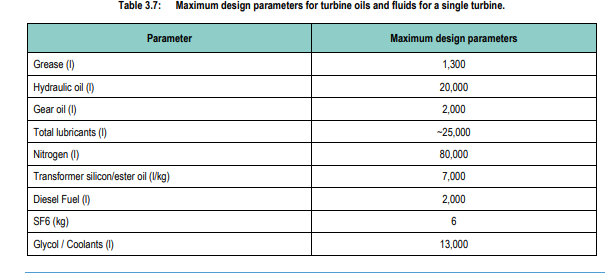
That’s each of 240-300 turbines supplying 2.4GW nominal in toto. Multiplying everything up, you start to grasp the scale of the materials requirement for our brave new Net Zero world. None of this includes the concrete, of course. And we know of course that the mining and refining and transportation and manufacturing will be achieved using fossil-fuel power: the fruit of wind turbines is sterile; it is incapable of producing more wind turbines.
The following two images show what you might call showstopping data from the strangely conflicted IEA report aforementioned. The first compares the mineral intensity of electric vehicles with plebeian vehicles and the mineral intensity of clawing essentially nothing out of the atmosphere with burning stuff:

The second shows the required growth in minerals required to reach the “SDS” scenario (Sustainable Development Scenario; Paris agreement compliant levels of carbon dioxide cuts). The factors involved are mind-boggling, I’m sure you’d agree.

A week ago [about Dec 2] Jo Nova wrote about the way expensive energy prices are driving manufacturers of wind turbines and electric cars into the arms of our friends the Chinese communists and their coal-powered (ahem) dystopia. The European solar panel manufacturers died a long time ago (it’s so much cheaper to build solar panels when you don’t have to pay the workers, eh Winnie?).
In comments below that article, tonyb tipped me off to a Blackrock document on the materials intensity of wind power:
Trn to page 16 of this report (worth reading it in full) for a fascinating analysis of the amount of materials needed to build enough wind turbines to produce the wind generated equivalent output of a gas fired power station
The image he referred to is this:

It would certainly frighten all but the most ardent Net Zero fan. The attribution to the image led me further down the rabbit hole, to Issues in Science and Technology from which its numbers are drawn. That takes us to an article called “The Hard Math of Minerals” by Mark P. Mills of Northwestern University/ Manhattan Institute. Mills quotes the eminently quotable Feynman twice: the second time thusly:
If Feynman were alive today, one suspects he would repeat another of his favored aphorisms: “For a successful technology, reality must take precedence over public relations, for nature cannot be fooled.”
Mills, op. cit.
The Mills essay says nothing that a sceptic would be unaware of, but it lays out the sceptic’s case in such a clear and cogent manner that I wish all Net Zero politicians (isn’t that all of them?) could be made to read it.
Mills begins with the material intensity of wind power – describing in words what Blackrock converted into an image. From there he moves on to the need to upgrade the grid and add on battery storage. The materials requirement necessitates a vast increase in mining – which, as we have already noted, will be done with diesel vehicles. He points out the poor grade of the minerals in question – to the layman, at least. 1%? 0.5%? Ask a punter how much useful metal there is in a typical ore and you would probably get a different answer.
Anyway, the requirement for metals is going to have to go through the roof. The demand might exceed the known reserves of some metals (not as terrifying as it might seem: reserves are not the same as the extractable resource). Studies show that the Net Zero pathway is impossible: we can’t open enough mines (in the West, at least).
Next Mills notes that our plans rely on a continuous erosion of the prices of batteries etc – and if learning by doing is key, that will occur. But he wonders whether the increase in demand might mean that the required materials will increase in cost sufficiently to overpower the expected savings.
There is, in short, no escaping the fact that the astonishing scale of global materials production needed for proposed energy transition plans will almost certainly place severe limits on aspirations for expanding the use of wind, solar, and battery systems. But even before those limits are reached, the pursuit of a materials-heavy energy infrastructure will cause economic impacts that ripple beyond energy markets, inflating the cost of nonenergy uses for the same minerals in computers, conventional manufacturing equipment, everyday consumer appliances, and more.
Mills, op. cit.
China has cornered the market in rare earths, etc: yes, we have been hoist by our own petard. The final conclusion? Something that many of us have been saying for quite a little time:
Nuclear fission offers a potential hundredfold reduction in material intensity over combustion, and a thousandfold reduction over solar and wind.
Mills, op. cit.
Yes. Dat nuclear. It’s the good stuff. And we know that the alarmists aren’t really all that scared of climate change until they embrace it.
Final Yell Into the Abyss
The Blackrock report says this about lithium:
There are some bright spots near-term in the Mining space – lithium, for example, continues to experience a significant imbalance of supply versus demand, which has resulted in very strong upward price moves in the last twelve months.
Blackrock, op. cit.
Proving that they love us just as much as we love them.
via Climate Scepticism
December 12, 2022 at 04:54PM
 Iowa Climate Science Education