Month: January 2023

Suddenly the media suddenly starts asking if vaccine harm might be a thing?

By Jo Nova

Is the dam wall breaking?

Last week the Wall Street Journal ran with a headline: Are vaccines fuelling new Covid variants? It would have been unthinkable last year. Back then, it was a pandemic of the evil un-vaccinated.

Tonight Consultant cardiologist Assem Malhotra has a double page spread in the UK Telegraph warning… “the jab can rapidly speed up the development of heart disease”. In his twitter feed he’s very excited: “Do they have proof? YES MORE THAN ENOUGH! “We’ve finally broken British mainstream news“.  That tweet has now been seen by 2.1 million people. Obviously other people are excited too.

But steel yourself, the mainstream press is 3 years behind the news and the first journalists putting their heads over the parapet are making sure risky sentences are buried six feet deep in qualifiers. The risk of myocarditis is small they say, people recover fast (except for the ones that died), the vaccines are still useful,  Covid causes myocarditis too, etc etc, ad nauseum.

Sarah Knapton, Telegraph

While there have always been anti-vaxxers, this new concern is drawing in people from outside usual conspiracy theory circles

The feature starts with a long introduction assuring us that Dr Malhotra is an expert who used to believe in the vaccines. What’s new, is that he is not made out to be a crazy man.

Dr Malhotra is right to say that heart deaths have increased alarmingly in the last few years. According to the British Heart Foundation there have been around 30,000 more deaths than expected involving heart disease since the pandemic began – more than 230 additional deaths over expected rates each week.

While Dr Malhotra acknowledges that other causes are a factor, he remains convinced that vaccines are also playing a role. He cites Pfizer’s own trial data, which showed there were four cardiac arrests in those who took the vaccine compared with just one in the placebo group.

Ponder for a moment how blandly that was put. Some 30,000 people might have been killed by the vaccine. Well, it was playing a role…

Only now, thirteen months late, is the Telegraph softly telling its audience about the Gundry trial of cardiac risk markers that doubled after vaccination. The same one we discussed here in November 2021.

They’re also making up excuses to cover their spineless insouciance for the last three years:

The problems are only now coming to light because Phase 3 clinical trials have too few people enrolled to pick up rare events, particularly if the heightened risk occurs in a small subgroup – such as young men.

Buried at the bottom — the meme that may start to take off:

Dr Malhotra believes the jab can rapidly speed up the development of heart disease, and now includes vaccine damage in his diagnoses of patients.

“When you’ve got a pre-dose angiogram and a post-dose one that shows damage that usually takes years to trigger, you have to think of the most likely explanation,” said Dr Malhotra.

The Red Pill cometh

As word spreads to a new audience, suddenly thousands more people will be noticing things they didn’t notice before. They might realize Aunt Millie got boosted a few weeks before her heart attack, or that their own heart hasn’t been quite the same, or that there was a 15 year old at school who died suddenly. The gnawing sense that the vaccines can cause harm may ignite the ripe fields of discontent.

Once alerted to a pattern, a brain is good at finding it everywhere. For once, confirmation bias is our friend. Hopefully this is where things start to unravel for the Big Lie — “Safe and Effective”.

10 out of 10 based on 1 rating

via JoNova

https://ift.tt/l9kgJLi

January 8, 2023 at 02:15PM

Coastal Erosion? Well, It’s Climate Change, Innit?

By Paul Homewood

 image

https://www.bbc.co.uk/news/uk-england-norfolk-63822899

You will all recall this piece of junk reporting by the BBC, which claimed:

But punishing weather conditions linked to climate change have eroded so much of the village’s soft sandy rock that her house is now the last one before the cliff edge.


As I mentioned, I fired off a complaint to the BBC about. I have just had their first response:

Thank you for contacting us and sharing your concerns with the BBC News Website article entitled, ‘Happisburgh: The Norfolk village crumbling into the sea’.
The article focused on how coastal erosion is affecting the village Happisburgh, hearing from Nicola who’s home is at the cliff’s edge and is worried she’ll have to move as the cliff crumble. We went on to hear from North Norfolk District Council about their relocation project and a spokesperson for the Department for Environment, Food and Rural Affairs.
We do report that the village is “susceptible to erosion because the cliffs are made from boulder clay which slumps when wet” and that wooden and concrete defences “fell into disrepair as the cost of maintaining them rose.”
We do not claim that storms are the cause of the erosion, however the British Geological Survey does state “the future predictions of sea-level rise and storm frequency due to climate change are likely to have a profound impact on coastal erosion” and the Met Office acknowledges there are “genuine impacts” as a result of human-induced climate change:
https://www.metoffice.gov.uk/about-us/press-office/news/weather-and-climate/2022/2022-provisionally-warmest-year-on-record-for-uk
https://www.bgs.ac.uk/case-studies/coastal-erosion-at-happisburgh-norfolk-landslide-case-study/
(The BBC is not responsible for content found on non-BBC websites.)
We acknowledge the weight of scientific consensus around climate change and this underpins all of our reporting of the subject. The scientific community has reached a significant consensus on man-made global warming. We therefore reflect that with due weight when reporting on the science involved.

Kind regards,
Brónach Dawson

They never learn do they! Did they really think I would be fobbed off with a reply written by a girl who evidently has only just left school, judging by her profile page.

I have naturally responded, pointing out that they have not addressed my complaint, which is that there is no evidence for their claim about punishing weather conditions. Storms are not worse than before, and neither are sea level rise of any other form of extreme weather in Norfolk. I also point out that the BGS are only talking about a possible scenario in future, and that they have not said it is already happening. Indeed they say the cliffs have been eroding at the same rate for 5000 years.

Why they don’t simply publish a correction, which nobody would read anyway, instead of ending up in the ECU, where they might get egg on their face, I will never know.

But what I find most remarkable is how the likes of poor Bronach have been so badly brainwashed about climate change. She quite clearly believes, judging by her reply, that climate change really is eroding the cliffs at a rapid rate of knots, not to mention being responsible for all sorts of other nasty things. And she appears to be genuinely surprised that anybody should dare challenge her beliefs with actual facts!

via NOT A LOT OF PEOPLE KNOW THAT

https://ift.tt/2RF7vTu

January 8, 2023 at 12:59PM

Svalbard walrus thrive in the face of sea ice decline, mocking predictions of future catastrophe

From Polar Bear Science

Dr. Susan Crockford

The extended visit of an immature male walrus to the UK last month (dubbed ‘Thor’, presumably from Svalbard, Norway) has precipitated the tired and vacuous ‘victim of climate change’ cries from the peanut gallery, including Bob Ward of the Grantham Institute. The facts, however, put all that to rest.

I wrote about Ward in my book, Sir David Attenborough and the Walrus Deception, because he has a habit of tenaciously filing official complaints when anyone says or writes anything sensible that just happens to challenge the reigning narrative that climate change is ruining everything and will drive virtually every beloved species to extinction.

And as usual, Ward is wrong again, this time about Atlantic walrus, who have been busily rebuilding their once-decimated populations brought to near-extinction levels by human slaughter over 350 years. Legal protections against hunting enacted by Norway in 1952 have allowed the species to recover, albeit slowly.

That’s because in some areas (like Svalbard) very few females were left to populate the old hauling grounds (NPI 2022), which markedly reduced the rate of recovery until very recently.

Atlantic walrus status

The IUCN Red List classified the Atlantic walrus as ‘near threatened’ in 2016: an important step below ‘vulnerable’ which takes into account current healthy population numbers. This was despite concerns the subspecies could possibly face a population decline of >10% within three generations due to sea ice loss (much less than the Pacific walrus suffered due to food deprivation back in the 1980s (Fay et al. 1989; Lowry 1985), before everything could be blamed on lack of sea ice).

The US Fish and Wildlife Service determined in October 2017 that the Pacific walrus is not being harmed by climate change and is not likely to be harmed within the foreseeable future (MacCracken et al. 2017; USFWS 2017). The IUCN Red List (2015) assessed the Pacific walrus as ‘data deficient‘ (Lowry 2015). Despite these findings, the IUCN listed the walrus species (i.e. both subspecies together), as ‘vulnerable’ (Lowry 2016), apparently based on modelled projections of future declines.

In Svalbard, however, Atlantic walrus numbers have been steadily rising as summer sea ice has been falling. The Norwegian MOSJ website has conveniently graphed this trajectory, copied below:

The numbers on the graph start with two baseline estimated numbers provided in 1980 and 1993 (1980=100 and 1993=741), and conclude with population counts from aerial surveys done in 2006, 2012, and 2018 (2006=2629; 2012=3886; 2018=5503).That’s 109% between 2006 and 2018, and 42% between 2012 and 2018: impressive increases for any species.

However, the 2016 North Atlantic Marine Mammal Commission (NAMMCO) Report on Atlantic walrus (updated in 2021) stated that the tendency of animals to pile on top of each other at haulouts makes it hard to see every individual, even if you are counting them in a photograph. Large numbers of animals in the water are similarly difficult to count, especially if they are close together and actively diving and swimming.

As a consequence, officials determined that all recent counts of Atlantic walrus were probably an underestimate of the true population abundance. This means the 2018 estimate based on an aerial survey was likely an underestimate, which means it’s highly likely (given other evidence) that numbers have continued to climb since then.

Sea ice

Arctic sea ice since 1979 has declined dramatically in summer–and very modestly in winter–but from 2007 to 2019, that declining pattern stalled. That’s not my opinion but the conclusion of Walt Meier of the US National Snow and Ice Data Center (NSIDC), who showed the flat trend in a graph published in September 2019. The same pattern continues to 2022:

However, overall sea ice coverage is of little consequence to the issue of Atlantic walrus health and survival around Svalbard: what we need to know is what the ice has been doing in the Barents Sea, especially over the last 15 years or so.

Data on Barents Sea ice since 2006 has been published by Regehr et al. (2016) but only up to 2015. It shows the greatest decline of all Arctic regions: a loss of 4.11 days per year. It appears that this trend may have continued to 2022 (Frey et al. 2022).

In other words, the Svalbard population of Atlantic walrus increased 109% between 2006 and 2018, even as summer sea ice declined markedly in the Barents Sea.

[In Franz Joseph Land, in the eastern half of the Barents Sea, walrus numbers in 2017 were estimated to be approaching “pre-hunting levels” (9,000-11,000)].

As did Matt Ridley, I call that walrus thriving in the face of sea ice loss. It makes a mockery of model predictions of future calamity based on summer sea ice loss because it is now clear that the less summer sea ice, the more food for walrus and other species (see below). Winter and early spring ice, on the other hand, is declining only modestly and that’s when walrus really need it to mate and give birth.

Primary Productivity Increases

A report by Frey and colleagues this year (Frey et al. 2022) confirms that primary productivity–which generates more food for walrus–has continued to increase due to less sea ice coverage in summer since 2003, especially in the Barents Sea (Crockford 2021).

In the graphic from the report copied below, note the marked overall increase in primary productivity in the Barents Sea compared to other regions (left column, 3rd from the top): it has seen the greatest increase in primary productivity, including a huge spike in 2017 (the year before the last walrus survey).

The increased amount of food available to all species (including walrus) means that the carrying capacity of the Barents marine ecosystem has also increased since 2003–all as a consequence of dramatically less summer sea ice.

Wandering juveniles

Despite all of the above, we shouldn’t forget the individual that started this discussion: a lone male estimated to be 3-5 years of age that visited the UK in December. In other words, an immature animal a decade away from what is considered breeding age for males (about 15 years). Mature walrus congregate on the sea ice to mate and give birth in the winter/early spring (January-April); immature animals and seniors past breeding age do not participate in this activity and are free to wander well away from the pack ice (Freitas et al. 2009; NAMMCO 2021).

Wanderer ‘Thor’, as long as he stuck to shallow coastal regions where he could feed easily (as he apparently did), was not in any danger from climate change on his UK sojourn, which had the added advantage of being well out of range of predatory polar bears.

References

Crockford, S.J. 2021. The State of the Polar Bear Report 2020. Global Warming Policy Foundation Report 48, London. PDF here.

Crockford, S.J. 2022. Sir David Attenborough and the Walrus Deception. Amazon KDP.

Fay, F.H., Kelly, B.P. and Sease, J.L. 1989. Managing the exploitation of Pacific walruses: a tradegy of delayed response and poor communication. Marine Mammal Science 5:1-16. PDF HERE.

Freitas, C., Kovacs, K.M., Ims, R.A. et al. 2009. Deep into the ice: overwintering and habitat selection in Atlantic walruses. Marine Ecology Progress Series 375:247-261.

Frey, K.E., Comiso, J.C., Cooper, L.W., Garcia-Eidell, C., Grebmeier, J.M. and Stock, L.V. 2022. Arctic Ocean primiary productivity: the response of marine algae to climate warming and sea ice decline. 2022 Arctic Report Card. NOAA.DOI: 10.25923/0je1-te61

Kovacs, K.M. 2016. Odobenus rosmarus ssp. rosmarus. The IUCN Red List of Threatened
Species 2016: e.T15108A66992323. http://dx.doi.org/10.2305/IUCN.UK.2016-1.RLTS.T15108A66992323.en

Lowry, L. 1985. “Pacific Walrus – Boom or Bust?” Alaska Fish & Game Magazine July/August: 2-5. pdf here.

Lowry, L. 2015. Odobenus rosmarus ssp. divergens. The IUCN Red List of Threatened Species 2015: e.T61963499A45228901. https://dx.doi.org/10.2305/IUCN.UK.2015-4.RLTS.T61963499A45228901.en.

Lowry, L. 2016. Odobenus rosmarus. The IUCN Red List of Threatened Species 2016: e.T15106A45228501.

MacCracken, J.G., Beatty, W.S., Garlich-Miller, J.L., Kissling, M.L and Snyder, J.A. 2017. Final Species Status Assessment for the Pacific Walrus (Odobenus rosmarus divergens), May 2017 (Version 1.0). US Fish & Wildlife Service, Anchorage, AK. Pdf here (8.6 mb).

NAMMCO. 2021. Atlantic walrus. North Atlantic Marine Mammal Commission Report for 2016, updated January 2021. Tromso, Norway. https://nammco.no/topics/atlantic-walrus/

NPI (Norwegian Polar Institute). 2022. Walrus population in Svalbard. Environmental Monitoring of Svalbard and Jan Mayen (MOSJ). http://www.mosj.no/en/fauna/marine/walrus-population.html

Regehr, E.V., Laidre, K.L, Akçakaya, H.R., Amstrup, S.C., Atwood, T.C., Lunn, N.J., et al. 2016. Conservation status of polar bears (Ursus maritimus) in relation to projected sea-ice declines. Biology Letters 12: 20160556. http://rsbl.royalsocietypublishing.org/content/12/12/20160556USFWS 2017.“Endangered and Threatened Wildlife and Plants; 12-Month Findings on Petitions to List 25 Species as Endangered or Threatened Species” [pdf] 4 October 

via Watts Up With That?

https://ift.tt/CfnIae2

January 8, 2023 at 12:43PM

German Renewable Energies Expert: Global Warming Is Going To Pause As North Atlantic Cools

By Prof. Fritz Vahrenholt, Klimanachrichten
(Translated, edited by P. Gosselin)

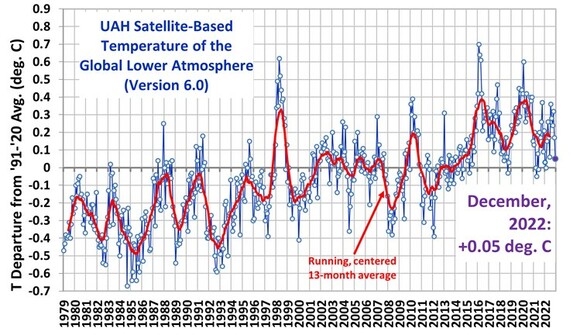
The unusually mild weather at the turn of the year in Central Europe has strengthened the belief of many in Germany that CO2-induced global warming is in full swing. Globally – and this is the only thing that matters – temperatures are developing in a different direction.

If we take the average of the last years, the global temperature has been constant for 8 years and 4 months.

In December, the deviation of the global temperature from the 30-year average of the satellite-based measurements of the University of Alabama (UAH) dropped again, to 0.05 degrees Celsius. To be sure, there is a long-term temperature increase through 2015. But it has averaged only 0.13 degrees Celsius per decade since 1979.

Weakening North Atlantic Oscillation

But it gets even better: the latest scientific studies show for Europe that it will first go slightly downhill for 15-20 years.

Chart by Dr. Roy Spencer.

Some climate science heavyweights recently caused a stir in the Nature journal “Climate and Atmospheric Science.” Katja Matthes, director of the GEOMAR Helmholtz Centre for Ocean Research in Kiel, Johann Jungclaus of the Max Planck Institute for Meteorology in Hamburg and Nour-Eddine Omrani of the Norwegian Bjerknes Centre for climate research published a study showing that we are facing a weakening of the North Atlantic Oscillation, a cooling of the North Atlantic and a related global temperature development as between 1950 and 1970 (the authors say in their summary).

The graph shows the decline in North Atlantic temperatures by 2040, but because of the global warming trend, temperatures are not falling back to 1950-1970 levels, explains one of the authors, Eddine Omrani. The expected pause in warming gives us time, Omrani says, to work out technical, political and economic solutions before the next warming phase, which will take over again from about 2050.

Why is the coming cooling in Europe not being reported?

It is astonishing that so far not a single German daily newspaper has reported on this encouraging message. In contrast, the apocalyptic delusion of the “last generation” financed with American foundation money receives wide space and benevolent judges. Hardly anyone questions the false narrative of the people who glue themselves to the street to protest.

Those who suppress such news of impending cooling are complicit in the politically induced destruction of our society. What did Economics Minister Robert Habeck (Greens) say recently in Qatar? He needs natural gas in the next few years, but in 7 years he won’t need it anymore, because Germany will get out of gas by then anyway. Why does he want to get out if it becomes not warmer in the next 20 years in Europe, but rather colder? Won’t we need even more gas than today if it cools down?

The publication of the climate researchers from Kiel, Hamburg, Bergen, Venice and Houston brings us another important insight. The warming of the years 1980 to 2015 was significantly influenced by the warm phase of the Atlantic Ocean. We can estimate that a significant part of the warming can be attributed to this natural cycle. This  period is used, among other things, to make temperature forecasts into the future. However, the models attribute the natural warming contribution to the CO2 effect. This incorrectly calculated, higher CO2 effect is carried forward into the future. Models that do not take into account the natural cyclical influences – and the models are not yet able to do so – thus arrive at warming forecasts that are far too strong.

It should not go unmentioned that there are a number of publications (such as this one involving Matthes and Omrani, Solar forcing synchronizes decadal North Atlantic climate variability) that consider a coupling of the strength of solar cycles with the North Atlantic Oscillation as likely. The last solar cycle from 2008 to 2019 was the weakest in 100 years. The current cycle so far is shaping up to be just as weak. The one-dimensionality of the climate and energy debate, culminating in the claim that CO2 emissions alone determine our climate, is quite frightening.

Conference in Hamburg

On 19 January 2023 the congress “Save our industry” is taking place in the hotel Elysee in Hamburg. Participants will include Michael Shellenberger, Prof. Patzelt, Prof. Koch, Dr. Pillkahn, Prof. Mayer, Roland Tichy and yours truly. The event can be found here. Unfortunately, it was already fully booked two weeks after the announcement; more are being planned. However, the Hamburg event can be followed here.

In addition, I would like to point out that my new book: Die Grosse Energiekrise – und wie wir sie bewältigen können (The Great Energy Crisis – and How We Can Manage It) will be published on February 17. The book will be presented at a press conference at the German Press Club in Berlin together with Otto Schily, former Federal Minister. The book has 207 pages and costs 22 €. The book is published by LangenMüller Verlag.

Best wishes,
Prof. Fritz Vahrenholt

Donate – choose an amount

via NoTricksZone

https://ift.tt/R9SzoWD

January 8, 2023 at 12:27PM