Month: January 2023

Energy Transition and Impossible Dreams

Daniel Yergin writes at Project Syndicate The Energy Transition Confronts Reality.  Excerpts in italics with my bolds and added images.

Given the scale and complexity of the transition away from hydrocarbons, some worry that economic analysis has been given short shrift in the policy planning process. A clear-eyed assessment of the transition’s prospects requires a deeper understanding of at least four major challenges.

Overview

The “energy transition” from hydrocarbons to renewables and electrification is at the forefront of policy debates nowadays. But the last 18 months have shown this undertaking to be more challenging and complex than one would think just from studying the graphs that appear in many scenarios. Even in the United States and Europe, which have adopted massive initiatives (such as the Inflation Reduction Act and RePowerEU) to move things along, the development, deployment, and scaling up of the new technologies on which the transition ultimately depends will be determined only over time.
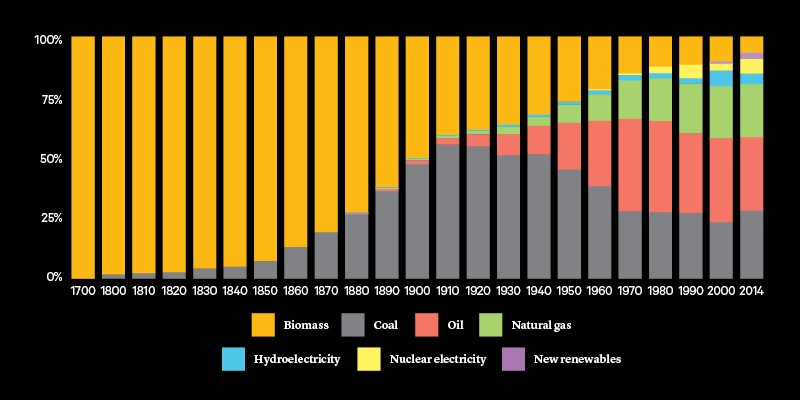
Progress of civilization through changing mixes of energy sources.

Beware:  The Imagined Transition is to be Sudden and not Additive.

The term “energy transition” suggests that we are simply taking one more step in the journey that began centuries ago with the Industrial Revolution. But in examining previous energy transitions for my book The New Map, I was struck by how different this one is. Whereas technology and economic advantage drove earlier transitions, public policy is now the most important factor.

Moreover, previous energy transitions unfolded over the course of a century or more, and they did not wholly displace the incumbent technologies. Oil overtook coal as the world’s top energy source in the 1960s, yet we now use three times more coal than we did back then, with global consumption hitting a record high in 2022.

By contrast, today’s transition is intended to unfold in little more
than a quarter-century and not be additive.

Given the scale of what is envisioned, some worry that macroeconomic analysis has been given insufficient attention in the policy-planning process. In a 2021 paper for the Peterson Institute for International Economics, the French economist Jean Pisani-Ferry notes that moving too rapidly to net-zero emissions could precipitate “an adverse supply shock – very much like the shocks of the 1970s.” He warns that a precipitous transition “is unlikely to be benign and policymakers should get ready for tough choices.”

Hard Reality #1  Energy Security is Top Priority

Developments since energy markets began to tighten in the late summer of 2021 point to four big challenges to watch out for. First, owing largely to the disruptions caused by Russia’s war in Ukraine, energy security has become a top priority again. For the most part, keeping the lights on and factories operating still requires hydrocarbons, so energy security means ensuring adequate and reasonably priced supplies and insulation from geopolitical risk and economic hardship.

Even with climate change remaining a central focus, US President Joe Biden administration’s has urged domestic companies to increase their oil production and released supplies from the Strategic Petroleum Reserve at a far greater scale than any previous administration. In Germany, the Greens in the governing coalition have spearheaded the development of the country’s capacity to import liquefied natural gas, with the first deliveries of LNG from the US arriving this month through infrastructure built in less than 200 days. Energy security is not something that is going to be assumed away in the years ahead.

Hard Reality #2  The Scale Reaches Beyond Our Means

The second challenge concerns scale. Today’s $100 trillion world economy depends on hydrocarbons for over 80% of its energy, and nothing as massive and complex as the global energy system can be transformed easily. In an important new book, How The World Really Works, noted energy scholar Vaclav Smil argues that the four essential “pillars of modern civilization” are cement, steel, plastics, and ammonia (for fertilizer), each of which is heavily dependent on the existing energy system.

Given these starting conditions, will solutions like veganism help? Smil points out that five tablespoons of petroleum are embodied in the system that gets a single tomato from cultivation in Spain (including the required fertilizer) to a dinner table in London. Yes, energy efficiency could be improved. But the main effects will show up in developed countries, rather than in the developing world, where 80% of all people live, and where rising incomes will drive up energy demand.

Land required for wind farms to power London UK.

Hard Reality #3 North and South Interests Conflict

That points to the third challenge: the new North-South divide. In the Global North – primarily Western Europe and North America – climate change is at the top of the policy agenda. But in the Global South, that priority coexists with other critical priorities, such as boosting economic growth, reducing poverty, and improving health by targeting indoor air pollution from burning wood and waste.

Hence, for many in the developing world, “energy transition” means
moving from wood and waste to liquefied petroleum gas.

This divide was vividly illustrated last year when the European Parliament passed a resolution denouncing a proposed oil pipeline running from Uganda through Tanzania to the Indian Ocean. MEPs objected that the project would adversely affect the climate, the environment, and “human rights.” Yet they cast their votes from a body located in France and Belgium, where per capita income (in current dollars) is, respectively, 50 times and 60 times greater than in Uganda, where the pipeline is seen as a foundation for economic development. The resolution provoked a furious reaction. The deputy speaker of Uganda’s parliament denounced the Europeans for exhibiting “the highest level of neocolonialism and imperialism against the sovereignty of Uganda and Tanzania.”

Hard Reality #4 Materials Demands Blow Away Supplies

The fourth challenge concerns the material requirements of the energy transition. I see this as the shift from “Big Oil” to “Big Shovels” – that is, from drilling for oil and gas to mining the minerals for which demand will increase enormously in a world that becomes more electrified.

In a new S&P study, The Future of Copper, we calculate that the supply of “the metal of electrification” will have to double to support the world’s 2050 climate objectives. Recently, a host of authorities – including the US and Japanese governments, the European Union, the World Bank, the International Monetary Fund, and the International Energy Agency – have all published alarming reports about the expected exponential growth in demand for minerals such as lithium and cobalt.

But alarm itself will not open major new mines, a process estimated to take 16-25 years and which faces ever-more complex permitting requirements around the world. In some key resource countries, governments are openly hostile to mining.

So, while the direction of the energy transition is clear, policymakers and the public must recognize the challenges that it entails. A deeper and more realistic understanding of the complex issues that need to be addressed is essential as the effort to achieve the transition’s goals proceeds.

My Comment

The direction of the called for energy transition is clear alright, but is it necessary?  Recently, no less than John Kerry. told the World Economic Forum the world will eventually move to a low-carbon economy, but it may be too late to avoid the worst effects of climate change.  Meanwhile, there are a number of serious scientists who expect global cooling in coming decades.

The unmentioned Hard Reality #5:  Smart People will Adapt to Climate and Weather, as they always have. That is, if they haven’t already trashed their energy system and planetary resources chasing an impossible dream.

Zero Carbon Lemmings in a Rush.


via Science Matters

https://ift.tt/aiTAM5r

January 24, 2023 at 05:28PM

Hyping Maximum Daily Temperatures (Part 2)

From Jennifer Marohasy’s Blog

Jennifer Marohasy

Available Australian Bureau of Meteorology parallel maximum temperature data for Mildura – temperatures recorded from both a mercury thermometer and a platinum resistant probe on the same day in the same shelter – show no equivalence. They are different. Therefore, it is impossible to reliably compare official temperatures recorded from probes with historical temperatures recorded with mercury thermometers for the town of Mildura on the banks of the Murray River.

This has implications for claims of new record hot days for Mildura. If the issue of non-equivalence extends to all 700 automatic weather stations spread across the landmass of Australia, it was implications for the calculation of the global average temperature by NASA that relies on Bureau data. Indeed, if the instrument change has created a non-equivalence in the record, then no reliability can be placed on any claims by the Bureau and/or other scientists and institutions using Australian data, of record hot days, fewer extreme cold days or a claimed accelerated global warming trend.

I can’t know, because I was only able to secure the data for Mildura and this was following the intervention of then Minister for the Environment Josh Frydenberg back in October 2017. The intervention occurred after then popular 2GB radio broadcaster Alan Jones wrote to the Minister on my behalf asking that this data be made available to me.

It all began for me when on 23 September 2017, the Bureau reported a record hottest September day for the state of Victoria based on an instantaneous reading of 37.7 °C from its uncalibrated purpose-built temperature probe in a weather station at Mildura.

The media then repeated that this was the hottest September day ever recorded back to 1889.

Back in 1889, indeed for the period up until 1 November 1996, the Bureau used a properly calibrated mercury thermometer to measure official temperatures at Mildura.

I was sceptical of the instantaneous reading from the probe as representing a new record hot day. I set about getting access to the parallel data for Mildura that I hoped would allow me to see what the mercury thermometer in the same Stevenson screen had recorded on that day.

A Freedom of Information request, lodged by my husband John Abbot in December 2019, for parallel data for the other 34 official weather stations purported recording temperatures from mercury thermometers and probes in the same shelters has so far been denied by the Bureau.

Boris Kelly-Gerreyn from the Bureau initially claimed provision of the scanned A8 forms too onerous and of no public interest. More recently, and as preposterously, Boris Kelly-Gerreyn has claimed the information does not exist in the form of reports and therefore cannot be provided. On 29th November 2021, Elizabeth Hampton, Acting Freedom of Information Commissioner, absurdly sided with the Bureau. John Abbot lodged a complaint with the Administrative Appeals Tribunal that will be heard on 3rd February in Brisbane.

I received scans of the A8 Forms from Mildura at the direction of Minister Frydenberg as two tranches in October and then December 2017.

My immediate and initial analysis of the first tranche indicated that the probe was recording too cool relative to the mercury. I wrote to the Minister asking for more A8Forms and recommending that the Bureau:
1. Suspend the announcement of new record hot days;
2. Inform the World Meteorological Organisation that its temperature measurements from probes are not comparable with historical measurements from mercury thermometers;
3. Establish an audit mechanism.

I was ignored by the Minister. Australian science writer and blogger Joanne Nova did publish something at her blog. It was most disheartening when Bill Johnston in the same thread set about discrediting my findings.

After receiving the second tranche, and tediously manually transcribing more mercury and probe values from the scanned A8 Forms from Mildura, my second go at analysis again confirmed that the first probe – recording official temperatures from 1 November 1996 until 3 May 2000 – erroneous recorded temperatures too cool by 0.2 °C, and with a strong seasonal variation. The difference is statistically significant.

On 3 May 2000, the Bureau changed the Stevenson screen to a smaller design, and while there is no record of a change in the type of probe, this almost certainly also occurred based on the very different recording pattern relative to the mercury that I found through analysis of the data after transcribing the values from the scanned A8 Forms.

Initially the temperatures as recorded at Mildura, from what I am assuming was a new second probe in the new shelter, where more consistent with the measurements from the mercury thermometer. But then I could see from the data that the temperatures from the probe started to cool relative to the mercury thermometer for the period to 27 June 2012. Cooling was at a rate of nearly 1°C per 100 years.

Then on 27 June 2012 the probe which had now been recording the official temperature at Mildura for 12 years while drifting to record ever cooler, was changed.

The limited available parallel data indicates that this third probe records too hot relative to the same mercury thermometer – often by 0.4 °C.

The changing pattern in the difference between recordings from the mercury versus probe for maximum daily temperatures shown as monthly averages.

After the 27 June 2012, the Bureau stopped recording parallel data every day, particularly on hotter days. To be clear, on the hottest days from the period 27 June 2012 through until 31 January 2015 there are no recordings from the mercury thermometer and so this data is not normally distributed. I explained all of this in a blog post on 11 February 2018, that again received surprising little attention.

I notified mainstream climate scientists and various journalists but they didn’t seem to want to understand what it all meant. I had been concerned about the issue since 2014, when I wrote to Australia’s Chief Scientist, Alan Finkel. Now I felt I had some more and compelling proof. I was concerned that the entire historical temperature record for Australia was becoming compromised, and I lost interest in my weather forecasting using machine learning so dependent on reliable temperature data.

Meanwhile, these same university professors who showed no interest in any of the quality assurance issues associated with the change in instrumentation that I was alerting them to by email, claimed that it had suddenly got a lot hotter here in Australia.

Sophie C. Lewis and Andrew D. King, for example, publishing in Geophysical Research Letters (volume 42, Issue 18) conclude that it has gotten significantly hotter here in Australia since 2012. They attribute the ‘dramatically increased rate of observed hot record breaking in recent Australian temperatures’ to human-caused global warming.

I wrote to Dr Lewis suggesting the step-up in temperatures could be because of changes in how temperatures are measured, specifically a change over to a third probe design. She never replied.

The World Meteorological Organisation provides a definition of daily maximum temperature: the highest temperature in that 24-hour period that can be read directly from a mercury thermometer, but when using a temperature probe ‘instantaneous’ values must be averaged over one to ten minutes.

Ignoring all of this, the Australian Bureau of Meteorology uses purpose-built probes and takes instantaneous readings. These are then used uncritically to claim catastrophic human-caused global warming – and record new hot days, including at Mildura.

I predict that this is going to all come crashing down one day, including on the careers of Sophie Lewis, Andrew King, Boris Kelly-Gerreyn and Elizabeth Hampton.

It could have started to be put right by Josh Frydenberg back in 2017, but he obfuscated. Much thanks to Alan Jones for at least trying to get something done.

There is still time for the current director of the Bureau, Andrew Johnston, to help me work out the extent of the problem by making all the parallel data public. But so far, he won’t even met with me; all-the-while emailing that the bureau’s purpose designed probes are equivalent to the old mercury thermometers making numerical averaging unnecessary. Except the limited data that I have obtained, transcribed and analysed for Mildura tells a completely different story. A story of incompetence, as much as malfeasance.

via Watts Up With That?

https://ift.tt/r1macZj

January 24, 2023 at 04:59PM

Cutting down the tree while praising its harvest

Debate on energy security in the Belgian Parliament on 20221208

Last weekend, I came across this interesting article about a discussion about energy security in the Belgian Federal Parliament. First some background. This discussion took place last year on December 8. The Belgian grid manager (Elia) published at that time a report that there might be a small capacity shortage in the winter of 2024 and a large capacity shortage in the winter of 2025. There was already the earlier decision to extend the life of the two youngest nuclear power reactors, but those nuclear reactors would not be available in these two winters because of maintenance necessary for their life extension. The other five nuclear reactors will be decommissioned by 2025, meaning that Belgium will enter these two winters with roughly half of its production capacity.

It therefor should not come as a surprise that some members of the Belgian Chamber of Representatives directed a lot of criticism towards the energy policy of the Prime Minister and the Minister of Energy. For example, Bert Wollants aired his fear that the lights will go out in 2025 if we don’t keep more nuclear power reactors open. He pleaded to make a swift decision on keeping more of them open. He was not the only one who made that plea.

Then the Prime Minister had his chance to respond to the criticism. It is the first part of his response that raised my eyebrows (translated from Dutch, my emphasis):

Colleagues, after all the loudmouthing, let’s look at the facts. Let me reassure you first and foremost: the light or the heating will not go out in our country. Let that be clear.

But the discussion in other countries in Europe before this winter is a different discussion. In Germany, an industrial shutdown plan is being worked on. In Switzerland there are plans to demand that electric cars should not be used in winter. In France, they have a “Plan de Délestage”. In other countries, the most polluting power stations, coal-fired power stations, are being extended in time. Some of the countries today, they don’t have a blackout today thanks to whom?

He basically said that other countries in Europe have some serious problems, contrary to Belgium (probably to show that Belgium is doing fine under his watch?).

That last sentence is intriguing. Not sure who or what is keeping some of those countries from a blackout, but these first sentences seems to be an introduction to a claim that Belgium somehow has to do with it (that would be utterly ridiculous).

Indeed, that seems to be the case:

Thanks to us.

Yep, he actually said that and he even confirmed it in his next sentence:

Thanks to our country.

Then he even doubled down:

Thanks to the fact that we have a solid energy policy in our country, those countries are not exposed to a blackout today.

Belgium has a solid energy policy?!?!?! 😆

He then ended the first part of his response with:

Those are the facts. I am willing to take some loudmothing, but those are the facts.

Okay, let’s just look at those “facts”. I am not sure where he gets the idea that Belgium somehow prevents some of its neighboring countries (plural) from having blackouts. Belgium has a relatively small grid compared to its neighboring countries (except Luxembourg). For the countries that he is naming in his response: the German grid is more than 5 times bigger than that of Belgium and the grid of France more than 6 times. The idea that Belgium’s grid is capable of keeping the grids of not one, but even multiple neighboring countries from blackouts seems pretty unlikely to me. I want to see those receipts.

Also, the claim that Belgium has a “solid energy policy” is laughable. The energy policy of the last two decades is 1) exit nuclear energy and 2) add more solar and wind. That is still the policy of the current government and this longstanding policy will not prevent us from having a potential deficit in the winter of 2024 (and 2025).
I could however accept that the current government took some first steps to add some balancing power (in the form of gas fired power plants) into the mix, but that decision will only show its effects in the future. Even if it would be possible to start building those gas fired power plants right now, these are unlikely to be finished by 2024 or 2025.

But then, if these first steps will only start producing results several years into the future, why did our Prime Minister takes credit for it now? He clearly stated that the reason why Belgium doesn’t have the same problems as its neighbors is the energy policy of his government. That doesn’t make no sense.

It didn’t make any sense for Bert Wollants either. He came forward again and explained that we currently don’t have the same problems as our neighbors because of the decision made by the previous government to extend the life of two nuclear reactors. If the previous government wouldn’t have done that, then those two reactors would have been closed by now and Belgium would have lost almost 1 GW of its capacity (on a needed capacity of about 8 to 10 GW back then in December 2022).

… auch…

Not only did the Prime Minister try to suggest that the energy policy of his government is the reason why we are not in problems at this moment, he also seems to be unaware that Belgium is currently in a (relatively) good position because it still have most of its nuclear reactors running and probably also because we are experiencing a rather soft winter. None of which has anything to do with the energy policies of the current government. More, the goal of his government is to try to shut down as much nuclear reactors as soon as possible.

He is in fact praising the harvest of the tree that he is trying to cut down…

via Trust, yet verify

https://ift.tt/oURXaf0

January 24, 2023 at 04:22PM

Researchers propose compulsory climate change teaching in core law curriculum

[image credit: latinoamericarenovable.com]

Sounds vaguely sinister — where does education end and indoctrination start? No prizes for guessing which climate theories would get to be ‘taught’.
– – –
Academics from Durham University are urging that climate change education should be made compulsory across the core law curriculum, says Eurekalert.

The researchers evaluated students’ engagement and their broader views concerning climate change education by integrating climate change and environmental law into the core curriculum at the University of Exeter, a Russell Group University.

The results showed that law students want to study climate law and the climate context of law as part of their core curriculum.

Students also said that climate change education should be compulsory and taught across the programme.

In the study, the researchers argue that climate change is still perceived as a niche topic and that students are leaving Law School without a proper understanding of the legal framework or social context within which they will practice.

They emphasise the importance of understanding climate constitutional legislation and net zero, climate risk and interpretation of legal rules in the context of climate change.

Their findings are published in the leading generalist law journal, Legal Studies.

Students graduating from law school will spend their working lives needing to understand and apply legal norms in the context of a society dealing with the impacts of climate change, while transitioning to ‘net zero’ carbon economies.

Legal educators now face the responsibility of ensuring that law graduates are equipped with adequate knowledge of climate law and social context in which they will operate.

Full article here.

via Tallbloke’s Talkshop

https://ift.tt/BD5uSoL

January 24, 2023 at 02:10PM