Month: January 2023

Worldwide: Milloy 13 million-view tweets sends Aussie fake news media into meltdown

Now it’s the Australian Associated Press (AAP) lying about my tweet pointing out the hoax that is CO2 warming. Here’s the AAP article (Web | PDF). This fake news attack is the same as others — that I cherry-picked eight years out of a longer warming trend. That is false for the same reasons discussed … Continue reading Worldwide: Milloy 13 million-view tweets sends Aussie fake news media into meltdown

via JunkScience.com

https://ift.tt/TE39SRy

January 24, 2023 at 01:58PM

The strange coincidence of the Offshore Wind Industry and 178 dead whales

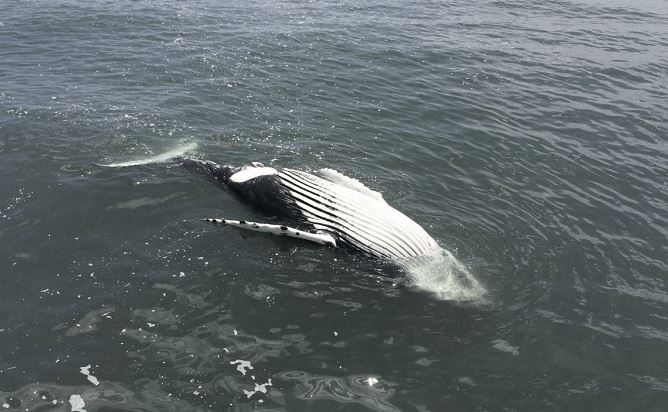
Floating humpback whale offshore of Delaware. Photo: Marine Education, Research & Rehabilitation Institute.

Floating humpback whale offshore of Delaware. Photo: Marine Education, Research & Rehabilitation Institute.

By Jo Nova

There have been a lot of dead whales on the East Coast of the US lately. David Wojik noticed that NOAA was investigating 178 dead whales in something called an Unusual Mortality Event, or a UME — it’s like an episode of X-Files.

NOAA says this wave of strandings mysteriously started in 2016 which was before the offshore wind factory industry got going —  but Wojik points out the timing matches very well. Offshore lease sales for the wind industry ramped up 2015-16. There were nine big sales, he says, off New Jersey, New York, Delaware and Massachusetts. And not so coincidentally, apparently 2016 was also the year that NOAA started giving permission slips for whale hunts, sorry whale harrassments for “geotechnical and site characterization surveys“.

In bureaucrat-valium-lingo, the license to cause incidental dead whales is called an IHA — or an Incidental Harassment Authorization. This appears to have fooled Greenpeace.

Although since wind turbines are a sacred totem, NOAA could have called them a 007 License to Kill Humpbacks and they might not have cared either. The whales are dying for the planet you know. They’re probably happy about it too.

David Wojik, CFACT

The “unusual mortality” data is astounding. Basically the humpback death rate roughly tripled starting in 2016 and continued high thereafter.

To date NOAA has issued an astounding 46 one-year IHA’s for offshore wind sites. Site characterization typically includes the protracted use of what I call “machine gun sonar”. This shipboard device emits an incredibly loud noise several times a second, often for hours at a time, as the ship slowly maps the sea floor.

Wojik explains why wind “farms” might pose a threat to whales, and why it’s likely to get worse with bigger turbines and larger farms going in:

There are lots of ways this sonar blasting might cause whales to die. Simply fleeing the incredible noise could cause ship strikes or fish gear entanglements, the two leading causes of whale deaths. Of the whales could be deafened, increasing their chances of being struck by a ship later on. Direct bleeding injury, like getting their ears damaged, is another known risk, possibly leading to death from infection. So there can be a big time difference between blasting and death.

Note also that these deaths need not be in the immediate vicinity of the sonar blasting, so spatial correlation is unlikely. Humpbacks in particular are prodigious travelers. One group was tracked traveling 3,000 miles in just 28 days, over 100 miles a day on average.

Thus a sonar blasting, site characterization in one place could easily lead to multiple whale deaths hundreds of miles away. If one of these blasters suddenly goes off near a group of whales they might go off in different directions, then slowly die.

For more on this noise see my https://www.cfact.org/2022/07/26/threat-to-endangered-whales-gets-louder/

The whole original article is at CFACT.

10 out of 10 based on 2 ratings

via JoNova

https://ift.tt/K9yT2Sd

January 24, 2023 at 01:13PM

The Copper Conundrum

Guest Post by Willis Eschenbach

There’s been a lot of talk lately about how the scarcity of “rare-earth” minerals like lithium and cobalt will short-circuit the “green revolution”. In that regard, I came across an interesting 2022 Standard & Poors Global (SP Global) study on the amount of plain old everyday copper needed for a Net-Zero 2050 scenario. The study is entitled “The Future of Copper: Will the looming supply gap short-circuit the energy transition?“, and the answer is … yep. It will.

In my post “Bright Green Impossibilities” I listed a number of physical, political, and economic reasons why we can’t get to “Net-Zero” CO2 emissions by 2050. This post is about one reason that I didn’t mention in that post.

The problem is that copper is the only material suitable for transmitting electricity … and in addition, it’s used in building construction, appliances, electrical equipment, brass hardware, and cell phones, as well as expanding applications in communications, data processing, and storage

So if we’re going to go to an all-electric world, we’re going to need a truly massive amount of copper.

How much? Well, according to “The Future of Copper” linked above, here’s the bad news:

Figure 1. Estimates of the amount of copper needed to achieve Net-Zero 2050.

No bueno.

And as they say on the TV, “But wait, there’s more!” The USGS estimates that there are 880 million tonnes of recoverable copper in the ground. And here’s how that compares to the cumulative copper needs shown in Figure 1.

Figure 2. Cumulative amount of copper required for Net-Zero 2050 per Figure 1, and known recoverable copper reserves using current technology.

So … by 2040 we’ll need about all the copper we’ve currently located in the ground, and we’re still nowhere near Net-Zero 2050. We’re likely to find more in the ground, which will allow for further recoverable reserves. But it will generally be very poor ore and expensive to mine. “Back in the day”, as they say, ores which were 4% or even 6% copper were not uncommon. But newly discovered ores are on the order of 0.1% copper. Of course, as it becomes more scarce it will become more expensive, allowing poorer ores to be economically viable … but that leads to another problem.

The current London Metal Exchange price for copper is about ten thousand dollars per tonne. So the copper necessary for Net-Zero will cost a minimum of fourteen trillion dollars at current prices. However, as noted immediately above, as copper becomes more scarce the prices will inevitably rise. So the likely total cost will be at least fifty percent higher or even more, call it a minimum of twenty trillion dollars …

And that’s just for the smelted copper. It doesn’t include turning the copper into electrical wiring with insulation, transporting the wire and other copper products to where they’re going to be used, installing the new transmission lines, substations, switching gear, generators, and all the other costs to get the global electrical grid up to what would be required for an all-electrical world. Top consulting firm McKinsey says:

Our analysis of the industry-standard scenario for net zero by 2050 suggests that about $275 trillion in cumulative spending on physical assets, or approximately $9.2 trillion per year, would be needed between 2021 and 2050.

That means we’d have to spend $25 billion each and every day, including weekends, until 2050. Starting tomorrow. Riiight … full McKinsey article here.

And expanding any kind of mining faces a host of political, environmental, and regulatory problems. It can easily take ten years and billions of dollars before the first shovel goes into the ground. Opposition from “greens” has stopped almost all new mining in the US … while at the same time, those geniuses clamor for an end to fossil fuels.

A final difficulty factor. Much of the copper ore, and the majority of the refining and smelting facilities, are in … yep … China. From the linked study:

The challenge will be compounded by increasingly complex global geopolitical, trade, and country-level risk environments. There are several dynamics that will have a particular bearing on copper access. China holds a preeminent position in copper smelting (47%), refining (42%), and usage (54%), in addition to its sizable position in production, making it the epicenter of world copper. Continued trade tensions and other forms of competition between the United States and China could affect the copper market going forward. Supply chain resilience has emerged as a strategic imperative, particularly after the COVID-19 pandemic and the war in Ukraine. The study finds that by 2035 the United States will be importing between 57% and 67%—that is up to two-thirds—of its copper needs. An intensifying competition for critical metals is very likely to have geopolitical implications.

And if you think the Chines won’t play those “geopolitical implications” to their advantage, you don’t understand our Eastern friends.

So can we please stop this Net-Zero nonsense? It’s an impossible goal that will not solve an imaginary problem, and it will bankrupt us all, cause widespread energy poverty, and shaft the poor in the process.

Best to everyone on a lovely winter day,

w.

As Is My Wont: I can defend my words. I can’t defend others’ interpretations of my words. So when you comment, please quote the exact words you are discussing.

4.8
5
votes

Article Rating

via Watts Up With That?

https://ift.tt/ByOV9r8

January 24, 2023 at 01:01PM

Ross Clark: The National Grid is falling apart thanks to Net Zero

By Paul Homewood


  image

We’re left with demand management to keep the lights on – rewarding the rich at the expense of the poor, and all using taxpayer funds
So near, and yet so far. A couple of weeks ago, when the air was mild and the wind was blowing strongly, it became fashionable to thumb your nose at Vladimir Putin. We made it through the winter of 2022/23 without the blackouts he tried to inflict on us. Russia can keep its filthy gas and oil – we can do without it thanks to our cheap and plentiful renewables.
Not so fast. Temperatures have plummeted again, Britain is becalmed by an anticyclone, and the National Grid is warning that supply is going to be tight this evening. Coal plants are being dusted down several months after they were supposed to have closed, and the National Grid is activating what it calls its Demand Flexibility Service. This means customers signed up to the scheme can earn up to £6 per kilowatt-hour saved if they agree to turn off their appliances between 5 and 6pm.
It is not hard to spot a slight issue with this offer: the more electricity you use on a normal Monday, the easier it will be for you to cash in today. As with so many green subsidies, it perversely rewards the well-off at the expense of the poor. If you own an 18 bedroom mansion you can easily claim your fee by switching off the lights in the east wing and delaying recharging your Tesla until 7pm. If you normally use only one electric light, there will be no savings for you. And needless to say, the free electricity for some households will ultimately be subsidised through higher bills for everyone else.
But there is a far bigger problem with trying to deal with the intermittency of wind and solar power through demand management. The gaps in supply are far too big to be filled in this way. Britain already has enough installed wind and solar capacity – 38 gigawatts of it – to theoretically meet 100 per cent of average electricity demand. On a good day, such as we had a fortnight ago, solar and wind generate more than 50 per cent of our energy needs. But this morning at 10 am it was down to 19 per cent, and at times in December it fell to less than two per cent. If you are going to try to build a grid based on wind and solar, and try to manage demand by paying people to switch their appliances off, you are going to have to chuck such enormous quantities of money at people that they are prepared to spend days on end shivering in the dark.
The trouble is that that is more or less what the Government is trying to do. For years it has incentivised the green energy industry to build more and more wind and solar farms. Energy storage, on the other hand, has followed way, way behind. A few token – and very expensive – battery installations have been built, but, together with pumped storage systems built between the 1960s and 1980s, they can only store enough energy to keep Britain powered-up for less than an hour. Meanwhile, the steady baseload provided by nuclear is shrinking as old reactors shut down and new ones fail to open; Hinckley C is still years away.
At the moment we fill the gaps with gas-generated power, but once that has been removed from the grid, as the Government intends to do by 2035, all we will have to save us from unplanned blackouts is demand management – which is really just blackouts through bribery.

https://netzerowatch.us4.list-manage.com/track/click?u=c920274f2a364603849bbb505&id=33ab369561&e=4961da7cb1

via NOT A LOT OF PEOPLE KNOW THAT

https://ift.tt/qBwO5oC

January 24, 2023 at 11:21AM