Month: January 2023

Global Oil & Gas Discoveries Up, As Drilling Continues Apace

By Paul Homewood

h/t Dennis Ambler

While Keir Starmer wants to shut down North Sea oil, the rest of the world fortunately is not so stupid:


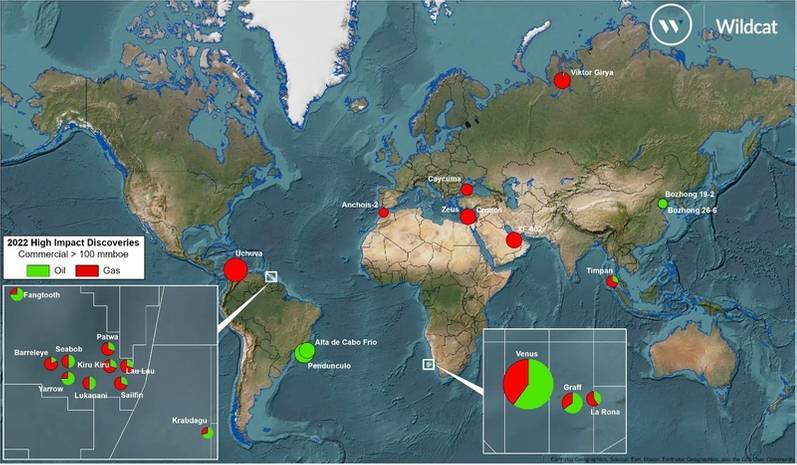
 image

In a tumultuous year of change in the world, high impact drilling in 2022 remained at a similar level to 2021, with 81 high impact wells completing (Figure 1). Performance improved with discovered resource increasing from 7.4bnboe in 2021 to a preliminary estimate of 9.2bnboe in 2022, and the commercial success rate, i.e., the proportion of wells which may result in a potentially commercial development, increasing from 29% in 2021 to 36%, Westwood Energy authors wrote in their report this week.

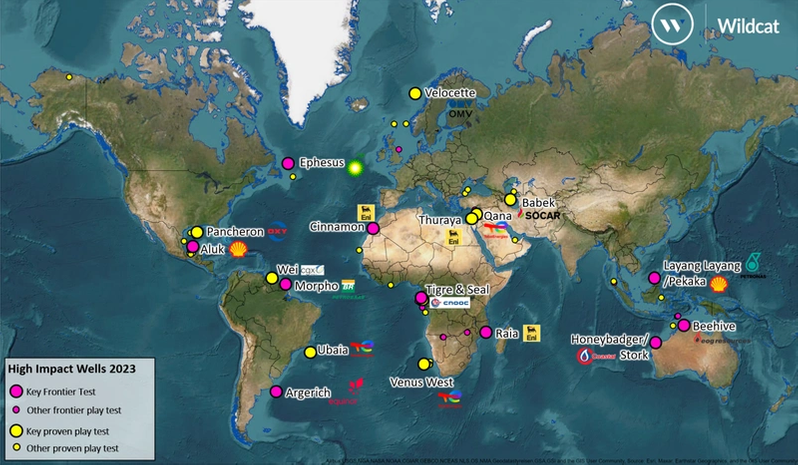
High impact well numbers in 2023 look to be in line with 2020-2022 with 75-85 high impact wells currently expected to complete in the year. Higher oil prices in 2022 have not fed through into more exploration.

South America will continue to be a key region for high impact exploration, particularly in the Suriname-Guyana Basin and offshore Brazil. Argentina will see its first ever deepwater well drilled in 2023. Activity in North America is expected to rebound in 2023 following a quiet year in 2022 when only nine high impact wells completed. This will include more than five high impact wells in the US GoM, further commitment wells offshore Mexico, and a key frontier basin test in the Orphan Basin offshore Canada.

Africa is expected to see wells in the emerging Orange Basin offshore Namibia, as well as frontier tests offshore Morocco, Gabon, and Mozambique. The Eastern Mediterranean has also seen a recent up-tick in high impact exploration drilling, which will continue into 2023 with around five high impact wells expected. High impact drilling activity in Europe, the Middle East and Asia Pacific is expected to fall slightly in 2023 compared to the previous year.

2023 Outlook

High impact well numbers in 2023 look to be in line with 2020-2022 with 75-85 high impact wells currently expected to complete in the year. Higher oil prices in 2022 have not fed through into more exploration.

South America will continue to be a key region for high impact exploration, particularly in the Suriname-Guyana Basin and offshore Brazil. Argentina will see its first ever deepwater well drilled in 2023. Activity in North America is expected to rebound in 2023 following a quiet year in 2022 when only nine high impact wells completed. This will include more than five high impact wells in the US GoM, further commitment wells offshore Mexico, and a key frontier basin test in the Orphan Basin offshore Canada.

Africa is expected to see wells in the emerging Orange Basin offshore Namibia, as well as frontier tests offshore Morocco, Gabon, and Mozambique. The Eastern Mediterranean has also seen a recent up-tick in high impact exploration drilling, which will continue into 2023 with around five high impact wells expected. High impact drilling activity in Europe, the Middle East and Asia Pacific is expected to fall slightly in 2023 compared to the previous year.

https://www.oedigital.com/news/502143-high-impact-drilling-held-steady-in-2022-discoveries-up-to-9-2-billion-barrels

via NOT A LOT OF PEOPLE KNOW THAT

https://ift.tt/RtEPugr

January 24, 2023 at 02:50AM

Does the Oil Industry Have a Future? (Part I)

Ed. note: Julián Salazar Velásquez is a geologist and petroleum engineer with a nearly 50-year career in the Mexican and Venezuelan oil industries. A leading educator and proponent of free market energy, he is author of numerous articles and Gerencia Integrada de Campos de Hidrocarburos (2020), a primer on the oil industry value chain. His four-part world view starts today and continues this week in Part II, Part III, and Part IV.

The current depiction of the oil and gas industry is not only incorrect but worrying. In the more than two years that I have been educating at conferences, in courses, in articles, and in my book—I have seen how unsound dogma threatens progress and prosperity in our countries.

Background

In December 2021 in Petroleum Magazine, I published “Energy Transition or Transgression? What to do in the face of the global campaign against the oil industry with the political threats of anti-fracking and global warming?”

I gave a talk on the article at the Venezuelan American Petroleum Association (VAPA), Venamerica, and “Colegio de Ingenieros de Venezuela—Monagas” (CIV-MONAGAS). The conference title–“The two great current threats to the oil industry: anti-fracking and global warming”–refers to legal prohibitions based on unfounded catastrophic environmental impacts.

The alleged danger of CO2 emissions from fossil-fuel usage has been propagated in a large part of public opinion and institutions. I warned about the anti-oil and gas campaigns and demonstrations that have grown in Europe, Canada, USA, and Latin America against fossil fuels, even in support of bans which would represent devastating results for the future of humankind. In fact, mineral fuels and petrochemical derivatives have encountered prohibitions, not only for the exploration and production of unconventional shale deposits but in activities across the value chain of the hydrocarbon industry.

In the 2017 edition of my book Gerencia Integrada de Campos de Hidrocarburos, I saw these threats as something temporary. I was optimistic when I reflected on the question: Does the oil industry have a future? On that occasion I mentioned with conviction:

I can state with high probability of certainty that this sector will continue to expand to meet the growing demand for energy, so that oil and gas will continue to represent the most widely available source at the lowest cost. On the other hand, alternative energy sources will grow in parallel, sharing the market as they become more competitive.

Five years later, I now see that things have turned for the worse. Not only has the anti-oil and gas position become more radicalized, but the actions of the international political leadership are flagrantly supporting energy generated by wind and solar. Most recently, the activists are trying to establish barriers in the international financial system against oil, gas and coal, based on “net zero strategies, decarbonization, green energy, renewable energy and energy transition,” with the argument of saving the planet from the supposed negative of “global warming,” or as it is now called “climate change.”

The international protests in Europe, USA, Canada and Latin America, (Figure 1) have had the support of the governments and radical environmental organizations, supported by left-leaning political groups. Hence their radius of action has been increasing, with strong influence on governmental and non-governmental institutions of civil society, as corroborated by the following detrimental results:

  • Prohibitions and moratoria on activities for the exploration and exploitation of unconventional shale deposits in Europe, Mexico, Costa Rica, Colombia and some states of the USA and Canada. Oil and gas are only produced from this type of deposit in the USA, Canada, Argentina and China.
  • Stoppage of the 1,700-mile Keystone XL Pipeline by the US through an executive order. This project was built in order to transport 830 thousand barrels per day of crude oil from the oil sands of western Canada to the refineries in Texas.
  • Promise to stop all oil exploration activities, both conventional and unconventional in Colombia by the left-wing candidate, and a ban on fracking, which is already in its implementation phase after winning the presidency in June 2022.
  • Proliferation of campaigns against the industry and oil usage by radical environmental groups, financed by non-governmental organizations that have influenced the policies of countries against the use of fossil fuels. (Figure 2)
  • Increases—after the pandemic and the start of the Russian-Ukrainian war—in the prices of oil, gas and its derivatives, given the decrease in production and increase in demand, with the subsequent global energy crisis; also, short-term problems for energy supply in this winter of 2022 in Europe and North America. 

(To Be Continued in Part 2)

The post Does the Oil Industry Have a Future? (Part I) appeared first on Master Resource.

via Master Resource

https://ift.tt/HNvF49c

January 24, 2023 at 01:14AM

California:  Atmospheric River and Misguided Climate Fear

By Steve Goreham

Originally published in The Washington Examiner.

For more than three weeks, California has been pummeled by a series of storms arriving one after another from the Pacific Ocean. Torrential rains, mud slides, power outages, and floods plague state residents from north of San Francisco down to Los Angeles, four hundred miles to the south. Scientists attribute this event to an “atmospheric river” condition in the Pacific Ocean. Many also claim that this phenomenon is due to human-caused climate change.

According to the National Oceanic and Atmospheric Administration, an atmospheric river is a long, narrow region in the atmosphere that can transport large amounts of water vapor, roughly equivalent to the average flow of water at the mouth of the Mississippi river. When atmospheric rivers make landfall, they release this water vapor in the form of rain or snow. An atmospheric river that forms in the tropics near Hawaii, sometimes called the Pineapple Express, can deliver large amounts of water to the U.S. West Coast.

This winter’s atmospheric river has been catastrophic. Ten different storms have stuck the California coast in the last three weeks. More than 20 people have died, thousands have been forced to evacuate their homes, and 25 million people are under a flood watch. The state averaged more than 11 inches of rain from late December to mid-January. The series of flooding storms were unexpected, following several years of severe drought in California.

Government leaders and some scientists blame human carbon dioxide emissions and climate change. In commenting on the flood damage, Governor Gavin Newsom said California was “proof that the climate crisis was real and that we have to take it seriously.” When touring damaged areas last week, President Joe Biden stated, “if anybody doubts the climate is changing, they must have been asleep for the past couple of years.”

But this has happened before. Geologic evidence shows that massive floods occur in California every century or two. A historic cataclysmic event was the great flood of the winter of 1861-1862. During December and January of that winter, a series of massive storms slammed, one after another, into the west coast of the state. This occurred after two decades of drought during 1840-1860. The event would also be called an atmospheric river by today’s scientists.

During the great flood of 1861-1862, a train of storms dumped record amounts of rain on California. Sixty-six inches of rain fell on Los Angeles, more than four times the yearly average. In early January, the capital city of Sacramento was submerged under ten feet of water. Governor Leland Sanford moved the legislature to San Francisco on January 22 to wait for the floods to subside. Sacramento remained flooded for months.

William Brewer toured California’s Central Valley at the end of January 1862 by boat. He wrote that the entire valley was a lake from the mountains in the east to the coast range hills on the west up to the tops of the 20-foot-high telegraph poles. One-quarter of the state’s estimated 800,000 cattle drowned during the flood.

Of course, the 1861-1862 event could not have been caused by to human-made global warming. There were no coal-fired power plants or Sport Utility Vehicles and only a few wood- or coal-burning locomotives. Most transportation was by horse and horse-drawn wagon. World carbon dioxide emissions at that time were less than a million times smaller than today’s emissions from industry. The flood of 1861-1862 demonstrated the power of natural weather events in Earth’s chaotic climate.

The Merriam-Webster dictionary provides one definition of superstition as “a false conception of causation.” The current California atmospheric river event is very similar to the 1861-1862 occurance, which could not have been caused by human emissions. There is no evidence that the current atmospheric river event is caused by human emissions either, but those afraid of human-caused climate change are claiming that this is the case.

It’s remarkable that so many intelligent people profess that the current California disaster is due to human-caused climate change. University professors, government officials, and the news media are among the believers. They seem to call every weather event “extreme.” They may also tell you that if we all drive electric cars and build wind turbines everywhere, we can eliminate atmospheric river events. This can best be described as modern superstition, on the level of past beliefs that witches caused crop failures. Instead, Californians must adapt to weather as they have throughout history.

Steve Goreham is a speaker on the environment, business, and public policy and author of the book Outside the Green Box: Rethinking Sustainable Development.

4.5
2
votes

Article Rating

via Watts Up With That?

https://ift.tt/jzlxrVH

January 24, 2023 at 12:51AM

Simply Staggering: Gobsmacking Cost of Using Batteries to ‘Store’ Wind & Solar Power

Giant Tesla battery at Jamestown South Australia.


Rent-seekers would have us believe that battery storage will soon cure wind and solar’s hopeless intermittency, notionally smoothing out the highs and filling in the lows (aka sunset and calm weather).

The only thing wrong with that narrative is the fact that it is an outright lie.

Lithium-ion battery technology is probably as good as it will ever get; the natural limits on storing releasing electricity over time are best explained by the laws of physics, starting with thermodynamics.

However, it’s the law of economics that David Wojick deals with in his piece below.

Astronomical battery cost looms over “renewables”
CFACT
David Wojick
15 December 2022

The amount of storage needed to make renewables reliable is so huge that even if the cost dropped fantastically we still could not afford it.

We now know that the battery storage for the entire American grid is impossibly expensive, thanks to a breakthru study by engineer Ken Gregory. Looking at several recent years he analyzed, on an hour by hour basis, the electricity produced with fossil fuels. He then calculated what it would have taken in the way of storage to produce the same energy using wind and solar power. He did this by scaling up those year’s actual wind and solar production.

Based on his work, which only covered 48 states, our round working estimate of the required storage for the whole country is an amazing 250 million MWh. America today has less than 20 thousand MWh of grid scale battery storage, which is next to nothing.

Grid scale batteries today cost around $700,000 a MWh. For 250 million MWh we get an astronomical total cost of $175 trillion dollars just to replace today’s fossil fuel generated electricity needs with wind and solar. Even the fantastically low cost estimates that some people are proposing puts the cost around the total annual GDP of America. Even worse, if we get the electric cars and trucks the Biden Administration is calling for these astronomical numbers could easily double.

Note that the range of estimates for future battery unit cost is itself enormous, so no single figure is credible. Turns out that does not matter, because even the fantastically low estimates give fantastically high total costs.

Let’s start with the reality. The EIA has collected annual utility data on the cost of grid scale battery arrays. A recent report is “Battery Storage in the United States: An Update on Market Trends — August 2021”.

From 2013 to 2018 the average reported cost was around $1,500,000 per MWh. The range was pretty large, from under $500,000 to around $3,000,000 per MWh.

It is worth noting that in 2020 EIA excitedly reported a big drop in cost. This was from an average of $2,100,000 in 2015 way down to a low of $600,000 in 2019. I am rather skeptical that this 70% cost drop was real. There was no technological breakthrough to cause it. I suspect it was either a case of price cutting or of utilities manipulating their cost reports. Tesla has been bidding very low, at around $500,000 for some time. These are likely loss leader bids. Today Tesla charges about $650,000 per MWh just for the batteries, much less whole facilities.

It is certainly the case that the cost must be going way up these days, not down, given the huge price spike in lithium and other essential constituent materials, as well as in the energy needed for making these monster battery arrays.

So it seems fair to say that the cost is at least $600,000 a MWh, quite possibly a lot more. A million dollars a MWh is not an unreasonable estimate. Keep in mind that a MWh is what an average American home uses in just a month, so it is not a lot of juice storage for a lot of money.

Now comes the fantasy. There are several recent mainstream estimates of the future capital cost of grid scale battery arrays. These estimates are often used in fantasy assessments of the economic feasibility of a transition from coal and gas fired generation to wind and solar. The battery cost estimates are crucial because it will take an enormous amount of batteries to try to make intermittent wind and solar reliable.

For example, DOE’s National Renewable Energy Laboratory has published battery cost projections through 2050 in their report “Cost Projections for Utility Scale Battery Storage: 2021 Update”. NREL is gung-ho on renewables, so also on the batteries needed to try to make wind and solar reliable.

Each NREL projection is for a narrow range of costs. The low end of that range is a mere $143,000 per MWh in 2030 and $87,000 in 2050. That is right, just $87,000 for something that today costs $600,000 to $1,000,000, with costs going up.

Clearly this projection is extremely rosy, to the point of fantasy.

In a recent report — “The Future of Energy Storage” — MIT goes even lower. Their 2050 battery cost estimate is a tiny $70,000 per MWh! For something that costs upwards of half a million dollars today. Surely this is pure fantasy.

Mind you given the Biden goal of zero electric power emissions by 2035, the 2050 fantasy figure may be irrelevant since what counts is the cost between now and 2035. But even NREL’s 2030 estimate of $143,000 is unbelievable. Given the way prices are rising, $1,000,000 is a better bet. Biden’s goal is pure fantasy.

Energy policy needs to be based on sound engineering estimates, not wishful fantasies. But in this case even the fantastically low unit costs yield impossibly high total costs. This shows how truly impossible the renewables plus storage policy really is.

Listed below are the total storage costs for our 250,000,000 MWh, for each of the possible unit costs discussed above.

$1,500,000 per MWh = $375 trillion

$1,000,000 = $250 trillion

$600,000 = $150 trillion

Gregory’s $347,000 = $87 trillion

NREL $143,000 = $36 trillion

NREL $87,000 = $22 trillion

MIT $70,000 = $18 trillion

US annual GDP is about $23 trillion, so even the fantastically low MIT number gives a storage cost nearly equal to that enormous number. More reasonable unit costs quickly get the total into the hundred trillion dollar range or more.

Clearly these astronomical cost figures show that battery storage is simply impossible when it comes to making wind and solar reliable at grid scale. This is why the battery systems being built today are as nothing compared to what is actually needed to go with the wind and solar systems they accompany. Yet it is claimed that wind and solar plus batteries are replacing reliable fossil fuel power plants. This is simple and hugely false.

If wind and solar developers were required to include the batteries needed to make their projects reliable, none would ever be built. I invite that requirement.
CFACT

Giant Tesla battery, Geelong Victoria.

via STOP THESE THINGS

https://ift.tt/6zTE3WI

January 24, 2023 at 12:30AM