Month: January 2023

Claim: Solar Powered Refrigerators would Solve African Food Waste

Essay by Eric Worrall

If only people like International Environment and Resource Policy Post Doc Abay Yimere talked to the engineering department before discussing technology solutions.

Installing solar-powered refrigerators in developing countries is an effective way to reduce hunger and slow climate change

Published: January 20, 2023 12.36am AEDT

Abay Yimere
Postdoctoral Scholar in International Environment and Resource Policy, Tufts University

Food loss and waste are major problems around the world. When food is tossed aside or allowed to spoil, it makes economies less productive and leaves people hungry. 

It also harms Earth’s climate by generating methane, a potent greenhouse gas. Food loss and waste accounts for 4% of global greenhouse gas emissions. If food waste were a country, it would be the third-largest emitter in the world, ahead of India and behind only China and the U.S.

..

Expanding food cold chains to the world’s least-developed countries can have enormous impacts. But it also raises concerns if it’s not done in a way that avoids contributing to climate change.

Existing refrigeration systems release hydrochlorofluorocarbons, or HCFCs, and hydrofluorocarbons, or HFCs, which are extremely potent greenhouse gases. Producing electricity with fossil fuels to power these systems also worsens climate change. For these reasons, exporting traditional cold chains to developing countries is not environmentally and socially sustainable. 

Instead, developing countries need cold chains that run on renewable energy and use alternative refrigerants with lower climate impacts. As a scholar focusing on sustainable development, green growth and climate change, I believe that expanding cold chains in the developing world – particularly sub-Saharan Africa – will not only benefit the environment but also provide important social benefits, such as empowering women.

…

Read more: https://theconversation.com/installing-solar-powered-refrigerators-in-developing-countries-is-an-effective-way-to-reduce-hunger-and-slow-climate-change-195143

A friend uses solar power to run his fridge – 10KW of solar panels + a battery backup, to run two household fridge freezers and a freezer. Total cost about $10,000 USD of solar panels and battery – for one family of four. Even so, he has to switch over to grid power a few times per year, when a prolonged period of cloudy weather prevents his battery charging.

The cost of the battery alone is a showstopper. Without the battery, my friend’s solar fridges would be close to useless. With the battery, they only let him down sometimes. But how many poor Africans can afford a $10,000 family fridge? Or even a $3000 family fridge?

There is a better solution – an absorption refrigerator.

Absorbtion refrigerators are simple, cheap, 1920s technology, which can be driven by any source of heat – including, but not limited to solar energy. They used to be very common – my grandpa had a kerosene powered cooler chest size portable absorption fridge he kept into the back of his pickup truck, for camping trips.

The following video from 1939 explains how an absorption fridge works.

Absorption fridges don’t need electricity, and have no moving parts, though they can use electricity to supply the heat they need to operate. A fire, normally propane or kerosene, drives a cyclic series of chemical reactions which keeps the interior of the fridge cold.

Such fridges could easily be adapted to use a wood fuelled fire box, they only need a source of heat – it doesn’t matter how the heat is produced. They don’t use CFCs, the cooling cycle uses ammonia, water and hydrogen – so they could be recharged with minimal effort in the field using cheap chemicals.

Such fridges could be assembled by a competent welder from a blueprint. Africa has plenty of skilled machine welders and metal workers, nothing gets thrown away in Africa until it is truly beyond repair. Like I said, there are no moving parts, there are no expensive, difficult to obtain components – just an arrangement of gas tight pipes and radiators.

All skilled African tradesmen would need is the knowhow to assemble the fridge, out of parts they likely already have in their worksheds.

By all means run the absorption fridge on solar power, when sunlight is available – a cheap solar concentrator would be enough, they wouldn’t need expensive solar panels. A molten salt heat reservoir, like the salt in an off peak electric powered wall heater, could possibly be used to keep the refrigerator running at night, or the owner could light up the firebox, and power the fridge from coal or wood after the sun goes down.

Of course, some of the absorption fridges might be adapted by the owners to work on fossil fuel, even if they didn’t start out that way – so maybe that rules them out as a perfect “climate solution”, even if they would be an incredibly cheap and accessible solution to Africa’s cold food storage problem.

via Watts Up With That?

https://ift.tt/nki1IFR

January 22, 2023 at 08:58AM

Climate Debate UK

By Paul Homewood


I have come across this newish organisation, which seems to offer a very level headed analysis of most of the climate and energy topics we come across every day.

You may want to subscribe.

 image

Demanding Debate on Climate and Energy Policy

New sales of petrol and diesel cars are set to be banned, and ordinary people are being priced off the road. The domestic gas boiler is due to be replaced with expensive and inferior heat pumps, requiring extensive retrofits of our homes at yet more expense. Governments, technocrats and ideologues pursue ever more intrusions into our lives, with plans to control our diets and change our behaviour. Smart meters will ration our energy use through time-of-day pricing, and will switch off our appliances at the push of a button in some far-away office. We are going to be confined to ’15 minute neighbourhoods’. Industries are moving overseas. Businesses are closing down. Prices are rising. Energy policies are failing.

All of this is necessary to protect the planet from climate change, claim advocates of green policies. But dissenting opinion has been excluded from public broadcasters, news media, and civil society. Political parties offer no differences of perspective and no choice to voters. A vast democratic deficit now exists between the public and the Net Zero agenda.

Climate and energy policy has been driven by a political, not scientific consensus. It was formed without any conversation with the public about the scientific facts, evidence, or about the consequences of such a radical change of society and the principles driving it. And it has created bloated national and global bureaucracies, stuffed full of single-minded ideologically driven technocrats who believe it is their role to design your life and lifestyle, regardless of your opinion.

This site will examine every part of the climate debate, from the science and the abuse of science, through to the policy failures that are undermining our economies and changing our lives without our consent. This will help you, to read and make up your own mind about whether green utopia is for you, or whether you would rather that democracy and debate, not shrill and empty virtue signalling about a ‘climate crisis’, drive policymaking.

https://climatedebate.co.uk/

via NOT A LOT OF PEOPLE KNOW THAT

https://ift.tt/T9Lzubp

January 22, 2023 at 07:54AM

Sea Level Update from Noosa National Park, Queensland Australia

It is repeated, non-stop: glaciers and ice sheets are melting, and so the sea levels are rising. We are all doomed. We will all be drowned, said Hanrahan.

So, each year on the highest tide I go see how much the ocean has risen.

From the lookout, wondering as we setoff, will we be washed away at the moment of the highest astronomical tide

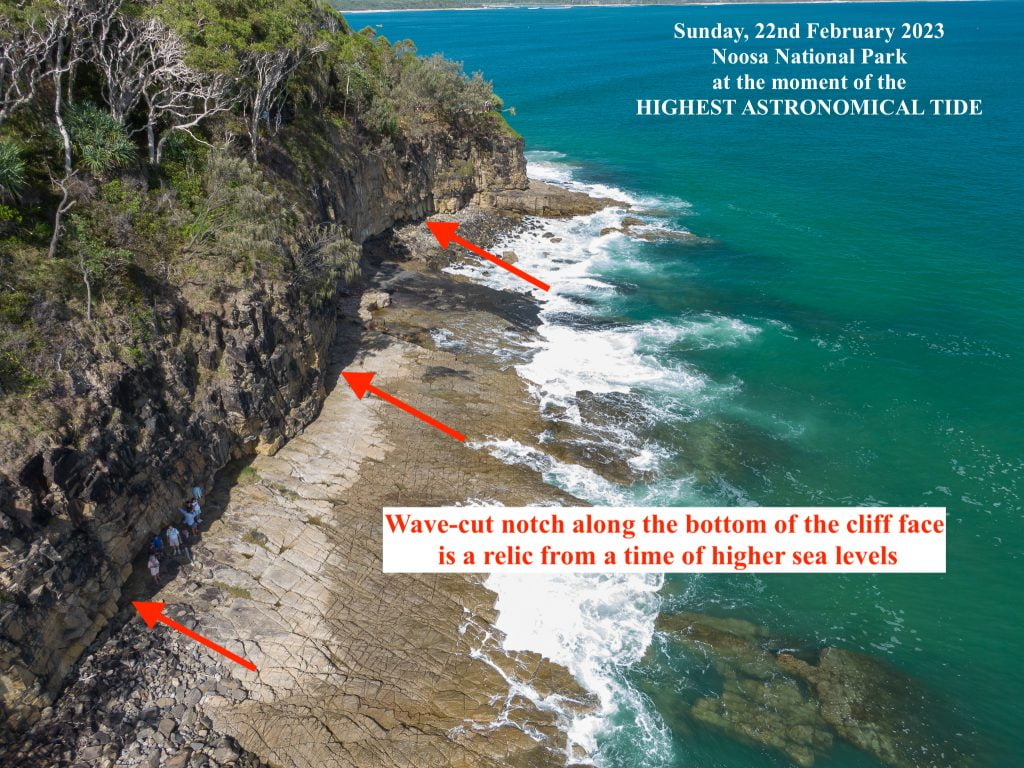
Each year I go to that rock platform with the wave cut notch expecting to be drowned.

With my drone, approaching the platform in advance of the highest astronomical tide

Alas, at the moment of the highest astronomical tide for 2023 – officially 8.32 am on Sunday 22nd January – the waves didn’t reach to the wave cut notch; not anywhere near it.

That notch, it must be a relic from a time of higher sea levels.

It was so much fun! This morning. Being out on the rock platform under Boiling Pot Lookout in Noosa National Park.

Patrick and I droning, while waiting to be washed away
Evan and Yuko checking the height of the wave cut notch, while waiting to be washed away

Fun, because I was with some friends, the sun was shining, and my drone took off. And, of course because it was the morning of the highest astronomical tide. And we didn’t get washed away.

via Jennifer Marohasy

https://ift.tt/Lbpc6tI

January 22, 2023 at 05:44AM

Bob Ward v Nigel Farage

By Paul Homewood

Nigel Farage has been interviewing Bob Ward about Net Zero:


It is the usual blustering performance from Ward, who avoids answering questions by going on a rant.

Fundamental questions, such as:

  • What difference will Net Zero make in the UK, when it only accounts for 1% of the world’s emissions
  • How are people expected to afford heat pumps and insulation
  • Most new “green jobs” are actually going to China
  • How high energy costs are costing many more jobs than are created
  • While we are cutting emissions, China and others are massively increasing them

Ward, for instance, deflects the question of heat pump affordability by claiming that they are cheaper to run, which is not even true.

And his response to the final question about China is that China will not be bullied, but will respond to UK leadership on climate. If he really believes that, he must be delusional:

image

BP Energy Review

Bob Ward is, of course, the Policy & Communications Director for the Grantham Research Institute on Climate Change and the Environment, in other words the PR man. The Institute was set up by the billionaire Jeremy Grantham, and is chaired by Nicholas Stern, neither of whom give much confidence about the objectivity of the Institute’s work. And as their own website makes clear, their purpose is a political one, not scientific:

“The Institute’s purpose is to accelerate the transition, and remove obstacles, to a sustainable, inclusive and resilient world.”

Part of their funding comes from Jeremy Grantham, but there is also a large dollop of taxpayers’ money involved, amounting to over £6 million last year, as well as EU funding and grants from far left American foundations, such as ECF, Rockefeller, and Climate Works:

image

image

https://www.lse.ac.uk/granthaminstitute/about/about-the-institute/

The climate scam is big business!

via NOT A LOT OF PEOPLE KNOW THAT

https://ift.tt/HZkDdOj

January 22, 2023 at 05:43AM