Month: May 2023

An Enhanced Hippocratic Oath for a Free Society

Jeffrey A. Singer advocates for a new version of the oath to which medical doctors swear in his Newsweek article We Need a New Hippocratic Oath That Puts Patient Autonomy First.  Excerpts in italics with my bolds a added images.

A noble profession should require its students and graduates
to swear an oath revering patients’ rights and autonomy.

In the mid‐​20th century, medical schools began administering modernized versions of the oath, more applicable to modern times and sensibilities. In the last 20 or so years, many medical schools have created unique versions of the oath, often allowing students to compose them. These newer versions stray far from the oaths that older‐​generation doctors like me recited. Some have shifted the emphasis from patient care to social justice, generating a firestorm of controversy.

Yet all these oaths—traditional or modern—are self‐​indulgent.

They focus primarily on how physicians should comport themselves, relate to professional colleagues, and view the medical profession’s role. But they also regard patients similarly to how parents regard children.

The original oath states, “I will prescribe for the good of my patients… and never do harm to anyone… nor give advice which may cause his death.” But it also pledges to impart to “the sons of the master who taught me and to the disciples who have enrolled themselves and agreed to the rules of the profession, but to these alone, the precepts and the instruction” (emphasis added) anticipating the protectionism of cartelized modern medicine.

The Declaration of Geneva, composed by the World Medical Association, states “the health of my patient will be my first consideration,” while “maintaining the honor and noble traditions of the medical profession,” but makes no mention of informed consent or respecting patients’ choices.

Many medical school graduates of my generation recited the oath that Dr. Louis Lasagna, Dean of Tufts University Medical School, composed in 1964. The oath pays proper fealty to patients’ privacy and to treat the whole patient—not just a set of lab tests or x‑rays. And it pledges to “not play at God.” But the oath makes no references to patients’ freedom and autonomy.

Since the 1990s, many medical schools have added “white coat ceremonies” to the list of medical school rituals. These are ceremonies for incoming classes of medical students, where they also recite a version of the Hippocratic oath.  The 2019 white coat ceremony oath for Harvard Medical School and Harvard School of Dental Medicine vowed to “place ethics and equity at the core of each patient interaction,” “combat structural oppression,” “promote social justice,” and “leverage our position of privilege to confront health inequities.” No mention of patients as autonomous individuals.

Among the most controversial oaths was the white coat ceremony oath taken last September by incoming medical students at the University of Minnesota Twin Cities Medical School. After noting that the Medical School “is located on Dakota land” and committing to “uprooting the legacy and perpetuation of structural violence within the healthcare system,” the students pledged to “honor all indigenous ways of healing that have been historically marginalized by Western medicine” and did not only commit to healing the sick but to “healing our planet and communities.”

None of the oaths, dating back to the original, make more than a passing mention of respect for patients as autonomous, sovereign adults. All of them smack of paternalism. None of these oaths prioritize or consistently apply a commitment to individual patient autonomy, including respect for patients’ rights to self‐​medicate and to seek treatment from any health care provider they choose—an oath that states, for example,

“Even if they act against my advice and I disapprove of their choices, I will respect the right of my patients as autonomous adults to self‐​medicate and oppose any laws and regulations that force them to seek my permission—or permission from any other health professional, through a prescription or otherwise—to consume medications or treatments according to their independent judgment.”

Today’s medical students should reject being forced to take oaths that have nothing to do with patient care. Instead, a noble profession should require its students and graduates to swear an oath revering patients’ rights and autonomy.
Footnote:  Overheard on a golf course: 

Q:  What’s the difference between God and a Doctor?
A:  God knows He’s not a Doctor.


via Science Matters

https://ift.tt/zKVPOjN

May 9, 2023 at 11:06AM

The Auto Industry in Jonestown

From the MANHATTAN CONTRARIAN

Francis Menton

The notorious events in Jonestown took place so long ago that most readers probably don’t have personal memory of them. In November 1978, in the jungles of Guyana, under the powerful spell of a religious cult with a charismatic leader, and of an all-embracing groupthink, some 900 people somehow agreed to participate in a mass suicide. It was a shocking instance of the kind of collective insanity to which humans can be susceptible.

You might think that the Jonestown massacre was a uniquely extreme example of such a mass psychosis, perhaps attributable largely to unusually susceptible subjects or to the isolated location. Surely our best and brightest leaders of government and business would never fall prey to such collective craziness.

If you think that, then perhaps you should look at what is currently going on in the automotive sector of the economy, under the spell of the climate cult and of government functionaries demanding fealty to anti-carbon doctrines.

On April 12, 2023 the EPA released its most recent proposed regulation of automobile emissions. The document is titled “Multi-Pollutant Emissions Standards for Model Years 2027 and Later Light- Duty and Medium-Duty Vehicles.” It is 262 pages long in the standard Federal Register single-spaced three-column format, thus designed to be virtually impossible to read for anyone who is not getting paid to do it. But the heart of the proposed new rule is that, over a period of a few years, it is to become difficult-to-impossible for automobile manufacturers to continue to sell any significant number of internal combustion engine vehicles. Of course EPA never states that explicitly, and makes the game as difficult as possible for any layman to decipher. But try this language from page 29,196 (12 pages into the document and still in the early part of the Executive Summary):

GHG Emissions Standards. . . . The proposed standards are projected to result in an industry-wide average target for the light-duty fleet of 82 grams/mile (g/mile) of CO2 in MY 2032, representing a 56 percent reduction in projected fleet average GHG emissions target levels from the existing MY 2026 standards.

As I understand it, no internal-combustion car can meet this 82 g/mile CO2 emission standard on its own, so the standard effectively means that a manufacturer can only sell IC cars if it can also make and sell enough “zero-emission” cars to get an average down to this level. Thus does EPA deviously announce its intention to force manufacturers to make, and consumers to buy, all or almost all electric vehicles.

Now, at this point this is only a proposed rule. Currently, despite wide availability of electric vehicles, they have only about a 7% market share in the U.S. They also have many disadvantages as against combustion vehicles, including higher price, difficulty to repair when damaged, poor resale value, limited range, long time to recharge, and so forth. And all those are before you get to the most important problem with EVs, which is that the government geniuses are simultaneously working to destroy the electrical grid that is supposed to be the source of the energy for these things.

Might you think that the auto makers would be pushing back on behalf of themselves and their customers to keep combustion vehicles available? You would be wrong. From all appearances, the manufacturers are falling all over themselves to get on the electric car bandwagon. The EPA document itself contains a long list of industry announcements (from page 12,190 – 12,191):

A proliferation of announcements by automakers in the past two years signals a rapidly growing shift in product development focus among automakers away from internal-combustion technologies and toward electrification. For example, in January 2021, General Motors announced plans to become carbon neutral by 2040, including an effort to shift its light-duty vehicles entirely to zero-emissions by 2035. In March 2021, Volvo announced plans to make only electric cars by 2030, and Volkswagen announced that it expects half of its U.S. sales will be all-electric by 2030. In April 2021, Honda announced a full electrification plan to take effect by 2040, with 40 percent of North American sales expected to be fully electric or fuel cell vehicles by 2030, 80 percent by 2035 and 100 percent by 2040. In May 2021, Ford announced that they expect 40 percent of their global sales will be all-electric by 2030. In June 2021, Fiat announced a move to all electric vehicles by 2030, and in July 2021 its parent corporation Stellantis announced an intensified focus on electrification across all of its brands. Also in July 2021, Mercedes-Benz announced that all of its new architectures would be electric-only from 2025, with plans to become ready to go all-electric by 2030 where possible.

But as with the transformation of the electrical grid — where we forge ahead without ever having gotten a demonstration of feasibility or cost — the automakers are also forging ahead en masse into EVs with no demonstration that electric cars can become a successful mass product that fulfills all the functions that IC cars can fulfill. Tesla seems recently to have turned the corner into profitability, but with an expensive niche product that only the wealthy can afford and which is almost always a second (or third or fourth) car.

How is it going with other manufacturers? The Wall Street Journal had an editorial on May 3 summarizing the results so far for a collection of EV startups. There’s Lordstown:

Lordstown had manufactured only 31 vehicles by late February 2023—most of which had to be recalled. Losing patience, Foxconn on April 21 threatened to withdraw its investment, triggering Lordstown’s bankruptcy warning.

And Rivian:

Rivian commanded a $153.3 billion market capitalization. Now it’s worth less than $12 billion.

The WSJ summarizes stock trends of other EV startups:

[O]ther EV startups have crashed from their pandemic highs, including Canoo (down 96%), Nikola (99%), Faraday Future Intelligent Electric (99%), Rivian (90%), Lucid (87%) and Fisker(81%).

How about at the big traditional manufacturers. Robert Bryce at his Substack on May 3 collects some recent information as to Ford:

In March, Ford Motor Company announced that it lost $2.1 billion on its EV business last year. Those losses were double the losses it had on EVs in 2021. As I noted in a video I posted on TikTok on March 23, Ford made 61,575 EVs in 2022. Thus, the company lost about $34,000 on every EV it sold last year. I also noted that the costs of making EVs aren’t falling. Last year, the cost of battery packs for EVs went up by 7%. . . . Indeed, it appears Ford’s 2022 losses were only a warm-up lap. Yesterday afternoon, Ford reported a $722 million loss on its EV business over the first three months of 2023. During that span, Ford sold 10,866 EVs, meaning it lost $66,446 on every EV it sold.

Bryce goes on to quote a JD Power report from May 1: “[M]any new vehicle shoppers are becoming more adamant about their decision to not consider an EV for their next purchase.”

When I last had a post on EVs (February 23), several commenters expressed the opinion that they thought the manufacturers could overcome all the manufacturing problems (cost, battery capacity, charging, etc.) and thus EVs would shortly become the superior product in the marketplace. I suppose that is possible, although if central planning turns out to work in this instance it will be the first time ever anywhere. And further, there is nothing the manufacturers can do to make a country of 200 million or so EVs work when all the reliable generation on the electrical grid has been removed, and home heat has also been electrified. The auto manufacturers seem to be only too willing to go along with a collective suicide, a la Jonestown.

via Watts Up With That?

https://ift.tt/t5z4qvL

May 9, 2023 at 08:55AM

Americans Increasingly Choose a Warmer Life

We hear that a new El Nino forming in the Pacific Ocean is likely to push global-average temperatures to new record highs in 2023.

Setting aside the fact that we have no idea if current temperatures are warmer than during the Medieval Warm Period of ~1,000 years ago, I have to ask…

So what?

Doing something about global warming depends a lot on how much we are asked to pay to fix it. If it was cheap and practical, we would have already transitioned to renewable energy sources.

It also depends upon just how much global warming we have experienced, and whether it is enough to be concerned with. For the global oceans, the climate models enlisted to scare us in a steady stream of alarmist news reports over-predict ocean warming by a factor of 2. In America’s heartland during the summer, the discrepancy is a factor of 6(!). So, clearly, public concern is being inflated by factually incorrect information.

What Temperature do Americans Choose?

When it comes to life in these United States, roughly 50% of U.S. residents have at least a moderate worry about climate change and global warming. As mentioned above, I believe this is largely due to their response to what is reported by the news media, which is routinely exaggerated.

An interesting question that the late Dr. Pat Michaels asked about 25 years ago is, what temperature do Americans choose to live with? We have a large country with a wide range of climates, from frigid winters to tropical year-round, so there is considerable choice of what climate we decide to live in.

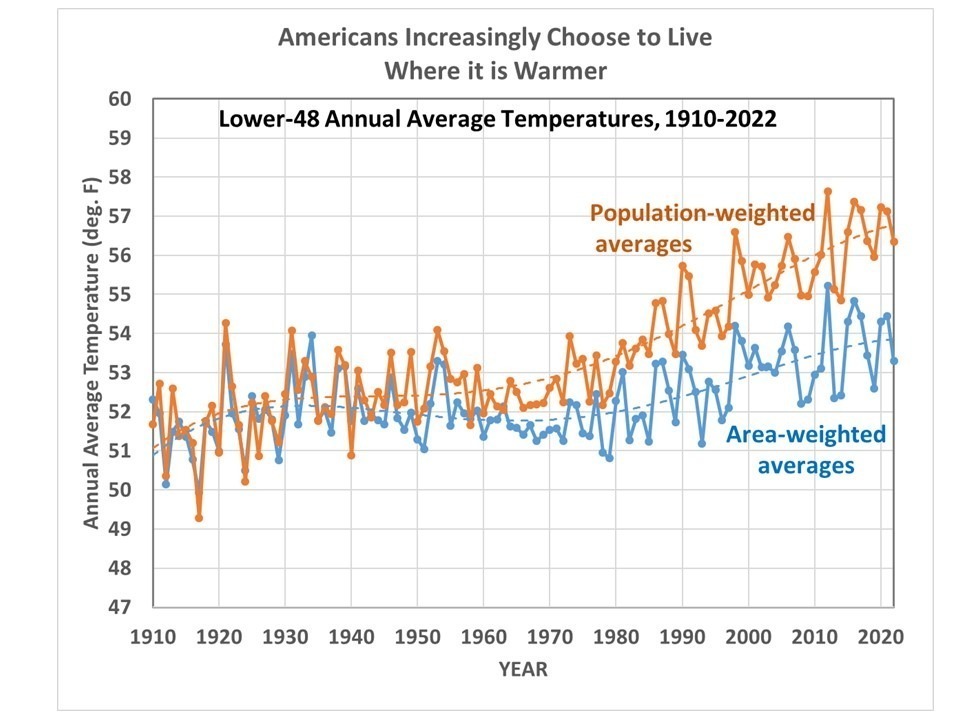
Dr. Michaels pointed out (most recently in 2013) that over the years, Americans tend to migrate to warmer climates. Some of us might claim to be concerned about global warming, but we increasingly choose to live where it’s warmer. I’ve updated those calculations to 2022, and the results are the same:

The blue curve is the usual area-averaged temperatures for the Lower 48, while the orange curve is the state population-weighted average. While the area average temperatures have warmed modestly over the last century, the temperatures where people choose to live have increased by twice that amount. (The possibility that Urban Heat Island effects have spuriously warmed these NOAA-reported temperatures is part of a research project we have been involved in).

Some might claim that the migration to states with warmer temperatures has more to do with economic opportunity than with temperature. But who creates economic opportunity? People. And where do people choose to live? Where the weather is warmer.

There’s a reason why people are flocking to Texas and Florida, and not to the Dakotas or Maine. Ultimately, it’s due to the climate. So, while some of us like to think we are Saving the Earth by buying a Tesla, our migration habits are telling a different story.

The post Americans Increasingly Choose a Warmer Life first appeared on Roy Spencer, PhD..

via Roy Spencer, PhD.

https://ift.tt/CHa1k6X

May 9, 2023 at 07:50AM

UK Government is playing into Putin’s hands

London, 9 May – Net Zero Watch has warned that the Government’s ban on fracking and its strangling of North Sea oil and gas investment is playing into Russian hands.

The merchant bank Goldman Sachs has today warned that European gas prices could triple this winter, triggering a new energy cost crisis, even before the possibility of Russia sabotaging undersea cables and pipelines, a real threat raised by security experts last week.

Net Zero Watch has been warning for years that Britain’s energy security can only be safeguarded by developing domestic energy resources. Its director Andrew Montford said:

Putin barely needs to attack oil and gas infrastructure in the UK, because the Government is doing such a good job of restricting domestic supply without him. Net Zero policy plays straight into his hands.”

Net Zero Watch has been highlighting the fact that prioritising renewable energy over reliable energy sources represents a major thread to national security for several years.

Andrew Montford said:

The government are sacrificing everything on the altar of their Net Zero dogma: economic security and national security just don’t seem to matter to them any longer.”

Further information

* Net Zero Watch calls for emergency restart of fracking

Government’s years of irresponsible neglect has left Britain “at mercy of Putin”

Revitalise North Sea exploration and start fracking — or lose Putin’s energy war for good

How UK shale gas was killed by Green lies and Russian propaganda

via Net Zero Watch

https://ift.tt/4SvNULe

May 9, 2023 at 07:32AM