Month: May 2023

Scientists Employ Wit To Highlight The Lack of Climate Trends Across Greece Since The 1800s

The accumulation of over two centuries of precipitation records across Greece indicates there have been overall slightly declining trends in precipitation extremes across the region and “negligible climate variability.” This supports a new study’s tongue-in-cheek title referencing a “404 Not Found” climate crisis.

Eight scientists have published a new study  examining the popularized conceptualization of an anthropogenically-induced climate change that has increasingly become “the post-modern scapegoat for which every disaster is blamed.” The authors point out, for example, that even the 2020-2021 COVID-19 pandemic has been blamed on a human-caused warming climate.

The study utilizes detailed precipitation data available for Greece, as these climate records often extend to the early 1800s.

The scientists tendentiously searched for climate-related (i.e., 30+ years) trends that might confirm there is a “climate emergency, climate crisis, etc.” in the works linked to an anthropogenic influence.

However, no trend consistent with any anthropogenic climate influence could be found in the records. Hence, the wit-intended “404 Not Found” study title (which one of the 3 peer-reviewers recommended be kept in the final publication rather than discarded).

“The current period can be characterized as normal without notable climatic events.”

“The overall period does not show a linear trend or appreciable difference in the two 30-year climate periods.”

“…precipitation did not linearly change during the past 7 decades.”

Analyses of precipitation extremes may even support a “decreasing, albeit slightly” trend over the two centuries, as the record average and maximum rainfall depths occurred in the 1800s or early 1900s.
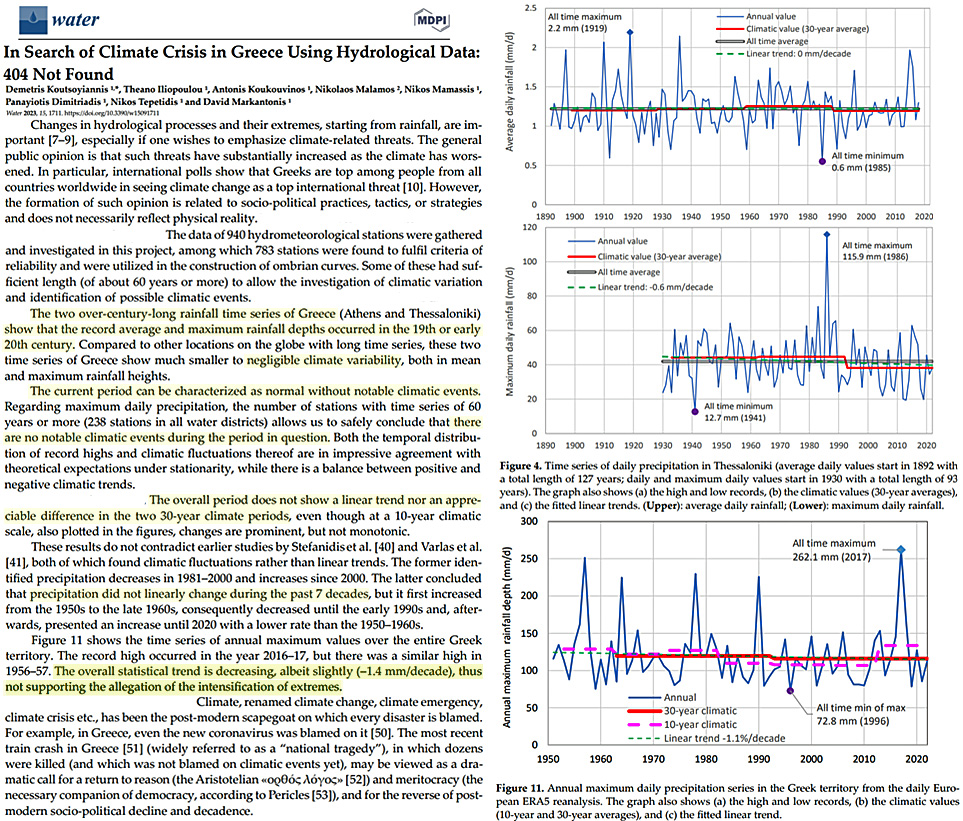
Image Source: Koutsoyiannis et al., 2023

In anticipation of the timeworn, “But Greece is not the globe!” criticism, it should be noted that comprehensive analysis of global-scale precipitation data in the satellite era also do not support detection of intensifying trends associated with the timing of the sharp rise in anthropogenic CO2 emissions or a warming climate.
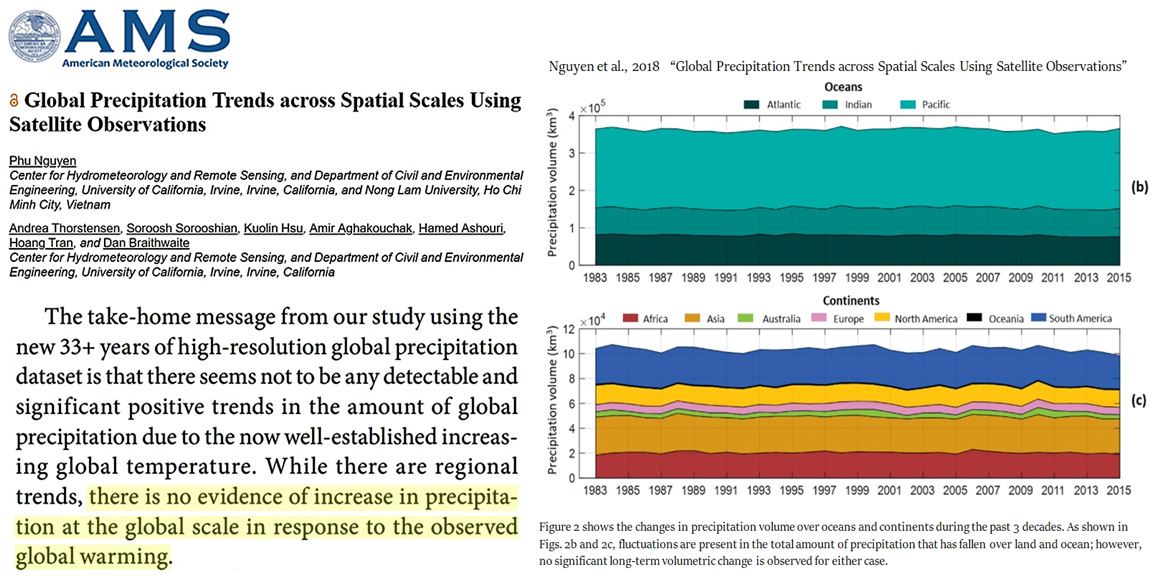
Image Source: Nguyen et al., 2018

via NoTricksZone

https://ift.tt/tHksJ0Q

May 1, 2023 at 11:38AM

2023 April Arctic Ice Melt Abates

The graph shows that coming out of the annual March maximum, April 2023 began 238k km2 lower than the 17 year average.  SII even showed extents ~200k km2 lower than MASIE on April 1.  However, after two weeks both indices tracked with the average until month end.  According to MASIE, the typical April loses 1100 km2, but this year lost only 918k km2.  SII shows a loss of only 590k km2 during April. Meanwhile, other years, especially 2007 were losing ice much more rapidly than average.  

Why is this important?  All the claims of global climate emergency depend on dangerously higher temperatures, lower sea ice, and rising sea levels.  The lack of additional warming is documented in a post Satellite Temps Hit Bottom: February 2023.

The lack of acceleration in sea levels along coastlines has been discussed also.  See USCS Warnings of Coastal Floodings

Also, a longer term perspective is informative:

post-glacial_sea_level
The table below shows the distribution of Sea Ice across the Arctic Regions, on average, this year and 2007.

Region 2023120 Day 120 Average 2023-Ave. 2007120 2023-2007
 (0) Northern_Hemisphere 13446987 13514506  -67519  13108068 338919 
 (1) Beaufort_Sea 1070966 1067918  3048  1059189 11777 
 (2) Chukchi_Sea 966006 956111  9895  949246 16760 
 (3) East_Siberian_Sea 1087137 1085582  1555  1080176 6961 
 (4) Laptev_Sea 897845 890425  7420  875661 22184 
 (5) Kara_Sea 933170 912998  20172  864664 68506 
 (6) Barents_Sea 415992 553986  -137994  396544 19449 
 (7) Greenland_Sea 761413 648178  113235  644438 116975 
 (8) Baffin_Bay_Gulf_of_St._Lawrence 1123308 1207572  -84264  1147115 -23807 
 (9) Canadian_Archipelago 854843 848924  5918  838032 16810 
 (10) Hudson_Bay 1249469 1238384  11085  1222074 27396 
 (11) Central_Arctic 3239670 3230693  8977  3241034 -1364 
 (12) Bering_Sea 491550 473366  18184  475489 16061 
 (13) Baltic_Sea 32086 20744  11342  14684 17402 
(14) Sea_of_Okhotsk 321714 376553  -54840  295743 25971 

Overall, the extent is slightly below average by 68k km2, or 0.5%.  The main deficits are in Barents, Baffin and Okhotsk, parttly offset by a surplus in Greenland Sea.


via Science Matters

https://ift.tt/qt7si9B

May 1, 2023 at 10:38AM

“totalitarian control over society”

Robert F. Kennedy Jr. says WEF and Bill Gates are using climate to manipulate people in the same way that COVID was used.

via Real Climate Science

https://ift.tt/nGo20K3

May 1, 2023 at 09:45AM

“The Decade We Could Have Stopped Climate Change”

The New York Times says we could have stopped billions of years of climate change during the 1980s, and because we didn’t we lost our chance to save the planet. Losing Earth: The Decade We Almost Stopped Climate Change – … Continue reading

via Real Climate Science

https://ift.tt/E5NZWIP

May 1, 2023 at 09:32AM