Month: May 2023

Urbanization Effects on GHCN Temperature Trends, Part V: Tmin Warming at U.S. vs. non-U.S. Stations

In my last post (Part IV) I showed how urbanization (as measured by population density) affects GHCN monthly-average Tmax and Tmin near-surface air temperatures during the warm season in the Northern Hemisphere. We are utilizing a technique that recognizes rural thermometer sites can experience large spurious warming with very small increases in population density, as has been known for over 50 years.

The urban heat island (UHI) effects on Tmin averaged 3.5 times as large as on Tmax, an unsurprising result and qualitatively consistent with previous studies. Also, I showed that the homogenization procedure NOAA uses to adjust the Tmax and Tmin temperatures caused greater UHI effects compared to raw (unadjusted) data, a result I cannot explain.

Again I will emphasize that these UHI warming results are based upon spatial comparisons between neighboring stations, and do not say anything quantitative about how much urbanization effects have spuriously warmed long-term temperature trends over land. That is indeed the goal of our study, but we have not reached that point in the analysis yet.

Here in Part V of my series on UHI I just want to show the difference between U.S. and non-U.S. stations, in this cased for adjusted (homogenized) Tmin data. This is shown in the following two plots, which are the same except the second plot has a logarithmic scale in population density.
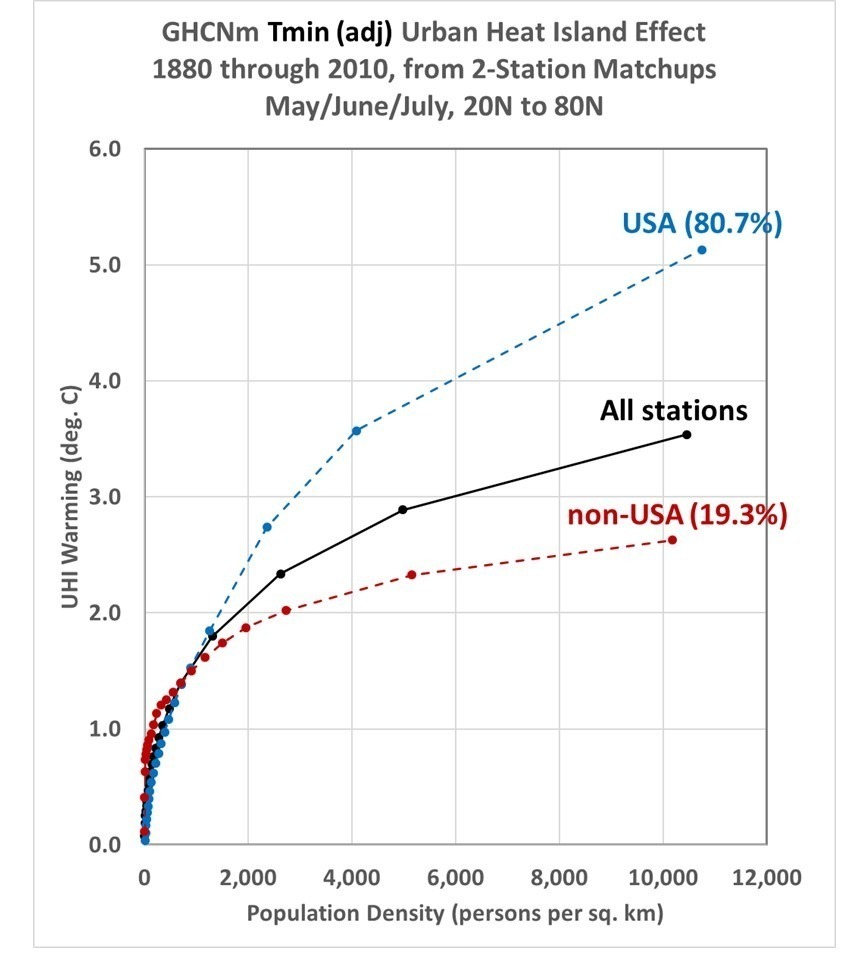
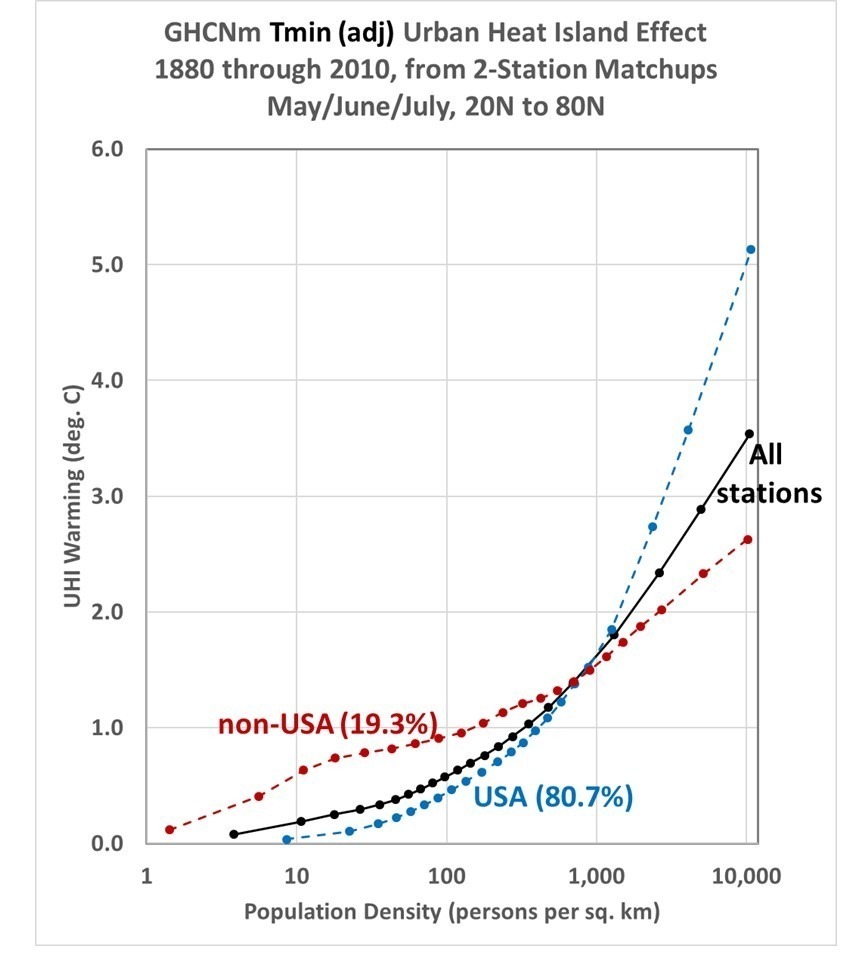
The non-U.S. stations have a more rapid rise in UHI warming at very low population densities than the U.S. stations do, but less rapid warming at high population densities. Possible reasons for this include country differences in thermometer siting and differences in waste heat generation. I’m sure you can think of other possible reasons.

As can be seen most (over 80%) of the GHCN 2-station matchups come from the U.S. Other countries have considerably fewer 2-station matchups, for example Canada (7.8% of the Northern Hemisphere total), Japan (4.7%), Turkey (2.8%), South Korea (1.3%), and China (1.1%). These low totals are not necessarily due to a lack of stations, but to a lack of station pairs within 150 km and 300 m elevation of each other needed for my current method of analysis.

The post Urbanization Effects on GHCN Temperature Trends, Part V: Tmin Warming at U.S. vs. non-U.S. Stations first appeared on Roy Spencer, PhD..

via Roy Spencer, PhD.

https://ift.tt/jFULdxr

May 1, 2023 at 09:05AM

Feds admit offshore wind can kill whales!

Originally posted at CFACT

David Wojick, Ph.D.

Despite public proclamations of innocence, it turns out BOEM and NOAA clearly acknowledge the deadly threat of offshore wind development to marine mammals. Not surprisingly they do it in documents that are subject to judicial review, lest they be caught fibbing.

Of course these admissions are well hidden, buried in the depths of thousand page documents, but they are there to be found. These are the Draft Environmental Impact Statements (DEIS) that precede each offshore wind project. They are jointly prepared by BOEM and NOAA.

The key is that the overall project EIS includes the EIS for NOAA’s harassment authorizations for the construction of that project. In fact you can find this language by searching the DEIS for the word “harassment”. I am told that this is standard language which varies little from project to project.

The standard language says just what we have been saying! Harassment is likely to lead to dangerous behavior, including increased likelihood of deadly ship strikes and entanglements. It also says, as we have, that having multiple projects increases these risks.

Here is a good example of admitting that harassment is can cause harm. I could not have said it better.

“It is possible that pile driving could displace animals into areas with lower habitat quality or higher risk of vessel collision or fisheries interaction. Multiple construction activities within the same calendar year could potentially affect migration, foraging, calving, and individual fitness. The magnitude of impacts would depend upon the locations, duration, and timing of concurrent construction. Such impacts could be long term, of high intensity, and of high exposure level. Generally, the more frequently an individual’s normal behaviors are disrupted or the longer the duration of the disruption, the greater the potential for biologically significant consequences to individual fitness. The potential for biologically significant effects is expected to increase with the number of pile-driving events to which an individual is exposed.”

Empire Wind DEIS v.1, Page 3.15-14, PDF page 372

This warning is about risks created by pile driving but all forms of acoustic harassment fit this description. NOAA harassment authorizations are based on the estimated number of critters that will be exposed to unsafe sound levels. The source of the dangerous sounds is irrelevant. What matters most is the volume. Sound is a pressure wave; the louder the sound the greater the physical pressure on the hearing system. Pain and physical damage are possible.

In fact the infamous sonar surveying sounds, implicated in the whale deaths to date, can be much louder that the incredibly loud pile driving. Driving the enormous piles for the proposed wind projects is estimated to create sounds around 190 decibels, which is painfully loud in humans.

But some sonar equipment deliberately emits sounds over 200 decibels. Decibels is a log scale so this is not just 5% greater than 190; it is much greater.

Thus it makes no sense that NOAA claims sonar surveys have no significant impact and so do not fall under NEPA, while pile driving does. This is especially true when, as just happened, a dozen different projects are given simultaneous authorization to acoustically harass large numbers of whales.

What is important is that NOAA and a BOEM are clearly stating that the acoustic threats we have been warning about and suspecting are real. The telling correlations between sonar blasting and increased whale deaths cannot be waived away.

Correlation is not causation, but correlation between cause and predicted effect is very strong evidence that the cause is effective. NOAA and BOEM’s repeated insistence that there is no evidence offshore wind development is killing whales is clearly contradicted by their own Environmental Impact Statements.

Harassment kills.

Author

David Wojick

David Wojick, Ph.D. is an independent analyst working at the intersection of science, technology and policy. For origins see

http://www.stemed.info/engineer_tackles_confusion.html

For over 100 prior articles for CFACT see

http://www.cfact.org/author/david-wojick-ph-d/

Available for confidential research and consulting.

via Watts Up With That?

https://ift.tt/BUVC0F9

May 1, 2023 at 08:55AM

United Nations Threatening Energy Producers

6:35 AM · May 1, 2023

via Real Climate Science

https://ift.tt/zcLfAij

May 1, 2023 at 08:53AM

Biden Recycling The Same Scam For 36 Years

“Our climate bill wasn’t just the most significant investment to fight climate change ever – it’ll also create millions of new jobs in the clean energy economy.” 7:30 PM · Apr 20, 2023 The language is almost identical to his … Continue reading

via Real Climate Science

https://ift.tt/c8qsD7Z

May 1, 2023 at 08:45AM