Month: May 2023

A Critique of AR6

By Andy May

After more than two years of hard work, Marcel Crok, I, and 11 other scientists have finally published our critique of the International Panel on Climate Change (IPCC) sixth report (AR6). The entire book has been extensively peer reviewed and a low-resolution pdf of a nearly final draft of the book has been available for weeks at clintel.org. All comments received on this draft have been carefully considered and incorporated, if approved by the team, in the final book. We are a bit hard on AR6, but our criticisms are well deserved. Only the eBook is out now, the print edition should be along in a week or two. The Kindle edition is text-to-speech enabled. Available at Amazon, Kobo, and Barnes and Noble.

A Brief Summary of the Contents

The IPCC has completed its sixth climate change assessment cycle consisting of seven reports in total, collectively known as “AR6.” A team of eight scientists, in addition to several anonymous expert reviewers, from the Clintel network, have analyzed several claims from the Working Group 1 (The Physical Science Basis) and Working Group 2 (Impacts, Adaptation and Vulnerability) reports. The team and reviewers are from Spain, Canada, Italy, Germany, Norway, The Netherlands, the U.K., and the U.S. In every chapter, this book documents biases and errors in the IPCC assessment. The errors are worse in the WG2 report but are also present in the WG1 report. 

For example, the IPCC ignored 52 highly relevant peer-review articles showing that “normalised disaster losses” saw no increase attributable to climate change yet highlighted one, out of 53 papers, that claimed there is an increase in losses. That one paper is – not surprisingly – flawed, but apparently its conclusions were so appealing to the IPCC that they fell for it. The strategy of the IPCC seems to be to hide any good news about climate change. 

We are on a highway to climate hell”, said UN-boss Guterres recently. But an in-depth look at mortality data shows that climate-related deaths are at an all-time low. Well-known economist Bjorn Lomborg published this excellent news in a 2020 peer-reviewed paper, but the IPCC chose to ignore it, see figure 17 here

Back in 2010, errors in the fourth WG2 report led to the investigation of the IPCC by the InterAcademy Council. This IAC Review recommended, among other recommendations, that “[h]aving author teams with diverse viewpoints is the first step toward ensuring that a full range of thoughtful views are considered.” This important recommendation is still ignored by the IPCC. One of the key recommendations in IAC Review that the AR6 authors ignored, as documented in our book, is:

“The IPCC should encourage Review Editors to fully exercise their authority to ensure that reviewers’ comments are adequately considered by the authors and that genuine controversies are adequately reflected in the report.”

InterAcademy Council Review of the IPCC, page xiv

Numerous very well documented reviewer’s comments were completely ignored in AR6, our book documents many of the more egregious of these. The AR6 Working Group 1 report is not free from bias and misleading conclusions either. The IPCC tries to rewrite climate history by erasing the existence of the Holocene Climatic Optimum, a warm period between 10,000 and 6000 years ago, by embracing a new hockey stick graph, that is the result of cherry-picked temperature proxies. They ignore temperature reconstructions that show significantly more variability in the past.

The IPCC claims there is an acceleration in the rate of sea level rise in recent decades. We show this claim is flawed because the IPCC ignores decadal natural variability in the sea level rate. We also show that the IPCC sea level tool – made available for the first time – shows a mysterious and unlikely jump upward in 2020.

Canadian economist Ross McKitrick, pointed out that all models used by the IPCC, show too much warming in the troposphere, both globally and in the tropics (where models predict a ‘hot spot’). Observed warming indicates a moderate climate sensitivity between 1 and 2.5 degrees Celsius, while the IPCC claims a climate sensitivity of 3 degrees.

On top of that, the IPCC is ‘addicted’ to its highest greenhouse gas emission scenario, the so-called RCP8.5 or now SSP5-8.5 scenario. In recent years, several papers have demonstrated that this scenario is simply not plausible and should not be used for policy purposes. Deep inside the WG1 report the IPCC acknowledges that this scenario has a ‘low likelihood’, but this very important remark was not highlighted in the Summary for Policy Makers, so the media and policy makers are unaware of this. This implausible scenario is commonly used in the report.

Our conclusions are quite harsh. We document biases and errors in almost every chapter we reviewed. In some cases, of course, one can quibble endlessly about our criticism and how relevant it is for the overall ‘climate narrative’ of the IPCC. In some cases, though, we document such blatant cherry picking by the IPCC, that even ardent supporters of the IPCC should feel embarrassed.

The AR6 report reveals that they have ignored the very important multi-decadal ocean oscillations discovered in the 1990s and 2000s (see Vinos, 2022 Ch. 11 and Wyatt and Curry, 2014) long after the IPCC had focused exclusively on anthropogenic causes. These ocean oscillations, collectively, have a large effect on our climate, but are unrelated to “non-condensing greenhouse gases.” AR6 states that:

“there has been negligible long-term influence from solar activity and volcanoes”

AR6, page 67

Yet, they acknowledge no other natural influence on multidecadal climate change despite the recent discoveries suggesting significant natural climate change, a true case of tunnel vision.

We were promised IPCC reports that would objectively report on the peer-reviewed scientific literature, yet we find numerous examples where important research was ignored. In Ross McKitrick’s chapter on the “hot spot,” he lists many important papers that are not even mentioned in AR6. Marcel Crok gives examples where unreasonable emissions scenarios are used to frighten the public in his chapter on scenarios, and examples of bias and hiding good news in his chapters on extreme weather and snowfall. Nicola Scafetta and Fritz Vahrenholt document that over 100 papers showing solar activity correlates with climate change have been ignored by the IPCC. Numerous other examples are documented in other chapters. These deliberate omissions and distortions of the truth do not speak well for the IPCC, reform of the institution is desperately needed.

Perhaps this is why, after 47 reports and 32 years, they have yet to convince a majority of the people on Earth, or in the United States, that manmade climate change is our most important and serious societal problem. Other problems are always considered more important and urgent. In a 2018 Pew Research poll climate change ranked 18th, of 19 issues in importance, in a similar 2014 poll, climate change ranked 14th in a list of priorities. A 2022 poll by the Pew Research Center also found climate change ranked 14th. In the UN My World 2015 Report, a poll of 10 million people around the world, climate change ranked dead last of 16 issues in importance. Minds are not being changed.

Are we at a fork in the road? Will the United Nations, the IPCC, and politicians finally realize that their 50-year-old hypothesis is out of date and incorporate the new natural warming forces discovered in the past thirty years into their work and projections? In the past the IPCC has fought off attempts to independently review their work. We hope our documentation of the problems in AR6 eventually leads to the necessary changes in their organization and procedures.

via Watts Up With That?

https://ift.tt/MPUOdbc

May 28, 2023 at 04:40PM

The Mississippi River Flood Of 1912

“THE FLOOD OF 1912 In April and May, 1912, the Mississippi reached a height never before equaled, and the great river went tearing through levee after levee on its resolute course to the sea. ‘The river reached a maximum width … Continue reading

via Real Climate Science

https://ift.tt/ktzjUeV

May 28, 2023 at 04:28PM

STUDY: ‘Global warming can cause headaches’ through ‘stress of…changes in weather patterns’ – Makes Parkinson’s, ‘stroke, MS, migraines, & dementia worse’

From CLIMATE DEPOT

According to researchers from the American Academy of Neurology, global warming is fueling a rise in neurological diseases ranging from migraines to Alzheimer’s. People with Parkinson’s and multiple sclerosis (MS) may also experience worsening symptoms. … 

According to the Environmental Protection Agency, rising global average temperature continue to impact widespread changes in weather patterns, and extreme weather events—such as heat waves and hurricanes—are likely to become more frequent or more intense. Experts suggest that the stress of these events can trigger headaches.

The World Health Organization has referred to climate change as “the single biggest health threat facing humanity.”

By: Admin – Climate DepotMay 25, 2023 5:50 PM

https://www.pennmedicine.org/news/news-blog/2023/may/headache-and-climate-change

Why Climate Change Might Be Affecting Your Headaches

by Kelsey Geesler

Recurring headaches are one of the most common nervous system disorders, with an estimated 45 million, or one in six, Americans complaining of headaches each year. People who experience headaches or migraines regularly are probably familiar with different triggers for their headaches—such as consuming alcohol, increased stress, or changes in sleep quality. But what people suffering from headaches might not realize is that climate change can have effects on headaches.

How Can Climate Change Cause Headaches?

According to the Environmental Protection Agency, rising global average temperature continue to impact widespread changes in weather patterns, and extreme weather events—such as heat waves and hurricanes—are likely to become more frequent or more intense. Experts suggest that the stress of these events can trigger headaches.

“Not only can experiencing an extreme storm itself be stressful, but the aftermath, where we have to deal with injuries, destruction to our homes or other property, and the loss of our possessions can add to that stress said Marilyn Howarth, MD, an adjunct associate professor of Pharmacology at the University of Pennsylvania Perelman School of Medicine and director of the Community Outreach and Engagement Core with the Center of Excellence in Environmental Toxicology (CEET). “This stress can cause people who are already susceptible to headaches to experience them more frequently or more acutely.”

With the increase of weather events that cause flooding, like hurricanes and other intense downpours, there is also an increased likelihood that storage facilities for chemicals and other hazardous materials may be disturbed, which could cause spills and leaks that can contaminate the soil, water, and air.

“A number of common chemicals, like solvents, are known to cause irritation in the nose and throat, and headaches, and if a high enough concentration of these chemicals makes it into the soil around our homes, or into our drinking water, exposure can cause headaches in some individuals,” Howarth noted. “Individuals may also come into contact with contaminated water while attempting to access their homes or evacuate the affected area, which could trigger headaches.”

Research also suggests that rising temperatures associated with climate change have an impact on changing foliage and pollen in some areas.

“These changes can lead to an increase in pollen that already exists in an area, or the introduction of a new kind of pollen in an area that has never seen it before,” Howarth elaborated. “People with existing allergies may see them get worse, and people who never experienced allergies in the past might develop them.”

recent study from Holly Elser, MD, PhD, a Neurology resident at Penn Medicine, illustrates an increase in emergency department visits for patients diagnosed with headaches following wildfires in California.  “Wildfires are most common in the Western U.S., with climate change driving the intensification and length of wildfire seasons. But even Mid-Atlantic states like Pennsylvania and New Jersey are subject to the effects of wildfires,” Elser said, noting a “red flag” warning in the Philadelphia region, just last month, resulting from warm temperatures, combined with very low humidity and strong winds, caused an increased risk of fire danger.

Children may be particularly susceptible to climate change impacts such as increased air pollution exacerbating asthma and flooding redistributing chemicals and causing mold growth which can also exacerbate asthma.

#

Global warming can cause headaches

 Headaches are not lethal every time, but their recurring episodes can cause huge discomfort and hinder our daily activities and productivity. Other than common factors like alcohol, stress, and poor sleep, now global warming has also become a major factor that can trigger headaches, found the University of Pennsylvania.

In its latest research, scientists found that the aftermath of storms, mainly led by climate change, can lead to stress and headaches. The aftermath of such storms includes the destruction of homes, property, loss of possessions, health issues, etc. Contamination of soil, water, and air, can also lead to an increase in cases of nose and throat irritation resulting in headaches.

Experts suggest that a spike in average temperature due to climate change can impact the changing foliage and pollen in some areas. Which can increase allergy symptoms among individuals.

#

Study Finds: Headaches and other neurological diseases are getting worse — due to climate change

Headaches are getting worse, and a new study says climate change may be to blame.

According to researchers from the American Academy of Neurology, global warming is fueling a rise in neurological diseases ranging from migraines to Alzheimer’s. People with Parkinson’s and multiple sclerosis (MS) may also experience worsening symptoms.

Strokes may also become more prevalent as the planet heats up. The team notes that global warming causes air pollution, which previous studies have linked to worsening brain health. Smog from traffic and industry contains tiny toxic particles called particulate matter. They enter the bloodstream after people breathe them into their lungs. eventually, they can travel to the brain.

“Although the international community seeks to reduce global temperature rise to under 2.7 ºF before 2100, irreversible environmental changes have already occurred, and as the planet warms these changes will continue to occur,” says the Cleveland Clinic’s Andrew Dhawan, MD, DPhil, in a media release. “As we witness the effects of a warming planet on human health, it is imperative that neurologists anticipate how neurologic disease may change.”

#

Does climate change make stroke, MS, migraines, dementia worse?

Review of hundreds of studies sees increased neurological risk in climate change

Climate change and pollution are making troublesome neurological disease symptoms worse, according to new research in Neurology, the journal of the American Academy of Neurology.

The authors reviewed 364 studies from 1990 to 2022 on climate change, neurological disorders, temperature and pollutants to reach their conclusion. As Forbes summarized findings, “extreme weather events accelerated by climate change are associated with an increase in strokes, migraines and seizures, an increase in hospital visits among patients with dementia and worsening severity of multiple sclerosis symptoms.”

The studies all involved adult subjects, not children.

The World Health Organization has referred to climate change as “the single biggest health threat facing humanity.”

The report said extreme weather is marked by drastic temperature change, high temperatures and heat waves.

Filed under: astrologycovidlockdownnew studyresetwackywho

via Watts Up With That?

https://ift.tt/Gj9yoew

May 28, 2023 at 12:42PM

Cold Grips Globally: Alaska’s 4th Cold Winter… Record Cold Down Under…UK’s Delayed Spring…

Excerpts from EIKE here.

1. Alaska’s fourth cold winter in a row

Alaska was once seen as a beacon of hope in the AGW coal mine: but after four cold winters in a row, culminating in a historically cold winter season in 2022-23, The Last Climate Frontier has certainly lost that status – the catastrophists will now have to look elsewhere to bolster their narrative.

According to NOAA’s data, and despite the agency’s official forecasts that consistently heralded “warmer than average” seasons, the last four winters in Alaska have shown a strong cooling trend.

The Old Farmer’s Almanac is also off its rocker. It predicted a “much milder than normal winter” for 2022-23 with below average snowfall. That was wrong on both fronts. Historic snowfall totals of more than 250 cm fell across much of Alaska, and Anchorage set a new record for leftover snow that stayed on the ground well into April.

April was also a historically cold month across Alaska, with an average temperature of -8.7 degrees Celsius, which is 5.5 degrees Celsius below the multi-decadal norm and the fourth coldest April in 99 years of NOAA records.

The snow has now continued into May, tumbling even more records.

There’s a Twitter video to go with it.

2. More and more new cold records “Down Under”

Icy polar air masses continue to dominate large parts of Australia – most recently in the west. Moreover, a continent-wide cold air outbreak from Antarctica is expected in the second half of this week.

Australia is cooling, and the proof is in measurements: For the past six years, it has been colder than average Down Under, and the list of cities that have recorded the coldest seasons since records began is growing (such as Brisbane last winter).

May 2023 continues this cooling trend, with the lowest May temperatures on record already recorded in a number of locations early in the month – including Cooma, Omeo, Bombala and Canberra. In Sydney last Sunday, the lowest temperature recorded at the start of autumn in 85 years (since 1938) was 7.1°C.

Over the weekend, it was the West’s turn to freeze.

Large parts of Western Australia just experienced the coldest May morning in at least two decades. On both Sunday and Monday morning, the temperature in Broome, for example, dropped to 11.5 °C, the lowest autumn reading since 1999.

3. May snow in Europe – even in Spain

Meteorological summer may be just around the corner, but Europe’s higher altitudes are seeing further and unusually heavy snowfall – and the media have been characteristically silent despite all their clamouring for “snowless winters”.

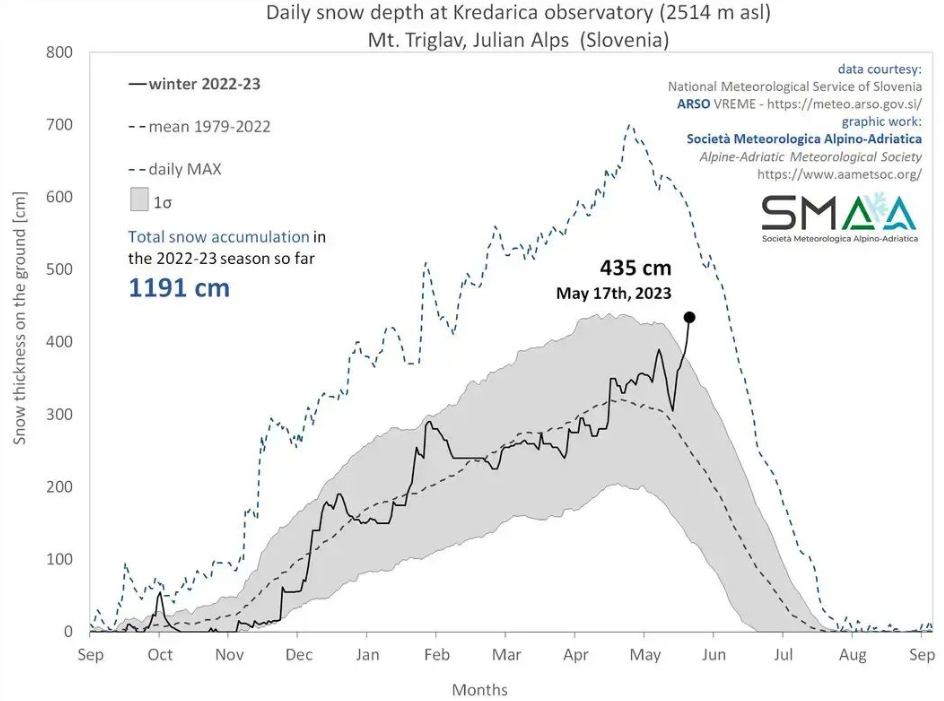
In the French Alps, Tignes and Les 2 Alpes received huge amounts of snow at the beginning of May, and accumulations have continued to rise since then. More recently, it was Austria’s turn to experience a late winter onset, with Hintertux, for example, reporting half a metre of new snow in the last few days alone.

4. The heavy May snow in Europe not limited to Alps

Large parts of Scandinavia have been buried in the recent off-season, as have the mountains of northern Spain, where several centimetres of snow have accumulated in recent days – following absurd MSM warmth reports of an early season heatwave.

Parts of the Iberian Peninsula have recently been hit by a polar cold snap that has led to “unusual snowfall” in La Raya, a mountainous region in the Principality of Asturias in northwestern Spain, Reuters reports.

See Twitter-Video.

5. The year without spring in the UK

The year 2023 has been cold and wet in the UK so far, and spring still refuses to start in mid-May.

Even mainstream meteorologists can’t explain why winter’s grim conditions are still dragging on, and are themselves shocked by “all the severe frosts we’ve had this spring”.

BBC meteorologist Tomasz Schafernaker said that people approach him in the street and ask when spring will finally arrive. What have we done to deserve this cold, gloomy weather dragging on for so long?

According to Schafernaker, the answer lies in the history books, particularly the weather conditions of the 1970s and 1980s.

The BBC meteorologist actually explains it in terms of global warming: “From time to time we revert to previous weather patterns, and that’s what we’re experiencing this year … But thanks largely to climate change, temperatures have been creeping up – snow has become less frequent, and spring has occasionally brought very warm weather. And we have got used to that.”

6.Surprising May snow in the Gulmarg region of Kashmir

The Indian region of Kashmir is still experiencing wintry conditions in June.

The ski resort of Gulmarg in the Kashmir Valley continues to surprise tourists with massive snowfall and freezing cold. In Apharwat, there is still 30 cm of snow on the slopes, attracting thousands of tourists every day.

“We are experiencing a winter season in the middle of summer; I did not expect such severe cold,” said one tourist.

In May, there was a dramatic change in the weather, and the higher elevations of the Kashmir Valley saw rare off-season snowfall. Temperatures also remain well below normal, allowing the ski season to be extended all around.

7. Frost hits Europe
In large parts of Europe it is freezing cold. What’s more, despite the mainstream’s cries of “No snow!”, the continent’s higher elevations have continued to receive copious amounts of late spring snow.

Much of central and eastern Europe has been exceptionally cold over the past few nights, and despite “The Science” predicting an impending devastating drought, rain has returned (in the form of heavy snowfall in the Alps and Pyrenees).

A recent Reuters article says there is little chance that the rains will address the underlying drought: “At this time of year we can only have spotty and localised storms that will not address the rainfall deficit,” said Jorge Olcina, professor of geographic analysis at the University of Alicante, a mouthpiece for the AGW and darling of the MSM.

Well, the rains are here, Olcina, and they are proving to be heavy, persistent and widespread – especially in the regions that “The Science” claims to be most concerned about: Spain, Portugal and southern France.

Getting back to the cold records: Low-lying areas of France and Germany have been experiencing frost lately, which was not in keeping with the season. In the small town of Wittingen (71 m above sea level), for example, a new May record of -1.6 °C was set. At least 16 low-lying stations across Germany, including the metropolis of Hanover, also experienced rare late frosts.

Snow is predicted for Scandinavia, the Alps and the Pyrenees into June – amazing!

8. Deadly snowstorm in Mongolia

Mongolia endured a brutal and deadly winter of 2022-23 that resulted in massive livestock losses and the suffering of 212,000 people, according to Save the Children. Now, in late spring, the country continues to be battered by deadly snowstorms.

Currently, 13 of Mongolia’s 21 provinces are experiencing a “dzud” – a natural phenomenon unique to Mongolia in which heavy snowfall and extreme cold lead to a shortage of grazing land for livestock. Between 1940 and 2015, official “dzud declarations” were made twice a decade. In recent years, however, dzuds have increased in frequency and now occur annually.

As with the increasing “cold waves” in India, the AGW party has no answer to this phenomenon.

As Xinhua reports, the return of winter in the country has also caused extensive damage to buildings and infrastructure such as roads and power lines.

The cold and snow have also killed many animals, NEMA added, contributing to the huge winter losses.

“The climate is very different from when I was a child,” Delgerbat said in early May. “When I was young, the snow had melted around this time and it was already spring, but now spring comes so late.”

Donate – choose an amount

via NoTricksZone

https://ift.tt/fJ1TUuh

May 28, 2023 at 11:34AM