Month: September 2023

Ulez will add just 13 minutes to life expectancy in London but the Mayor is forcing it anyway

Ulez will add just 13 minutes to life expectancy in London but the Mayor is forcing it anyway

By Jo Nova

It’s not now and has never been, about your health

Sadiq Khan, the mayor of London is forcing workers to shell out thousands of pounds to buy new cars or fill his tax coffers with the £12.50 daily fee for driving slightly older models. Some will have to give up their cars altogether — and for many it means a profound change of lifestyle. Yet what’s it all for?

The Mayor’s own team shows it will achieve almost nothing, yet he’s doing it anyway. It’s not, and has never been about “the science”. The results of research are entirely optional apparently:

Noa Hoffman, The Sun

Research by the Mayor’s own team in collaboration with Transport for London has found the scheme’s impact will be “minor” and “negligible”.

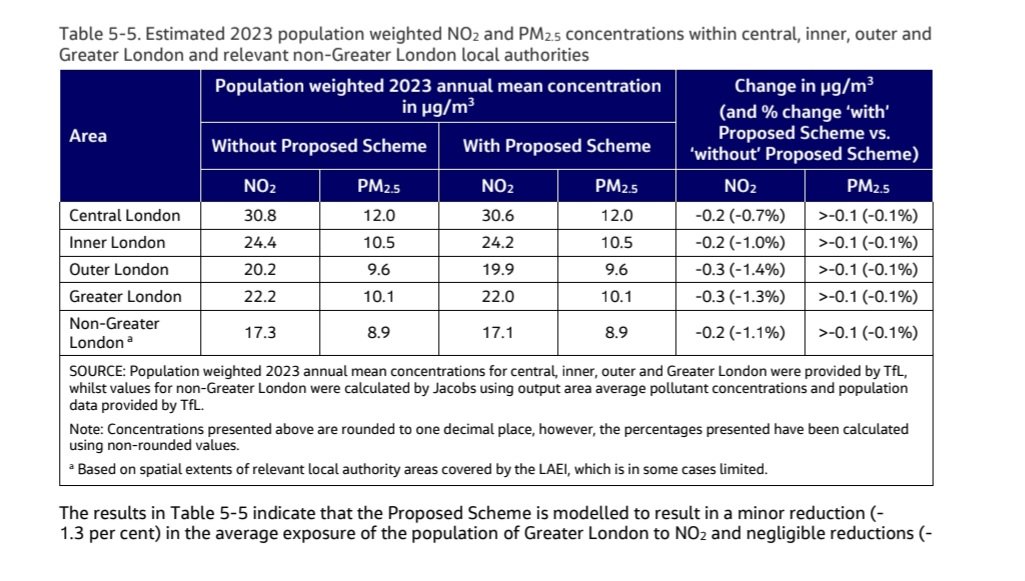
It’s predicted to only cause a 1.3% reduction in the average Londoner’s exposure to nitrogen dioxide (NO2).

And it would add just 13 minutes to the life expectancy of a Londoner in 2023, according to the Channel Four News Fact Check service.

A defiant Mr Khan insists the policy is critical to improving air quality.

An extra 13 minutes is “transformative”?

A spokesperson for the Mayor said: “The science is clear – the impact of the ULEZ expansion will be transformative.

Ulez air improvements table.

Ulez is expected to make almost no difference to air quality in London. Click to enlarge.

The ULEZ (Ultra low emission zone) charges are projected to bring in £2.5 million a day to City Hall. That’s a nice bonus for Mr Khan to be used for all kinds of pet projects to “win friends and influence people”. Ulez will also add nearly 3,000 new cameras to the streets of London and get the riff raff off the road and onto buses where they belong.

Apparently there are two convoys protesting Ulez on Sunday in London — the PetrolHeads in vintage cars are coming.

People are angry:


0 out of 10 based on 0 rating

via JoNova

https://ift.tt/Do9B2l4

September 8, 2023 at 01:37PM

Net Zero Offshore Wind

By Paul Homewood

The Government has today announced the results of the fifth auction of Contracts for Difference (CfD) subsidies for renewable electricity generation. Its has been a failure, and may represent a landmark moment for renewables policy.

Only 3.7GW of new capacity has bid successfully, mostly through small projects, as compared to nearly 12GW last year. There were no bids for offshore wind, the UK’s flagship renewable generator.
Participants in the auction bid for guaranteed prices, below a cap set by ministers in advance of the auction. The cap for offshore wind was set at £44/MWh (in 2012 prices, equivalent to around £70/MWh today). This is higher than successful bids in the past, yet no wind farm developers felt able to bid at this price. Wind industry claims that this is due to rising prices are implausible – CfD contracts are index-linked.
While offshore wind’s failure to bid may be surprising to some, perhaps even to the Government, it will come as no shock to those familiar with the long-term capital and operating cost trends for wind power, as revealed in audited financial statements. Costs have not been falling dramatically as the industry claimed. All around the world the wind industry is in trouble for the same reasons; costs remain high, and high levels of subsidy are needed to reward investors.
In addition, the latest auction round closes down the loophole that allowed windfarms to reap huge windfall profits by failing to activate their contracts so that they could benefit from higher prices in the open market.
The fact is that wind power, wherever, is an expensive way of generating energy. That isn’t surprising either; wind is a physically low-quality fuel and the cost of turning it into electricity is intrinsically high.
The previously successful low bids for offshore wind were unrealistic, a point we made at the time. Even when built, wind farms delayed taking up their contracts so they could operate on a merchant basis, taking advantage of temporarily high wholesale prices.
Importantly, the cap for onshore wind bids in this round of the CFD auction was higher than that for offshore, at £53/MWh (2012 prices). There were a substantial number of successful bids at this price, though they are all located in Scotland, where land rents are lower and where the developers can expect to make extra income through the infamous “constraint payments”, where a wind farm is paid to reduce output. (Demand in Scotland is low and the grid links to England are congested, limiting exports.) Even so, we doubt that these successful onshore bids are strongly economic.
Andrew Montford, director of Net Zero Watch, said:
"Government seems to have believed the spin about falling offshore wind costs, and set a low cap on bids for new contracts, thus calling the wind industry’s bluff by accident. Doubtless, the industry will now beg for new and higher subsidies, blaming inflation and supply chain problems. Government should not believe this spin. As global experience shows, wind power is extremely and intrinsically expensive."
Dr John Constable, energy editor of Net Zero Watch, said:
"The CfD auction results are symptomatic of a wider failure of wind power around the world. The industry is in a crisis from which it is unlikely to recover, because its costs are simply too high to be sustainable. The time has come for Government to admit that renewables have failed, and to start looking at realistic energy policies."


There’s an interesting comment in EDP:

Andrew Harston, chair of East Wind, said: "This is a difficult time for UK offshore wind developers with massively increased costs of the order of 40% in their supply chain as a result of inflation effects and the impact of higher interest rates.

The impact of interest rates is real and significant. For years they have of course been artificially ultra low, thanks to QE. That has been in effect yet another subsidy for renewable energy, paid for by savers. It can also be argued that inflation has also been ultra low until 2021, as the pandemic depressed economic activity.

Either way, that 40% would suggest costs of around £65/MWh at 2012 prices, or £80/MWh at current prices. This is at a similar level to the market price of electricity.

Given the wider system costs involved with intermittent renewables, offshore wind certainly cannot be regarded as a bargain.

This is particularly so given the historic power price has been around £50/MWh. This has risen in the last couple of years because of two factors:

1) Higher carbon prices, which feed into the price of gas-fired power. This is the direct result of govt policy, deliberately designed to force gas power out.

2) The attack by western govts and banks on new gas and oil exploration, which has restricted supply.

It is no coincidence that just today WSJ are reporting that Biden has cancelled seven Alaskan oil and gas increases, originally granted by Trump.

And what do DESNZ say about this disaster for renewable strategy:

image

https://www.gov.uk/government/news/record-number-of-renewables-projects-awarded-government-funding

It may be a record number, but they are all tiny projects. Previously CfDs were reserved for large scale ones.

Nearly half, 1.5 GW, is solar capacity, which will produce a tiny amount of power, only about 1 TWh. Worse still, it will be next to useless in winter.

FOOTNOTE

Net Zero Watch state:

In addition, the latest auction round closes down the loophole that allowed windfarms to reap huge windfall profits by failing to activate their contracts so that they could benefit from higher prices in the open market

I may be wrong, but I thought the loophole was being closed from next year’s round, AR6.

Can anybody throw some light on this?

via NOT A LOT OF PEOPLE KNOW THAT

https://ift.tt/V9CsygR

September 8, 2023 at 12:54PM

Friday Funny – JournalGate

Earlier this week you may have read this: How to Publish a High-Profile Climate Change Research Paper.It’s worse than we thought. Josh has a take on it below: Like his…

The post Friday Funny – JournalGate first appeared on Watts Up With That?.

via Watts Up With That?

https://ift.tt/u01pr2i

September 8, 2023 at 12:05PM

Manmade Climate Change Remains Unproven, Dutch, German Scientists Say

Anything but certain…

By , EIKE

Studie von CLINTEL-und EIKE-Referenten: Menschgemachter Klimawandel unbewiesen!

Source: https://ift.tt/xVJphrZ

A highly topical peer-reviewed study in the scientific magazine “climate” proves on the basis of measured data that the “man-made” climate change claimed by the media and politicians is anything but certain.

37 international scientists from different institutions statistically examined public data on the temperature development on the continents of the northern hemisphere. They specifically chose the north, since the largest part of the earth’s land mass is located here and therefore a particularly large number of values from measuring stations from many decades are available.

Among the authors are some names known to EIKE readers, such as Willie Soon, Johan Berglund, Marcel Crok, Ana G. Elias, François Gervais, Hermann Harde, Ole Humlum, Patrick Moore, Nicola Scafetta, Jan-Erik Solheim, László Szarka and Fritz Vahrenholt.

Rural vs urban

It was important for the researchers to compare data from measuring stations in rural and urban areas. The reason for this is the well-known heat island effect of settlements, which makes cities and larger villages somewhat warmer than the undeveloped surroundings.

Global Warming: Is the Covered-up Cause the Heat Island Effect?

Every inhabitant can easily understand that Built areas are basically warmer: Building facades heat up more through solar radiation than, for example, a tree or a meadow. Heaters and air conditioners generate heat deliberately or as a side effect – all this causes a higher local temperature by up to 2°C on an annual average.

This naturally raises the question for the honest scientist whether the urban heat island effect does not falsify temperature data. The question is justified, since the number of measuring stations has been drastically reduced since 1990 – and those that have been maintained are mostly located near settlements, since they are maintained from there.

Another problem: In countries like China, cities have grown enormously in recent decades, “overgrowing” previously remote locations of measuring stations. For this reason alone, thermometers at such locations are measuring a higher temperature this year.

Natural warming or industrial global warming?

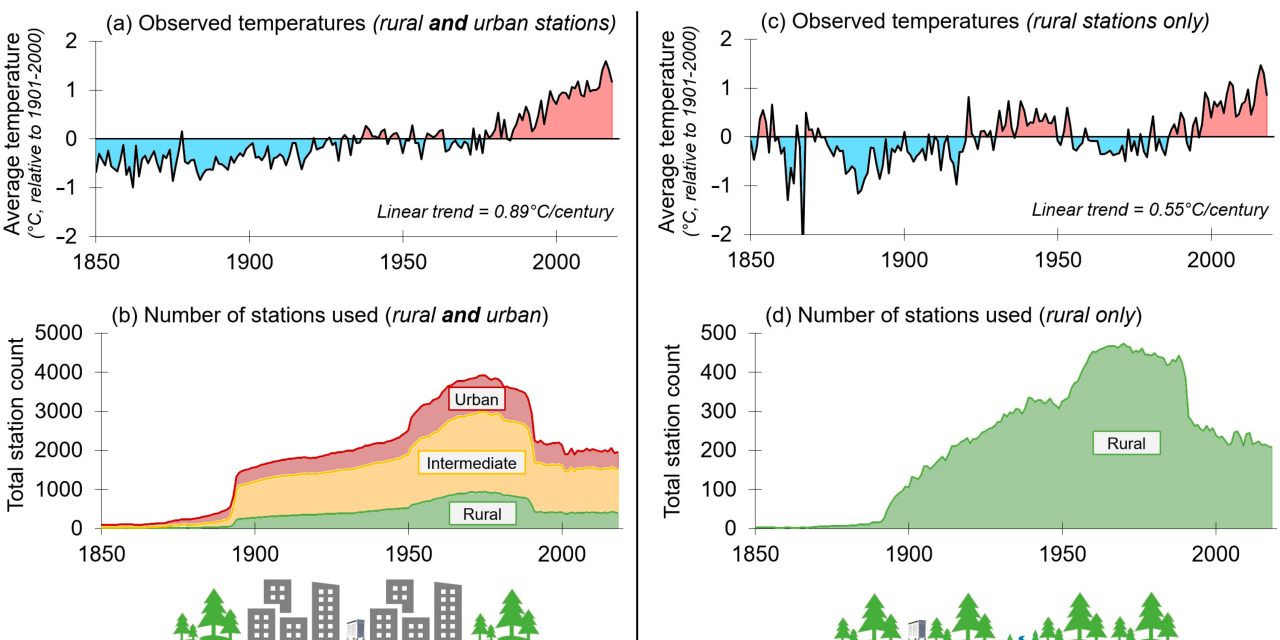
Government scientists claim that the average temperature of the earth’s atmosphere has risen since 1850 because booming industry has been blowing huge amounts of the greenhouse gas carbon dioxide into the air ever since. The “climate” study examined measurement series from 1850 to 2018 and found that the mean temperature has risen by 0.89°C per century. That’s true for mixed measurement data from settlements and the province. If one uses only values from rural areas, one obtains a warming of only 0.55°C (38% less).

Warm industrial age is good for mankind

Now, one could say that even if there is a small error in the data, CO2 still heated the world. Not at all – until 1850 the “little ice age” prevailed in the northern hemisphere, as the cooling phase lasting about 400 years is somewhat dramatically called. It is to be expected that after this long period of time it will naturally become warmer again, and this is good for people. And nothing new: The High Middle Ages and the Roman period were epochs of rich harvests and cultural flourishing.

First appearing at  AUF1 (edited)

Also see this presentation by Marcel Crok


Donate – choose an amount


via NoTricksZone

https://ift.tt/v8VUPqg

September 8, 2023 at 11:48AM