Month: September 2023

The Ill Wind of Offshore Wind Projects

The BBC reports:

A Mirage in the Wind

In the ever-evolving landscape of so-called renewable energy, offshore wind power has been lauded as a promising solution. Yet, recent revelations from the UK government’s auction process seem to further validate the skepticism surrounding these projects.

“No new offshore wind projects have been bought by developers at a key government auction, dealing a blow to the UK’s renewable power strategy. Results showed no bids for new offshore wind farms, but there were deals for solar, tidal and onshore wind projects.”

The Economics of Wind

The crux of the matter appears to be the economic viability of these offshore wind projects. Developers argue that the set price for electricity generation is simply too low to make these ventures feasible.

“Firms have argued the price set for electricity generated was too low to make offshore wind projects viable. The government said a ‘global rise’ in inflation impacting supply chains had ‘presented challenges for projects’.”

This sentiment is echoed by industry insiders who believe that the auction’s price floor failed to account for the escalating costs of developing these wind farms.

“Industry insiders told the BBC that the £44 per megawatt hour price floor set for the latest auction failed to take account of higher costs.”

Lost Opportunities and Questionable Ambitio

Keith Anderson, chief executive of Scottish Power, labeled the auction’s outcome as a “multi-billion pound lost opportunity” and a stark reminder for the government.

“He said the contracts had been ‘recognised globally as a lynchpin of the UK’s offshore success’, but said ‘the economics simply did not stand up this time around’.”

While the UK has been a frontrunner in offshore wind, with some of the world’s largest farms, the recent auction results cast a shadow over its future prospects.

“The UK is a world leader in offshore wind and is home to the world’s four largest farms, supporting tens of thousands of jobs, which provided 13.8% of the UK’s electricity generation last year, according to government statistics.”

A Stain on Renewable Energy’s Image

While many activists and politicians continue to push for renewable energy, this recent debacle serves as a stark reminder of the inefficiencies and pitfalls associated with offshore wind power. The very need for such emissions reduction strategies, especially through wind power, remains questionable at best.

“Officials in the regions pushing for renewable energy say they are worried that the bribery scandal hurts the image of renewables when the energy needs to be further promoted.”

We’ve seen evidence of multiple cracks in the offshore wind industry lately:

In Conclusion

As the world grapples with the complexities of energy sources, it’s essential to critically evaluate the true benefits and costs associated with each. The recent auction results in the UK serve as a testament to the inherent challenges with offshore wind power and the misguided ambitions surrounding it. It’s high time to demand transparency, accountability, and a genuine reevaluation of the so-called benefits of wind energy.

H/T peta of newark, Dave A

via Watts Up With That?

https://ift.tt/mztoJxi

September 9, 2023 at 12:06AM

Saturday

0 out of 10 based on 0 rating

via JoNova

https://ift.tt/srdpViu

September 8, 2023 at 10:00PM

Wrong, LA Times, There is No Evidence ‘Climate Change Boosts Risk of Explosive Wildfire Growth in California’

From ClimateREALISM

By Anthony Watts

An article in The Los Angeles Times (LA Times) published on September 4, 2023 makes the claim that a study by a Berkeley think tank proves “Climate change has ratcheted up the risk of explosive wildfire growth in California by 25%.” This is false. The study ignores other more important factors, and real-world data shows the moisture in the regions of California most affected by wildfires has actually increased, rather than decreased as the study claims.

The LA Times cites a Nature study titled “Climate warming increases extreme daily wildfire growth risk in California.” In the abstract of the paper the authors make an important admission: “Some portion of the change in wildfire behavior is attributable to anthropogenic climate warming, but formally quantifying this contribution is difficult because of numerous confounding factors and because wildfires are below the grid scale of global climate models.”

They also say: “We find that the influence of anthropogenic warming on the risk of extreme daily wildfire growth varies appreciably on a fire-by-fire and day-by-day basis, depending on whether or not climate warming pushes conditions over certain thresholds of aridity, such as 1.5 kPa of vapor-pressure deficit and 10% dead fuel moisture.”

The study fails on these two points because later in the study they cite global climate models using Artificial Intelligence (AI) to tease out relationships that can’t be accounted for in the grid-scale climate models to produce predictions. Models, and especially AI enhanced results are not actual data – they are projections based on the assumptions built into the models and the AI.

The models fail to account for the myriad confounding factors the authors themselves previously acknowledged, such as the increase in arson caused wildfires. In fact, the word “arson” is not mentioned anywhere in the study nor is there any detailed discussion of the actual contributions to increased wildfires of the so-called “confounding factors” in the study.

Ironically, the answer lies in an LA Times article from 2021 which stated: “Electrical equipment accounted for about 12% and lightning 6%. But arson was also a factor, sparking about 9% of fires in 2019, and roughly 8% to 10% of the state’s wildfires in any given year.”

The authors also ignored a 2017 study in the Proceedings of the National Academy of Science (PNAS) which looked at actual data instead of computer models and concluded that in the United States, humans accounted for 84% of wildfires:

Our analysis of two decades of government agency wildfire records highlights the fundamental role of human ignitions. Human-started wildfires accounted for 84% of all wildfires, tripled the length of the fire season, dominated an area seven times greater than that affected by lightning fires, and were responsible for nearly half of all area burned.

A second problematic aspect of the study relates to their use of, “vapor-pressure deficit and 10% dead fuel moisture.” Leaving aside the study’s use of AI enhanced modeling to sift for correlations between small scale moisture changes and wildfire, the researchers also used a novel and little-known approach to link the so-called drought and heat to fossil fuel emissions: Vapor Pressure Deficit (VPD). The VPD is similar to, but not the same as, the more commonly known relative humidity seen in daily weather reports.  In layman’s terms, VPD measures how much water is in the air versus the maximum amount of water vapor that can exist in that air. This atmospheric metric is hardly ever used. Climate Realism has refuted the use of VPD to understand drought and wildfire previously.

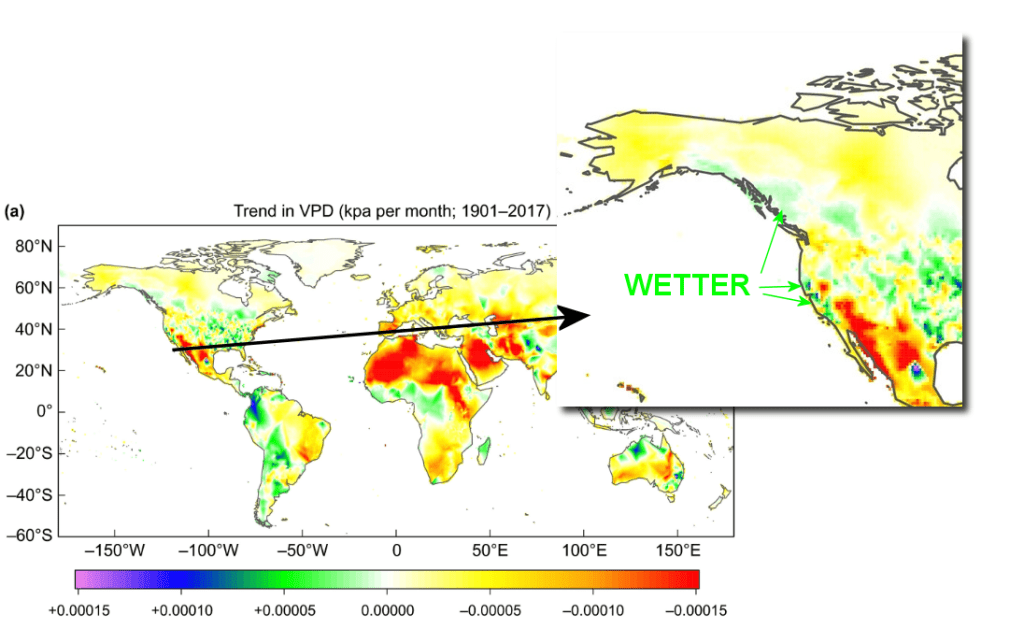
Most egregious of all, the Nature study itself ignored actual published data about VPD drying. The 2020 paper, Plant responses to rising vapor pressure deficit, examines actual data for the western U.S., specifically in the mountains of California, and shows VPD has decreased, indicating more moisture. These areas show VPD values that indicate more moisture, rather than less, and completely contradict the claims of drying made in the Nature study. This is seen in Figure 1 below, with both the U.S. and an expanded magnified panel showing the western area of the study. The green colors indicate wetter conditions.

Figure 1 – Figure 1A from the paper Plant responses to rising vapor pressure deficit, magnified and annotated by A. Watts to show the Western U.S. and Canada regions cited in the Nature paper. Green areas in California and Western Canada indicate wetter conditions, yet these are areas where the biggest wildfires occurred.

Not only are the authors of the Nature study ignoring the easily available and contradictory VPD evidence in their paper, but they also used global scale climate models to support their assertion that climate change induced VPD deficits are driving wildfires in California, while at the same time admitting the models aren’t suitable for purpose at that scale. Instead, they use AI to tease out fire projections they believe are there but really aren’t.

This is a classic example of the overreliance on models (and now AI) in climate research, instead of actual data. Models are not data, nor do they define reality as actual data does. It is shameful that science and the LA Times present model outputs as such.

Anthony Watts

Anthony Watts is a senior fellow for environment and climate at The Heartland Institute. Watts has been in the weather business both in front of, and behind the camera as an on-air television meteorologist since 1978, and currently does daily radio forecasts. He has created weather graphics presentation systems for television, specialized weather instrumentation, as well as co-authored peer-reviewed papers on climate issues. He operates the most viewed website in the world on climate, the award-winning website wattsupwiththat.com.

via Watts Up With That?

https://ift.tt/HBTPk8V

September 8, 2023 at 07:43PM

The Elites Directing The Energy Transition Really Have No Idea What They Are Doing

From the MANHATTAN CONTRARIAN

Francis Menton

We are on our way to Net Zero by 2050. It must be true because everybody says so. The entire $6+ trillion per year federal government is committed to the project, which obviously would not be the case if the whole thing were impossible. Equally fully committed are essentially all of the colleges and universities, where all of the smartest people are to be found. As well as every other elite institution of every kind and sort.

Take the World Economic Forum. If there is a number one elitest among all elite institutions, this has to be it. At their annual confab in Davos, Switzerland, they gather the greatest of geniuses to instruct the very top government and business leaders how to run the world. Would you like to go? It will cost you $52,000 to join the organization, and then an additional $19,000 to attend the conference. Chartering a private jet to get you there will cost a few more thousand. Once there, you can hear the very smartest people imparting their thoughts on the most important topics of the day, like “The Great Reset,” “Emerging Technologies,” “Diversity and Inclusions,” and, of course, “The Net Zero Transition.”

Is it possible that these people are completely incompetent and have no idea what they are doing?

A reader has sent me the very latest from the WEF on how the world is going to get to Net Zero. The piece has a date of September 5, 2023, and is titled “How battery energy storage can power us to Net Zero.” The authors are three people from the World Bank, with the lead author being one Amit Jain, who is the Bank’s Energy Storage Program Lead. This is the guy on the receiving end of tens of billions of dollars of government money to pass out to make the energy transition happen throughout the developing world.

Now, it so happens that energy storage is something I know a little about, and in particular about the problem of trying to store enough energy to make an electrical grid work without full dispatchable backup. See my energy storage Report, dated December 1, 2022, at this link.

So let’s take a look at Jain, et al.’s, take on how battery storage will “power us to Net Zero.” First, some excited happy talk:

Across the globe, power systems are experiencing a period of unprecedented change. Low-cost renewable electricity is spreading and there is a growing urgency to boost power system resilience and enhance digitalization. This requires stockpiling renewable energy on a massive scale, notably in developing countries, which makes energy storage fundamental. . . .

Making energy storage systems mainstream in the developing world will be a game changer. Deploying battery energy storage systems will provide more comprehensive access to electricity while enabling much greater use of renewable energy, ultimately helping the world meet its Net Zero decarbonization targets. International organizations and development institutions are leading the way forward to enable this decarbonization. . . .

So OK Amit, how much storage are we talking about here?

In 2022, approximately 192GW (gigawatts) of solar and 75GW of wind were installed globally. However, only 16GW/35GWh (gigawatts per hour) of new storage systems were deployed. A recent International Energy Agencyanalysis finds that although battery energy storage systems have seen strong growth in recent years, grid-scale storage capacity still needs to be scaled up to reach Net Zero Emissions by 2050. . . . To meet our Net Zero ambitions of 2050, annual additions of grid-scale battery energy storage globally must rise to an average of 80 GW annually between now and 2030.

Holy underwear, Batman! Could this guy really not even know what units he’s talking about? Thinking his readers might not understand the abbreviation “GWh” he helpfully defines it as “gigawatts per hour”! Could he really be this clueless? And he had two co-authors to check him!

And then there’s the statement that to meet the 2050 Net Zero ambition, annual deployments of grid-scale batteries “must rise to an average of 80 GW annually.” Of course he is using the wrong units (and undoubtedly does not know that). But let’s give him the benefit of the doubt, and assume that he is talking about the standard batteries available today, which are 4 hour batteries, meaning that 80 GW would provide 320 GWh of storage. If the world would add that much capacity every year from now to 2050, that would come to 8960 GWh of storage. How have Mr. Jain et al. come to the conclusion that this 8960 GWh of storage will be enough to “meet our Net Zero ambitions of 2050”? The piece contains no quantitative analysis or backup of any kind to support the proposition that this amount of storage would be sufficient.

My own energy storage Report does contain backup and calculations, although only for certain countries rather than for the whole world. For example, for the United States, the figures cited in my Report are that it would take some 233,000 GWh of battery storage to fully back up the electrical grid, assuming current levels and patterns of usage. Since the U.S. is about 4% of world population, we can multiply that figure by 25 to get the storage requirement for the world (assuming that the world electrifies to the U.S. level by 2050). The total would be 5,825,000 GWh. In other words, Jain, et al., are off by a factor of about 650, give or take maybe a few hundred.

But it’s OK, because Jain and his colleagues have no skin in this game. They just babble some happy talk to get their hands on a few hundred billions of money from rich governments, and pass it out to build impressive-looking battery projects that are actually next to useless to provide reliable grid electricity. They can be very confident that no one in their circles will ever check the math to see if the numbers add up. When 2050 rolls around and the whole thing doesn’t work, they will be long retired on generous pensions.

via Watts Up With That?

https://ift.tt/3UlbL4s

September 8, 2023 at 04:08PM