Month: September 2023

U.S. Grid Wind Power: Free Market Failure (1940-45)

“An ‘infant industry’ wind power is not.” (Bradley, below)

“At congressional hearings in 1951 to provide increased wind-power funding … Putnam’s blade failure … played right into the hands of those committed to other forms of electrical production: fossil, atomic or solar.” (Wired, below)

The quest to make electricity from wind attracted entrepreneurs well before government mandates and subsidies got involved in the 1970s. As grid power, wind turbines were concept-proven in the 1880s (as were solar panels).

The article below in Wired (October 19, 2009), “Oct. 19, 1941: Electric Turbines Get First Wind was published with the subtitle: “The giant turbine in Vermont was the first wind machine to feed the electrical grid. And then, disaster struck.”

The description below pertains to the 1.25 MW Grandpa’s Knob wind turbine, which during World War II distributed electricity to Central Vermont Public Service Corporation. “In the course of five years of experiments, the engineers in charge concluded that the major mechanical problems had been solved and that a unit could be designed to remain safely on line in any wind,” according to the project’s architect Palmer Putman. This led the Federal Power Commission (now FERC) to estimate the potential of domestic wind power in 1945.

Read and learn: an ‘infant industry’ wind power is not.

The Wired account follows:


The giant turbine in Vermont was the first wind machine to feed the electrical grid. And then, disaster struck. The unprecedented project was built up from nothing, practically conjured, by Palmer Putnam, an MIT-trained geologist with no formal education or experience in wind power….

Before this project, windmills had just pumped water for farmers in the boonies, or charged the batteries of rural radios so they could pick up the AM stations that brought news across the lonely, whistling prairies. The people who sold windmills marketed them to ranchers and farmers; their advertisements appeared in magazines like American Thresherman, Farm Power, Agricultural Technology and Successful Farming.

The American windmill, as it was called, was simple and Western and rugged. Its shape hardly changed after key 1880s experiments by Thomas Perry resulted in the founding of the Aermotor company, which dominated the industry thereafter. But that’s not the kind of turbine that Putnam had in mind. After looking into the designs of the past, he immediately decided that the economics of scale dictated that he build a wind turbine with 75-foot blades, the largest in the world. It would generate more than a megawatt of power and feed it on to the grid, working in tandem with a hydroelectric plant to even out the intermittency of the wind and the seasonality of water generation.

No one had ever pulled off that balancing act before, and most people working in the wind industry were probably too sane to try…. The strange thing is: Putnam succeeded. “Vermont’s mountain winds were harnessed last week to generate electricity for its homes and factories,” read the Sept. 8, 1941, issue of Time, jumping the gun a bit. “Slowly, like the movements of an awakening giant, two stainless-steel vanes — the size and shape of a bomber’s wings — began to rotate.”

The turbine ran through hundreds of hours of testing up to 1943, often pumping power onto the Central Vermont Public Service Corporation’s electrical grid. The project’s engineers were sure that, technically, the machine worked.

The Smith-Putnam wind turbine stood as a testament to the power of human — and American — ingenuity. A decade before, Soviet engineers had built the world’s largest wind turbine, a 100-kilowatt machine. Now the Yanks had constructed their own, 10 times more powerful.

Time concluded its article on the project with a hopeful half-prediction, “New England ranges may someday rival Holland as a land of windmills.” This was, after all, merely the prototype for whole lines of turbines that would be more resistant to German bombs than a centralized coal plant.

Unluckily, a bearing broke in 1943, and the war prevented its replacement until 1945. With the war waning, the wind machine got back up and running in the spring of that year. And that’s when disaster struck.

At midnight on March 26, 1945, the wind was blowing at a sleepy 5 miles an hour, too slow to make electricity. Harold Perry, a construction foreman, had been working nonstop for the 23 grueling days since the renewable power plant had gone back online after repairs. That night, an elevator carried Perry 100 feet up through the oil-derrick–like tower to the small, armored building that housed the controls for the world’s largest wind machine. Atop the rural Vermont mountaintop known as Grandpa’s Knob, Perry didn’t know that the grandest wind experiment in the first few millennia of human existence was about to fail….

At exactly 3:10 a.m. on March 26, 1945, after more than 1,100 hours of operation, the Smith-Putnam turbine experienced an epic failure. One of the turbine’s blades broke clean off and went sailing 750 feet through the night. The force of the breaking blade threw Perry off his feet, as the unbalanced machine shook like the bridge of the Starship Enterprise when it’s under attack…. What went wrong is as obvious as a 75-foot blade lying on the ground. The existence and failure of the turbine hurt renewable-energy advocates in political debates, too.

At congressional hearings in 1951 to provide increased wind-power funding, one historian notes, “[L]egislators considered Putnam’s blade failure to have proved the whole endeavor a washout.” The machine’s failure played right into the hands of those committed to other forms of electrical production: fossil, atomic or solar….

But the turbine wasn’t a failure for the thousands of wind engineers who’ve come after Putnam. “Interest in developing large wind-electric generating systems in the United States was stimulated primarily by one man, Palmer C. Putnam,” a crisis-induced 1973 NASA research report on alternative energy found.

… the S. Morgan Smith Company, which had bankrolled the project, assigned their patents to the public domain and asked Putnam to write a book detailing what happened, so that others could continue the work. They made the wind data they’d gathered from the region public. This turns out to have been immensely helpful to later generations. Without the unique experiment, nothing would have been known about large-scale systems. Less data means more risk — and risk is expensive in big power-plant projects. By gathering data on what did and didn’t work, Putnam saved time and money for subsequent researchers….

Despite Putnam’s initial hopes, his turbine was never rebuilt, nor any more on its exact model. Within six months of the catastrophic blade failure, the S. Morgan Smith Company shut down its wind program. They pulled the plug instead of plunking down the additional $300,000 that Putnam needed. The blade was carted off, the turbine torn down. A cellphone tower now adorns Grandpa’s Knob. Only the foundation of the great wind machine remains.

——————

Note: For more information on Grandpa’s Knob, see Palmer Putnam, Power from the Wind (New York: Van Nostrand Reinhold Company, 1948) and Putnam. Energy for the Future (New York: Van Nostrand Reinhold, 1953), pp. 188–191, 243–244.

The post U.S. Grid Wind Power: Free Market Failure (1940-45) appeared first on Master Resource.

via Master Resource

https://ift.tt/xuNrzSG

September 6, 2023 at 01:05AM

How to Publish a High-Profile Climate Change Research Paper

[In addition to the article I noted earlier today in The Free Press by Patrick Brown, Brown also wrote a post on his blog about his story~cr]

Roger Caiazza

Regular readers of Watts Up With That have noticed that there aren’t many articles in high-profile journals that suggest there are any issues with the narrative that climate change impacts are pervasive and catastrophic. On his blog, Patrick T. Brown explains that “There is a formula for publishing climate change impacts research in the most prestigious and widely-read scientific journals. Following it brings professional success, but it comes at a cost to society.”  His formula explains part of the reason we see so little skeptical research in those journals.

Background

Patrick T. Brown is a Ph.D. climate scientist. He is a Co-Director of the Climate and Energy Team at The Breakthrough Institute and is an adjunct faculty member (lecturer) in the Energy Policy and Climate Program at Johns Hopkins University. 

This month, he published a lead-author research paper in Nature on changes in extreme wildfire behavior under climate change. This is his third publication in Nature to go along with another in Nature’s climate-focused journal Nature Climate Change. He notes that “because Nature is one of the world’s most prestigious and visible scientific journals, getting published there is highly competitive, and it can significantly advance a researcher’s career.” 

His article is based on this publication experience, as well as through various failures to get research published in these journals.  He explains:

I have learned that there is a formula for success which I enumerate below in a four-item checklist. Unfortunately, the formula is more about shaping your research in specific ways to support pre-approved narratives than it is about generating useful knowledge for society.

Formula for Publishing Climate Changes Impact Research

Before describing his approach to get research published, he describes what is needed for useful scientific research.  He says:

It should prize curiosity, dispassionate objectivity, commitment to uncovering the truth, and practicality. However, scientific research is carried out by people, and people tend to subconsciously prioritize more immediate personal goals tied to meaning, status, and professional advancement. Aligning the personal incentives that researchers face with the production of the most valuable information for society is critical for the public to get what it deserves from the research that they largely fund, but the current reality falls far short of this ideal.

Brown explains that the “publish or perish” mentality in academic research is necessary.  In addition, it also matters “which journals you publish in”.  It turns out a “researcher’s career depends on their work being widely known and perceived as important.”  Because there is so much competition now it has become more important to publish in the highly regarded journals”  “while there has always been a tremendous premium placed on publishing in the most high-profile scientific journals – namely Nature and its rival Science – this has never been more true.”  As a result, “savvy researchers will tailor their studies to maximize their likelihood of being accepted.”  In his article he explains just how he did it.

First, he offers general advice:

My overarching advice for getting climate change impacts research published in a high-profile journal is to make sure that it supports the mainstream narrative that climate change impacts are pervasive and catastrophic, and the primary way to deal with them is not through practical adaptation measures but through policies that reduce greenhouse gas emissions. Specifically, the paper should try to check at least four boxes.

The first box to hit is that it is that “climate change impacts something of value is usually sufficient, and it is not typically necessary to show that the impact is large compared to other relevant influences.”  In order to do this there are tradeoffs:

In my recent Nature paper, we focused on the influence of climate change on extreme wildfire behavior but did not bother to quantify the influence of other obviously relevant factors like changes in human ignitions or the effect of poor forest management. I knew that considering these factors would make for a more realistic and useful analysis, but I also knew that it would muddy the waters and thus make the research more difficult to publish.

This type of framing, where the influence of climate change is unrealistically considered in isolation, is the norm for high-profile research papers. For example, in another recent influential Nature paper, they calculated that the two largest climate change impacts on society are deaths related to extreme heat and damage to agriculture. However, that paper does not mention that climate change is not the dominant driver for either one of these impacts: temperature-related deaths have been declining, and agricultural yields have been increasing for decades despite climate change.

The second box is to avoid discussion of anything that could reduce the impact of climate change:

This brings me to the second component of the formula, which is to ignore or at least downplay near-term practical actions that can negate the impact of climate change. If deaths related to outdoor temperatures are decreasing and agricultural yields are increasing, then it stands to reason that we can overcome some major negative effects of climate change. It is then valuable to study how we have been able to achieve success so that we can facilitate more of it. However, there is a strong taboo against studying or even mentioning successes since they are thought to undermine the motivation for emissions reductions. Identifying and focusing on problems rather than studying the effectiveness of solutions makes for more compelling abstracts that can be turned into headlines, but it is a major reason why high-profile research is not as useful to society as it could be.

His third component is to focus the presentation on alarm:

A third element of a high-profile climate change research paper is to focus on metrics that are not necessarily the most illuminating or relevant but rather are specifically designed to generate impressive numbers. In the case of our paper, we followed the common convention of focusing on changes in the risk of extreme wildfire events rather than simpler and more intuitive metrics like changes in the amount of acres burned. The sacrifice of clarity for the sake of more impressive numbers was probably necessary for it to get into Nature

Another related convention, which we also followed in our paper, is to report results corresponding to time periods that are not necessarily relevant to society but, again, get you the large numbers that justify the importance of your research. For example, it is standard practice to report societal climate change impacts associated with how much warming has occurred since the industrial revolution but to ignore or “hold constant” societal changes over that time. This makes little sense from a practical standpoint since societal changes have been much larger than climate changes since the 1800s. Similarly, it is conventional to report projections associated with distant future warming scenarios now thought to be implausible while ignoring potential changes in technology and resilience.

The good news is that Brown has transitioned out of a tenure-track academic position to one that does not require high-impact publications.  He explains a better approach than what is necessary to publish there:

A much more useful analysis for informing adaptation decisions would focus on changes in climate from the recent past that living people have actually experienced to the foreseeable future – the next several decades – while accounting for changes in technology and resilience. In the case of my recent Nature paper, this would mean considering the impact of climate change in conjunction with proposed reforms to forest management practices over the next several decades (research we are conducting now). This more practical kind of analysis is discouraged, however, because looking at changes in impacts over shorter time periods and in the context of other relevant factors reduces the calculated magnitude of the impact of climate change, and thus it appears to weaken the case for greenhouse gas emissions reductions. 

The final key to publication is presentation:

The final and perhaps most insidious element of producing a high-profile scientific research paper has to do with the clean, concise format of the presentation. These papers are required to be short, with only a few graphics, and thus there is little room for discussion of complicating factors or contradictory evidence. Furthermore, such discussions will weaken the argument that the findings deserve the high-profile venue. This incentivizes researchers to assemble and promote only the strongest evidence in favor of the case they are making. The data may be messy and contradictory, but that messiness has to be downplayed and the data shoehorned into a neat compelling story. This encouragement of confirmation bias is, of course, completely contradictory to the spirit of objective truth-seeking that many imagine animates the scientific enterprise.

Brown explains that despite the allowances he had to make to get it his work published there still is value in it:

All this is not to say that I think my recent Nature paper is useless. On the contrary, I do think it advances our understanding of climate change’s role in day-to-day wildfire behavior. It’s just that the process of customizing the research for a high-profile journal caused it to be less useful than it could have been. I am now conducting the version of this research that I believe adds much more practical value for real-world decisions. This entails using more straightforward metrics over more relevant timeframes to quantify the impact of climate change on wildfire behavior in the context of other important influences like changes in human ignition patterns and changes in forest management practices.

Brown explains his motivations and his new plans:

But why did I follow the formula for producing a high-profile scientific research paper if I don’t believe it creates the most useful knowledge for society? I did it because I began this research as a new assistant professor facing pressure to establish myself in a new field and to maximize my prospects of securing respect from my peers, future funding, tenure, and ultimately a successful career. When I had previously attempted to deviate from the formula I outlined here, my papers were promptly rejected out of hand by the editors of high-profile journals without even going to peer review. Thus, I sacrificed value added for society in order to for the research to be compatible with the preferred narratives of the editors.

I have now transitioned out of a tenure-track academic position, and I feel liberated to direct my research toward questions that I think are more useful for society, even if they won’t make for clean stories that are published in high-profile venues. Stepping outside of the academy also removes the reservations I had to call out the perverse incentives facing scientific researchers because I no longer have to worry about the possibility of burning bridges and ruining my chances of ever publishing in a Nature journal again.

Brown concludes:

So what can shift the research landscape towards a more honest and useful treatment of climate change impacts? A good place to start would be for the editors of high-profile scientific journals to widen the scope of what is eligible for their stamp of approval and embrace their ostensible policies that encourage out-of-the-box thinking that challenges conventional wisdom. If they can open the door to research that places the impacts of climate change in the appropriate context, uses the most relevant metrics, gives serious treatment to societal changes in resilience, and is more honest about contradictory evidence, a wider array of valuable research will be published, and the career goals of researchers will be better aligned with the production of the most useful decision support for society.

—————————————————————————————————————————————

Roger Caiazza blogs on New York energy and environmental issues at Pragmatic Environmentalist of New York.  This represents his opinion and not the opinion of any of his previous employers or any other company with which he has been associated.

via Watts Up With That?

https://ift.tt/SN34kiR

September 6, 2023 at 12:04AM

UAH Global Temperature Update for August, 2023: +0.69 deg. C

From Dr. Roy Spencer’s Global Warming Blog

September 4th, 2023 by Roy W. Spencer, Ph. D.

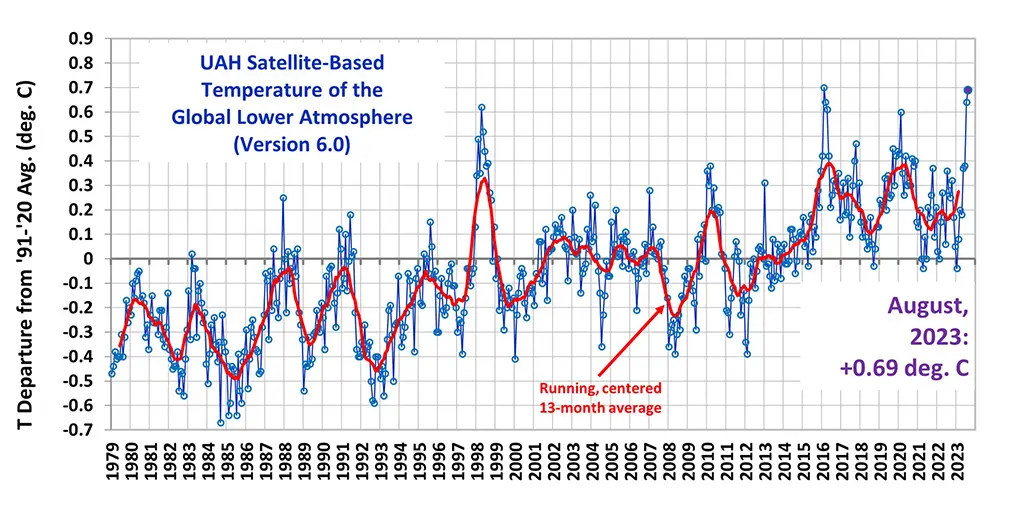
The Version 6 global average lower tropospheric temperature (LT) anomaly for August 2023 was +0.69 deg. C departure from the 1991-2020 mean. This is a little above the July 2023 anomaly of +0.64 deg. C.

UAH_LT_1979_thru_August_2023_v6_20x9 copyUAH_LT_1979_thru_August_2023_v6_20x9 copyUAH_LT_1979_thru_August_2023_v6_20x9 copy
UAH_LT_1979_thru_August_2023_v6_20x9 copy

The linear warming trend since January, 1979 now stands at +0.14 C/decade (+0.12 C/decade over the global-averaged oceans, and +0.19 C/decade over global-averaged land).

Various regional LT departures from the 30-year (1991-2020) average for the last 20 months are:

YEAR MO GLOBE NHEM. SHEM. TROPIC USA48 ARCTIC AUST
2022 Jan +0.03 +0.06 -0.00 -0.23 -0.12 +0.68 +0.10
2022 Feb -0.00 +0.01 -0.01 -0.24 -0.04 -0.30 -0.50
2022 Mar +0.15 +0.28 +0.03 -0.07 +0.22 +0.74 +0.02
2022 Apr +0.27 +0.35 +0.18 -0.04 -0.25 +0.45 +0.61
2022 May +0.17 +0.25 +0.10 +0.01 +0.60 +0.23 +0.20
2022 Jun +0.06 +0.08 +0.05 -0.36 +0.46 +0.33 +0.11
2022 Jul +0.36 +0.37 +0.35 +0.13 +0.84 +0.56 +0.65
2022 Aug +0.28 +0.32 +0.24 -0.03 +0.60 +0.50 -0.00
2022 Sep +0.24 +0.43 +0.06 +0.03 +0.88 +0.69 -0.28
2022 Oct +0.32 +0.43 +0.21 +0.04 +0.16 +0.93 +0.04
2022 Nov +0.17 +0.21 +0.13 -0.16 -0.51 +0.51 -0.56
2022 Dec +0.05 +0.13 -0.03 -0.35 -0.21 +0.80 -0.38
2023 Jan -0.04 +0.05 -0.14 -0.38 +0.12 -0.12 -0.50
2023 Feb +0.08 +0.17 0.00 -0.11 +0.68 -0.24 -0.12
2023 Mar +0.20 +0.24 +0.16 -0.13 -1.44 +0.17 +0.40
2023 Apr +0.18 +0.11 +0.25 -0.03 -0.38 +0.53 +0.21
2023 May +0.37 +0.30 +0.44 +0.39 +0.57 +0.66 -0.09
2023 June +0.38 +0.47 +0.29 +0.55 -0.35 +0.45 +0.06
2023 July +0.64 +0.73 +0.56 +0.87 +0.53 +0.91 +1.43
2023 Aug +0.69 +0.88 +0.51 +0.86 +0.94 +1.54 +1.25

The full UAH Global Temperature Report, along with the LT global gridpoint anomaly image for August, 2023 and a more detailed analysis by John Christy of the unusual July conditions, should be available within the next several days here.

Lower Troposphere:

http://vortex.nsstc.uah.edu/data/msu/v6.0/tlt/uahncdc_lt_6.0.txt

Mid-Troposphere:

http://vortex.nsstc.uah.edu/data/msu/v6.0/tmt/uahncdc_mt_6.0.txt

Tropopause:

http://vortex.nsstc.uah.edu/data/msu/v6.0/ttp/uahncdc_tp_6.0.txt

Lower Stratosphere:

http://vortex.nsstc.uah.edu/data/msu/v6.0/tls/uahncdc_ls_6.0.txt

via Watts Up With That?

https://ift.tt/qrhXwT9

September 5, 2023 at 08:02PM

Seditious Conspiracy

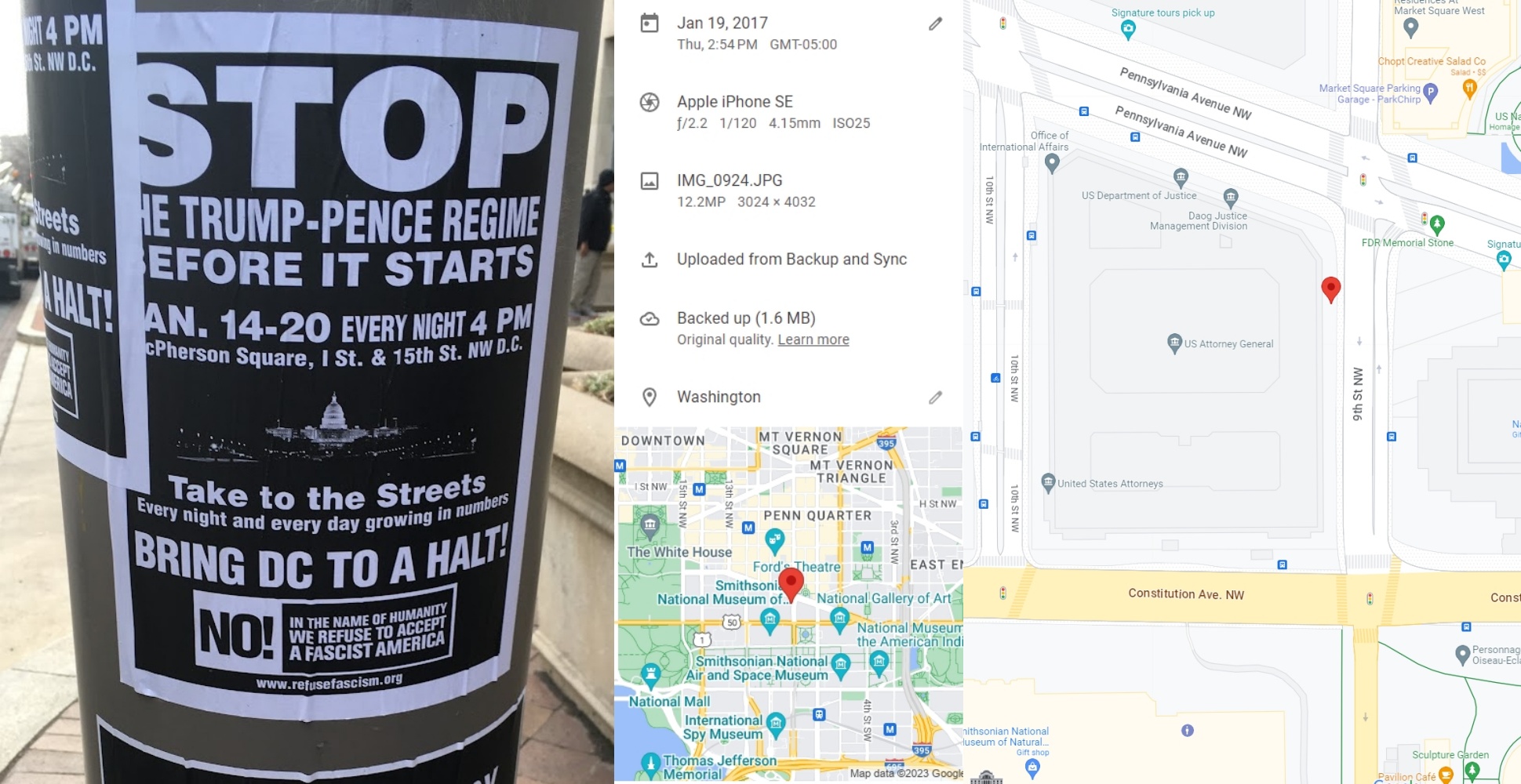
I took this picture of seditious conspiracy against Donald Trump on the last day of the Obama/Biden presidency, outside the office of the Attorney General.

via Real Climate Science

https://ift.tt/Nng526t

September 5, 2023 at 07:27PM