
20,000 young people to be deployed to save the planet!
The post Biden dusts off the old Climate Corps fantasy appeared first on CFACT.
via CFACT
September 26, 2023 at 03:41AM
20,000 young people to be deployed to save the planet!
The post Biden dusts off the old Climate Corps fantasy appeared first on CFACT.
via CFACT
September 26, 2023 at 03:41AM
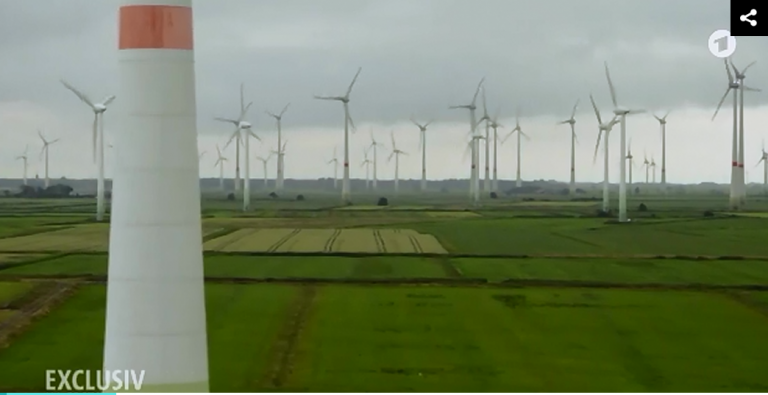
As wind and solar capacity increases, Germany’s once thriving economy shrinks. And it’s the sudden and dramatic collapse in German industrial output that’s allowed the wind and sun cult to cry ‘victory’ with a claim – based on a statistical fudge – that Germany obtained 50% of its power from ‘renewable’ sources. Sitting behind the hyperbole is the fact that the bulk of what was generated by so-called ‘renewables’ came from ‘biomass’ ie wood stripped from Germany’s shrinking woods.
The other reason for Germany breaking 50% ‘renewable’ energy barrier, is down to the fact that its declining economy means less demand for electricity, overall.
Already suffering Europe’s highest power prices – with worse to come – German households and businesses are unlikely to increase their power use, anytime soon. Plenty of German businesses like BASF, Wacker and Siltronic – have fled in search of cheap energy, pitching up in places like Singapore and the USA, a process that began over a decade ago.
Francis Menton takes a look at the truth behind the numbers.
Congratulations To Germany On Achieving More Than 50% Of Its Electricity Production From “Renewables”!
Manhattan Contrarian
Francis Menton
29 August 2023
On the march to Net Zero carbon emissions from usage of energy, the key first step is to eliminate fossil fuels from the generation of electricity, replacing them with the magical “renewables.” Or so we are told. Once electricity generation is fossil fuel-free, then all energy use can be switched to electricity, without any of the evil emissions. Voilà — Net Zero!
But somehow, in the places that have tried to go this route with wind turbines and solar panels, the push to get more electricity generation from “renewables” has seemed to stall out at around 40 – 45%. (Some small countries with lots of hydropower get higher percentages by counting the hydropower as “renewable.”). Countries may build more and more solar panels and wind turbines, but somewhere in the 40s the percentage that those things contribute to electricity generation just doesn’t seem to budge very much any more.
And that’s why it’s so exciting that in the first half of 2023 Germany finally crashed through the 50% barrier, becoming the first significant country with little hydropower to achieve more than half of its electricity generation from “renewables.” With a simple internet search, you can find large numbers of news sources relaying the great news.
For a few examples, here are Reuters, June 27 (“Renewable share of German power use climbs to 52.3% in first half”); Fraunhofer, July 3 (“German Net Power Generation in First Half of 2023: Record Renewable Energy Share of 57.7 Percent”); Clean Energy Wire, June 27 (“Renewables covered more than half of German electricity consumption in first half of 2023”); and Solar Quarter, July 5 (“Germany Achieves Record 57.7% Renewable Energy Share in Net Power Generation for First Half of 2023”). Why the exact percentages vary a little from article to article, I cannot explain; but they are all at least a little in excess of the key 50% figure.
So this is surely Germany continuing to lead the way to the green energy transition. Certainly, Germany has only accelerated its pursuit of the idea that the route to Net Zero is the building of more and yet more solar panels and wind turbines. A site called Renewable-Energy-Industry.com compiles data on additions to Germany’s wind and solar generation capacity just in the first half of 2023: “Record Additions in Germany: 8,000 MW of New Wind And Solar Capacity in The First Half of 2023.”:
[S]olar energy in particular is booming in Germany. From January to June 2023 alone, around 465,000 new solar plants with 6,500 MW capacity . . . went into operation and produce electricity, more than ever before in a six-month period. . . . In the first six months of 2023, just under 350 new wind turbines with a capacity of around 1,750 MW went into operation. . . .
The addition of 8000 MW of generation capacity in just six months is a huge increment in a country where peak electricity usage is less than 85,000 MW (or 85 GW).
So are these large additions to capacity what has succeeded in pushing Germany over the 50% threshold? Unfortunately, if you read deep into the Reuters piece linked above, you will start to get a very different understanding. It turns out that Germany’s percentage of electricity from renewables increased not because the production of electricity from renewables increased, but rather because Germany’s economy is shrinking. After decades of effort and hundreds of billions of dollars of subsidies and greatly increased consumer electricity prices, the contribution of wind and solar energy in Germany’s economy remains almost insignificant.
Despite all its new solar and wind facilities, Germany’s production of electricity from those sources has lately been going down rather than up. Here is the story for the first half of 2023) (from the Reuters piece linked above:
Renewables, at 137.5 TWh, represented 51.7% of total output, up from 46.4% in first half 2022, even as green power production volumes decreased by 0.6%.
The 137.5 TWh of electricity that Germany’s “renewable” facilities produced in the first half of 2023 is a pitiful percentage of their supposed theoretical capacity. A chart at Clean Energy Wire here gives Germany’s generation capacity of solar, plus onshore and offshore wind as 130.8 GW as of 2022. (In a country with only about 85 GW of peak usage!). Add the new 8 GW of capacity added in the first half of 2023, and you would have 138.8 GW of wind and solar capacity, or 602.9 TWh hours of capacity (138.8 x 24 x 181) for the 181 days in January to June 2023. That would mean that the wind and solar facilities combined produced at a rate of only 22.8% of capacity over that period.
So if production of electricity from “renewables” actually decreased, how could the percentage of electricity production from the “renewables” have increased from 46.4% to 51.7% of the total? Easy — the production from all other sources (fossil fuels and nuclear) went down dramatically:
Conventional energy sources – nuclear, coal, natural gas and oil – provided 128.4 TWh of output, down from 160.0 TWh a year earlier.
They ran the conventional generators less because the demand for electricity was not there:
The fall in conventional production reflected the phase-out of nuclear energy by mid-April and operators cutting output to match weak demand.
The change from 160.0 TWh to 128.4 TWh from conventional sources would be a 19.75% decline. That’s rather enormous in one year. Now, how could it be that Germany is experiencing that kind of a huge decline in the demand for electricity? You might check out the big front page article from today’s Wall Street Journal, “Germany’s Shrinking Economy Sparks a Struggle for Solutions.” (different headline online). The world leader in the supposed “green energy transition” turns out also to be in the unique position of having an economy that is shrinking, and not by a little:
Germany will be the world’s only major economy to contract in 2023, with even sanctioned Russia experiencing growth, according to the International Monetary Fund.
The WSJ piece goes into a variety of factors that may be contributing to the shrinking economy. But self-inflicted high energy prices turn up again and again:
Energy costs are posing an existential challenge to sectors such as chemicals. . . . Energy prices in Europe have declined from last year’s peak as EU countries scrambled to replace Russian gas, but German industry still faces higher costs than competitors in the U.S. and Asia.
And meanwhile, with Germany’s massive investments in wind and solar electricity generation, are those sources actually making any major inroads in the overall market for primary energy in the country? Here is an extremely revealing chart, again from Clean Energy Wire, with data from 2022:

In the “renewables” category for all primary energy (not just electricity), we learn that they include “biomass” as a “renewable.” Probably, that’s mostly wood, used for heating homes, and hardly a zero carbon source. The amount of energy produced from the “biomass,” at 1,040 PJ and 8.8% of primary energy, far exceeds the combined total from wind and solar (713 PJ and 6.0% of primary energy).
The whole “more than 50% from renewables” mantra turns out only to apply to electricity (far less than half of primary energy usage). And rather than representing the advance of the mythical wind and solar, the whole thing is just an artifact of a shrinking economy, largely itself caused by the destructive build-out of the wind and solar facilities. They are destroying their economy, and have almost nothing to show for two decades and hundreds of billions of dollars invested in the useless wind and solar farms.
Manhattan Contrarian

via STOP THESE THINGS
September 26, 2023 at 02:35AM
Last week there was a television programme that I especially wanted to see; a programme that, if the past was any indication, most commentators at this site would have deliberately dodged. The programme was Chris Packham, is it time to break the law? You will have missed something good and worthwhile. It gave a chance to evaluate a potential major opponent.
I was also interested in the programme because I had watched and, via Open Mic had strongly recommended watching, Chis Packham’s series Earth. This clearly established his ability to step into Attenborough’s shoes as a leading television personality with a mission to support wildlife and climate change. Also a potential major adversary of anything vaguely critical of catastrophic climate advocacy.
The programme fully lived up to my expectations. Packham came across as a dedicated advocate, someone very genuine (if misguided). His thesis was that for his entire life he had supported wildlife and warned about climate change. He was now discouraged because of a lack of any real response and was pondering engaging with groups (like Just Stop Oil or Extinction Rebellion) that conducted quasi-legal (like slow walking and holding up traffic) or even illegal acts. Packham agonised over this conundrum, seeking advice here, there, and everywhere. He got all sorts of advice ranging from don’t break the law (from Lord Deben) to sabotaging oil pipelines. He tried to interview relevant Tory Ministers but to no avail. In the end Packham stated that he had come to believe that those who broke the law were engaged in laudable actions and that, after much reflection, he personally could break the law in support of climate change protests.
A fascinating and I believe very honest treatment of most of the entire subject. Personally I don’t believe he covered the rights of the general public to be free of public nuisance with sufficient detail. Also there was the nagging doubt as to whether Packham and the programme makers were engaged in incitement. It was noticeable that when the list of credits at the end of the programme rolled it was headed by their legal advisor.
So why am I suggesting you might benefit from seeking out the programme and viewing it? Well, I believe there has been a tendency to view those supporting climate catastrophe as not deserving our full efforts. They are treated as lacking in reason or knowledge. Packham stands as an example of those we so dismiss at our peril. He comes across as entirely honest, committed and knowledgeable, someone who cannot easily be dismissed and also one who will gather support. His only fault in the programme IMHO was to summarily dismiss Peter Lilley’s arguments regarding forest fires, waving his hands as he maintained that so much evidence (never given) supported the view that climate change was causing them to increase this year.
I found the programme fascinating and well worth spending the hour spent watching it. It also generated much discussion afterwards with “she who must be listened to”. We failed to agree upon a fundamental question: if you were convinced that climate change was a realistic threat, is it legitimate to break the law to support action to counteract it? I was jail-bait, my wife would promise to visit me.
via Climate Scepticism
September 26, 2023 at 02:27AM
The article liked below is a real tour de force which states the real state of where climate policies are leading us. This section gives a flavour of it:
"The promises of upsides are simply lies. There are no drop-in replacements for the things that make our lifestyles today. That is why the Climate Change Committee told Parliament that up to 62% of emissions reduction is going to come from ‘behaviour change’, which is to say that Net Zero requires government to use the criminal law and price mechanisms to regulate what people can do. That is what Sunak means when he says that previous governments have not been straight with the public."
The Impossibility of Net Zero (netzerowatch.com)
via climate science
September 26, 2023 at 01:49AM
 Iowa Climate Science Education