Following the Africa Climate Summit in Nairobi this month, I am reposting a pertinent article regarding the world of hurt caused by misguided governmental policies driven by CO2 hysteria.
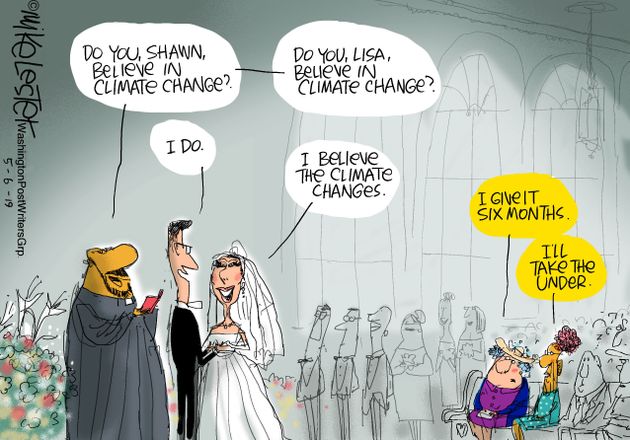
This is a fourth post toward infographics exposing the damaging effects of Climate Policies upon the lives of ordinary people. (See World of Hurt Part 1 , Part 2, and Part 3 ) And all of the pain is for naught in fighting against global warming/climate change, as shown clearly in the image above. This post presents graphics to illustrate the fourth of four themes:
Zero Carbon Means Killing Real Jobs with Promises of Green Jobs
Reducing Carbon Emissions Means High Cost Energy Imports and Social Degradation
100% Renewable Energy Means Sourcing Rare Metals Off-Planet
Leave it in the Ground Means Perpetual Poverty
The War Against Carbon Emissions Diminishes Efforts to Lift People Out of Poverty
The OurWorldinData graph shows how half a billion people have risen out of extreme poverty in recent decades. While much needs to be done, it is clear that the world knows the poverty factors to be overcome.
That comprehensive diagram from CGAP shows numerous elements that contribute to rising health and prosperity, but there is one resource underlying and enabling everything: Access to affordable, reliable energy. From Global Energy Assessment:
“Access to cleaner and affordable energy options is essential for improving the livelihoods of the poor in developing countries. The link between energy and poverty is demonstrated by the fact that the poor in developing countries constitute the bulk of an estimated 2.7 billion people relying on traditional biomass for cooking and the overwhelming majority of the 1.4 billion without access to grid electricity. Most of the people still reliant on traditional biomass live in Africa and South Asia.
The relationship is, in many respects, a vicious cycle in which people who lack access to cleaner and affordable energy are often trapped in a re-enforcing cycle of deprivation, lower incomes and the means to improve their living conditions while at the same time using significant amounts of their very limited income on expensive and unhealthy forms of energy that provide poor and/or unsafe services.”
The moral of this is very clear. Where energy is scarce and expensive, people’s labor is cheap and they live in poverty. Where energy is reliable and cheap, people are paid well to work and they have a better life.
How Climate Policies Keep People Poor
Note that the vision for 100% access to electric power was put forward by the African Development Bank in 2016. (Above slides come from The Bank Group’s Strategy for The New Deal on Energy for Africa 2016 – 2025). Instead of making finances available for such a plan, an International Cabal organized to deny any support for coal, the most available and inexpensive way to electrify Africa. This is an organized campaign to deny coal-fired power anywhere in the world, despite coal being the starting point in the development pathway for every modern society, and currently the success model for Asia, and China in particular. [Note in Figure 3 above that South Africa, the most advanced of African nations gets the majority of its power from coal.] The chart above comes from IEEFA 2019 report Over 100 Global Financial Institutions Are Exiting Coal, With More to Come. Their pride in virtue-signaling is expressed in the subtitle: Every Two Weeks a Bank, Insurer or Lender Announces New Restrictions on Coal.
How Climate Policies Waste Resources that could Improve Peoples’ Lives
The Climate Crisis Industry costs over 2 Trillion US dollars every year, and is estimated to redirect 30% of all foreign aid meant for developing countries into climate projects like carbon offsets and off-grid wind and solar.
A much better plan is put forward by the Copenhagen Consensus Center. A panel of social and economic development experts did cost/benefit analyses of all the Millenium Goals listed by the UN working groups, including climate mitigation and adaption goals along with all the other objectives deemed desirable. They addressed the question:
What are the best ways of advancing global welfare, and particularly the welfare of developing countries, illustrated by supposing that an additional $75 billion of resources were at their disposal over a 4‐year initial period?
These challenges were examined:
Armed Conflict
Biodiversity
Chronic Disease
Climate Change
Education
Hunger and Malnutrition
Infectious Disease
Natural Disasters
Population Growth
Water and Sanitation
Imagine how much good could be done by diverting some of the trillions wasted trying to bend the curve at the top of the page?
More evidence emerges suggesting modern relative sea level (RSL) is among the lowest in several millennia. About 7000 years ago coasts were rapidly submerged beneath the sea at rates of up to 22 meters per year.
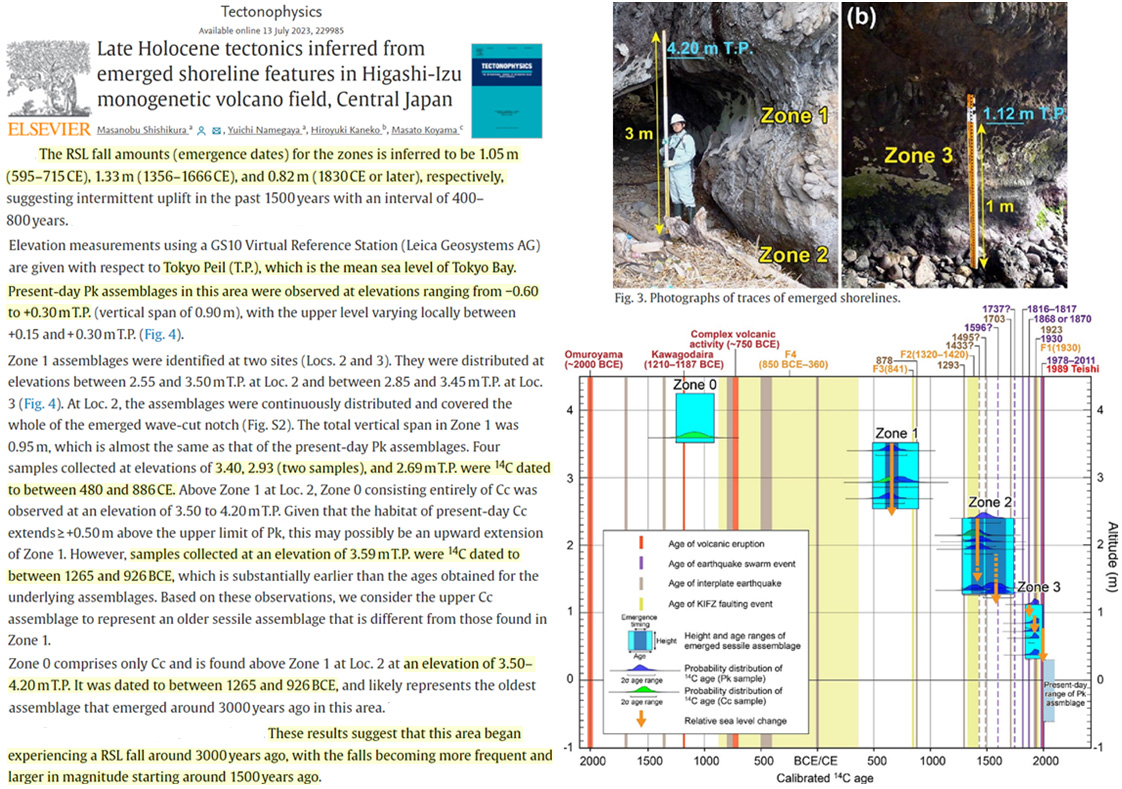
Ancient shoreline elevation evidence indicates RSL along the coasts of Central Japan has fallen ~0.82 m since the 1800s (Shishikura et al., 2023).
RSL was ~4.2 m higher than present approximately 3000 years ago and still ~2.8 m higher than present about 1500 years ago.
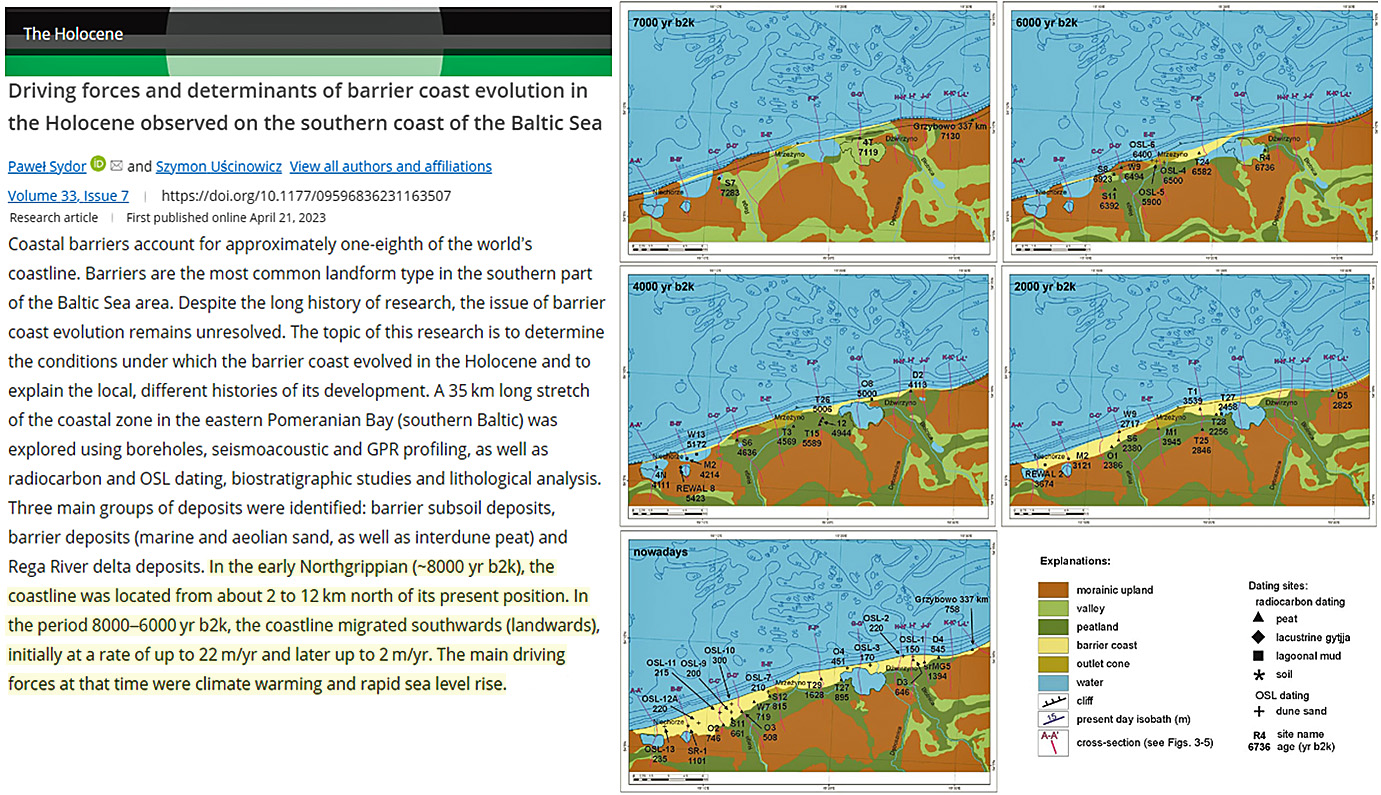
From about 8000 to 6000 years ago sea level rise and warming were so rapid that coastlines retreated landward at rates of 22 m per year (Sydor et al.,, 2023). Per the charts shown in the study, there is more coastal land area above sea level today than anytime in 7000 years.
“In the period 8000–6000 yr b2k, the coastline migrated southwards (landwards), initially at a rate of up to 22 m/yr and later up to 2 m/yr. The main driving forces at that time were climate warming and rapid sea level rise.”
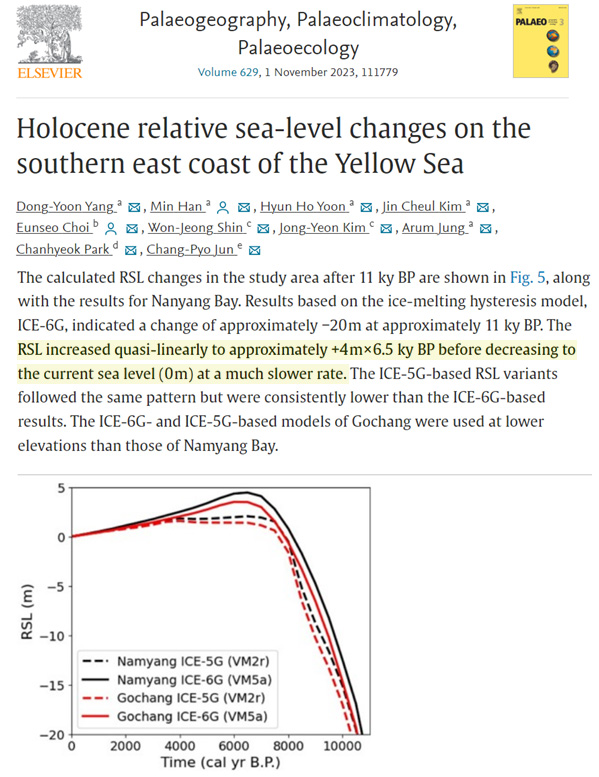
Sea levels used to be 4 m higher than today along the coasts of the Yellow Sea about 6500 years ago, or when CO2 was 265 ppm (Yang et al., 2023).
“RSL [relative sea level] increased quasi-linearly to approximately +4 m [above present sea level] 6.5 ky BP before decreasing to the current sea level (0 m) at a much slower rate.”
The climate-change movement is a powerful cultural entity. It does not affirm or negate the reality of its core narrative, which is for science to decide. Culture does, however, explain the power and prevalence of the narrative, the political and societal responses to it and the apparent willingness of many people to incur immense cost to avert a supposed existential threat, without proof of either its existence or our ability to alter its impact. In a new book available from the Global Warming Policy Foundation, The Grip of Culture: the Social Psychology of Climate Change Catastrophism, Andy A. West, who works for the Philosophy Foundation in London, provides an academic analysis of the phenomenon. Its lessons have particular relevance to Canada’s climate obsession.
As we know, the overarching climate narrative is that human GHG emissions have created a climate emergency that calls for urgent and extraordinary action, without which the consequences for humanity will be catastrophic. In many ways, its cultural characteristics parallel religions and ideological movements, starting with an unshakable foundational belief impervious to contradictory evidence, and extending to incessant incantations from politicians, mainstream media, thought leaders and environmentalists.
The faithful are reassured by groupthink, while apostates or sinful skeptics, i.e. “deniers,” are vilified, penalized and ostracized.
Environment and Climate Change Minister Steven Guilbeault’s veiled threat to charge Premier Scott Moe of Saskatchewan criminally if he violates federal coal regulations evokes Thomas of Torquemada, Grand Inquisitor of the Spanish Inquisition — though so far absent the burnings at the stake. The movement has its high priests and priestesses — Al Gore, Justin Trudeau, Greta Thunberg, King Charles and Mark Carney, none a scientist — who convey certainty to the multitudes.
Core principles and a multitude of subsidiary tenets are validated by exaggerated interpretations of scientific studies, as well as anecdotal evidence and conveniently chosen statistics that reinforce the sacred text. For example, the end of the Little Ice Age is invariably the starting point for calculating a global temperature increase — which is like a government calculating its effects on economic growth by starting at the trough of the last recession. Confirmation bias is provided by influencers, including uniquely unqualified Hollywood stars, who propagate the doctrine of the faith. Fear is employed as a powerful motivator and is inculcated from childhood. Apocalyptic doom is preordained for collective disobedience and salvation promised for devotees and repentants who comply with onerous strictures, many of which have no practical utility.
The instinctive response from climate alarmists to public hesitancy is that “the science is settled,” the facts are overwhelming and the need so urgent they can’t waste time quibbling with ignorant or malevolent naysayers who in any case are probably racist, misogynist, far-right conspiracists.
Climate alarmists have a fundamental problem, however, which may help explain their stridency. The complexity of climate science is not settled, as Steve E. Koonin, a physicist and former undersecretary for science in Barack Obama’s Department of Energy, explained in his 2021 book, Unsettled. Other prominent scientists agree, although they are a distinct minority.
Nor is climate apocalypse supported by the UN’s Intergovernmental Panel on Climate Change (IPCC), even though its conclusions go farther than the scientific studies on which it allegedly relies. Proffered evidence is based on models that have consistently run hot. Yet the conventional consensus is to accept at face value the predictions of people who have been consistently and spectacularly wrong and who, if they were around in the 1970’s, were more than likely to have issued dire warnings about an impending ice age, like Paul Ehrlich and Kenneth Watt, as well as newspapers and journals like Time, Science Digest, The New York Times and Newsweek.
Barring a miraculous technological innovation, there is virtually no chance of reaching global net zero by 2050.
Two-thirds of GHG emissions come from poorer countries that are deliberately increasing their use of fossil fuels, while the developed economies, including Canada, have consistently failed to reach the targets they have set themselves. And it takes centuries for excess carbon dioxide to disappear from the atmosphere, so any partial reduction in anthropogenic emissions would only slow their increase, not prevent it or eliminate them. Nevertheless, McKinsey says $275 trillion may be spent on the doomed gesture, disproportionately hurting the least advantaged and weakening the West in what may actually be an existential struggle with an expansionist communist China.
Andy West writes that culture can be a great unifier of societies and even civilizations. But because it is not based on reason, it can also be extraordinarily destructive: witness the calamities perpetrated by communism and fascism. So it is uncertain where climate catastrophism may lead or what negative feedback could potentially provoke a counter-reaction. Last year’s European energy crisis did undermine support for it, even if green activists claimed it proved we need more of the renewable energy that had in fact made the continent more vulnerable to higher prices and inadequate supply.
Zeitgeists do change. When people have to choose between food and heat and when the poorest countries are deprived of the affordable energy they desperately need to raise themselves up, then practicality and guilt may eventually change people’s beliefs. That they haven’t yet done so demonstrates the power of culture in the face of logic, morality, self-interest and the facts.
The recent cancellation of Alimonti et al shows clearly that catastrophising bad weather events and attributing them to a collapse of the climate is now the main weapon deployed to scare populations into embracing the Net Zero agenda. Of course, reference is still made to global warming, but most recent rises seem to owe more to frequent upward retrospective adjustments of temperature, rather than any significant natural boost. Perhaps we should not be surprised by this turn of events. In a short essay titled ‘The New Apocalypticism’, the science writer Roger Pielke Jr. noted: “For the secular millenarian, extreme events – floods, hurricanes, fires – are more than mere portents, they are evidence of our sins of the past and provide opportunities for redemption in the future, if only we listen, accept and change.”
The climate is collapsing all around us, shout the headlines – they require we ignore the data, the historical record, even common sense. When all is said and done, the Earth is not actually boiling! Well Professor Gianluca Alimonti and three other Italian scientists didn’t ignore the past data, much of it in fact from the UN Intergovernmental Panel on Climate Change, and they found little change in extreme weather events. They published a paper concluding that there was certainly not enough to justify the declaration of a ‘climate emergency’. A year later, the publisher Springer Nature bowed to the demands of a group of activist scientists and journalists led by the Guardian and Agence France-Presse and retracted the non-conforming paper. An addendum was proposed and sent to four reviewers for comment. Three reviewers argued for publication. The fourth stated that typical readers were not climate experts and “editors should seriously consider the implications of the possible publication of this addendum”.
We own climate science, boasted UN communications flak Melissa Flemingat a recent World Economic Forum disinformation seminar, and we partner with Google to keep our version at the top of the search list. What a great service these climate experts provide in telling us what to think and see as we unsophisticated rubes struggle towards the path of true enlightenment!
h/t Dr. Willie Soon; From a left wing hero of 2014, to a green energy heretic who hangs out with Bjørn Lomborg, to accusations of sex offences. But we’ve seen all this before.
In 2014, the George Monbiot lauded Brand’s flawed left wing activism.
The volatile comedian-turned-activist’s ability to be openly and honestly flawed sets him apart from the grand old men of the left
Mon 29 Dec 2014 22.29 AEDT
No one is better at attacking Russell Brand than Russell Brand. He takes the lavish criticisms aimed at him and, like Cyrano de Bergerac, shows his opponents how to do it properly.
He is volatile, vulnerable, troubled, mercurial, but unlike most people in public life, he makes no attempt to hide it. His emotional honesty helps to explain his appeal, and his ability to inspire people who had switched off from politics.
Yes, his politics are rough and inchoate, but he doesn’t claim to have all the answers. Sometimes he can be incoherent. But even that is a refreshing change from the stifling coherence of some of the grand old men of the left, for whom everything must conform to a rigid scheme of loyalties and enmities, and who appear unable to admit mistakes. This obnoxious and dishonest rigidity, often enforced by a cult-like following, is, I believe, one of the reasons why the left often struggles to build support.
How quickly things change. The Guardian reclassified Brand as a hate figure when Brand strayed off the establishment narrative thought plantation once too often.
Russell Brand is the latest to platform climate conservative Bjørn Lomborg’s ‘reckless’ net-zero cost claims
“I know that polluting the planet cannot be good on a spiritual level and there seems to be significant evidence to suggest that man-made climate change is real,” Brand said.
During the segment on Brand’s “Stay Free” show, viewed 315,000 times in the four days after it was published, Lomborg argued that renewable energy was too expensive and appeared to try to undermine the role that batteries play in storing renewable energy.
The Guardian commentator and environmentalist George Monbiot wrote last week that Brand had seemingly shifted from “challenging injustice to conjuring phantoms”.
In an age of distortion, public figures have powerful tools and a responsibility. This is an object lesson in how that can go wrong
In 2014, the Guardian asked me to nominate my hero of the year. To some people’s surprise, I chose Russell Brand. I loved the way he energised young people who had been alienated from politics. I claimed, perhaps hyperbolically, he was “the best thing that has happened to the left in years” (in my defence, there wasn’t, at the time, much competition).
He championed the “Freedom Convoy” that occupied Ottawa, which apparently stood proudly against the “tyranny” of Justin Trudeau’s policies. He hawks Graham Hancock’s widely debunked claims about ancient monuments.
Now, surprise, Brand has been accused of sexual assault.
Russell Brand allegations come as no surprise to anyone who listened to his jokes
Katy Hall Age deputy opinion editor September 21, 2023 — 7.40pmSave
Though the recent accusations made against Russell Brand of rape and sexual assaults are shocking for their alleged levels of violence, that these claims are being levelled against Brand himself is not shocking at all.
Until his recent pivot into the wellness and conspiracy theorist space, a central aspect of Brand’s persona that made him a globally loved comedian and actor was his sexual proclivities. He identified as a sex addict and spoke freely and often about the number of women he had slept with. He regularly used his bedroom antics as material in his comedy routines, while marketing himself as a kind of new-age ethical shagger. Where some go to great lengths to hide their sexual habits, Brand positioned the spotlight on his.
Isn’t it strange that high profile personalities get cancelled and in some cases are accused of sexual assault, after they offend the establishment or tangle with the green movement?
If any of these people are guilty of the crimes of which they have been accused, they deserve whatever is coming.
But being rude to an ex girlfriend also does automatically make Russell Brand guilty of a sex crime. Andrew Sachs grandaughter Georgina Baillie, the target of Jonathan Ross and Russell Brand’s cruel prank, actually spoke up in Brand’s defence a few days ago:
…
“From my own personal experience I do not see Russell as a rapist however a lot of the evidence is very compelling so one has to keep an open mind,” she said. “I want him to continue on his path of recovery and when we make mistakes we make amends that’s what we do.”
“He was always very nice to me,” she continued. “It was always clear what the parameters were and that was mutually agreed upon and never did anything untoward happen – apart from that [the Sachsgate tapes].
“I was struggling with addiction for about 10- 15 years and I was finding it very hard to get clean and sober. So one of my mutual friends between me and Russell called him up and said, ‘Georgie needs some help’, and so he sent me to rehab.
There is another factor which makes me wonder what is really happening. A few days ago Rumble accused a senior member of the British Conservative Government of sending a “deeply inappropriate and dangerous” letter to Rumble, demanding they cancel Brand’s ability to profit from his online content – including Brand’s Rumble interview with climate lukewarmer Bjørn Lomborg.
… On Thursday, Rumble accused a parliamentary committee of “deeply inappropriate” behaviour after Caroline Dinenage, the Conservative chair of the culture, media and sport committee, wrote a letter to the company’s chief executive, Chris Pavlovski, to express concern that Brand “may be able to profit from his content on the platform”.
In a public statement posted on X, Rumble called the letter “disturbing” and said parliament’s demands were “deeply inappropriate and dangerous”. The platform added that it was devoted to an internet “where no one arbitrarily dictates which ideas can or cannot be heard, or which citizens may or may not be entitled to a platform”.
Rumble added: “Singling out an individual and demanding his ban is even more disturbing given the absence of any connection between the allegations and his content on Rumble.” …
I’m not passing judgement on which if any accusations are true, and what people did or didn’t do. I don’t have the evidence in front of me to make such judgements.
Likewise the failure of media or governments to pursue leftist figures doesn’t automatically make them guilty. Climate hero Bill Gates maintains his relationship with Jeffrey Epstein was entirely innocent. Bill Gate’s claim in my opinion is plausible, however suspicious his association with Epstein seems. Scum like Epstein would surely have made it a priority to cultivate innocent friendships with powerful people, as a smoke screen to help conceal his own crimes, to help shield his less innocent friends, and to create an opportunity to dupe innocent people into being sincere character witnesses.
Maybe it’s all a big coincidence that high profile people with the capacity and willingness to damage the climate movement seem to be unusually susceptible to public accusations of sexual assault.
But the question in my mind, if the allegations against “Russell Brand” are “no surprise”, as Sydney Morning Herald reporter Katy Hall claims, why wasn’t more done to address these concerns back when Brand was a hero of the left?
I think it is reasonable to suspect there may be some serious journalistic and possibly even legal double standards at play.
How can Brand be confident he will be treated fairly by the British justice system, if formal charges are laid in response to the accusations which have been levelled, when the British government is already openly exercising their influence to attack his reputation, deplatform and silence him?
I’d be a lot happier if I could be certain that the intense pressure to shut down Russell Brand, in his moment of vulnerability, was not simply opportunistic political payback for Brand rousing millions of followers to start asking who is cashing in on their green cost of living pain, and all the other ways he has challenged government narratives in recent years. And I’d be happier still, if I knew for sure the British government’s actions were not something worse than opportunism.
Russell Brand’s interview with Bjørn Lomborg – part of Brand’s Rumble stream the British Conservative Government tried to cancel.


 This is an organized campaign to deny coal-fired power anywhere in the world, despite coal being the starting point in the development pathway for every modern society, and currently the success model for Asia, and China in particular. [Note in Figure 3 above that South Africa, the most advanced of African nations gets the majority of its power from coal.] The chart above comes from IEEFA 2019 report Over 100 Global Financial Institutions Are Exiting Coal, With More to Come. Their pride in virtue-signaling is expressed in the subtitle:




 Iowa Climate Science Education