10 bogus climate claims from August 2023 debunked here.
via JunkScience.com
September 14, 2023 at 06:14PM
10 bogus climate claims from August 2023 debunked here.
via JunkScience.com
September 14, 2023 at 06:14PM
Essay by Eric Worrall
How do Alarmists cope when their partner inconsiderately brings home a loaf of bread wrapped in plastic, despite a freezer is full of home made bread?
Help! I Care More About Climate Change Than My Partner
When it comes to disagreeing about climate change, can there be a middle ground?
By Brianna Sharpe
Updated September 13, 2023One afternoon, I was cleaning up after lunch with my toddler balanced on my hip when I saw it: a Ziploc bag in the garbage. “Eric!” I shouted in frustration at my husband, who wasn’t even home. My daughter looked expectantly at me. “Dada home?” I shook my head, glad that he wasn’t. The words I was thinking of were not playground-approved.
…
Eric thinks climate change is real and concerning. But my anxiety about the planet’s future is foreign to him. Recently, when we chatted about our kids’ lives 20 years from now, he described a future with things like careers, homes and families. All I could picture was a world they wouldn’t want to bring their own children into. How can we share so much, but diverge so drastically on this?
Caroline Hickman, a psychotherapist with the University of Bath and the Climate Psychology Alliance, says this kind of tension is increasingly common; she’s even seen couples break up over the strain of differing environmental views. “You’re not talking about whose turn it is to take the rubbish out; you’re talking about extinction and survival,” she says. While successful relationships are built on communication and compromise, “people are not willing to compromise on this.”
…
This tension even led to a stalemate on whether to have children. MC worried about their child’s future and the ethics of bringing another person onto the planet. Her husband still wanted kids. After years—and lots of support and space for MC—they found a way forward, and she’s due any day. But when it comes to the big picture, their conversations still turn into a battle.
…
Although he’s supported her since then, he’ll also bring home plastic-wrapped bread right after she’s stocked the freezer with homemade loaves. “It’s a lot of work to make bread, soap, canned vegetables and everything else,” Heather says, frustrated by her husband’s consumerism. She lovingly calls their relationship one of “comedic tension”; she likes to wag her finger at him in jest, “and he gives me all kinds of excuses to do that.”
…
Read more: https://chatelaine.com/health/sex-and-relationships/climate-change-relationships/
Don’t forget folks, their vote counts as much as yours does. And no, Brianna is married to a different Eric.
Regarding home made bread, she could ask her partner how her home made could be improved. Maybe she is doing it wrong – getting bread right is a surprisingly subtle art, even small changes make a big difference.
In any case, I doubt home baking is the climate conscious choice Brianna thinks it is.
I love making home made bread, but the fact is heating up the oven just for a single loaf of bread, or a small number of loaves, likely takes lot more energy than mass producing thousands of loaves of bread in a production line oven. Surface area to volume ratio helps ensure the heat insulation on really big ovens is a lot more effective than small household ovens. And producing that biodegradable plastic wrap for shop bought bread is a lot less energy intensive than running a freezer to preserve a batch of home made loaves.
As for washing out the ziplock bags – Brianna, where do you think the detergent you use for washing ziplock bags comes from? Hint Brianna – they don’t make detergent out of thin air.
But I guess we’ve all come to expect this level of fundamental ignorance from our most zealous climate alarmists.
By the way, please keep using the detergent, or switch to using new ziplock bags every time. I know dish washing detergent is a petroleum product, just like the ziplock bags you re-use, but you need to think about the health of your young child. E. Coli infection from improper food handling can wreak havoc on the health of the very young. Perhaps you could switch to a brand of detergent which makes a big deal of their fake carbon credits.
via Watts Up With That?
September 14, 2023 at 04:11PM
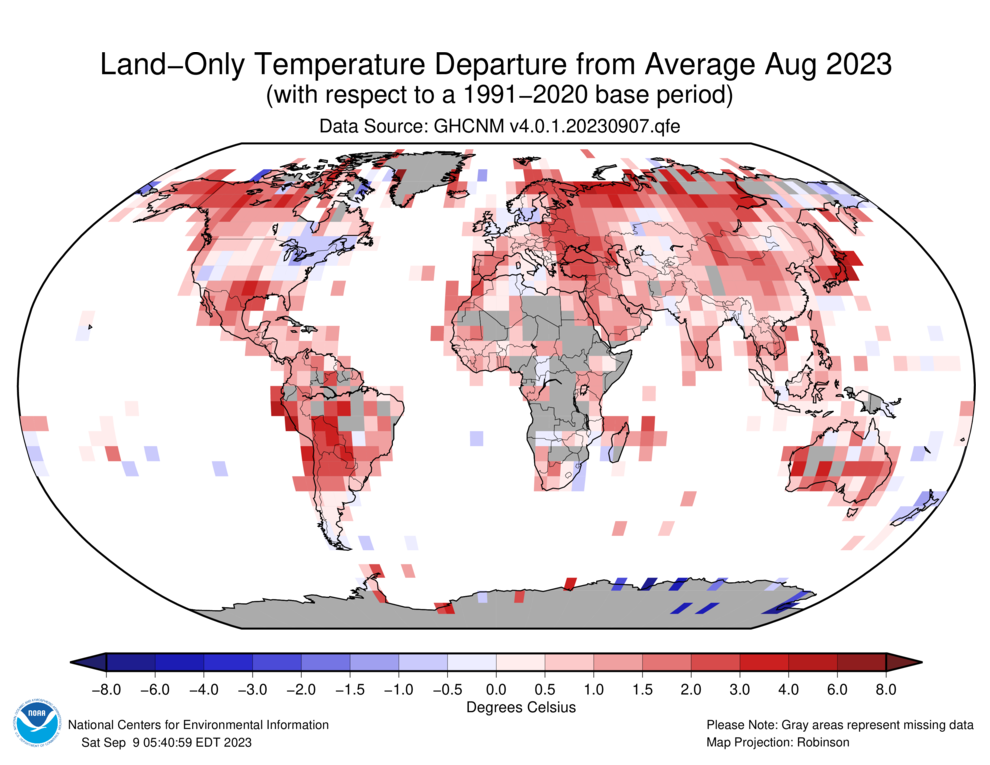
NOAA says August was the hottest ever, including record heat in the Congo – where they don’t have any thermometer data.


The other NOAA map doesn’t look so scary.

Global Mapping | Climate at a Glance | National Centers for Environmental Information (NCEI)
via Real Climate Science
September 14, 2023 at 03:29PM
By Jo Nova
For nearly fifty years, more than four out of ten Americans said they had a “great deal of confidence” in the people running our institutions of science. This was the strongest possible answer people could give. But all that has changed in the last few years with public opinion on science now splitting along political lines. Faith in the institutions of science has collapsed among conservative voters.
The goodwill, the trust and esteem built by things like The Manhattan Project and the Moonshot carried on for decades, but when Covid arrived, and science was the number one public topic of debate, many scientists sat silent on the sidelines, and the price is that now among Republicans, half the confidence is gone.
It’s a remarkable fall among conservative voters in the US: dropping from 45% in 2018 to just 22% in 2022 who still “have a great deal of confidence” in the scientific community.
June 15, 2023
While Democrats were more likely than Republicans to trust science before the pandemic, what was a 10% point gap in 2018 is now a 31% gap between different groups of voters. During the pandemic Democrat voters briefly became more confidence in science, but that returned to the baseline the following year. The fall in Republican faith shows no sign of leveling off.
It’s hard to believe the effects of this will not translate to other areas like climate change. Once people have admitted scientists can be politicized, bought, blind, or wrong on one topic, it’s hard to see how “Trust the Science” rings true in any other arena.
The General Social Survey was started in 1972, is run by NORC at the University of Chicago every year, and surveyed 3,500 people in 2022.
While faith in medicine, education and “the press” had been eroding over the last fifty years, science had maintained its position. The latest collapse in trust is a marked change from the long term steady trend line.
While Democrats confidence in medical institutions did not change, Republicans saying they had a great deal of confidence dropped from 40% to 26%. For most of the years of the survey there was no political divide. This is a new phenomenon.
It’s been more than 20 years since Republican voters had as much confidence in the media as Democrats.
What happened in 2017? Presumably the bump in democratic faith in the media was due to the election of Donald Trump and partisan attacks on him.
All in all, it’s a sad, sad story when the nations institutions are not worthy of trust, and are so obviously politicized.
Survey details:
The General Social Survey has been conducted since 1972 by NORC at the University of Chicago. Sample sizes for each year’s survey vary from about 1,500 to about 4,000 adults, with margins of error falling between plus or minus 2 percentage points and plus or minus 3.1 percentage points. The most recent survey was conducted May 5 through December 20, 2022, and includes interviews with 3,544 American adults. Results for the full sample have a margin of error of plus or minus 3.0 percentage points. More information about the 2022 GSS is available here: https://gss.norc.org/Get-The-Data
0 out of 10 based on 0 rating
via JoNova
September 14, 2023 at 02:05PM
 Iowa Climate Science Education