Variations in the greenhouse effect are predominantly modulated by water vapor and cloud cover. CO2’s role in the greenhouse effect is so minor it cannot be discerned.
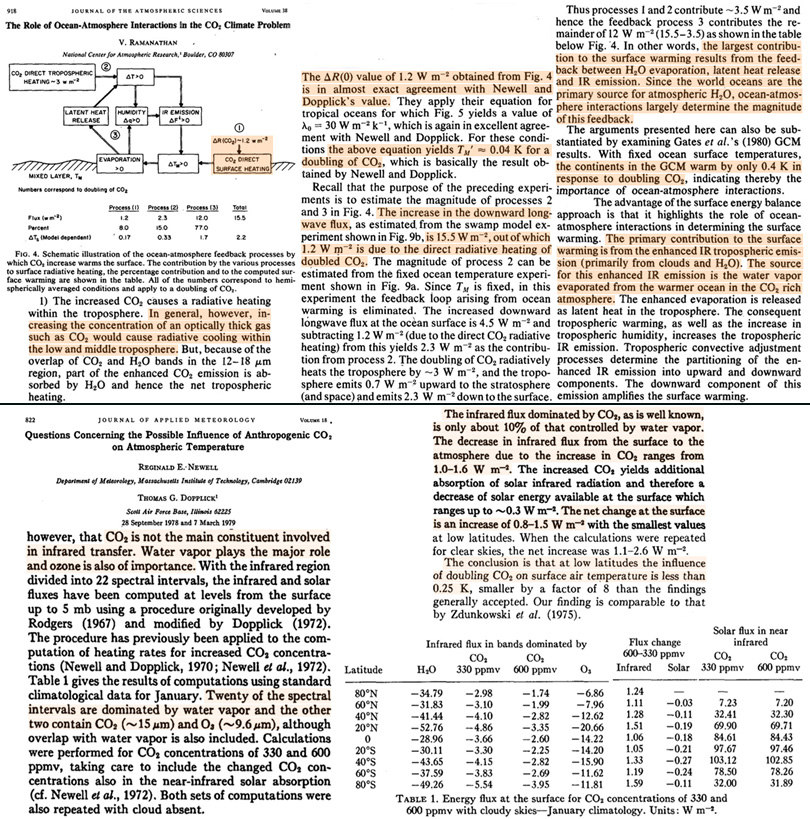
For decades scientists have reported that a CO2 concentration of about 300 ppm can only increase the downwelling longwave radiation (DLWR), or greenhouse effect, by about 1.5 W/m² at the surface. See, for example, the complementary studies by Ramanathan (1981) and Newell and Dopplick (1979).
“The infrared flux dominated by CO₂, as is well known, is only about 10% of that controlled by water vapor. The decrease in infrared flux from the surface to the atmosphere due to the increase in CO₂ ranges from 1.0 – 1.6 W/m².” – Newell and Dopplick, 1979
With the total DLWR value assessed as ~330 W/m² , this means that CO2’s 300 ppm (~1.5 W/m²) impact can only enhance the greenhouse effect by around 0.5%. Nearly all the rest is dominated by water vapor (and cloud).
“Carbon dioxide…increasing downwelling LW radiation by ~1.5 W/m². It is about 0.5% of the 327 W/m² of overall downwelling radiation that warms the Earth’s surface. The vast majority of that warming is contributed by water vapor. Together with cloud, it accounts for 98% of the greenhouse effect.” – Physics of the Atmosphere and Climate (textbook)
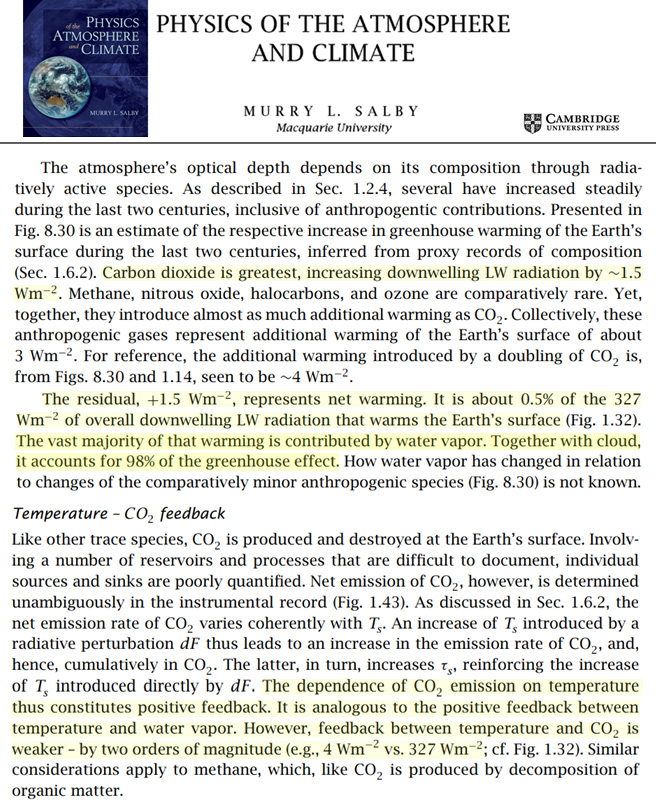
Image Source: Salby, 2012 (pg. 249)
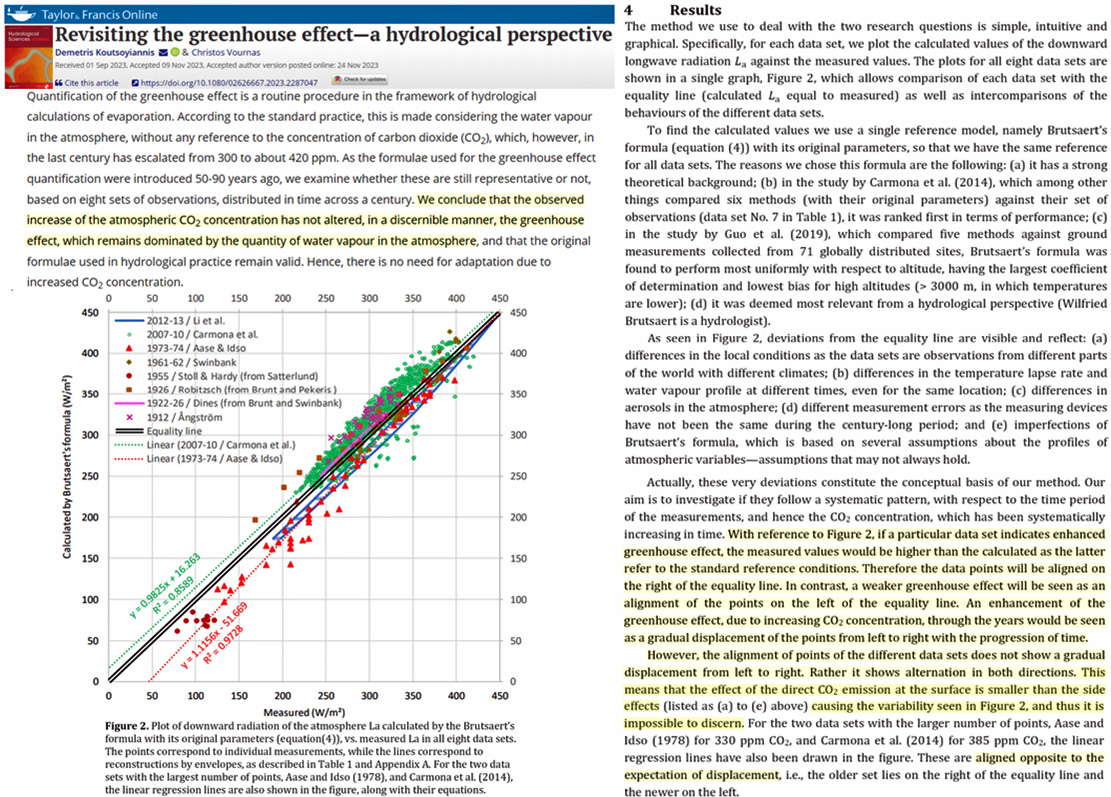
Image Source: Koutsoyiannis and Vournas, 2023
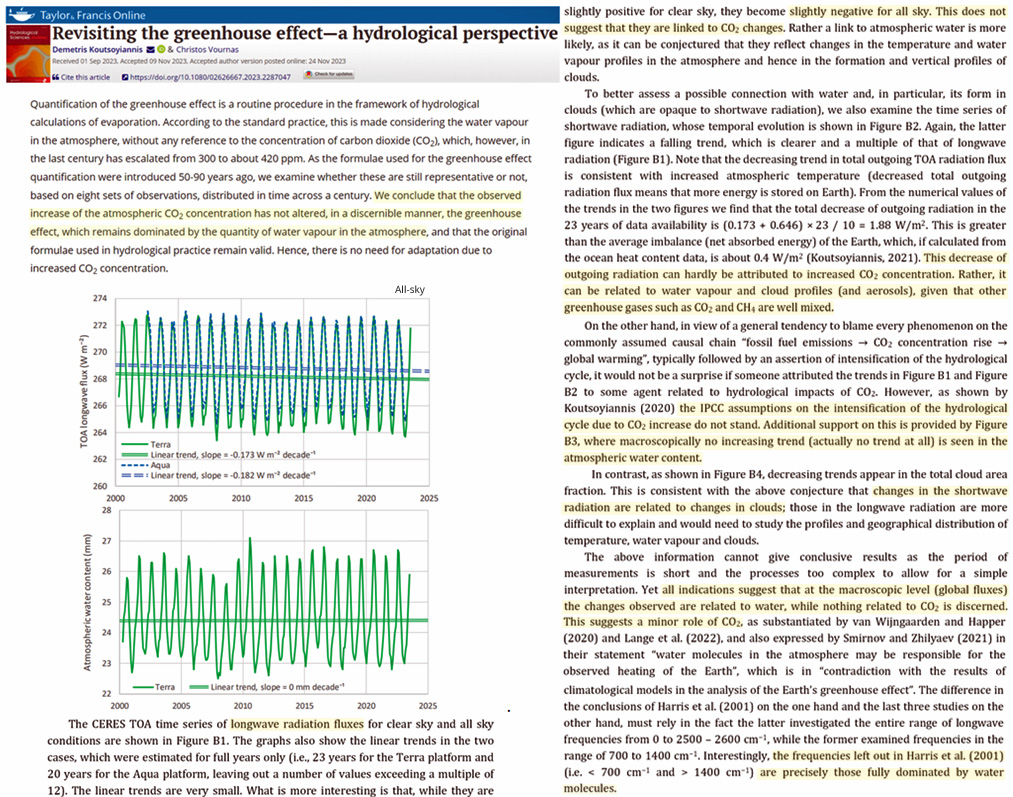
Image Source: Koutsoyiannis and Vournas, 2023
The declining greenhouse effect observed in recent decades has been reported by many other scientists.
“…the negative trend of G [greenhouse effect anomalies] indicates that the atmospheric greenhouse effect is temporarily [1985-1999] decreasing, despite the fact that greenhouse gasses are increasing.” – Cess and Udelhofen, 2003
If the greenhouse effect has not been enhanced since the 1980s, it cannot be responsible for modern warming.
via NoTricksZone
November 27, 2023 at 11:03AM
 Iowa Climate Science Education