
The Green Mirage recedes as you approach it.
Robert Lyman exposes the freakish math swirling around Dubai COP this fortnight in his Financial Post article COP28 by the (very big) numbers. Excerpts in italics with my bolds and added images.
This weekend’s climate meeting will discuss trillions of dollars.
No one will mention its chance of success is zero.
Neuroscience tells us the human brain is very bad at interpreting large numbers. Most people know that million, billion and trillion are all big numbers but can’t really understand what the difference between them is. Answer: it’s big. A million seconds is 12 days. A billion seconds is 31 years. A trillion seconds is 31,688 years, which is a lot more than 12 days.
Our cognitive difficulties with large numbers will be a problem when reading the news from the COP28 climate conference that convenes in Dubai on Thursday.
The conference has a wide-ranging agenda. It also will be attended by a large number of people — over 70,000 at last count. There’s the first large-number problem for COP28. How does a group of 70,000 people possibly discuss anything in a coherent way?
The organizers have identified five themes on which they would like to see agreement among the almost 190 governments that will be represented. When you’re talking governments, 190 is yet another brain-challenging number.
To oversimplify, there are four main themes:
 how to accelerate all countries’ efforts to reduce greenhouse gas emissions so as to meet a proposed 2050 “net-zero” target (zero not being a large number);
how to induce wealthier countries to give much more money to poorer countries to help them both mitigate and adapt to climate change;
how to persuade all countries to phase out production of fossil fuels by 2050; and, finally,
how to increase the UN’s role as central coordinator and global regulator of climate efforts.
Most discussions behind closed doors will be about money. Rich countries are now paying about US$70 billion in climate aid, mostly to help finance GHG emissions reduction. The developing countries want this raised to at least US$1.4 trillion per year by 2026, 20 times higher. Twenty is not actually that large a number, except when talking about multiplying already very big dollar amounts by it. Developing countries have also demanded that funding for adaptation rise to at least US$600 billion per year. At last year’s COP27 in Egypt, they got agreement in principle for a new fund to pay for the “loss and damages” they will incur from adverse weather events they attribute to the historic GHG emissions of the industrialized countries, though no dollar amounts were agreed to. Finally, developing countries are pushing for a new Global Biodiversity Fund, to which developed countries would donate a mere US$20 billion per year.

Round numbers: rich countries would be on the hook for US$2 trillion per year. If allocations were based on GDP, Canada would owe three per cent of the total — or US$60 billion per year. In Canadian dollars, that’s roughly 78 billion CAN$. There are about 16 million households in Canada so (do the math) each household would owe $4,875. Per year. That’s a number the average person can easily understand. He or she can also understand there is absolutely no way the Canadian public or voters in any other OECD country would ever agree to such a thing. Not even if they didn’t know (but they do) that China, producer of 30 per cent of the world’s GHG emissions, not only would not be contributing but might well qualify as a recipient.

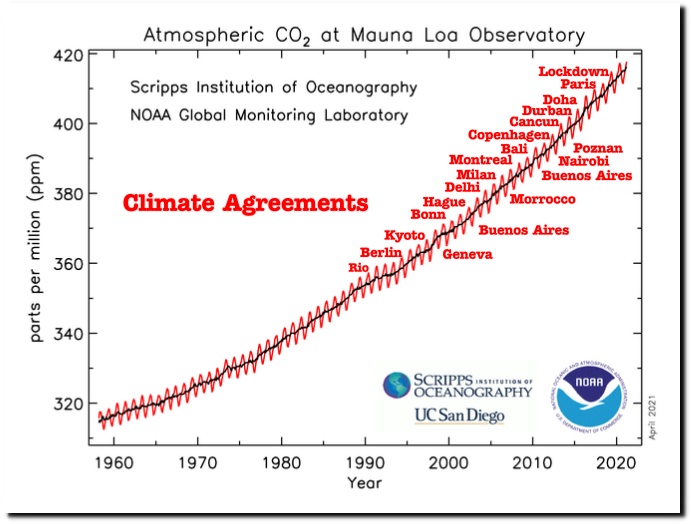
The previous 27 COPs (for Conference of the Parties) have all promoted ever-more ambitious emissions reductions. But since the first COP global emissions have risen 60 per cent, driven by developing countries’ relentless efforts to achieve more economic development for their burgeoning populations. There is no evidence that trend will change. China, India, Russia, Saudi Arabia, Iran, Iraq and others all see fossil fuel production as key to their economic development and energy security. They are unlikely to commit to production declines even if a few OECD countries do.
The United Nations secretariat will lobby hard at COP28 to expand the role of existing institutions, including even more climate summits to place even more political pressure on leaders, and they may succeed in this (though many of us feel just one a year is already more than enough). How difficult can it be to convince tens of thousands of climate stakeholders to travel to exotic conference locales each year? Especially if the general public cannot grasp the numbers they’re playing with.
This weekend the media in general will report in glowing terms on the energy and enthusiasm of conference participants, especially those representing environmental NGOs. The communiqué will note every new commitment made yet entirely ignore that the probability the entire process will meet its objectives is a very, very small number not significantly different from zero.

via Science Matters
https://ift.tt/CnDE6fo
November 29, 2023 at 01:11PM


 Iowa Climate Science Education