Month: March 2024

Exploding Energy Prices in California

“California leaders know that rising prices are a huge problem. The state is now considering a plan to tie utility rates to personal income so that the rich pay more and low-income residents pay less. Costly California looms as an example of poor energy policy.”

Energy prices are skyrocketing in California. The state’s electricity, gasoline, and natural gas prices are amongst the nation’s highest and rising. Green energy policies are the primary cause for high and escalating California energy prices.

Electricity

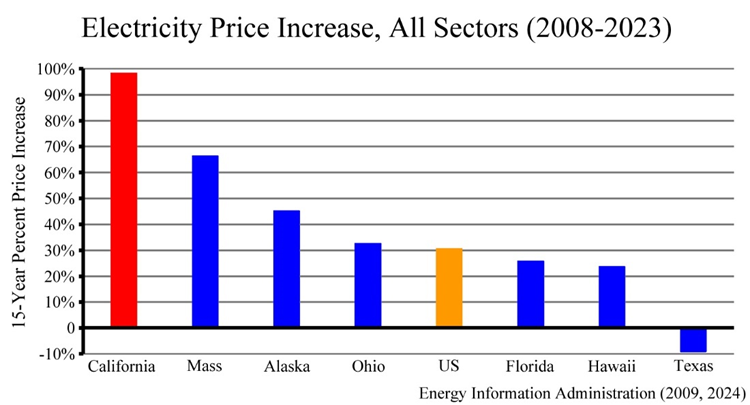
California electricity prices increased by 98.2 percent over the last 15 years, the highest rise in the nation. No other state comes close in terms of price increases. US average electricity prices rose 30.6 percent over the same period. California power prices rose to a level that is the second highest in the nation, only lower than Hawaii. In contrast, prices in Texas have actually declined since 2008 due to a focus on retail competition and a sharp decrease in natural gas prices, more than offsetting wind and solar additions. [1]
California is the epicenter of green energy in the United States. The state established the first renewable portfolio standard in 2002, mandating that 20 percent of electricity be from renewable sources by 2017. Governor Arnold Schwarzenegger instituted a 33 percent renewable requirement by 2020. In 2018, Governor Jerry Brown signed an executive order mandating 100 percent zero-carbon electricity by 2045.

The transition from traditional power plants to renewables has been a top priority for California for the last 20 years. By the start of 2023, California’s grid contained more than 6 gigawatts(GW) of wind, 17.5 GW of utility-scale solar, and 14 GW of residential rooftop solar.

Over the last two decades, the state retired 11 coal-fired power plants and converted three other coal plants to burn biomass fuel. The San Onofre Nuclear Generating Station closed in 2013, and the Diablo Canyon Power Plant, the state’s last nuclear plant, has been scheduled for closure.

In 2022, natural gas provided 42 percent of California’s in-state electricity generation, with other sources providing: solar (27%), nuclear (8%), hydroelectric (8%), wind (7%), geothermal (6%), and biomass (2%). The state imports about one-fifth of its electricity from surrounding states.

Solar and wind generators are more expensive than traditional coal, gas, and nuclear generators. Wind and solar occupy huge amounts of land, perform poorly during winter months, and suffer from intermittent output.
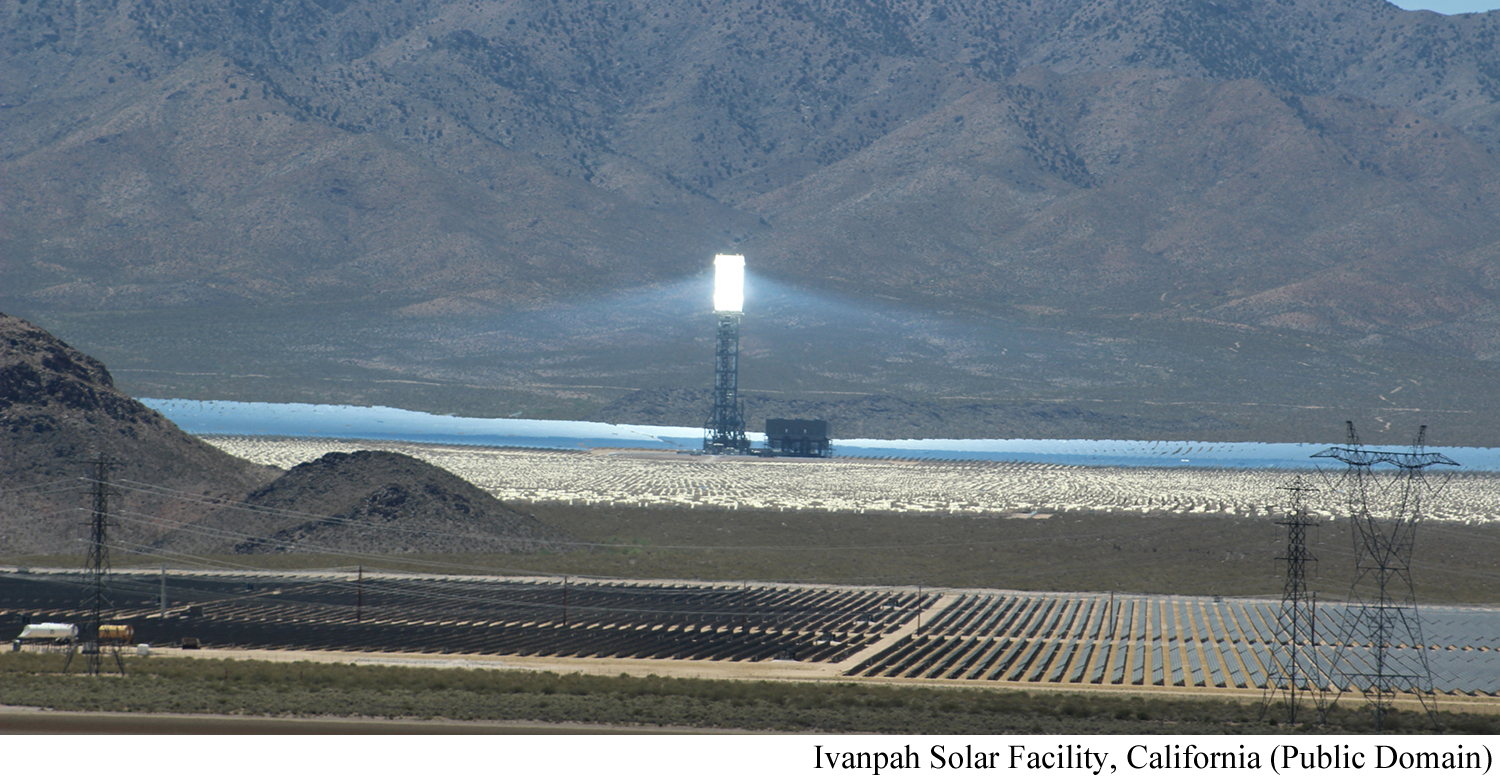
Vaclav Smil’s book Power Density points out that wind and solar systems use about 100 times the land area of traditional generators to produce the same electricity output. Renewable facilities also tend to be far from population centers, requiring expensive buildouts of transmission systems. Land and transmission costs boost the price of electricity from these generators.

The intermittency of wind and solar generation has the largest cost impact. Cloudy days and nights eliminate solar output and windless days idle wind turbines. Winter solar output drops to about half the available summer output. About 90 percent of traditional coal or natural gas generators must be maintained as backup for intermittent wind and solar systems, boosting power prices.

Batteries

California leads the US in deployment of grid-scale batteries. The plan is to use batteries to store electricity when wind and solar generation is high and then release the stored power back to the grid when wind and solar output is low. Wind and solar plus battery systems are being deployed as a low-carbon alternative to coal and gas power plants.

But the use of grid-scale batteries to backup renewable generators multiplies the cost of electricity. Utility-scale solar systems cost about $1 million per megawatt (MW) of rated capacity. Grid-scale batteries with four hours of discharge duration cost about $1.5 million per megawatt of capacity. These batteries can back up solar for only about four hours.

To replace a gas-fired power plant, a battery system would need to back up a solar installation for one or more days. A battery that can back up a $1 million one-megawatt solar facility for a single day would cost about $9 million. Grid-scale batteries only have a 12-year lifetime, about one-half of the solar lifetime. Adding batteries to backup solar for a single day boosts the total capital cost by more than a factor of ten.

Gasoline

February 29 found California regular gasoline prices at $4.74 per gallon, the highest in the nation. California drivers pay 40 percent more than the national average. The state has its own blend of gasoline, and claims that the blend will emit fewer greenhouse gases when burned. Higher gasoline taxes and a shortage of local refineries also factor into the high prices.

Natural Gas

California also consistently ranks in the top 10 in natural gas prices. Prices are high because the state has long discouraged local production, importing more than 90 percent of its gas from other states. There is a also a shortage of gas storage facilities.

Green energy policies affect not only electricity and fuel prices, but also housing utility and construction costs. Many regulations aim to reduce greenhouse gas emissions from buildings. The California Air Resources Board passed a regulation outlawing new residential gas heaters by 2030. San Francisco, Los Angeles, and other cities have voted to ban gas appliances in new construction. Only electric heat pumps, water heaters, and stoves may be used. These measures further boost the cost of energy for homeowners.

Housing Costs

Housing prices are rising because of green energy mandates. The 2020 California Solar Mandate requires newly constructed homes to have solar panels and wiring for electric appliances. The California Building Standards Commission enacted standards that require electrical conduit for level two EV charging in single-family homes and parking facilities with EV chargers for multi-family homes and hotels. These additional requirements make the cost of housing less affordable for low-income residents.

Conclusion

Southern California Edison, Pacific Gas & Electric, and San Diego Gas & Electric, the big California utilities, have all asked for 2024 rate increases, in part needed to bury hundreds of miles of transmission lines to reduce the threat of forest fires. Residents already pay $300-500 per month for energy. There seems to be no end in sight to rising California energy prices.

California leaders know that rising prices are a huge problem. The state is now considering a plan to tie utility rates to personal income so that the rich pay more and low-income residents pay less.

But affordable energy is clearly not as important as efforts to try to stop global warming. Costly California looms as an example of poor energy policy.

—————–

[1] Storm Uri (February 2021) rate spikes of $10 billion or more have been paid by floating bonds and/or are in legal limbo, which would make Texas’s electricity rates higher than recorded.


Steve Goreham is a speaker on energy, the environment, and public policy and the author of the new bestselling book Green Breakdown: The Coming Renewable Energy Failure. His previous posts at MasterResource can be found here.

The post Exploding Energy Prices in California appeared first on Master Resource.

via Master Resource

https://ift.tt/zMlAk04

March 12, 2024 at 01:05AM

Inside a 2074 Climate Fantasy

Essay by Eric Worrall

“… We had bigger things to worry about, like whether drag queens should have been allowed to read books to children …”

Baby, it’s hot outside: A fearmonger’s guide to dressing for the apocalypse

By Sandy Powell
Updated March 11 2024 – 12:13PM, first published 11:30AM

It is the year 2074 and we are at the end of another glorious half-century of climate extremes that have kept us on our toes; nimble and spry and ready for the next challenge. Those of us who have survived at least.

As I was digging the weekend’s accumulated ash and filth from around the front door of my burrow this morning I thought about a time, 50 years ago, when we didn’t live underground and were mildly surprised by the warming weather.

It was a beautiful time when we still used that antiquated term “drought” as though the rain would at some point return to a stable and reliable pattern in the coming years.

We were aware of climate change, of course, and had been for half a century, but that was a thing that far off future generations would have to prepare for, not us. We were simply too comfortable to make any substantial changes to our lives. 

And why would we? We had bigger things to worry about, like whether drag queens should have been allowed to read books to children and whether the tax cuts we were giving billionaires were big enough.

Perhaps that is too cynical; people were struggling to afford to feed and house their families and had just lived through, what was then, a once-in-a-lifetime pandemic and were reasonably inward looking in their concerns.

Read more: https://www.canberratimes.com.au/story/8551006/a-fearmongers-guide-to-dressing-for-the-climate-change-apocalypse/

Granted this is an attempt at political parody, but the logical inconsistency of this future climate fantasy is just irritating.

If “we still used that antiquated term “drought” as though the rain would at some point return to a stable and reliable pattern”, how can there be any vegetation left to burn? Surely it all burned away and never re-grew ages ago, because there was no water to irrigate the new seedlings, or they all got washed away in the infrequent but brutal mega floods. Dust I can believe – Australia is a very dusty place, even super floods wouldn’t be able to remove all the dust. But dust and ash, not so much.

If somehow the ash and dust got there anyway, despite the lack of rain and vegetation, and everything is covered in dust and ash, all that investment in solar panels was a big waste of money.

Ah but sometimes it rains – so who in their right mind would live underground, and risk getting drowned in a flood? Better hope those fossil fuel driven water pumps work properly. Maybe you live underground until it floods, then climb a tree? Ah I forgot, all the trees burned down long ago.

Describing Covid as a “once in a lifetime pandemic”? Well Covid is still here – but where are the lockdowns? Does anyone still believe the lockdowns were anything but a massive government overreaction?

And if the world of 2074 is an apocalyptic dystopia, who would care who got tax cuts way back when?

Reading this ill considered attempt at political parody was just painful, like trying to watch a badly scripted Hollywood movie which gets all the science wrong. But I guess you have to have an engineering mind, to feel irritated by such obvious inconsistencies, or to understand the absurdity of bumbling Western “solutions” to climate change.

via Watts Up With That?

https://ift.tt/suR8vlh

March 12, 2024 at 12:00AM

Claim: Social Science can Solve the Climate Crisis

Essay by Eric Worrall

Making do with less: “… We can repair and recreate our relationships with the Earth and the consumption that has gotten us to this point. …”

The world is not moving fast enough on climate change — social sciences can help explain why

Published: March 11, 2024 12.10am AEDT
Fayola Helen Jacobs Assistant Professor of urban planning, University of Minnesota
Candis Callison Associate professor, School of Public Policy and Global Affairs, and Institute for Critical Indigenous Studies, University of British Columbia
Elizabeth Marino Associate Professor of Anthropology, Oregon State University

The first is that climate change has the potential to exacerbate health, social and economic outcomes for Black, Indigenous, people of colour (BIPOC) and low-income communities. The second is that social systems and institutions — including governmental, cultural, spiritual and economic structures — are the only places where adaptation and mitigation can occur.

There are a range of outcomes that may stem from climate related disasters with a vast inventory of what is possible. There are also hopeful examples that point the way to rich collaborations and problem solving. For example, Tulsa, Okla. was the most frequently flooded city in the U.S. from the 1960s into the 1980s, but a coalition of concerned citizens came together with the city government to create a floodplain management plan that serves as a model for other cities. 

There is an adage that says in order to go quickly, go alone; if you want to go far, go together. Make no mistake, climate change is the most urgent issue of our time. However, moving quickly and carelessly will serve only to re-entrench existing social, economic, political and environmental inequalities. 

Instead, we must look at other ways of being in the world. We can repair and recreate our relationships with the Earth and the consumption that has gotten us to this point. We can pay attention and listen to global Indigenous peoples and others who have cared for this earth for millennia

We must be more creative with our solutions and committed to ensuring that all, and not just a privileged few, are able to live in a better world than the one in which they were born into. Technological approaches alone will not achieve this goal. To build a better world we need the social sciences.

Read more: https://theconversation.com/the-world-is-not-moving-fast-enough-on-climate-change-social-sciences-can-help-explain-why-218091

If more government solved people’s problems, the Soviet Union would have been a beacon of prosperity.

I think social workers have their place – someone to turn to, if someone’s life turns into a train wreck, and they have no other place to go, though arguably private charities and churches adequately fill this role.

But social workers trying to convince everyone to live with less, trying to address “the consumption that has gotten us to this point“? Instead of telling everyone to love poverty, why not focus on creating conditions where everyone can be rich enough to fix their own problems?

Because there is a well trodden path to achieving near universal wealth – get the government out of the way. The Asian Miracle transformed a bunch of impoverished fishing villages into some of the wealthiest places on Earth in just 5 decades. All that was needed was lower taxes and business friendly government – and an almost complete lack of social workers.

Sir John Cowperthwaite, the Legendary post WW2 Hong Kong finance secretary who is widely credited with kick starting the Asian Miracle, spent most of his career battling social workers and other well intentioned government busybodies, point blank refusing to provide the British Government with detailed Hong Kong economic data, to block their meddling.

Cowperthwaite was once asked what poor countries should do to replicate the success of Asian tigers like Hong Kong, which thrived under his administration. Cowperthwaite’s response was “They should abolish the office of national statistics.”.

via Watts Up With That?

https://ift.tt/rYSeWME

March 11, 2024 at 08:05PM

Mann v. Steyn: Round 2

by Judith Curry

The latest developments.

Some new filings from Mark Steyn:

New Trial:
Judgment as Matter of Law:
 
Stay of Execution:

https://www.steynonline.com/documents/14133.pdf

Further details at steynonline [link]

via Climate Etc.

https://ift.tt/4vlByLN

March 11, 2024 at 05:09PM