Month: March 2024

Smoke and Mirrors: My Model Can Beat Up Your Model

Contributed by Robert Lyman © 2024. Robert Lyman’s bio can be read here.

EXECUTIVE SUMMARY

On March 5, 2024, a Committee of the Ottawa City Council met to decide … Continue reading

The post Smoke and Mirrors: My Model Can Beat Up Your Model first appeared on Friends of Science Calgary.

via Friends of Science Calgary

https://ift.tt/kzpH7ar

March 25, 2024 at 11:54PM

‘The River Is Essentially Dead’: How Enviros’ Push To Save Salmon Ended Up Killing ‘Hundreds Of Thousands’ Of Them

From The DAILY CALLER

Daily Caller News Foundation

NICK POPE
CONTRIBUTOR

A well-funded environmentalist group played a key role in the push to remove dams in the Pacific Northwest’s Klamath River ahead of premature deaths of thousands of salmon.

American Rivers — an organization that has received millions of dollars from left-of-center environmentalist grantmaking organizations in recent years — was “the orchestrator of the Klamath dams removal project,” according to Siskiyou News, a local outlet in Northern California. The drawdowns of several reservoirs pursuant to the scheduled removal of four dams in the river preceded the deaths of “hundreds of thousands” of young salmon in the waterway, according to Oregon Public Broadcasting.

The push to remove the dams is often marketed as beneficial for salmon, as proponents of the plan — including American Rivers — have argued that the dams obstruct the natural movements of salmon as well as their access to habitat. However, weeks after beginning the process to remove one of the systems scheduled for deconstruction on the river, a large number of the 830,000 young salmon released into the river on Feb. 26 had died as of March 2, according to the California Department of Fish and Wildlife (CDFW). (RELATED: White House Won’t Confirm If Biden Will Visit East Palestine, Says He’s ‘Taking It Very Seriously’)

CDFW officials attributed the mass-death to gas bubble disease, which is caused by changes in water pressure, and stated that the changes in pressure driving the deaths was attributable to old dam infrastructure that is slated for removal. The agency further stated that water turbidity and dissolved oxygen levels do not appear to have contributed to the mass-death.

The young salmon that died travelled through a tunnel involved in the dam infrastructure that had previously not been accessible to the fish before officials altered the flow of water through the system as part of the removal process, Peter Tira, an information officer for the CDFW, explained to the Daily Caller News Foundation. The deaths were primarily a function of where the fish were released into the water, and the outcome, though unfortunate, is a learning opportunity for stakeholders who remain committed to making the Klamath River a free-flowing cold water river system again in the long-term, Tira told the DCNF.

WaterMixing-e1710536561178-768x327
Water from the Klamath River mixes with water from a different body in northern California. (Photo via the office of Republican California Rep. Doug LaMalfa)

Dead fish are pictured along the Klamath River system. (Photo via the office of Republican California Rep. Doug LaMalfa)

American Rivers is also closely involved with the Klamath River Renewal Corporation (KRRC), a nonprofit coalition that is playing a key role in the removals in accordance with its stated mission to “remove the Klamath hydroelectric dams and restore a free-flowing river.” Along with other organizations involved with the KRRC, American Rivers has appointed several officials to the group’s board of directors.

However, some officials and environmental policy experts are not buying the government’s explanation for the mass-death of salmon, asserting instead that it is clear that the removal of the dams set conditions for the mass-death.

“The risk of gas bubbles is well known, so the fact that one million salmon were killed is a failure of government staff to prevent their death. Rather than act as this is the fault of the dam, government staff should acknowledge their mistake and learn from it,” Todd Myers, the director of the Washington Policy Center’s Center for the Environment, told the DCNF. “It is unfortunately typical that when government actions harm the environment, agencies spend more time deflecting blame than addressing the problem or being held accountable.”

https://dailycaller.com/2024/03/24/river-essentially-dead-enviros-push-save-salmon-ended-killing-hundreds-thousands/

Regardless of whether or not dam removal is the right decision, poor planning or execution of the removals should not be excused, Myers emphasized.

Republican California Rep. Doug LaMalfa, whose district includes the river and a is a longtime opponent of removing the dams, agreed with Myers’ assessment of the causes for the deaths.

LaMalfa has been warning removal proponents “from day one” that moving to hastily remove the dams without a comprehensive plan to handle second-order effects could be catastrophic, he told the DCNF. He believes many proponents of removing dams are mostly interested in adding metaphorical “trophies” to their shelves rather than devising and implementing effective plans to remove the dams responsibly.

“This is about political scores. People like me and others have been warning them for two decades that when you do this and you have no plan for the silt — and they don’t have one — they have been exposed that they have no plan. They’re just doing it, doing it on the fly,” LaMalfa told the DCNF. “We see the destruction with the flume that has gone down the whole river and out in the ocean. I understand it’s even moved all the way up towards Crescent City, which is many miles up the coast.”

https://dailycaller.com/2024/03/24/river-essentially-dead-enviros-push-save-salmon-ended-killing-hundreds-thousands/

American Rivers, meanwhile, does not appear to have publicly addressed the high volume of salmon deaths in the river, despite having advocated for the removal of the Klamath River dams for years. American Rivers did not respond to requests for comment.

“I’ve been around natural disasters all of my life, and I’ve never seen anything like this,” Siskiyou County Supervisor Ray Haupt told the California Globe. “The river is essentially dead, as is everything in it.” (RELATED: Scientists Look To Fight Climate Change By Dumping 6,000 Gallons Of Chemicals Into Ocean Near Martha’s Vineyard)

American Rivers has received at least $3.6 million from left-of-center grantmaking and environmentalist organizations — including the Charles Stewart Mott Foundation, the Resources Legacy Fund, the William and Flora Hewlett Foundation and the Water Foundation — since 2020, according to a review of tax filings. The New Venture Fund, one of the grantmaking nonprofits overseen by left-wing dark money behemoth Arabella Advisors, gave American Rivers nearly $400,000 between 2020 and 2022, according to tax filings.

There are still several other dams on the river that are set to come down as part of the removal project. Many property owners are seeing the values of their property along the water drop because of changes driven by the dam removal, LaMalfa told the DCNF.

“People with homes in the area are seeing their home values drop, even in one case their actual house might drop into the canyon because the water table has shifted,” LaMalfa told the DCNF. “And people with loans on their homes no longer have the value to keep their equity up.”

https://dailycaller.com/2024/03/24/river-essentially-dead-enviros-push-save-salmon-ended-killing-hundreds-thousands/

For its part, KRRC has established a mitigation fund to pay locals who may be adversely impacted by the consequences of dam removal.

“The California Department of Fish and Wildlife (CDFW) manages the Fall Creek Fish Hatchery,” which is the facility that released the ill-fated salmon into the waterway, a KRRC spokesperson told the DCNF. “The Department determined the mortality of salmon fry was caused by remaining dam infrastructure, not by dam removal. Fortunately, that infrastructure will be removed along with the rest of the dam this year. In the meantime, CDFW will be trucking fish around the dam to avoid this occurring with upcoming releases from the hatchery. “

https://dailycaller.com/2024/03/24/river-essentially-dead-enviros-push-save-salmon-ended-killing-hundreds-thousands/

All content created by the Daily Caller News Foundation, an independent and nonpartisan newswire service, is available without charge to any legitimate news publisher that can provide a large audience. All republished articles must include our logo, our reporter’s byline and their DCNF affiliation. For any questions about our guidelines or partnering with us, please contact licensing@dailycallernewsfoundation.org.

via Watts Up With That?

https://ift.tt/ZhIJ6m7

March 25, 2024 at 08:04PM

Behavioural Scientists Aren’t Just Wrong About How to Win Over Electorates to Crackpot Progressive Policies; Their Evident Contempt for the Masses Has Contributed to the Global Populist Revolt

From THE DAILY SCEPTIC

BY BEN PILE

Nothing strikes as much fear through the establishment’s fact-checkers and hate-vanquishers as the rise of ‘populism’. Democratic backlashes against dominant ideologies and policy agendas are the natural and inevitable reaction to the intransigence of those who advance them. These reactions, which look likely to sweep many populist parties to power in elections this year, are seen by incumbents as the re-emergence of ‘dark historical forces’, but our leaders have no other words for the challenges to their authority than ‘far-Right’. The reason they cannot grasp what’s really going on – indeed, one of the causes of their unpopularity – is that they’ve placed too much faith in what has turned out to be really bad science.

According to the narrative of anointed pundits, tractors on their way to Europe’s capital cities and the EU Parliament are like so many Nazi tanks rolling across the continent. The EU Parliamentary election is at risk of a ‘far-Right takeover’ as polling shows voters beginning to reject the liberal consensus. This paranoid fantasy is not wholly without a basis in fact – the benighted really are changing the political landscape. Following Giorgia Meloni’s 2022 victory in Italy, Geert Wilders’s PVV became the largest party in the Netherlands last year but has been unable to form a Government. Since 2020, AfD has doubled its polling to around 20%, pushing Germany’s SPD and Greens into third and fourth places. The German Government is now contemplating banning the party, so bereft of ideas is it about how to counter its criticisms in the public square. France’s longstanding spectre haunting global blobists, Marine Le Pen’s party, would, according to recent polling, win a majority of seats in the National Assembly if an election were held tomorrow. 

According to the establishment view, science is at loggerheads with the populism now sweeping across Europe. But to pit science against ideology in this way is false. Science has been used to legitimise numerous contemporary political agendas, invoked in the same way that God used to be to legitimise a particular political platform. Most notably, ‘climate science’, which is invoked by increasingly remote elites struggling to overcome yawning democratic deficits claim that ‘saving the planet’ is in the best interests of their electorates. Yet, to those being forced to pay the price for these economically ruinous policies, it’s obvious that the Net Zero agenda is, at root, an ideological crusade designed to advance the interests of wealthy elites. And many are now wondering if the ‘climate change’ we’re constantly being warned about will be as devastating as the policies designed to mitigate its effect, which seem to require the suspension of democracy, the transformation of society and the draconian regulation of lifestyles insofar as they require energy.

As politicians and others have met resistance to their agendas based on ‘unimpeachable science’, they have sought an explanation. The answer they found is epitomised by a 2011 article by liberal science warrior Chris Mooney, who helpfully set out ‘The Science of Why We Don’t Believe Science’. Neuroscientists and social psychologists, explained Mooney, had identified differences in the structure of brains owned by liberals and conservatives, which made the latter more prone to ‘motivated reasoning’ and therefore to ideology, whereas liberals were biased only towards truth. This explained why Republicans were more sceptical of climate change then their Democrat counterparts who obediently recognised the authority of ‘the scientific consensus’. Mooney’s essay, which followed his 2005 book, The Republican War on Science, was itself worked into a book in 2012, The Republican Brain: The Science of Why They Deny Science – and Reality.

Mooney’s work, born in the pre-Obama era of ‘muscular atheism’ and a regrouping of Left-of-centre ideas around scientism, though largely inconsequential, marked the completion of cognitive and behavioural scientists’ entry into the political sphere. Only somebody with insufficiently developed neural circuits – a.k.a. Republicans – could disagree with climate propaganda, or they were funded by Big Oil, or both. It didn’t really matter, because Science had spoken. 

But Mooney’s confidence was misplaced. Whereas the scientific consensus on climate change had been broadly (and falsely) reported as being as indubitable as ‘basic physics’, the new lab-coated recruits of this political, and increasingly cultural war, could not claim anything so tangible. First, studies confirmed that academic psychology was experiencing a ‘replication crisis’ – barely a third of published science in the field could be reproduced experimentally. Second, psychological science was revealed to be dominated by Left-wing scientists, with measurable impacts on peer-review. Conservative scientists were less likely to be published. A soft science – and perhaps the softest science – was now being used to supposedly explain why more people didn’t believe in hard science, although, to complicate things, the hard science wasn’t that hard after all. 

In Britain, where politics was less polarised under a suffocating Blairism, this naked scientism had a much easier ride into the establishment. A consensus on climate change – and pretty much everything else – had formed in Westminster, excluding any inconvenient influences from politics. In a 2010 report, jointly produced by the Cabinet Office and the Institute for Government, Cabinet Secretary, then Sir, now Lord Gus O’Donnell, who had commissioned it, wrote in the foreword: 

Many of the biggest policy challenges we are now facing… will only be resolved if we are successful in persuading people to change their behaviour, their lifestyles or their existing habits. 

The report, citing “major advances in understanding the influences on our behaviours” argued that “influencing behaviour is central to public policy”, and that in tackling “crime, obesity or environmental sustainability, behavioural approaches offer a potentially powerful new set of tools”.

But there had been no development in the behavioural sciences – they remained mired in the depths of the replication crises and obvious ideological bias. The only change that occurred was a dim view of individuals’ competences had developed and become fashionable within policy circles, displacing a view that had hitherto constrained technocratic paternalism. Barely a year following its publication, Cass Sunstein’s 2008 book, Nudge: Improving Decisions About Health, Wealth and Happiness had become the British Establishment’s operating manual. The Nudge Unit, properly known as the Behavioural Insights Team, was born. 

After all, something had been lacking in public life since before even Blair’s triumphant arrival at Downing Street and politicians struggled to put their finger on it. In the early days of New Labour, Deputy Prime Minister John Prescott declared that the state’s performance would now be measured by a ‘quality of life barometer’. Even the amount of birdsong – a metric of ecological sustainability and subjective wellbeing – would be measured. Sadly for Prescott, the plans for happiness were shelved in favour of a ‘War on Terror’, and so it was a touchy-feely David ‘hug-a-husky’ Cameron who finally seized the therapeutic initiative. He had convened a Quality of Life policy group in 2007 to investigate the policies required to make us adjust our behaviour to make life better for everyone, e.g. use less fossil fuels. And having taken office in 2010, the nudgers were the very group to help him make the ‘difficult’ choices required to save the planet. 

The coalition ‘greenest Government ever’ brought together the two opposition parties that had convinced themselves they were planet savers. But the strongest constituency in Britain (ever) had a very different idea about what was lacking in politics. Worse, the Leave vote having won, no less an earthquake in the form of Donald Trump sent a second panic through the anointed classes. How could the nudgers, either side of the Atlantic, have got it so wrong? In the wake of these catastrophes, psychologists set to work developing new hypotheses to explain the public’s lack of gratitude.

Then, the most curious intervention from psychologists in the years between the Referendum and the Covid pandemic came from the green quarters. In 2018, an obscure 2016 paper by clinical psychologist Margaret Klein Salamon came to the attention of climate protesters. The paper called for the creation of a “climate emergency movement”, which would “lead the public into emergency mode”. This “mode is the mode of human psychological functioning that occurs when individuals or groups respond optimally to existential or moral emergencies”, claimed the psychologist. Thus, having had the ‘truth’ of the ‘climate emergency’ explained to them, the public would rise up and force governments to act to save the planet. Klein-Salamon’s hypothesis spawned Extinction Rebellion and its franchises, and Greta Thunberg’s Schools Strike movement. But the public, in their millions, stayed at home. Rather than rising up, they became impatient with the failure to clear the mere dozens of protesters from the streets. 

A more successful intervention by social psychologists was the infamous survey which claimed that 97% of academic papers on climate change supported the consensus position. Cook et al.’s 2013 study was routinely cited by Obama as representing the “overwhelming judgement of science”. It’s authors believed, like Klein-Salamon, that the public would be more receptive to the ‘climate emergency’ scaremongering if they knew it had the backing of most climate scientists – a contentious hypothesis of science communication known as the Gateway Belief Model. “An accurate perception of the degree of scientific consensus is an essential element to public support for climate policy,” explains the paper’s introduction. The paper was not accurate, but it created an article of faith around which its adherents could organise their arguments. It was political communication, not science communication. 

But how effective has this psychological ‘science’ been? 

Across the Atlantic, polls suggest that voters will return Donald Trump to the Whitehouse and terminate Justin Trudeau’s hyper-woke regime. Further to the south, the chainsaw-wielding libertarian Javier Milei won 56% of the popular vote in last year’s presidential election in Argentina. One in three Europeans now vote for anti-establishment parties, bleats the Guardian. Its sister paper nervously awaits the results of 40 elections around the planet that threaten to undermine the global order and all life on Earth. The Guardian, again, uncritically reported the words of John Kerry: “The populist backlash against Net Zero around the world is imperilling the fight against climate breakdown and must be countered urgently or we face planetary destruction ‘beyond comprehension’.”

It’s beginning to look like the advice of behavioural ‘scientists’ about how to engage the public on Net Zero and other policies is a bit duff. Big promises are made by these academics about their ability to influence the public. But what are they really capable of achieving?

Extremely limited evidence underpins behavioural scientists’ claims. The classic example of ‘nudge’, for example, is the discovery that the image of a fly painted onto a urinal helps men to take better aim, thereby leaving conveniences in better condition. Away from the toilet, psychologists discoveries are difficult to quantify in wider society. Some psychologists, observe their critics, have used exotic and inappropriate statistical methods to report greater effects than can realistically be detected and expressed in conventional terms. Even in the lab, an attempt to quantify the Gateway Belief Model found that consensus messaging yielded just a +1.7% change in support for climate policies. This result was later disputed by other researchers in the field, who conversely found ‘reactance’ in studies of consensus messaging – an awareness of being manipulated, which increased rather than overcame polarisation. 

It is a peculiar debate between academics on the green-Left about how best to manipulate climate-sceptic conservatives, rather than have it out with their enemy in the democratic open. And this cod-science’s hostility to democracy and the hoi polloi, which is conceived of as an unthinking, malleable mass, is reproduced in countless governments’ policies and communications. Perhaps then, they have not merely failed to manufacture consent but have actually helped to turn electorates against their would-be masters. 

It would be too much to say that the global ‘populist backlash’ is wholly caused by green blob head-shrinking. But behaviourists’ work seems more intended to legitimise intransigence and to justify draconian policy to politicians than to win over the public, whose reaction to it does not require a PhD to understand. Many millions are poured by governments into research which hasn’t merely produced some ‘reactance’ but ultimately looks set to be near-terminal for the green cause, if progressive governments and politicians suffer the catastrophic defeats at the ballot box that many predict. If the intention was to win over the public, then the psychologists are even more out of touch than their clients. Academic psychology epitomises, rather than rescues, elite intransigence.

People can be hectored and punished into lockdowns and forced by high prices to reduce their energy usage, and democracy can be slowly eroded. But academic psychologists have been unable to turn insight about men peeing on flies into preventing a pissed off public reciprocating official sentiments. 

When presented with actual choice, rather than one dictated by ‘choice architects’, the public do not choose either heat pumps or EVs, nor green technocratic globalists. Britain, for the moment, looks set to buck the trend sweeping the rest of the planet. But that’s partly because successive Conservative governments have placed far too much faith in propaganda informed by behavioural science, just like their progressive counterparts abroad. There’s a lesson here for Keir Starmer – but you can bet your bottom dollar he’ll ignore it.

Subscribe to Ben Pile’s The Net Zero Scandal Substack here.

via Watts Up With That?

https://ift.tt/vEb1Ks6

March 25, 2024 at 04:03PM

Wind and Solar The Grand Illusion

Mark Mills explains the many ways the deck is stacked against those gambling on Wind and Solar energy to replace hydrocarbon fuels.  The transcript is below in italics with my bolds and added images.

Have you ever heard of “unobtanium”?

It’s the magical energy mineral found on the planet Pandora in the movie, Avatar. It’s a fantasy in a science fiction script. But environmentalists think they’ve found it here on earth in the form of wind and solar power.

They think all the energy we need can be supplied by building enough wind and solar farms; and enough batteries.

The simple truth is that we can’t. Nor should we want to—not if our goal is to be good stewards of the planet.

To understand why, consider some simple physics
realities that aren’t being talked about.

All sources of energy have limits that can’t be exceeded. The maximum rate at which the sun’s photons can be converted to electrons is about 33%. Our best solar technology is at 26% efficiency. For wind, the maximum capture is 60%. Our best machines are at 45%.

So, we’re pretty close to wind and solar limits. Despite PR claims about big gains coming, there just aren’t any possible. And wind and solar only work when the wind blows and the sun shines. But we need energy all the time. The solution we’re told is to use batteries.

Again, physics and chemistry make this very hard to do.

Consider the world’s biggest battery factory, the one Tesla built in Nevada. It would take 500 years for that factory to make enough batteries to store just one day’s worth of America’s electricity needs. This helps explain why wind and solar currently still supply less than 3% of the world’s energy, after 20 years and billions of dollars in subsidies.

Putting aside the economics, if your motive is to protect the environment, you might want to rethink wind, solar, and batteries because, like all machines, they’re built from nonrenewable materials.

Consider some sobering numbers:

A single electric-car battery weighs about half a ton. Fabricating one requires digging up, moving, and processing more than 250 tons of earth somewhere on the planet.

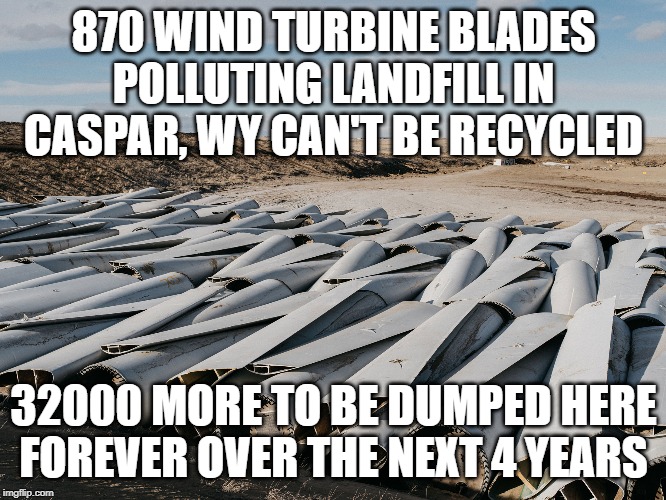
Building a single 100 Megawatt wind farm, which can power 75,000 homes requires some 30,000 tons of iron ore and 50,000 tons of concrete, as well as 900 tons of non-recyclable plastics for the huge blades. To get the same power from solar, the amount of cement, steel, and glass needed is 150% greater.

Then there are the other minerals needed, including elements known as rare earth metals. With current plans, the world will need an incredible 200 to 2,000 percent increase in mining for elements such as cobalt, lithium, and dysprosium, to name just a few.

Where’s all this stuff going to come from? Massive new mining operations. Almost none of it in America, some imported from places hostile to America, and some in places we all want to protect.

Australia’s Institute for a Sustainable Future cautions that a global “gold” rush for energy materials will take miners into “…remote wilderness areas [that] have maintained high biodiversity because they haven’t yet been disturbed.”

And who is doing the mining? Let’s just say that they’re not all going to be union workers with union protections.

Amnesty International paints a disturbing picture: “The… marketing of state-of-the-art technologies are a stark contrast to the children carrying bags of rocks.”

And then the mining itself requires massive amounts of conventional energy, as do the energy-intensive industrial processes needed to refine the materials and then build the wind, solar, and battery hardware.

Then there’s the waste. Wind turbines, solar panels, and batteries have a relatively short life; about twenty years. Conventional energy machines, like gas turbines, last twice as long.

With current plans, the International Renewable Energy Agency calculates that by 2050, the disposal of worn-out solar panels will constitute over double the tonnage of all of today’s global plastic waste. Worn-out wind turbines and batteries will add millions of tons more waste. It will be a whole new environmental challenge.

Before we launch history’s biggest increase in mining, dig up millions of acres in pristine areas, encourage childhood labor, and create epic waste problems, we might want to reconsider our almost inexhaustible supply of hydrocarbons—the fuels that make our marvelous modern world possible.

And technology is making it easier to acquire and cleaner to use them every day.

The following comparisons are typical—and instructive:

It costs about the same to drill one oil well as it does to build one giant wind turbine. And while that turbine generates the energy equivalent of about one barrel of oil per hour, the oil rig produces 10 barrels per hour. It costs less than 50 cents to store a barrel of oil or its equivalent in natural gas. But you need $200 worth of batteries to hold the energy contained in one oil barrel.

Next time someone tells you that wind, solar and batteries are
the magical solution for all our energy needs ask them
if they have an idea of the cost… to the environment.

“Unobtanium” works fine in the movies. But we don’t live in movies. We live in the real world.

I’m Mark Mills, Senior Fellow at the Manhattan Institute, for Prager University.


via Science Matters

https://ift.tt/BgPik26

March 25, 2024 at 03:52PM