We use cookies to ensure that we give you the best experience on WUWT. If you continue to use this site we will assume that you are happy with it. This notice is required by recently enacted EU GDPR rules, and since WUWT is a globally read website, we need to keep the bureaucrats off our case!
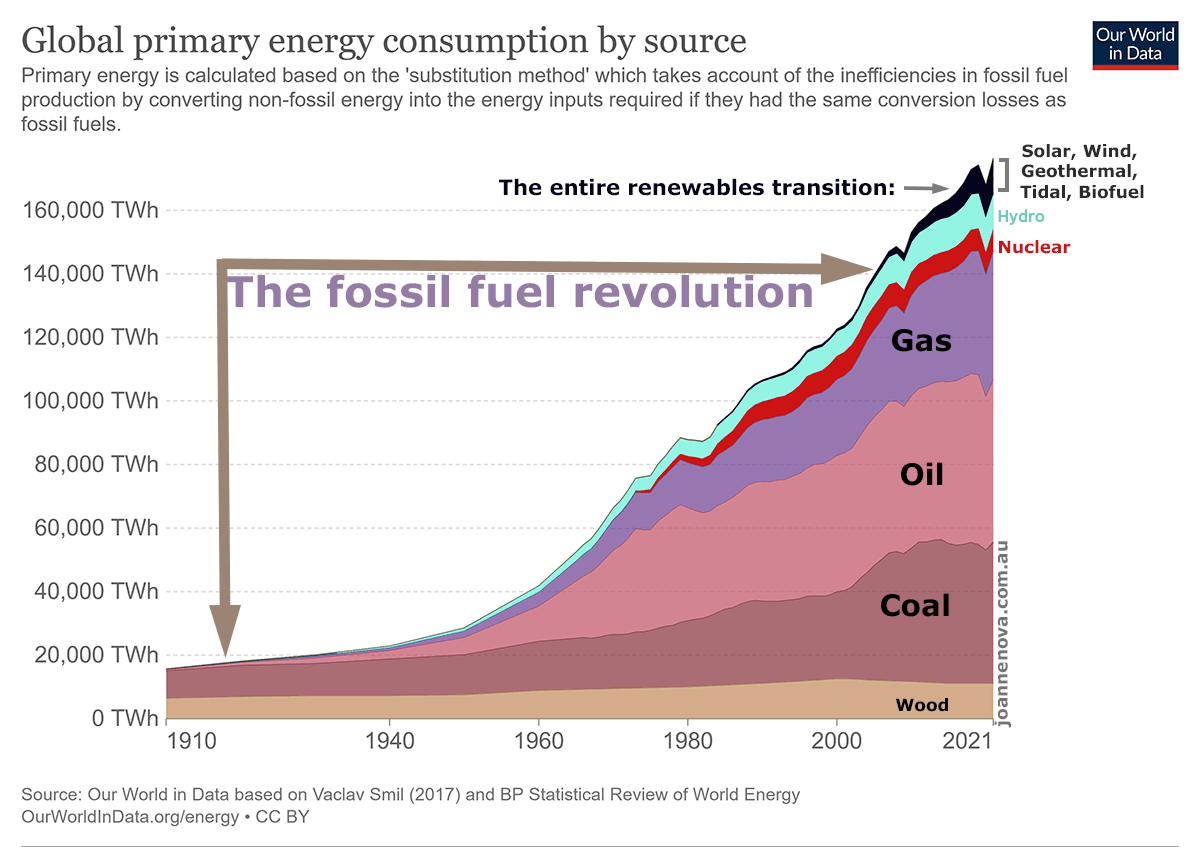
In a radical move, the CEO of an oil giant actually defended oil. The energy transition is falling apart so fast, even the prime targets of hate, the Big Oil Men themselves, are now openly pointing out what a waste of time and money solar and wind power are. Alternative energy sources have been unable to displace hydrocarbons at scale, despite the world investing more than $9.5 trillion over the past two decades. Wind and solar currently supply less than 4% of the world’s energy.
It takes more than just your average leap of logic to contend that the grand wind and solar ‘transition’ constitutes rational energy policy.
That so-called ‘policy’ means doling out massive subsidies to wind and solar generators for weather-dependent occasional power; then subsidising coal-fired power plants to stay operating to fill the ‘gaps’ caused by sunset and/or calm weather (because subsidies to wind and solar render coal-fired generators and economic as they can’t dispatch on those occasions when the wind is blowing and the sun is up); and giving further subsidies to power consumers to help them pay their crippling power bills, driven through the roof thanks to the cost of all of those subsidies and the fact that the subsidies have completely destroyed the normal on orderly marketing of electricity. Like a mangy dog chasing its tail – a completely bonkers state of affairs, from every perspective.
Alan Moran provides the backdrop for the break down in Australia’s once reliable and affordable power supplies.
Energy Policy and How to Fix it
Quadrant Online
Alan Moran
15 March 2024
Many people have personal concerns about the pursuit of green energy by governments, federally and state. The visual intrusion, the land-hungry windfarms and solar panels and the extensive enlargement of the transmission network required to accommodate them have a marked effect on individuals’ environments and livelihoods. But the more fundamental issue is the destruction of our economy and living standards from the policies being ruthlessly pursued by both Labor and – sad to say – Coalition parties and governments.
In pursuit of the myth that emissions of carbon dioxide from fossil fuels is bringing about a change in the global climate, throughout the Western world governments are spending inordinate amounts to damp down usage of coal, gas and oil, which are the cheapest means of generating electricity, the heartbeat of the modern economy.
Except to the most trivial degree, there has been no global warming or loss of coastlines. There is certainly no evidence of increased extreme events like cold, heat, fires, hurricanes or rain, despite what warmists and their shills would have you believe. And yet we have embarked upon measures that are squeezing our national living standards and, like a tourniquet, are constantly being further tightened.
These measures started small in Australia with John Howard’s introduction of a renewable energy target 20 years ago. This required wind and solar to provide 2 per cent of additional electricity. At the time, those who claimed expertise in these matters were assuring us that within a few years there would be no penalty or additional costs accruing to the adoption of this new form of energy. They told us technology developments would make it much cheaper than any other energy, some even going so far as insists that, by 2020, all the subsidies would have expired, with the industry needing no further assistance to stand on its own two feet. The government, we were assured again and again, was just giving it a filip to accelerate the progress of a transition that was already in train.
Over the years, John Howard’s small step has become a giant leap, with the attack on hydrocarbons bolstered by the continued denying of a place for nuclear, the one generation source that might match coal and gas in terms of price and reliability. Just one short-lived government – that of Tony Abbott – tried, with modest success to wind it back.
Prior to the Albanese government, we as a nation were spending $9 billion every year in measures which do nothing other than reduce our living standards and increase our costs. The subsidies to wind and solar that this stupendous sum entails are driving coal stations into insolvency as they have to back-off in the face of unfairly favoured renewable “competitors” receiving support that includes $40-plus per megawatt hour (about the same as the full total cost eight years ago before coal stations started to close) just for being able to operate. The programs fall within four types:
About $1.6 billion in grants and soft loans;
Some $4.8 billion in the cost of regulations requiring renewable energy be incorporated into electricity supplies, and the annualised costs of Snowy2 and for the expanded transmission system;
Around $1.4 billion in state schemes (which are a mix of grants and regulatory imposts)
About $1.2 billion in administrative costs of managing the system through the various regulators
The outcome has seen wholesale prices of electricity increasing threefold from $40 per MWh. Every temporary dip is greeted as heralding a new low-cost future: when it emerged that prices in the December 2023 quarter were at only twice their historical levels, regulators, politicians and a supplicatory media hailed the “decline” as a harbinger of the glorious green future. That triumph, such as it was, proved short-lived and prices in 2024 have again soared. Even industry figures, normally cowed by politicians, are acknowledging the great harm to their bottom lines and businesses and calling out the dangers of relying on inherently unreliable wind and solar.
But the Albanese government under the Svengali and serial ministerial failure, Chris Bowen, has turbocharged the carbon abatement programs crippling energy. It has
Vastly increased direct and regulatory enforced expansion of the transmission lines in an attempt to allow wind and solar to work;
Established measures to combat objections to intrusive wind farms and transmission lines;
Refused to introduce requirements for the rectification of land and safe disposal of the materials used in wind and solar facilities;
Introduced costly requirements on firms to identify the emissions of their own activities and of those of their suppliers and customers.
In addition, two new schemes have been introduced by the Albanese government. One is the Safeguard Mechanism whereby the top 215 companies must reduce their emissions by an additional 5 per cent per year to 2030. The annual costs of this depends on the price of the Australian Carbon Credit Units with which the targeted firms are presumed to buy in order to offset their liabilities. Some 200 million ACUs will need to be bought by 2030. In the unlikely event that their price will remain at its present $37.75, the cost is $906 million per annum.
The second major initiative is the recently announced Capacity Investment Scheme (CIS). Introduced as an initiative to “firm-up” renewables with batteries and other emission-free support for wind and solar, most of the estimated $68 billion spending targets additional renewables. Its aim is to “de-risk” investments by providers, ergo putting the financial risk on governments. Competing bids will be called for in a series of auctions for these government contracts (which will, by definition, be at above-market prices).
Estimating the costs of the CIS is even more difficult than is normally the case since the government refuses to release its budget, although it did indicate the program will bring additional spending on renewables and batteries to the tune of some $68 billion over six years. Informed estimates suggest that this is likely to cost electricity consumers about 55 per cent of the annual $10.3 billion per year to be spent — $5.775 billion per year. A government webinar on the CIS cast no light on the implications for existing transmission users from new suppliers receiving even more generous subsidies than those of the present schemes for large scale wind and solar.
So, the $9 billion a year in subsidies, going almost entirely to wind and solar, that the Albanese government inherited has now grown to at least $15.6 billion. To provide the batteries or pumped storage to firm-up intermittent wind/solar sources of energy would cost far more even than this. The renewables-sympathetic Global Roam consultancy, using highly optimistic assumptions, estimates battery back-up equivalent to 70,000 Hornsdale Tesla batteries. That would put the cost at $6.3 trillion – or three-times GDP. On top of all this are other measures like support for EVs and consequent tax increases on petrol and diesel vehicles and bans on the exploration for and use of gas.
But, placed in context, the $16 billion a year costs tower above the replacement cost of the existing coal capacity, which supplies 65 per cent of the generated electricity. At $6,000 per kw, replacing existing coal capacity would cost some $130 billion dollars. Furthermore, much of the existing coal-generated capacity remains highly reliable, cost-effective and need not be replaced for 20 years or more.
The measures drive price increases, with the presently observed doubling of wholesale prices just a down payment. Already we are seeing energy-intensive industries such as smelting, once the acme of Australia’s secondary industry, surviving on life support with government subsidies that pick up the costs to these industries incurred by the subsidies to wind and solar. Such support will be needed in an increasing range of productive activities that are subject to international competition.
The measures have been put in place by politicians with no knowledge of the energy sector’s costs and how it works. Politicians have been pressed in this direction by so-called experts, supported by and bankrolled by subsidy-seekers, who see the global warming con as a means to promote particular forms of energy and their preferred governing system.
The $16 billion a year in subsidies through regulations forcing the use of wind and solar and direct spending of taxpayer money is unlike other wasteful government spending. It is spending aimed at poisoning the once highly competitive low-cost electricity supply industry. It is akin to government forcing the nation to manufacture bombs to be dropped on the people financing them.
Should we ever elect a government that recognises the folly of these policies, its attempts to wind them back will confront considerable obstacles. Among these are the ideologists and vested interests in maintaining the existing policies. Renewable energy outfits, traders and those geared up to install batteries and transmission lines will campaign against them. So too will those who have extracted lengthy contracts from or with the assurances of governments. The union-controlled superannuation funds are heavily invested in renewables carrying “certain” (i.e. government guaranteed) returns and will exercise immense pressure.
Any Australian government that seeks resolute action to correct today’s disastrous course would only be able to resist these pressures if developments present clear and obvious pictures of the outcomes of these mistaken policies. One such outcome would likely involve a severe economic downturn and/or external pressures on sovereignty. But even this would be preferable to a long, slow decline that has confronted countries like Argentina, which regressed from a wealthy nation into a Third World economy due to progressively more harmful regulatory and redistributive policies from which the benighted nation could not extricate it. Is that really the future we seek for Australia? Quadrant Online
Looking Back on 500 Issues, Celebrating a Milestone
Video of the Week: Climate Fact Checks with Guest Steve Milloy of Junkscience.com
Geologists Reject Anthropocene Label
Climate Change is Not Making Disasters Worse, Other Human Actions Are
Podcast of the Week: Climatosis, Fossil Fueds, & Missy’s Twitch (Guest: Jon Pepper)
Climate Comedy
Recommended Sites
Watch ALL the Presentations by the ALL-STARS of Climate Realism at the Archive of Heartland’s 15 Climate Conferences
Looking Back on 500 Issues, Celebrating a Milestone
Climate Change Weekly (CCW) has reached a milestone, its 500th edition. Joe Bast, the founder and first president of The Heartland Institute, charged James Taylor, then managing editor of Heartland’s Environment & Climate News (now its president), with creating a weekly newsletter highlighting and summarizing important stories and research about climate science, economics, and policy each week.
Over time, CCW has become Heartland’s most widely read, longest continuously running newsletter—telling you the importance and continued relevance of the topic, its ongoing interest to readers, and, for good and bad, the copious amount of material we’ve had to write about. CCW currently has more than 6,000 weekly subscribers and many more readers online.
Joe Bast used to tell me “we’ve won the war on climate change,” yet the battle still proceeds apace, sadly displaying that facts either take a while to sink in, or don’t easily displace firmly held lies backed by powerful interests. I would honestly like to put this apocalyptic climate change fairy tale to bed once and for all, and write instead on other environmental topics that I think are important but flying under the radar—but we still have to fight.
My mom used to work for a Social Security judge. Over lunch one day I asked her how she felt about me working for an organization that was fighting to put the Social Security system out of business, and thus her out of work. She just laughed and said “Do your worst son!” She knew the Social Security system wasn’t going away any time soon, and that’s how I feel about climate change. As long as there is money and power at stake, regardless of the facts, as an issue and policy it will be around. Sad but true.
Which brings us to CCW’s continuing importance. Facts, data, and evidence must be brought to bear repeatedly, the light must be shined on falsehoods over and over, in order to finally vindicate the continued use of fossil fuels and their critical importance to humanity. As a trained ethicist, to me the defense of fossil fuels and the need to take down climate lies is not about economic efficiency—though that’s important, or environmental quality—although I care about that. It is fundamentally about human well-being. Banning the use of fossil fuels will make people poorer, society less well off, and cost lives, possibly in the millions; it will also rob people of the essential freedom of choice. Also, ending fossil fuel use won’t change the weather or control the climate—so the effort is all pain, no gain. That is what is at stake.
Looking back over past issues CCW has evolved in form, a bit. When Taylor first started writing CCW, it usually consisted of a lead essay of about 500 or 600 words, and usually five or six single-paragraph summaries, though in a few issues I found as many as nine separate summaries, covered in a total of about 1,600 to 1,800 words. Over time, the lead essay expanded by a couple of hundred words and the number of summaries dropped to four or five an issue, with the research or policies referenced discussed in more detail.
As I write CCW today, the lead essay is sometimes as long as 1,200 words, though I try to limit myself to 1,000, and four summaries are usually the maximum number, although it is usually two or three. My goal for the summaries is, if the readers read my summaries, they don’t have to (although they can) read the underlying research or story themselves. I try to give them all the important facts. Perhaps because I’m not as concise a writer as Taylor, each issue now comes in at around 2,000 words. Fewer topics covered, but more detail provided.
Over time, as new issues arose, CCW has addressed them. When Taylor was writing CCW, ESG, government efforts to push electric vehicles, and lawfare, the use of lawsuits by city and state governments, and private parties supposedly representing youths, had yet to become issues. They have become regular topics of discussion and analysis in CCW in recent years. In 2014, when I took over CCW, government efforts to shut down coal and natural gas powerplants through the power of the pen, regulations, and executive orders—not laws—were in their infancy. They have since become pervasive and all too successful, despite Heartland’s best efforts to publicize how dangerous the policy is.
When James was writing CCW, the Kyoto Climate Treaty was the international bete noire. Now we dismantle and mock the Paris Climate Agreement, which has failed as badly as the Kyoto treaty did.
Sadly, despite CCW’s repeated refutations of false claims of climate disaster and its presentation of peer-reviewed climate research that undermines the constant claim that there is a consensus that humans are causing catastrophic climate change, many of the false narratives debunked in CCW’s early years still regularly arise after 13 years of exposing them as lies.
For example, in issue 135, the last with Taylor at the helm, he discussed polling which showed people don’t care much about climate change and are unwilling to pay much to fight it. Since that time, the media has repeatedly claimed climate change is an existential threat that the public cares about and wants the government to do something about. But in truth, the polling hasn’t changed. People still rank climate change near last or dead last among the issues of concern they want politicians to address, and are still unwilling to pay much to fight it.
My first issue (CCW 136) discussed the urban heat island effect. After more than 20 years of discussion, and multiple peer reviewed publications exposing how it biases the ground-based temperature record, government scientists have still stubbornly refused to acknowledge the scope of the problem, or stop using woefully, badly-sited temperature stations that skew the reported average temperature record upward.
When Taylor wrote, CCW discussed the Climategate scandal. Since that time, we’ve had Climategate 2.0 and 3.0. Early CCWs regularly reported on data and research which directly refuted claims that climate change was: making hurricanes, tornadoes, wildfires, floods, and other natural disasters worse; that it was causing more deaths from weather and heat; and, that it was causing a dangerous decline in crop production. The same false claims continue to be made today, 13 years later, even though additional years of data still show people are living longer, fewer people are dying from temperature-related illness or extreme weather, crops are setting records, and natural disasters have not become more frequent or severe. It seems that the truth is less immediately compelling than one might hope.
The work The Heartland Institute does is important, and after 500 editions, CCW still continues to be vital to that work; the work of advancing personal liberty and economic freedom by promoting good public policy and fighting against laws and regulations that limit freedom and economic progress.
Get your Copy at Amazon TODAY!
Video of the Week
Climate Change Roundtable is now The Climate Realism Show. The same great climate news and analysis from The Heartland Institute’s world-class climate and energy experts, but a snazzy new name that gets right to the heart of what it is about. On episode 102 of The Climate Realism Show, we do a “Climate Fact Check” with Steve Milloy of JunkScience.com ffor some recent claims that have been made in the media.
Read the brutal truth about how battery production for electric vehicles cause immense environmental destruction and human tragedy.
Geologists Reject Anthropocene Label
For at least a decade and a half, those pushing the narrative that climate change poses a catastrophic threat to the Earth and all its inhabitants have argued the current period of geologic time should be referred to as the Anthropocene, implying that the impacts of human activities have become so profound and pervasive it should mark a change in how geologists refer to the present epoch. Their argument is that we have crossed a boundary in the way the Earth’s biosphere functions, its ecosystems interact, and living beings survive (or don’t) and flourish or decline.
Geologists, the official “keepers” of the geological timeline, who label epochs, have now spoken on this claim, rejecting it soundly.
The question of when epochs change and the causes of that change are important, shaping the “terminology in textbooks, research articles and museums worldwide,” notes The New York Times (NYT). “It would guide scientists in their understanding of our still-unfolding present for generations, perhaps even millenniums, to come.”
We are currently in what geologists have labeled the Holocene, an interglacial cycle that began about 12,000 years ago, ending the last major ice age. Proponents of the view that humans are causing profound, calamitous, climate change proposed that geologists recognize the impact of the rise of human civilization, particularly after the first atomic bomb was tested, as marking a new epoch; one where the planet’s biosphere is no longer dominated by nature and the cosmos, but by humankind.
After 15 years of studying and debating the issue, a panel of experts with the International Commission on Stratigraphy (ICS, which governs the labeling of the geologic timescale), said the recent period is not that unique or consequential. Humans impacted the Earth long before either atomic testing or climate change became a concern. Our development has depended on and continues to be interwoven with nature. Reporting on the ICS panel’s decision, the NYT writes:
Is it time to mark humankind’s transformation of the planet with its own chapter in Earth history, the “Anthropocene,” or the human age?
Not yet, scientists have decided, after a debate that has spanned nearly 15 years. …
A committee of roughly two dozen scholars has, by a large majority, voted down a proposal to declare the start of the Anthropocene, a newly created epoch of geologic time, according to an internal announcement of the voting results seen by The New York Times.
The vote wasn’t even close. The ICS panel rejected the proposal to label the period since nuclear bombs were first tested as the Anthropocene, by a vote of 12 against, four in favor and two abstaining, and three neither voting nor officially abstaining.
The New American quotes two scientists discussing the decision:
“The decision is definitive,” says Philip Gibbard, a geologist at Cambridge and a member of the ICS. “There are no outstanding issues to be resolved. Case closed.”
“The Anthropocene epoch was pushed through the media from the beginning—a publicity drive,” said Stanley Finney, a stratigrapher at Cal State Long Beach and the head of the International Union of Geological Sciences.
Geologists understand perspective. Humans undoubtedly have a huge impact on the planet, but it is not significant enough to have overtaken nature or be taken note of from a geologic perspective.
Climate alarmists would have one believe that humans control Earth’s thermostat and threaten its ability to sustain life. This is false. Geologists have looked at the past history of the Earth’s changes and determined that the human impact on earth just doesn’t fit that scale of change. This thoroughly refutes the climate alarm narrative.
A ruling at this time doesn’t mean that in the future the ICS won’t reconsider its decision should additional evidence indicate epoch relabeling is merited, but for the present time the issue is settled as a matter of geology—unless the ICS as a whole rejects its panel’s overwhelming decision, which is not expected.
Climate Change is Not Making Disasters Worse, Other Human Actions Are
Ted Nordhaus, director of the Breakthrough Institute, goes through extreme weather event after extreme weather event using data and historical documentation in an article in The New Atlantis to show that climate change is not making weather-related disasters worse and that human lives are in fact improving even as the climate warms. Having said that, some decisions and actions humans are taking are making natural disasters more costly, in terms of dollars if not lives.
In “Did Exxon Make It Rain Today?,” Nordhaus uses historical documentation and data to make three main points: “Headlines blaming extreme weather on climate change don’t hold up,” there is “peril” in catastrophism, and “we’re actually safer than ever before.”
Nordhaus first refutes the near constant drumbeat of environmental alarm that extreme weather events are becoming more frequent and more deadly. As he explains:
[T]he list of the worst climate-related disasters in U.S. history, those that claimed a thousand or more American lives, is dominated by events that occurred before 1940. There were hurricanes in 1893, 1893 again, 1899, 1900, and 1928; heat waves in 1896 and 1936; floods in 1862 and 1889; and wildfires in 1871 and 1918. By contrast, since 1940 only three climate disasters have claimed a thousand or more lives: a heat wave in 1980, Hurricane Katrina in 2005, and Hurricane Maria in 2017.
The story is much the same globally. Two climate disasters have claimed a million or more lives, both of them floods in China, in 1887 and 1931. Tropical storms in South Asia claimed multiple hundreds of thousands of lives in 1737, 1839, and 1876. The more recent climate catastrophes with comparable death tolls, such as the cyclone that killed up to half a million people in what is now Bangladesh in 1970, and the typhoon and resulting dam failure that took a similar toll in China in 1975 amid the chaos of the Cultural Revolution, have reliably occurred at the intersection of poverty, dense population, inadequate infrastructure, and failing political institutions.
It should be noted that each of the pre-climate-hype disasters occurred at a time when the human population and population density were much lower than at present.
Concerning various types of extreme weather events or climate-related “disasters,” wildfires, cyclones, and floods, Nordhaus explains they have, by and large, not become measurably more frequent or severe.
In my view, the most important point in Nordhaus’s essay concerns society’s resilience in the face of climate change, regardless of the cause or type of change. He writes:
The implications of this point will be counterintuitive for many. Yes, there are many types of disasters, like hurricanes and floods, that are causing greater economic costs in many places than they used to. But this is almost entirely because the places that are most exposed to weather disasters have far more people and far more wealth in harm’s way than they used to. Even if there were no global warming, in other words, these areas would be much more at risk simply because they have much more to lose.
Once you factor out how many more people and how much more economic activity are in exposed areas, the economic costliness of weather extremes in recent decades has generally been flat or declining, not rising. The human costs, meanwhile, measured by deaths associated with climate and weather extremes, have fallen dramatically over the last century. Improving infrastructure and technology have made most people much more resilient to climate hazards today, even in relatively poor regions and even as the climate has warmed.
Still, there has been no shortage of tragedies associated with extreme weather events in recent decades. But where they do occur, it is almost entirely due to failures of institutions and infrastructure, not the additional extremity of the weather event due to climate change.
Nordhaus is not the first scholar to make these points. Climate Realism has repeatedly made these points, providing links to data and copious research that make the case that despite modest warming, humans are doing better and, where costs of natural disasters are rising, it is due to the expanding bullseye effect of more people living in. and more infrastructure being constructed in, areas already prone to natural disasters.
Host H. Sterling Burnett speaks to author Jon Pepper has written a series of books that explores the trials and tribulations of the energy industry in a highly politicized age, the newest of which, “Missy’s Twitch,” explores a young woman’s passage from indoctrination and climate alarm induced spasms, to awareness of the lack of compelling evidence for climate alarm, and the toxic politics surrounding the issue.
The book is at turns hilarious and disturbing in the picture it paints of the current state of energy and climate politics, along the way presenting some caricatures of politicians and business interests who even the casual reader should be able to identify from real life, mocking them appropriately.
Subscribe to the Environment & Climate News podcast on Apple Podcasts, iHeart, Spotify or wherever you get your podcasts. And be sure to leave a positive review!



 Iowa Climate Science Education