Month: May 2024

The (Anti) Social Cost of Carbon

By Jonathan Lesser

Forty-two was the mystical number that explained “life, the universe, and everything” in Douglas Adams’ comic novel, The Hitchhiker’s Guide to the Galaxy.  Today, another mystical number, the so-called social cost of carbon (SSC), is providing the excuse for the Environmental Protection Agency and green-energy-enamored state regulators to enact crippling energy policies.

The SCC is the thumb on the scale that can justify virtually any policy aimed at eliminating fossil fuels. When the EPA first proposed its rule to reduce mercury emissions from coal-fired power plants, the agency’s cost-benefit analysis determined the benefits would be minuscule. Any putative benefits, it turns out, would come instead from reductions in carbon emissions and, here’s the key, based on a calculated value for the SCC.  The same was true for the EPA’s earlier attempt at carbon regulation via a “Clean Power Plan,” which was shut down by the Supreme Court. But here we are again with the agency’s newest rules trying to force coal plants to further reduce mercury emissions and to force both coal and natural gas-fired power plants to capture 90% of their carbon emissions. The technology to accomplish this doesn’t exist and EPA Administrator Michael Regan admitted the rule will force the closure of fossil-fuel power plants.

The SCC values used by the EPA are derived from calculations in integrated planning models (IPMs). Those models assume a simplistic linear relationship between carbon emissions and world temperature (never mind that the validity of that linear assumptions is a subject of deep debate in scientific circles). The models then assume that the resulting temperature increases cause all forms of environmental doom – rising sea levels, more disease, and declining agricultural production – for which yet more estimates are made to assign future cost consequences. Here’s the key: the IPMs project these costs out for the next 300 years (not a typo). Then, those far future costs are “discounted” to estimate a value in today’s dollars by using truly absurd assumptions about such things as inflation and economic growth.

A tongue-in-cheek forecaster’s creed is “Give them a number or give them a date. Don’t give them both.” Attempting to predict the future three centuries hence may be standard fare for science fiction writers, but basing energy policies on such predictions is insane.

Imagine someone in the year 1724 predicting life – and technology – today. Benjamin Franklin was 18 years old and working in his father’s print shop. George Washington would not be born for another eight years. The French scientist Antoine Lavoisier, who first identified carbon as an element in 1789, would not be born until 1743. The first patent on a flush toilet would not happen for another half-century. Thomas Edison would not invent the light bulb and the telephone for another 150 years. Could anyone in 1724 have imagined automobiles, mobile phones, and MRI machines? How about integrated circuits, nuclear power, and B-2 bombers?

To presume we can accurately predict, or even imagine, what the world will look like 300 years from now is just as preposterous. Yet, simplistic models and arbitrary assumptions are being used to drive energy policy decisions today. Using the SCC estimates, and assuming that new technologies will magically appear, the EPA can justify virtually any pollution control regulation, including those that effectively mandate electric vehicles. Similarly, even though offshore wind generation costs five times more than natural gas and coal, the SCC can “prove” the benefits of offshore wind exceed its costs. New York State, for example, assumes that, by 2040, thousands of megawatts of “dispatchable emissions-free generators” (the equivalent of a natural gas generator burning pure hydrogen) will provide the necessary backup for unreliable offshore wind, even though no such generators exist.

Contrary to the economic fantasies peddled by green energy advocates, policies to eliminate fossil fuels based on the supposed benefits captured by the SCC will cripple the U.S. economy. Electricity prices, coupled with ill-considered plans to electrify virtually everything, will soar. Supplies will dwindle, requiring rationing, either explicitly or through rolling blackouts, such as those experienced every day in South Africa. Rather than creating some green energy nirvana, the lack of adequate and affordable electricity will cause societal decay.

All of this based on a made-up number. 

Jonathan Lesser is a senior fellow with the National Center for Energy Analytics and president of Continental Economics.

This article was originally published by RealClearEnergy and made available via RealClearWire.

via Watts Up With That?

https://ift.tt/B2UsTeN

May 9, 2024 at 04:08PM

Asia Embraces Coal as the U.S. Rejects It

By Vijay Jayaraj

Vietnam and other Asian countries are on a coal spree! Given the dynamics of energy use in the rapidly developing industrial sector there, it is no surprise that these nations have backpedalled on big promises made at international climate conferences to reduce emissions of carbon dioxide from fossil fuels.

Vietnam’s projected 2024 growth rate for Gross Domestic Product (GDP) stands at 5.8%, the sixth highest in Asia. Among the biggest contributors to GDP is the industrial sector (38 percent), especially manufacturing. S&P Global has noted a considerable improvement in Vietnam’s manufacturing sector in the fourth quarter of 2023 and is expecting Vietnam to perform well this year.

Electricity is a cornerstone to manufacturing operations in Vietnam. In 2023, coal produced more than 40% of all electricity in the country, while the country’s abundant hydro reserves contributed around 30%. Natural gas accounted for about 10%.

However, 2024 is expected to see a shortfall in hydroelectric generation because of less rainfall. Simultaneously, electricity production with natural gas is being complicated by forecasts of higher gas prices. Bloomberg reports that state-run PetroVietnam Gas “recently decided not to purchase a cargo for June due to high offer prices.”

So, the heavy lifting to meet power demand must now come from coal. The country is urging coal miners to maximize production before demand reaches peak in the summer months. The country’s prime minister has asked for an increase in coal exploration as well, signalling a sustained interest in medium to long-time reliance on coal.

Vietnam’s move to increase coal use was inevitable. It cannot continually risk a huge demand-supply gap whenever dams go dry or gas prices skyrocket. The growth rate of power demand from expanding industries is increasing at a fair pace, and energy security is critical in ensuring manufacturing’s positive trend.

Similar Pattern Across Asia

Across Asia, a similar phenomenon is unfolding. The regional coal resurgence can be attributed to the rapid economic growth in these countries. China, the world’s largest coal consumer, witnessed a rise in consumption in 2024. Earlier this year, reports showed the construction of dozens of new coal plants in China. In 2023, the country accounted for 95% of construction of the world’s new coal power plants. There are a total of 1,142 operating coal-fired plants in China, which is five times more than in the U.S.

India, another major player in the Asian energy market, also saw an increase in coal imports and production. India has increased its spending on infrastructure, with an expected rebound in demand for coal-based steel and raw material manufacturing. Indonesia has 254 operational coal-fired power plants and 40 new plants under construction. Japan, too, is a big consumer of coal, being the top importer of Australian coal in recent years.

Like Australia, the U.S. has been a top source of coal imports for these Asian countries. S&P Global says, “U.S. metallurgical coal exports have seen growth fueled by Asian demand over the past few years. The potential for seaborne volumes to grow hinge on expansions in blast furnace steelmaking and met coke production in India, China and Southeast Asia.” New mines such as Arch Resource’s Leer South and the AMCI, POSCO and Itochu-led Allegheny Met’s Longview mine will play a role in meeting this demand from Asia.

It is an irony that U.S. miners are able to meet Asian needs while their own government rejects them as a fuel source for cheap electricity!

The advancement of recent emission-reduction targets for U.S. industry, as well as restrictions on the export capacity of natural gas by the Biden administration is quite astonishing in light of the ongoing expansions in fossil fuel capacity by various Asian nations.

The quality life for millions of Americans could very well decline in return for zero environmental benefit as that of Asians improves.

This commentary was first published at Real Clear Energy on May 8, 2024.

Vijay Jayaraj is a Research Associate at the CO2 Coalition, Arlington, Virginia. He holds a master’s degree in environmental sciences from the University of East Anglia, U.K.

via Watts Up With That?

https://ift.tt/StWINDn

May 9, 2024 at 03:18PM

Cats, dogs, rabbits, geese and frogs lived in the high Arctic during a hotter era 9,000 years ago

By Jo Nova

This new study pokes holes in the dogma five different ways

Credit to Kenneth Richards who found the study and discussed it at NoTricksZone

Bones in a cave inside the Arctic circle show that the world was hotter, the climate is always changing, and life adapts very well.

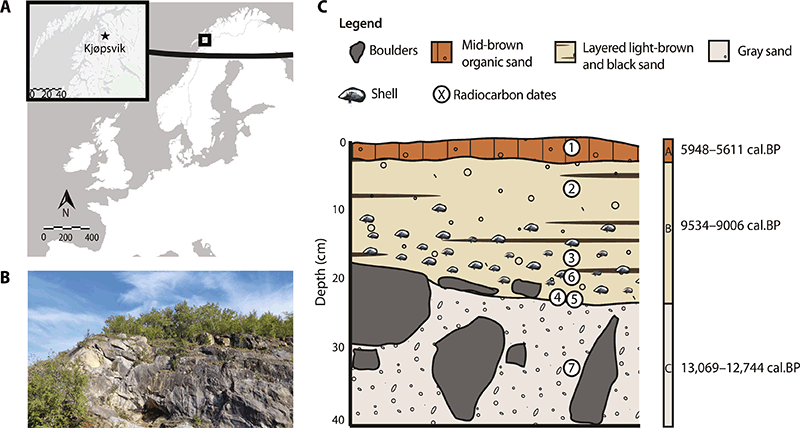
A special cave in far northern Norway has a a trove of thousands of old bones. They are deposited in layers that stretch back from 5,800 years ago to 13,000 years ago.  And it’s been a radical change: at the start, the cave was submerged under the ocean, so the bones are mostly marine species. But a few thousand years later the weather was warm, and birds and mammals had moved in. By 6,000 years ago the researchers estimate it was the hottest part of the holocene and 1.5°–2.4°C warmer than the modern era of 1961–1990.

After that, the cave was blocked by scree, and the bone fragments sat there seemingly undisturbed for nearly 6,000 years while the ice sheets moved and the Vikings came and went. Then in 1993 someone happened to build a road nearby. Now a team have analysed the DNA in the layers and discovered that far from being an ecological disaster, when the Earth was hotter the Arctic must have been full of life. They found lemmings, shrews, voles, hares, geese, frogs, seals, and pheasants. They were also surprised to find dogs and cats there, even though there were no humans at the time. The DNA test couldn’t distinguish whether these were our domesticated furry friends or their wild cousins. In any case, there were species that lived there then, that don’t live there now because it’s too cold.

Some of these species are headed northward again, and small children at universities are probably being frightened and told this is “unprecedented”, but the truth is that the Holocene really was hotter than today, and some of these species were seemingly happy about that for thousands of years. The other truth is that climate change happens naturally, even without SUV’s, and that species have migrated. Climate modelers have been trying to erase the Holocene period for ten years, because it was hotter than now, but CO2 levels were lower. When they are not denying it happened, they call that mismatch “the Holocene conundrum”.

Remember all the panic about animals being climate refugees forced to move because we drive cars? Well they’ve been there before.


In the press release the researchers put in all the usual inappropriate warnings about how climate change is real, and this study can’t be used against the (billion dollar) climate activist industry. It just reminds us how captured science is. Let the hostages speak:

She emphasizes that what happened to the climate after the last ice age cannot be used to take away the seriousness of what is happening as a result of current anthropogenic .

“But this knowledge can help us to better analyze how climate change will affect in the future,” says Boessenkool.

But the truth seeps out anyway — the species today are just returning towards areas they lived in thousands of years ago:

The species they list from this layer [5,800 years ago] include forest birds such as grouse and a genus of fish called Seriola (amberjacks), which is also now heading north again with a warming climate.

“We see that some of the species that are moving northwards today have been here before. We know that it was warmer in the past, but we don’t have a full overview of which animal species existed this far north,” explains Boilard.

Somehow freshwater fish colonized the area “immediately” after the ice retreated. Ain’t life remarkable?

The researchers also found remains of freshwater fish from a remarkably early phase.

“In the deposits dating back 9,500 years, we found remains of freshwater fish. We don’t know for sure how these fish migrated into Norway after the glaciers melted. But we see that freshwater fish arrive very early in the north, almost immediately after the ice disappeared,” says Boilard.

The changes at this one site are just extraordinary. We humans have some crazy idea that the land and oceans we see today have always been that way:

The lowest and oldest sediment layer examined was 13,000 years old. At that time, the sea level was above the opening and the climate was colder than today. In this layer the researchers only found fish species that are adapted to cold conditions, such as cod and ling.

Due to land shifting and ice melting the relative sea level was 90 meters higher… then the ice sheet advanced again:

Layer C (13,069–12,744 cal B.P.) coincides with the Late Glacial interstadial (14.0–12.9 ka), a period of mixed climatic conditions during which the Scandinavian Ice Sheet margins retreated rapidly and the relative sea level rose to ~90 m higher than present day (35, 45). In the vicinity of Nygrotta, the ice sheet had retreated deeper into the fjord, and exclusively marine-related species recovered from the sand deposit in layer C support its interpretation as shallow marine sand and Nygrotta being submerged at the time. Shortly after the deposition of layer C, the Scandinavian Ice Sheet readvanced again in the transition to and during the early part of the Younger Dryas stadial

For the cat lovers, the researchers did get excited that they might have found the furthest north and earliest evidence of Felis Silvestris, though poor old Felis was wiped out at the end of the Holocene maximum as temperatures fell again:

If the Nygrotta samples represent wildcat (F. silvestris), then this would be remarkable, as this would be the highest latitude location for this species ever (74). The potential authentic identification of wildcats is an exciting prospect as remains across Europe are scarce (74, 75). In Fennoscandia, the species has been recorded in Sjælland, Denmark, as part of the boreal fauna dated to 9.5 ka B.P. (24). In Norway, wildcats have only been found at three sites: Vistehola [~8.5 ka B.P.; (31)], Auve [(5–4 ka B.P.; (76)], and Årdal rock shelter (4–3 ka B.P.; Archive University Museum of Bergen)—all in southern Norway approximately 850–1000 km south of Nygrotta. The last evidence of wildcats in Fennoscandia comes from the site of Næsbyholm, Denmark, and dates to 2000 cal B.P. (7779). The species became extinct in Fennoscandia following the end of the HTM, as temperatures dropped and snow cover increased above the wildcat threshold of 20 cm over a 100-day period (75, 80). Estimates of past wildcat habitat limited their past distribution to the southwest coast of Norway (81), but our potential finding of wildcats at Nygrotta suggests that their range may have extended much further north already during the Early Holocene, at least along the coastline. Such early presence of wildcats would also be evidence for relatively low amounts of snow cover along Norwegian coastlines during this time and would suggest that the boreal pine and birch forests in Norway from 8 ka B.P. (82, 83) provided suitable habitat for this species.

It also opens the novel idea of using cats as a proxy for snow-cover.

And if anyone wonders if the Holocene warming was just a Norwegian thing, there are many more Holocene markers all over the world. 6,000 years ago the world was so much warmer, the Sahara was lush green and wet. Sea levels were 1 – 2 meters higher around Australia, temperatures were warmer in Greenland and in Vostok, and people saw a wave of warmth in 6,000 boreholes drilled across 6 continents. The deepest oceans around Indonesia were 2 degrees warmer 10,000 years ago. Pacific Islands were born in the last 5,000 years as the oceans cooled and shrank. And fires were far worse 4,000 years ago in Northern Australia.


REFERENCE

Aurélie Boilard et al, Ancient DNA and osteological analyses of a unique paleo-archive reveal Early Holocene faunal expansion into the Scandinavian Arctic, Science Advances (2024). DOI: 10.1126/sciadv.adk3032

Press Release https://ift.tt/fm76aq4


0 out of 10 based on 0 rating

via JoNova

https://ift.tt/DuLthnq

May 9, 2024 at 02:52PM

£100 MILLION FOR THE WINNER

Firms are beavering away trying to find the best way to capture CO2 and remove it from the atmosphere. You can see how they are doing at this link (from Renewable Guy) 

Musk-backed Xprize carbon removal competition… | Canary Media

I could not find any specific amount of CO2 which they are required to remove, or the cost of it or who is going to pay for it. Even Elon Musk would not be able to afford that! I look forward to China, India and Russia etc, paying their contribution. Or will they be given a free pass?

via climate science

https://ift.tt/RqK2lpL

May 9, 2024 at 02:51PM