Month: May 2024

Is UK Rainfall Becoming More Extreme? Not at Oxford.

By Paul Homewood


It’s worth taking a closer look at daily rainfall in Oxford, as it has such a long database, back to 1827. It tells us a lot about the weather in recent years, things that the Met Office want to hide from us.

Although we keep being told by the Met Office that our weather has been so wet in recent years because a “a warmer atmosphere can hold more moisture”, the principal factor is, and always has been, the number of days when it rains. In other words a meteorological phenomenon, not a climatic one.

The general definition of a rainday is when rainfall exceeds 1mm. The chart below plots these at Oxford. Data is from KNMI:


image

https://climexp.knmi.nl/data/pgdcnUK000056225.dat

Last year was 5th wettest and also featured high in the number of raindays. The years 2000, 2012 and 2014 also feature highly, as well as earlier ones such as 1872, 1916, 1927, 1951, 1958 and 1960.

Some periods have plenty of raindays, others much less. But there is no apparent trend in either direction.

But we can also analyse the average rainfall intensity, that is rainfall per rainday:

image

Last year had one of the highest intensities, in large part because spring and early summer was so dry. These are the times of year when daily rainfall is low, with mainly showery weather, so the overall average is bound to be exaggerated. But 2023 was by no means unusual, as there have been other years with similar rainfall intensity, such as 1915, 1949 and 1960.

More notable though is the occurrence of those years in the 1830s, when rainfall was clearly much more intense. Hardly evidence for the Met Office’s theory!

All of this is, of course, weather. I defy anybody to find a pattern or trend towards rainfall becoming more intense in Oxford in the above chart.

Again the overall trend suggests that rainfall intensity has been declining over the period of record.

Maybe the Met Office would like to explain.

via NOT A LOT OF PEOPLE KNOW THAT

https://ift.tt/7Hba6eo

May 9, 2024 at 01:10PM

The World’s Largest Floating Solar Farm Wrecked by a Storm Just Before Launch

Essay by Eric Worrall

h/t Dr. Willie Soon; Who could have predicted acres of fragile floating structures would be vulnerable to bad weather?

Madhya Pradesh: Summer Storm Damages World’s Largest Floating Solar Plant at Omkareshwar Dam (Watch Video)

Indore: A summer storm on Tuesday damaged a floating solar plant at Madhya Pradesh’s Omkareshwar dam. The floating solar plant, situated in the backwater of the dam, is the biggest of its kind in the world. A joint venture between  Madhya Pradesh Govt and National Hydroelectric Power Corporation (NHPC), the project was nearly completed and ready for its launch. A part of the project became operational last week.

The project near the village of Kelwa Khurd, aimed at generating 100 MW of electricity, with additional capacities of 88MW at Indawadi and 90 MW at Ekhand village. However, on Tuesday, summer storms with the speed of 50kmph hit the project and threw the solar panels all around the place. No employee was fortunately injured.

Read more: https://www.lokmattimes.com/national/madhya-pradesh-summer-storm-damages-worlds-largest-floating-solar-plant-at-omkareshwar-dam-watch-video-a514/

A video of the disaster;

Anyone who has ever owned a boat, particular a large boat which gets left in the water, knows what a harsh environment the sea can be. Some kind of failure was inevitable. If it hadn’t been a storm, there are plenty of other things which could have gone wrong.

Greens keep telling us we can expect more frequent and extreme superstorms – so what is the point of building vulnerable floating structures?

Plastics tend to disintegrate under tropical sunlight, especially when in contact with water or water spray. Ultraviolet from the sun drives exotic chemical reactions, which leads to chemical breakdown.

Metal sitting in water is difficult to manage, even stainless steel is not immune to corrosion. All metal structures in contact with water need to be protected with sacrificial anodes or comparable protective measures. Electricity and metal are an especially bad combination, any electrical fault which causes a current to run through metal in contact with water can cause corrosion to occur thousands of times faster than normal.

Let us hope developers and politicians take the hint, and stop throwing our money at inherently flawed ideas like floating solar arrays.

via Watts Up With That?

https://ift.tt/logfFRx

May 9, 2024 at 12:02PM

US Poll: Climatism Support Dropping

As the Biden administration moves forward with expensive and economically devastating regulations on vehicles, dishwashers, stoves and other major appliances under the guise of fighting “climate change,” Americans are questioning the efficiency, validity and cost of the agenda.

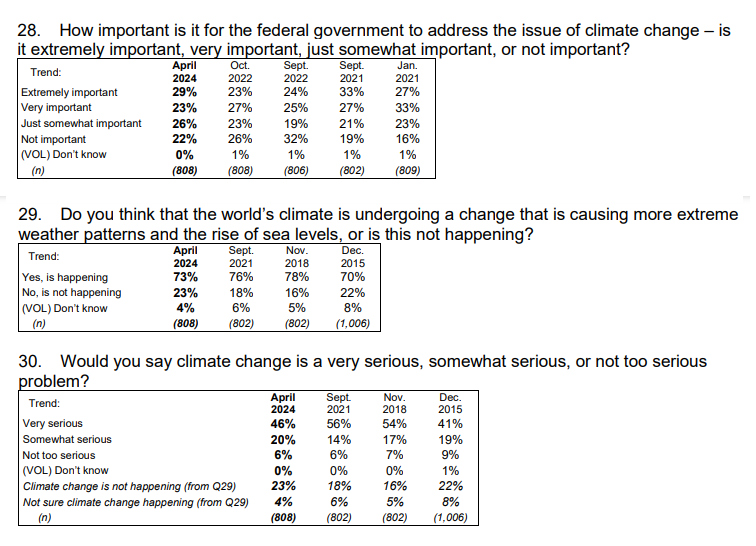
New polling from Monmouth University shows a significant drop in “serious concern” over the issue of “climate change,” particularly among young people.

National Climate Concerns Dip

Younger adults express less urgency than in prior polls

West Long Branch, NJ – Most Americans continue to acknowledge the existence of climate change, according to the latest Monmouth (“Mon-muth”) University Poll, but the number who see this as a very serious problem has fallen below half. Support for government action to reduce activities that impact the climate has dipped below 6 in 10 for the first time since Monmouth began polling this topic nearly a decade ago. The poll finds that the drop in the importance and urgency of climate change has been most pronounced among younger adults.

“Most Americans continue to believe climate change is real. The difference in these latest poll results is a decline in a sense of urgency around this issue,” said Patrick Murray, director of the independent Monmouth University Polling Institute.

METHODOLOGY
The Monmouth University Poll was sponsored and conducted by the Monmouth University Polling Institute from April 18 to 22, 2024 with a probability-based national random sample of 808 adults age 18 and older. Interviews were conducted in English, and included 163 live landline telephone interviews, 349 live cell phone interviews, and 296 online surveys via a cell phone text invitation. Telephone numbers were selected through a mix of random digit dialing and list-based sampling. Landline respondents were selected with a modified Troldahl-Carter youngest adult household screen. Interviewing services were provided by Braun Research, with sample obtained from Dynata (RDD, n=484), Aristotle (list, n=168) and a panel of prior Monmouth poll participants (n=156). Monmouth is responsible for all aspects of the survey design, data weighting and analysis. The full sample is weighted for region, age, education, gender and race based on US Census information (ACS 2021 one-year survey). 

Demographics (weighted)
Party (self-reported): 25% Republican, 44% Independent, 31% Democrat
Sex: 49% male, 50% female, 1% other
Age: 30% 18-34, 32% 35-54, 38% 55+
Race: 61% White, 12% Black, 17% Hispanic, 9% Asian/other
Education: 38% high school or less, 29% some college, 17% 4 year degree, 16% graduate degree

A Monmouth poll released last month found only 15% of voters view climate change as a determinative issue in how they will vote in the 2024 presidential election, ranking far lower than inflation, immigration, and abortion.   Compared to three years ago, climate change concern has declined by 8 percentage points among both Democrats (77% very serious, down from 85% in 2021) and Republicans (13%, from 21%) and by 13 points among independents (43%, from 56%).


My Comment:

The survey seems competent and credible.  It is obvious that global warming/climate change serves as a political wedge issue favored by Democrats and disfavored by Republicans.  Interestingly, with the decline of urgency in all groups, independents have flipped from slight majority favorable to unfavorable.

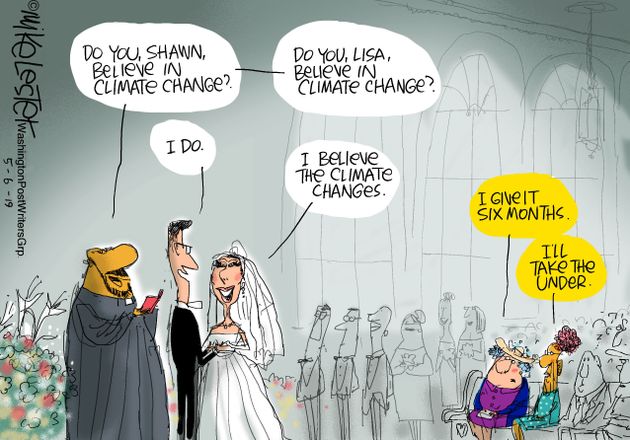
Note that climate change is undefined except as causing extreme weather and rising sea levels. I also think that the sequence of questions shows a bias for climate change to warrant governmental action.  Putting that question first sets a context for expressing belief and concern over the climate, and then sets up the final question of support or opposition. The question of human vs. natural causation includes a “Both Equally” response, which typically masks unwillingness to say “Don’t Know.”  However, even a 50-50 split between human and natural weakens the case for reducing human activity.  Then the next question about preventing climate change presumes humans are causing it and can stop it. Yet the urgency is diluted by 17% “Too Late”,  51% “Still Time” and 23% “Not Happening.”

In spite of the above attempts to bias, the body politic does not give majority support for government climate action.


See Also:

The Art of Rigging Climate Polls

via Science Matters

https://ift.tt/JQcykZM

May 9, 2024 at 11:11AM

Friday

10 out of 10 based on 1 rating

via JoNova

https://ift.tt/UbFn79I

May 9, 2024 at 09:36AM