
By Paul Homewood
JHB interviews Rupert Darwall about smart meters:
via NOT A LOT OF PEOPLE KNOW THAT
May 9, 2024 at 08:51AM
By Paul Homewood
JHB interviews Rupert Darwall about smart meters:
via NOT A LOT OF PEOPLE KNOW THAT
May 9, 2024 at 08:51AM
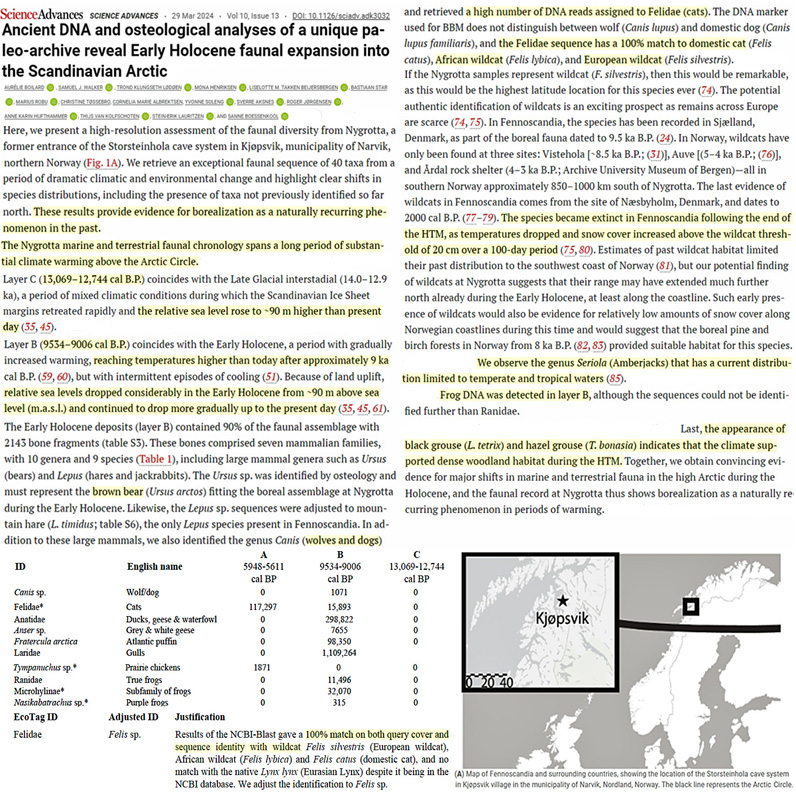
DNA evidence from a site north of the Arctic Circle indicates African wildcat (Felis lybica) used to reside in Arctic climates when CO2 levels were under 260 ppm, or at supposedly “safe” levels. The authors suggest this is a “remarkable” finding, as it is the “highest latitude location for this species ever.”
The presence of domestic cats (Felis catus) and European wildcats (Felis silverstris) in this region is also validated by 100% matching DNA evidence. Wildcat species became extinct in northern Europe after the Holocene Thermal Maximum (HTM) ended and “snow cover increased above the wildcat threshold of 20 cm over a 100-day period.”
Amberjacks (Seriola) – a fish species only found in temperate to tropical Pacific and Atlantic waters (Gulf of Mexico, Brazil) today – also lived north of the Arctic Circle during the Early Holocene.
Dogs (wolves), ducks, geese, prairie chickens, gulls, brown bear, and several species of frogs (no longer present in the Arctic today) also found the Arctic climate temperate enough to reside in northern Norway in the millennia centering around 9000 years before present.
The presence of mussel shells at much higher elevations indicate sea levels were ~90 m higher than today 13,000 to 12,000 years ago in this region (due mostly to uplift), falling to ~57 m higher than present between 9500 and 9000 years ago and then gradually declining to the present.
The authors suggest the DNA-confirmed presence of these species north of the Arctic Circle – much further north of where they can survive today – is evidence that warming periods and borealization were “a naturally recurring phenomenon in the past.”
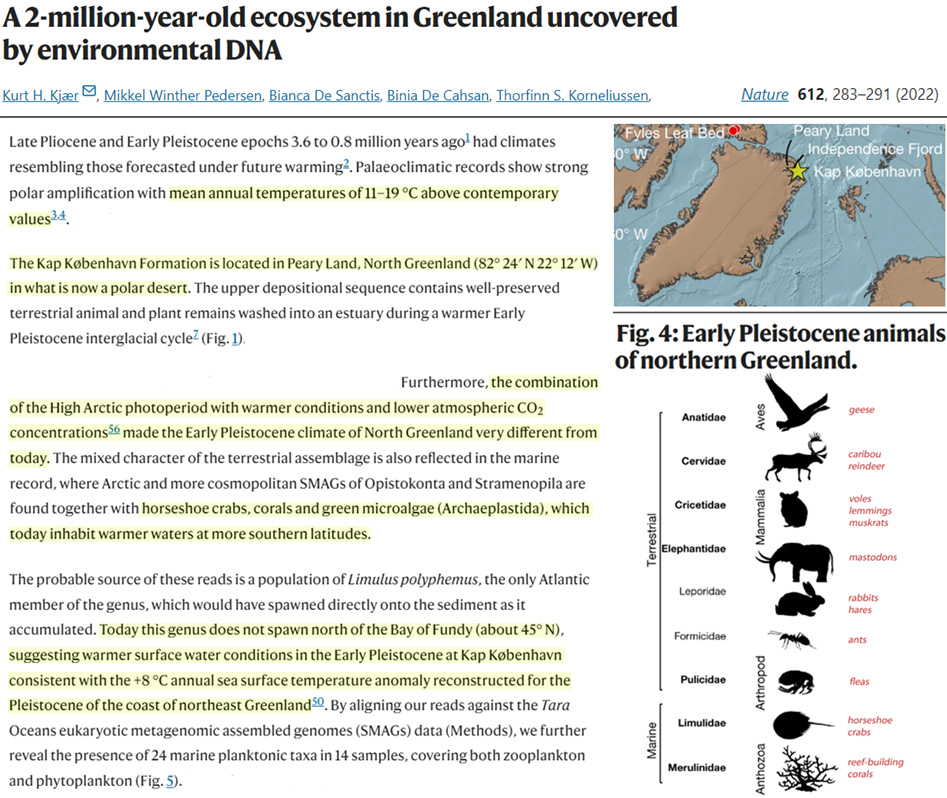
DNA analysis of species remains has become an insightful way to analyze past variations in climate. Another recent DNA database study (Kjaer et al., 2022) published in Nature indicated the High Arctic at 82°N (north of Greenland) was 11-19°C warmer than today 2 million years ago. This warmth allowed coral reefs, green algae, and horseshoe crab to reside in the Arctic Ocean at 82°N. Today horseshoe crab cannot occupy waters north of 45°N due to the much cooler ocean temperatures.
via NoTricksZone
May 9, 2024 at 08:12AM
The recent Monmouth University Poll reveals a noticeable shift in the American public’s perception of climate change, highlighting a reduction in both the perceived urgency of the issue and support for governmental action. This decline in concern, especially among younger adults, prompts a critical examination of what might be influencing these trends and the potential implications for climate policy.
Decline in Perceived Urgency Among Younger Adults
One of the more striking findings from the Monmouth Poll is the pronounced drop in urgency about climate change among younger adults. Previously seen as the most concerned demographic, their dwindling anxiety could signal a significant shift in future public and political engagement on environmental issues.
“Most Americans continue to acknowledge the existence of climate change, but the number who see this as a very serious problem has fallen below half. Support for government action to reduce activities that impact the climate has dipped below 6 in 10 for the first time since Monmouth began polling this topic nearly a decade ago,”
https://www.monmouth.edu/polling-institute/reports/monmouthpoll_us_050624/
reports the Monmouth University Polling Institute.
The data suggests that while 73% of Americans still acknowledge climate change, the conviction that this constitutes a serious problem warranting immediate action has notably diminished. In 2021, 56% of Americans viewed climate change as a very serious issue, a figure that has now declined to 46%. This decline is mirrored in the support for government action, which has also decreased across the board.
Partisan Differences and Shifting Opinions
The poll outlines a persistent partisan divide in beliefs about climate change, with 92% of Democrats acknowledging its occurrence compared to just 51% of Republicans. This partisan disparity extends to the urgency and required action concerning climate change, with drastically lower levels of concern and support for intervention among Republicans compared to Democrats.
“Republicans (51%) are the least likely to accept climate change as a reality, which is similar to GOP opinion in 2021 (48%) and 2015 (49%), but down from a momentary jump recorded in 2018 (64%),”
https://www.monmouth.edu/polling-institute/reports/monmouthpoll_us_050624/
the poll notes. This variability, particularly the drop following a temporary rise, could reflect the influence of political leadership and media narratives on public opinion.
Implications for Policy and Public Discourse
The decline in urgency and support for action against climate change among younger adults is particularly concerning. Historically, this demographic has been pivotal in pushing for environmental reforms. The shift could result from various factors, including climate change fatigue, skepticism over the effectiveness of proposed policies, or broader political and social disillusionment.
“Support for climate action remains relatively high in absolute terms, but it has softened due to a drop in the sense of urgency on this issue, particularly among younger adults,”
https://www.monmouth.edu/polling-institute/reports/monmouthpoll_us_050624/
explains Patrick Murray, director of the Monmouth University Polling Institute.
This waning enthusiasm could lead to significant challenges in advancing climate-related policies, potentially limiting the scale and scope of actions taken.
Conclusion: A Call for Critical Examination and Renewed Dialogue
The Monmouth Poll’s findings serve as a crucial barometer of public sentiment, suggesting that while belief in climate change remains relatively stable, there is a growing ambivalence about its severity and the effectiveness of governmental action.
I would suggest that a growing distrust of ideologically compromised media, government, and institutions is being propelled by an unending series of pronouncements that are clearly false to anyone with a memory or is capable of looking out a window.
via Watts Up With That?
May 9, 2024 at 08:06AM
By Paul Homewood

It’s been protecting London from costly and potentially deadly flooding since 1984.
But as the Thames Barrier celebrates its 40th anniversary, scientists have warned that the £535 million structure – opened by Queen Elizabeth II on May 8, 1984 – might not provide an adequate flood defence until 2070 as planned.
Repeated closures of its 10 steel-clad gates due to wild weather from climate change will add wear and tear, prompting the need for a replacement much sooner than previously thought.
Richard Tol, a professor of economics at the University of Sussex, said using the Thames Barrier until 2070 could be ‘risky’.
‘It will need to be replaced at one point – a major infrastructure project,’ he told MailOnline.
When it opened back in 1984, the Thames Barrier was built to last until 2030.
But in 2009, the Environment Agency, which operates the Thames Barrier, decided that the structure could carry on protecting London until 2070.
However, the gates are only designed to close a maximum of 50 times per year, and experts say the number of annual closures will exceed this figure in the near future as weather becomes wilder.
According to Hannah Cloke, professor of hydrology at the University of Reading, this means a replacement barrier will need to be sorted out ‘quite soon’.
‘We’re walking into a future where we know we’ve got more rainfall coming,’ she told the Financial Times.
‘It’s definitely not looking the same as it was when the Thames Barrier was designed and built.
‘If we do need to close the Thames Barrier more than we thought we did, then it’s going to have a shorter lifespan.’
The fact that EA extended its life from 2030 to 2070 rather destroys Hannah Cloke’s arguments, even if 2070 may now be overoptimistic now.
It is not clear whether Richard Tol believes the wild weather nonsense too, but I would be disappointed if he does, because he usually separates the facts from the hype.
So let’s now deal with Hannah Cloke’s wild weather claims.
Fortunately we have rainfall data from the Radcliffe Observatory in Oxford back to 1853, which tells us exactly what has been going on in the Thames Valley.
Annual rainfall has not become more extreme, and neither has monthly rainfall:


https://www.metoffice.gov.uk/pub/data/weather/uk/climate/stationdata/oxforddata.txt
And daily rainfall has been much more extreme in the past:

https://climexp.knmi.nl/gdcnprcp.cgi?id=someone@somewhere&WMO=UK000056225&STATION=OXFORD&extraargs=
The article makes a big play about the winter of 2013/14:

But the history of the Thames Valley is littered with such events:


https://www.ecad.eu/utils/showindices.php?3v3vbv04mjqj76v3ctg57smrmt
As for sea level rise, Dr Jonathan Paul, who also believes the wild weather nonsense, still assumes that seas will rise by a meter by 2100:


The data says otherwise:

https://www.tidesandcurrents.noaa.gov/sltrends/sltrends_station.shtml?id=170-081
But that does not stop the Mail quoting the loony from the Green Party:

The barrier will of course need to be replaced sooner or later. and given the inability of our bureaucracy to get any major infrastructure built on time and in budget, the sooner we start the better.
But the Mail is doing its readers a gross disservice by blaming it all on climate change.
via NOT A LOT OF PEOPLE KNOW THAT
May 9, 2024 at 05:22AM
 Iowa Climate Science Education