Month: May 2024

Adaptation to Heat: Then and Now

 “Getting cooled air piped into the car while enjoying a meal at a drive-in restaurant. Houston, Texas. 1957” (Texas Chronicles)

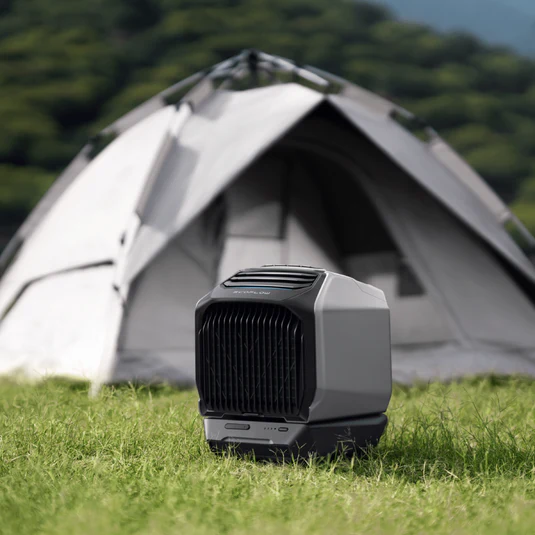
And now:

Don’t whine, adapt. Just like in the last century–and before.…

The post Adaptation to Heat: Then and Now appeared first on Master Resource.

via Master Resource

https://ift.tt/1vSBUR5

May 3, 2024 at 01:06AM

The Looming Electrical Power Shortage

By Steve Goreham

Originally published in Washington Examiner.

People in developed nations take abundant electricity for granted. When asked where electricity comes from, most will point to their wall outlet. But many states in the US are headed for a serious and prolonged shortage of electrical power not seen in decades, driven by rising demand from the artificial intelligence revolution and mandates to adopt green energy.

For 20 years, US electrical power policy has been dominated by efforts to try to “mitigate” global warming, believed to be caused by human greenhouse gas emissions. In 2021, President Joe Biden called for achieving a 100% carbon-free electric sector by 2035. Twenty-three states have enacted statues or issued executive orders to achieve Net Zero electricity generation by 2050.

Because of Net Zero mandates, US grid operators spent the last two decades replacing coal-fired power plants with natural gas plants, wind turbines, and solar installations. More than 200 coal plants have been closed, reducing electricity output from coal by almost 60% since 2007. From 2000 to 2023, wind and solar output rose from near zero to a combined 14.1% of US production. Over the same period, natural gas rose from 16.2% to 43.1% of power generation.

These efforts to transition from coal to wind and solar have been possible because US demand for electricity was almost flat from 2007 to 2023 at about 4.1 million gigawatt-hours. But grid operators in many states now face an unprecedented ramp in electricity demand.

The forced transition to green energy drives three new sources of power demand. First, 22 states now have zero-emissions vehicle mandates, which intend to ban the sale of cars with internal combustion engines by 2035, or a similar target date. In March, the Environmental Protection Agency finalized regulations that attempt to force about 40% of new light vehicles sold by 2030 to be electric. California and the EPA have also recently enacted regulations to force the heavy trucking industry to transition to electric trucks. To the extent that electric vehicles (EVs) are adopted, this will require the grid to deliver large amounts of additional power.

Second, cities and counties in seven states have banned gas appliances in new housing construction, such as New York City. In a 2022 study, the New England ISO concluded that a shift from gas appliances to electric appliances in New England would require more new electricity than a shift to EVs.

Third, the US federal government proposes to establish a new green hydrogen fuel industry. Seven billion dollars have been earmarked for “regional hydrogen hubs” to try to stimulate hydrogen production. Green hydrogen is produced by electrolysis of water and uses large amounts of electricity. To produce a single kilogram of hydrogen from electrolysis requires 50 to 55 kilowatt-hours of electricity, which is about double the daily electricity used by a typical US home. Plans call for billions of kilograms of green hydrogen to be produced.

But the electricity needed for the new artificial intelligence (AI) revolution will be greater than that needed for EVs, electric appliances, and green hydrogen combined. Amazon, Alphabet, Meta, Microsoft, and dozens of other firms are building massive new multi-acre data centers. In addition to new facilities, servers in the nation’s 2,700 data centers are being upgraded with new high-performance processing cards, boosting data center power consumption by six to ten times. Today, data centers use about 4% of US electricity, but the AI revolution is expected to boost that demand to more than 20% of US electricity consumption within the next ten years. Cryptocurrency generation, such as Bitcoin, also uses large amounts of electricity.

Rapidly rising power demand from the AI revolution and EVs, home appliances, and the proposed hydrogen fuel industry caught US grid operators unprepared.  We are now entering a decade in which electricity demand will exceed what can be supplied by a large margin.

The New York State data center market is expected to grow by over 50% from 2023 to 2030. The demand for electricity in Virginia is projected to more than double by 2035, driven by data center growth. California, Georgia, Texas, and the Pacific Northwest project large increases in electrical power demand. Jason Shaw, chairman of the Georgia Public Service Commission, stated: “When you look at the numbers it is staggering … It makes you scratch your head and wonder how we ended up in this situation. How were the projections that far off? This has created a challenge like we have never seen before.”

The coming power shortage will produce two big economic impacts. First, electrical utilities will cease the premature shut down of coal, gas, and nuclear power plants. It will be impossible to construct enough new wind and solar generators to provide electricity to meet the new demand for AI data centers, let alone the needs of electric vehicles, electric home appliances, and hydrogen electrolyzers.

We already see efforts to extend the operating lives of power plants that were scheduled for closure. California’s Diablo Canyon nuclear plant, which was scheduled to close in 2025, has been extended to operate until 2030. The Palisades nuclear plant in Michigan has been idle since May of 2022, but has now received $1.5 billion from the federal government to restart operations. Coal-fired power plants located in many Midwest states will likely operate for decades to come.

The second economic impact will be rapidly rising electricity prices, driven by a growing disparity between power demand and supply. Higher prices will reduce the demand for heat pumps endorsed by the green energy movement, which will remain more expensive than natural gas and propane furnaces in cold regions. EVs will be more expensive to charge and public EV charging facilities will struggle to be profitable. Gasoline cars will hold cost advantages for decades to come.

The transition to electric heavy trucks will fail. Heavy truck charging requires vast amounts of power. The South El Monte truck charging site in California, the first of its kind, is designed to simultaneously charge up to 32 heavy trucks. But when fully loaded, this facility would use more electricity than consumed by a California city with a population of 200,000 residents, such as San Bernardino or Huntington Beach.

Efforts to establish a green hydrogen fuel industry, using electrolyzers, will produce only a tiny market. High electricity costs will make hydrogen from electrolysis too expensive to power chemicals, steel, and other heavy industries. 

And the coming electricity shortage in the US is likely to be prolonged. US utilities have wasted much capital investment over the last few decades building intermittent wind and solar systems that don’t deliver much electricity. At the same time, the fleet of US nuclear power plants has been aging.

Today, 94 operating nuclear plants provide about 19 percent of US power. During the last two decades, ten nuclear plants have been retired, with only four new ones brought on-line. The other 90 plants began operating between 1970 and 1990.

Sixteen of these plants are 50 years or older and another 38 are between 40 and 50 years old. The good news is that the life of these plants can be extended for 60 years or more. But a decade from now, just as grid operators are making progress in closing the gap between power demand and supply, many of these nuclear plants will need to be refurbished or replaced.

The biggest impact will be on efforts to transition to a Net Zero electrical grid. The coming electrical power shortage will cripple these efforts. It will be impossible to serve both the artificial intelligence revolution and pursue a transition to wind and solar systems. The green energy transition will be sacrificed in favor of generating enough electrical power.

Steve Goreham is a speaker on energy, the environment, and public policy and the author of the new bestselling book Green Breakdown: The Coming Renewable Energy Failure.

via Watts Up With That?

https://ift.tt/JqFzlYG

May 3, 2024 at 12:04AM

Ocean Cooling Continues March 2024

The best context for understanding decadal temperature changes comes from the world’s sea surface temperatures (SST), for several reasons:

  • The ocean covers 71% of the globe and drives average temperatures;
  • SSTs have a constant water content, (unlike air temperatures), so give a better reading of heat content variations;
  • Major El Ninos have been the dominant climate feature in recent years.

HadSST is generally regarded as the best of the global SST data sets, and so the temperature story here comes from that source. Previously I used HadSST3 for these reports, but Hadley Centre has made HadSST4 the priority, and v.3 will no longer be updated.  HadSST4 is the same as v.3, except that the older data from ship water intake was re-estimated to be generally lower temperatures than shown in v.3.  The effect is that v.4 has lower average anomalies for the baseline period 1961-1990, thereby showing higher current anomalies than v.3. This analysis concerns more recent time periods and depends on very similar differentials as those from v.3 despite higher absolute anomaly values in v.4.  More on what distinguishes HadSST3 and 4 from other SST products at the end. The user guide for HadSST4 is here.

The Current Context

The chart below shows SST monthly anomalies as reported in HadSST4 starting in 2015 through March 2024.  A global cooling pattern is seen clearly in the Tropics since its peak in 2016, joined by NH and SH cycling downward since 2016.

Note that in 2015-2016 the Tropics and SH peaked in between two summer NH spikes.  That pattern repeated in 2019-2020 with a lesser Tropics peak and SH bump, but with higher NH spikes. By end of 2020, cooler SSTs in all regions took the Global anomaly well below the mean for this period.  

Then in 2022, another strong NH summer spike peaked in August, but this time both the Tropic and SH were countervailing, resulting in only slight Global warming, later receding to the mean.   Oct./Nov. temps dropped  in NH and the Tropics took the Global anomaly below the average for this period. After an uptick in December, temps in January 2023 dropped everywhere, strongest in NH, with the Global anomaly further below the mean since 2015.

Then came El Nino as shown by the upward spike in the Tropics since January, the anomaly nearly tripling from 0.38C to 1.09C.  In September 2023, all regions rose, especially NH up from 0.70C to 1.41C, pulling up the global anomaly to a new high for this period. By December, NH cooled to 1.1C and the Global anomaly down to 0.94C from its peak of 1.10C, despite slight warming in SH and Tropics.

Then in January both Tropics and SH rose, resulting Global Anomaly going higher. Tropics anomaly reached a new peak of 1.29C. and all ocean regions were higher than 01/2016, the previous peak. Now in February and March all regions have cooled bringing the Global anomaly back down 0.18C from its September peak.

Comment:

The climatists have seized on this unusual warming as proof their Zero Carbon agenda is needed, without addressing how impossible it would be for CO2 warming the air to raise ocean temperatures.  It is the ocean that warms the air, not the other way around.  Recently Steven Koonin had this to say about the phonomenon confirmed in the graph above:

El Nino is a phenomenon in the climate system that happens once every four or five years.  Heat builds up in the equatorial Pacific to the west of Indonesia and so on.  Then when enough of it builds up it surges across the Pacific and changes the currents and the winds.  As it surges toward South America it was discovered and named in the 19th century  It is well understood at this point that the phenomenon has nothing to do with CO2.

Now people talk about changes in that phenomena as a result of CO2 but it’s there in the climate system already and when it happens it influences weather all over the world.   We feel it when it gets rainier in Southern California for example.  So for the last 3 years we have been in the opposite of an El Nino, a La Nina, part of the reason people think the West Coast has been in drought.

It has now shifted in the last months to an El Nino condition that warms the globe and is thought to contribute to this Spike we have seen. But there are other contributions as well.  One of the most surprising ones is that back in January of 2022 an enormous underwater volcano went off in Tonga and it put up a lot of water vapor into the upper atmosphere. It increased the upper atmosphere of water vapor by about 10 percent, and that’s a warming effect, and it may be that is contributing to why the spike is so high.

A longer view of SSTs

The graph above is noisy, but the density is needed to see the seasonal patterns in the oceanic fluctuations.  Previous posts focused on the rise and fall of the last El Nino starting in 2015.  This post adds a longer view, encompassing the significant 1998 El Nino and since.  The color schemes are retained for Global, Tropics, NH and SH anomalies.  Despite the longer time frame, I have kept the monthly data (rather than yearly averages) because of interesting shifts between January and July. 1995 is a reasonable (ENSO neutral) starting point prior to the first El Nino. 

The sharp Tropical rise peaking in 1998 is dominant in the record, starting Jan. ’97 to pull up SSTs uniformly before returning to the same level Jan. ’99. There were strong cool periods before and after the 1998 El Nino event. Then SSTs in all regions returned to the mean in 2001-2. 

SSTS fluctuate around the mean until 2007, when another, smaller ENSO event occurs. There is cooling 2007-8,  a lower peak warming in 2009-10, following by cooling in 2011-12.  Again SSTs are average 2013-14.

Now a different pattern appears.  The Tropics cooled sharply to Jan 11, then rise steadily for 4 years to Jan 15, at which point the most recent major El Nino takes off.  But this time in contrast to ’97-’99, the Northern Hemisphere produces peaks every summer pulling up the Global average.  In fact, these NH peaks appear every July starting in 2003, growing stronger to produce 3 massive highs in 2014, 15 and 16.  NH July 2017 was only slightly lower, and a fifth NH peak still lower in Sept. 2018.

The highest summer NH peaks came in 2019 and 2020, only this time the Tropics and SH were offsetting rather adding to the warming. (Note: these are high anomalies on top of the highest absolute temps in the NH.)  Since 2014 SH has played a moderating role, offsetting the NH warming pulses. After September 2020 temps dropped off down until February 2021.  In 2021-22 there were again summer NH spikes, but in 2022 moderated first by cooling Tropics and SH SSTs, then in October to January 2023 by deeper cooling in NH and Tropics.  

Then in 2023 the Tropics flipped from below to well above average, while NH produced a summer peak extending into September higher than any previous year.  Despite El Nino driving the Tropics January anomaly higher than 1998 and 2016 peaks, the last two months cooled in all regions, especially the Tropics, suggests that the peak likely has been reached.

What to make of all this? The patterns suggest that in addition to El Ninos in the Pacific driving the Tropic SSTs, something else is going on in the NH.  The obvious culprit is the North Atlantic, since I have seen this sort of pulsing before.  After reading some papers by David Dilley, I confirmed his observation of Atlantic pulses into the Arctic every 8 to 10 years.

Contemporary AMO Observations

Through January 2023 I depended on the Kaplan AMO Index (not smoothed, not detrended) for N. Atlantic observations. But it is no longer being updated, and NOAA says they don’t know its future.  So I find that ERSSTv5 AMO dataset has data through October.  It differs from Kaplan, which reported average absolute temps measured in N. Atlantic.  “ERSST5 AMO  follows Trenberth and Shea (2006) proposal to use the NA region EQ-60°N, 0°-80°W and subtract the global rise of SST 60°S-60°N to obtain a measure of the internal variability, arguing that the effect of external forcing on the North Atlantic should be similar to the effect on the other oceans.”  So the values represent sst anomaly differences between the N. Atlantic and the Global ocean.

The chart above confirms what Kaplan also showed.  As August is the hottest month for the N. Atlantic, its varibility, high and low, drives the annual results for this basin.  Note also the peaks in 2010, lows after 2014, and a rise in 2021. Now in 2023 the peak was holding at 1.4C before declining.  An annual chart below is informative:


Note the difference between blue/green years, beige/brown, and purple/red years.  2010, 2021, 2022 all peaked strongly in August or September.  1998 and 2007 were mildly warm.  2016 and 2018 were matching or cooler than the global average.  2023 started out slightly warm, then rose steadily to an  extraordinary peak in July.  August to October were only slightly lower, but by December cooled by ~0.4C. January 2024 was unchanged from the previous month, but February anomaly rose 0.1C and March a little more to reach 1.2C anomaly.

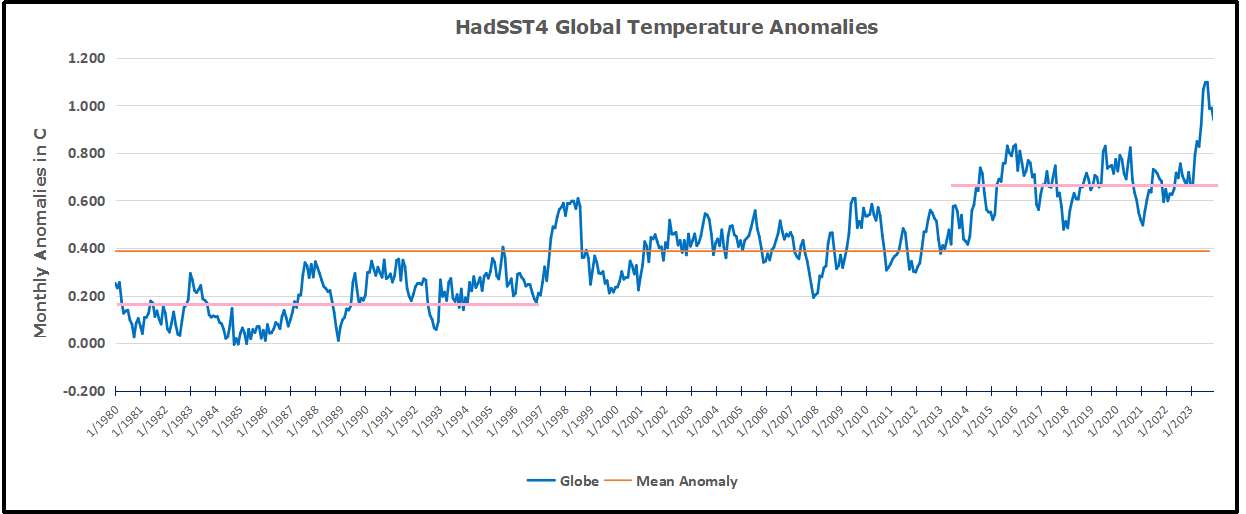
The pattern suggests the ocean may be demonstrating a stairstep pattern like that we have also seen in HadCRUT4. 

The purple line is the average anomaly 1980-1996 inclusive, value 0.18.  The orange line the average 1980-202306, value 0.38, also for the period 1997-2012. The red line is 2013-202306, value 0.64. As noted above, these rising stages are driven by the combined warming in the Tropics and NH, including both Pacific and Atlantic basins.

See Also:

2024 El Nino Collapsing

Curiosity:  Solar Coincidence?

The news about our current solar cycle 25 is that the solar activity is hitting peak numbers now and higher  than expected 1-2 years in the future.  As livescience put it:  Solar maximum could hit us harder and sooner than we thought. How dangerous will the sun’s chaotic peak be?  Some charts from spaceweatherlive look familar to these sea surface temperature charts.

Summary

The oceans are driving the warming this century.  SSTs took a step up with the 1998 El Nino and have stayed there with help from the North Atlantic, and more recently the Pacific northern “Blob.”  The ocean surfaces are releasing a lot of energy, warming the air, but eventually will have a cooling effect.  The decline after 1937 was rapid by comparison, so one wonders: How long can the oceans keep this up? And is the sun adding forcing to this process?

Space weather impacts the ionosphere in this animation. Credits: NASA/GSFC/CIL/Krystofer Kim

Footnote: Why Rely on HadSST4

HadSST is distinguished from other SST products because HadCRU (Hadley Climatic Research Unit) does not engage in SST interpolation, i.e. infilling estimated anomalies into grid cells lacking sufficient sampling in a given month. From reading the documentation and from queries to Met Office, this is their procedure.

HadSST4 imports data from gridcells containing ocean, excluding land cells. From past records, they have calculated daily and monthly average readings for each grid cell for the period 1961 to 1990. Those temperatures form the baseline from which anomalies are calculated.

In a given month, each gridcell with sufficient sampling is averaged for the month and then the baseline value for that cell and that month is subtracted, resulting in the monthly anomaly for that cell. All cells with monthly anomalies are averaged to produce global, hemispheric and tropical anomalies for the month, based on the cells in those locations. For example, Tropics averages include ocean grid cells lying between latitudes 20N and 20S.

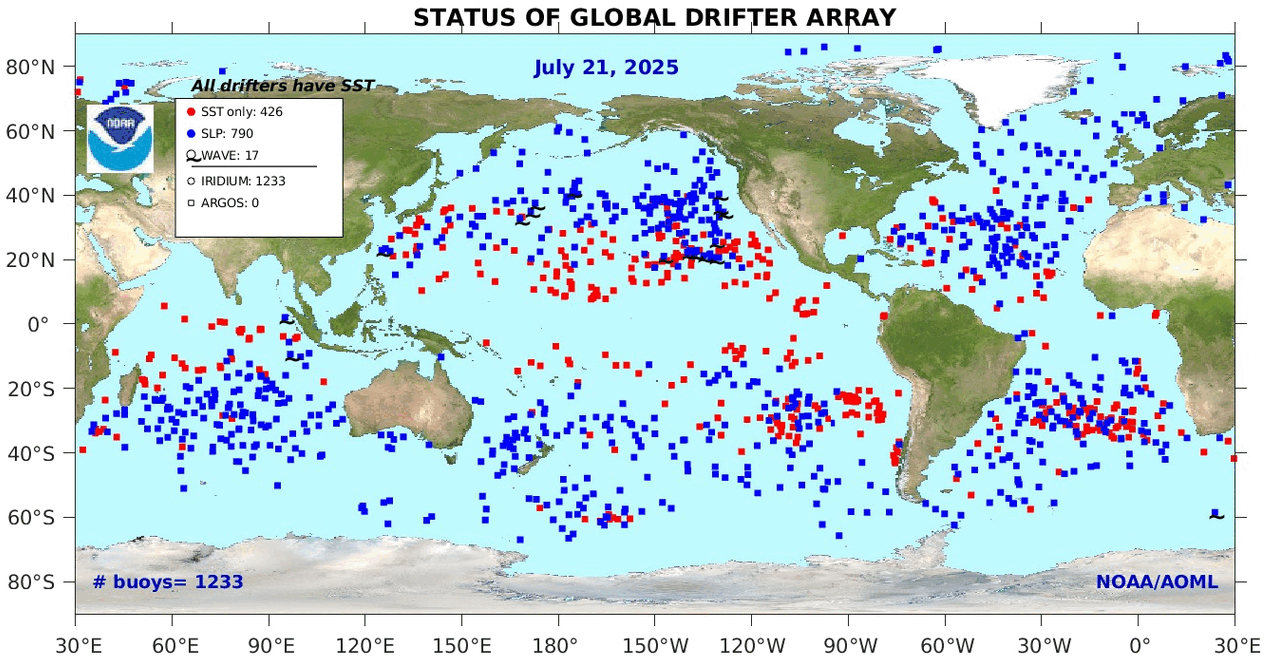
Gridcells lacking sufficient sampling that month are left out of the averaging, and the uncertainty from such missing data is estimated. IMO that is more reasonable than inventing data to infill. And it seems that the Global Drifter Array displayed in the top image is providing more uniform coverage of the oceans than in the past.

uss-pearl-harbor-deploys-global-drifter-buoys-in-pacific-ocean

USS Pearl Harbor deploys Global Drifter Buoys in Pacific Ocean


via Science Matters

https://ift.tt/lL0GUvE

May 2, 2024 at 08:51PM

Rockefellers Have a Bad Day at The Senate Budget Committee

Reposted with permission from Energy In Depth – a research, education and public outreach campaign of the Independent Petroleum Association of America (IPAA).

Mandi Risko

The Senate Budget Committee took the House Democrats’ political-theatre-esque investigation into energy companies and turned it into a complete political dud. At a hearing Wednesday intended to build off of the House Oversight Committee’s (HCOR) failed investigation into energy companies back in 2022, Democratic politicians and activist witnesses failed to produce anything of substance to support their decades-long campaign aimed at taking down the American energy industry.

The hearing comes just a day after the Senate Budget Committee and the House Oversight Democrats issued a joint report and a trove of documents alleging that oil majors deceived the public about climate change. And, even though Sen. Sheldon Whitehouse (D-RI) stated the documents “exposed” the industry, there was little mention of their contents – because they, like the numerous other documents analyzed by the HOC, are a complete nothingburger.

Putting a finer point on it, Representative Jamie Raskin (D-MD) told E&E News that “the hearing might be the end of the line for the investigation for now.”

Whitehouse’s Fishing Expedition Bound to Upset Other Democrats

While some politicians have hijacked the Senate Budget Committee far beyond its purview to focus almost exclusively on climate change, other Democrats are surely rolling their eyes at today’s political performance. In the wake of the Biden administration’s LNG pause, numerous Democrats have called out the importance of natural gas and rebuked their own party for turning against a needed economic and energy security powerhouse. Most recently, Jennifer Granholm thanked the industry for its extraordinary work supplying much-needed clean energy to the American people:

“You have helped us meet the moment when our energy and national security have needed it most [and] we will be counting on you again.”

Much like the House investigation, Sen. Whitehouse’s hearing – while also totally snooze worthy – was out of step and out of sync with the American people. Instead, it was used primarily for “political theatre,” a point Ranking Member Senator Chuck Grassley took issue with, arguing that committee has broken historic precedent in the production of its report and release of documents:

“The Majority could have been transparent with the Minority many months ago, as is normal course of business. The Majority chose not to do so. This unfortunate series of non-transparent events have undone years of investigative precedent.” (emphasis added)

Notably, this isn’t Sen. Whitehouse’s first swing at reviving the House’s flawed investigation into energy companies. Last June, he held a hearing featuring anti-industry activists Naomi Oreskes and Christine Arena who again failed to provide any momentum for this flailing campaign. This time, Sen. Whitehouse invited Oreskes’ former colleague Geoffrey Supran, former Department of Justice (DOJ) Attorney and La Jolla attendee Sharon Eubanks, along with Representative Jamie Raskin (D-MD).

Supran, the “Academic,” Didn’t Even Do His Homework

Geoffrey Supran, a self-described “disinformation scientist” funded by the Rockefellers who was intimately involved in the House Oversight Committee’s investigation, didn’t even do his homework. When asked by Sen. Alex Padilla (D-CA) about the internal industry documents that were intended to be the topic of discussion at the hearing, he admitted:

I have yet to review the documents themselves, they were only just released. I have reviewed the reports that accompany them, so forgive me for having only a superficial understanding of them.” (emphasis added)

Comically, it was Supran and Oreskes who bragged about their document reading abilities back in 2017 when they embarked on their Climate Change Communications study aimed at American energy companies.

In fact, experts such as Roger Pielke Jr., have pointed out that Supran has a record of identifying a conclusion with no data only to then morph his evidence in a fashion that makes oil and gas companies look bad – all in the name of taking down energy companies.

Underlying this bias, a noteworthy exchange occurred when Supran became noticeably uncomfortable when Sen. John Kennedy (R-LA) exposed him for endorsing fringe views on X. Sen. Kennedy pointed out that Supran couldn’t possibly be an unbiased witness when he endorses the dishonest and disruptive tactics used by activist group Climate Defiance:

The Link Between “Big Tobacco” and “Big Oil” Was Completely Debunked

Throughout the hearing, Democrats had little success in their attempts to create a link between the Big Tobacco lawsuits in the 1990s and the cases against energy companies. Even Sharon Eubanks, former director for the tobacco litigation Team at DOJ, didn’t provide this much sought after link. Instead, Eubanks opined about the good ol’ days and closed out the hearing by stating:

“There was more than one statute [supporting the DOJ’s lawsuit against Big Tobacco], that we went forward with. RICO was one, then we had the Medicare Reimbursement Act and the Medicare Secondary Pay and Provisions of the Social Security Act of 1930-something.”

While an interesting history lesson, Eubanks’ testimony didn’t advance the fringe narrative that energy lawsuits and Big Tobacco lawsuits are somehow analogous.

Ariel Cohen, a witness invited by the Senate Republicans, gave the clearest answer:

“The fundamental difference between tobacco and the fossil fuel industry is the fossil fuel industry brings a tangible economic good to the economy. Without it, we cannot have our transportation, or deliveries, our military…so I hope nobody in their right mind is advocating immediate cessation of fossil fuels.” (emphasis added)

Even James Hansen, a former Exxon employee and NASA scientist that supports a fossil fuel phase out has acknowledged that tobacco and hydrocarbons are entirely different products with drastically different values to society:

“Let’s be clear: the frequent comparison of the fossil fuel and tobacco industries is nonsense. Fossil fuels are a valuable energy source that has done yeomen service for humankind.”

Bottom line: Anti-industry advocates have tried for more than a decade to take down the American energy industry with no success and the Senate Budget Committee hearing was no different. After yet another allegedly “groundbreaking” document release, nothing new came to light. While politicians entertain these destructive games, American energy companies remain hard at work to ensure families and business have a reliable source of energy to power their homes and companies.

via Watts Up With That?

https://ift.tt/LwK96eq

May 2, 2024 at 08:06PM