Month: May 2024

THE GOVERNMENT SHOULD LISTEN TO JACOB REES-MOGG

Here is a link to the latest words from the former minister and  influential back bench MP. The government do not have time to make a credible change of direction before the election, sadly. But it is interesting to hear them at last speaking out.  

 Jacob Rees-Mogg: We can delay the net zero fantasy and make cheap energy Britain’s reality (gbnews.com)

via climate science

https://ift.tt/QAX0284

May 2, 2024 at 05:38PM

Water Vapor Absorbs 84 Times More Radiation Than CO2 … Clouds Drove 89% Of 1982-2018 Warming

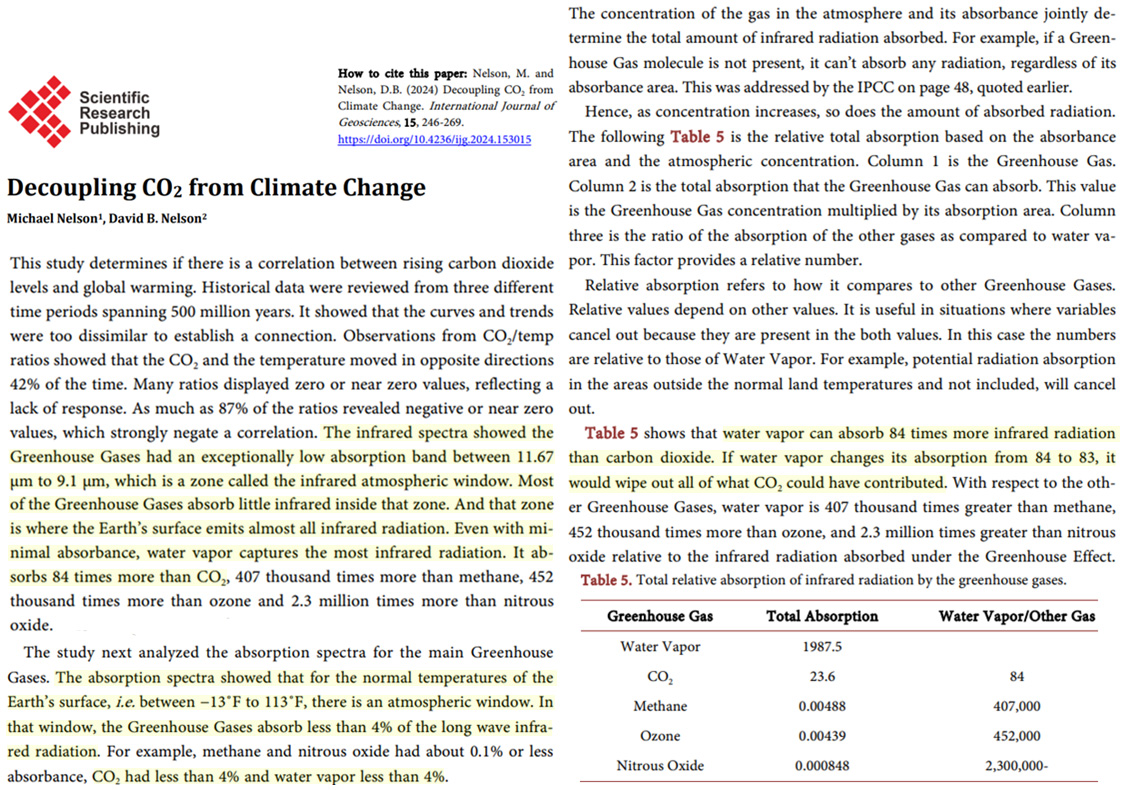
“CO2 is only present in the atmosphere in trace amounts (0.04%) and lacks sufficient enthalpy to have any measurable effect on the atmosphere’s temperature.” – Nelson and Nelson, 2024

New research (Nelson and Nelson, 2024) further documents the inconsequential role that CO2 plays in climate.

Less than 4% of longwave infrared radiation is absorbed by greenhouse gases in the lower atmosphere. Greenhouse gases can have no effect outside of their narrow infrared atmospheric window.

Of all the greenhouse gases, water vapor (30,000 ppm) has easily the most dominant effect, absorbing 84 times more radiation than CO2 does, and 407,000 times more radiation than CH4 (methane).

If water vapor’s absorption capacity were to change by a factor of 1 (i.e., from 84 times greater than CO2 to 83 times greater), this tiny change would “wipe out all of what CO2 could have contributed” within the greenhouse effect.

Image Source: Nelson and Nelson, 2024

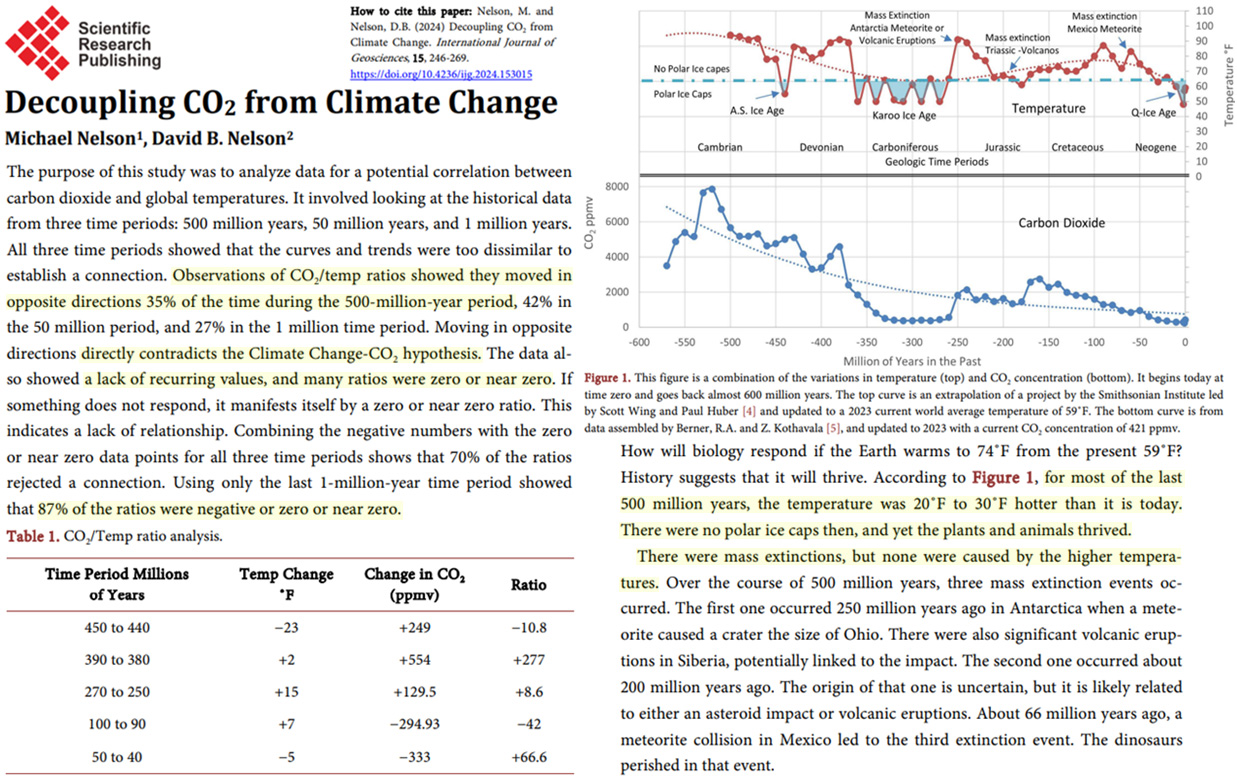
Over the last 50 million years CO2 and temperature were negatively correlated (CO2 rose, temperatures fell or temperatures rose, CO2 fell) 42% of the time, and there was a glaring lack of recurring ratios, and “many ratios were zero or near zero.”

Over the last 1 million years “87% of the ratios were negative or zero or near zero.” This “directly contradicts the Climate Change-CO2 hypothesis.”

Furthermore, high CO2 levels and/or warming were not the cause of mass extinctions, as plants and animals “thrive” in much hotter temperatures than exist today.

These conclusions are very similar to Davis (2017 and 2023), who determined that over the last 210 million years (a) CO2 falls as temperatures rise (negative correlation, r = -0.76), (b) mass extinctions occur 4.08 million years after CO2 peaks, and (c) global warming/CO2 radiative forcing “did not cause extinction of biodiversity.”

Image Source: Nelson and Nelson, 2024

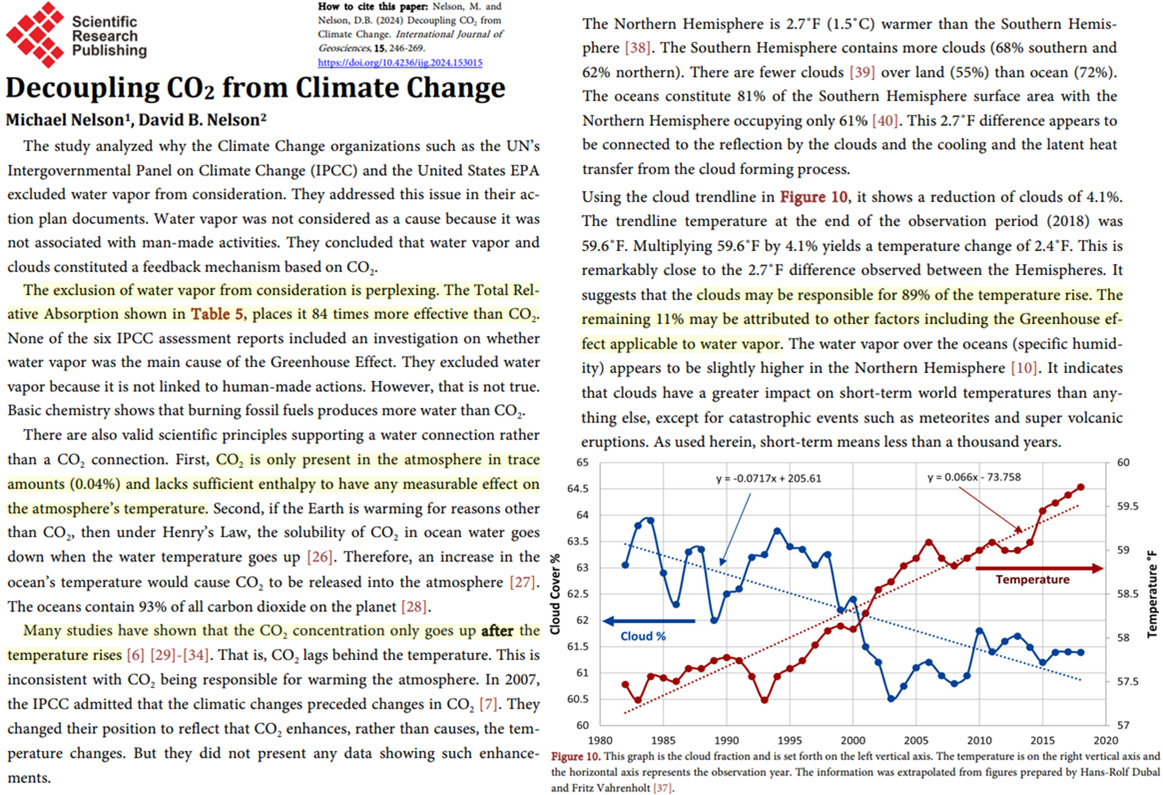
Finally, approximately 89% of the warming over the period 1982-2018 could be attributed to the decline in cloud cover, which has allowed more solar radiation to be absorbed by the Earth’s surface. The rest “may be attributed to other factors including the greenhouse effect applicable to water vapor.”

In other words, due to the decoupling of CO2 from global warming (or cooling), there is effectively no consequential role for CO2 in climate change.

Image Source: Nelson and Nelson, 2024

via NoTricksZone

https://ift.tt/UzMI0dO

May 2, 2024 at 04:42PM

Climate Obsessed Democrats Demand an Oil Exploration Halt in the Middle of a Gasoline Price Crisis

Essay by Eric Worrall

Who needs Gasoline?

Big oil privately acknowledged efforts to downplay climate crisis, joint committee investigation finds

Internal documents revealed by committee show companies lobbied against climate laws they publicly claimed to support

Dharna Noor Tue 30 Apr 2024 23.00 AEST

Big oil has privately acknowledged its efforts to downplay the dangers of burning fossil fuels, US Democrats have found.

Major fossil-fuel firms have also pledged support for international climate efforts, but internally admit these efforts are incompatible with their own climate plans. And they have lobbied against climate laws and regulations they have publicly claimed to support, documents newly revealed by the committee show.

The tranche of subpoenaed communications were unveiled on Tuesday morning by Democrats on the House oversight committee before a Wednesday hearing.

“For decades, the fossil-fuel industry has known about the economic and climate harms of its products but has deceived the American public to keep collecting more than $600bn each year in subsidies while raking in record-breaking profits,” said Rhode Island Democrat Sheldon Whitehouse, who chairs the committee.

In a 2019 memo to the CEO, for instance, an Exxon official suggested removing reference to the Paris accord from a document because referencing it “could create a potential commitment to advocate on the Paris agreement goals”.

And in February 2020, BP announced plans to become a net zero emissions company by 2050 or sooner and to “help the world get to net zero”. Private emails sent months before, however, indicate that company top brass may have doubted that goal was achievable.

Read more: https://www.theguardian.com/us-news/2024/apr/30/big-oil-climate-crisis-us-senate-report

The demand for a halt to oil and gas exploration is contained in Senator Sheldon Whitehouse’s committee report.

… Perhaps most telling, despite its previous statements supportive of the Paris Agreement, BP’s CEO announced earlier this year that the company would increase oil and gas production from 2024 through 2027, citing increased global demand for energy.94 The increase in production is inconsistent with the Paris Agreement. Scientists are clear that to meet the goals of the Paris Agreement, new and expanded oil and gas exploration must stop immediately. 95 MSCI found in its “Implied Temperature Rise” ratings that, if BP’s business plan was extrapolated to the global economy, the world would warm 3.1°C—similar to Exxon’s and Chevron’s ratings and well above Paris Agreement targets.96 The documents, actions, and analyses suggest that BP’s stated commitment to the Paris Agreement is not credible.

Like its peer companies, Shell also first expressed support for the Paris Agreement in 2015 and now claims that it “supports the more ambitious goal of the Paris Agreement, which is to limit the rise in global average temperature this century to 1.5° Celsius. ”97 However, MSCI still estimates that, if extrapolated across the economy, Shell’s activities would be consistent with 2.3°C of warming.98 In 2021, Shell promised to undertake a gradual decline of about 1–2 % a year in total oil production through 2030, including divestments.99 Then, last summer, Shell announced plans to boost fossil fuel production. 100 It now states that oil and gas production will remain stable until 2030 and that it will invest $40 billion in fossil fuel production between 2023 and 2035.101 Shell’s current oil and gas expansion plans are inconsistent with the Paris Agreement. Despite originally pledging to reach net zero by 2050 for its total emissions consistent with the Paris Agreement, Shell now concedes that the “2050 target is ‘currently outside our planning period.’”102

Read more: https://www.budget.senate.gov/imo/media/doc/fossil_fuel_report1.pdf

Senator Whitehouse does make some valid points. I’m pretty disappointed by the behaviour of some oil companies, their weak mismanagement of this political confrontation with Democrats is doing nobody any good.

Whitehouse claims that Shell promised a 1-2% / annum drawdown in total oil production. I checked Senator Whitehouse’s reference to this promise, while this isn’t exactly what Shell said, I believe Senator Whitehouse’s interpretation of Shell’s public commitment is a reasonable interpretation, and I accept Senator Whitehouse’s criticism that some oil companies do not appear to have lived up to some of their public commitments.

But Senator Whitehouse’s claim that oil companies concealed their knowledge that climate change would have a catastrophic impact also does not stand up to scrutiny.

For example, Senator Whitehouse’s report rehashes tired claims about ancient internal memos, but the memos I have read in my opinion are not what Senator Whitehouse claims they are.

Read one for yourself.

The memo, and bear in mind this was a private internal memo, is anything but certain that climate change will have catastrophic impact. For example, at the bottom of Page 4, continuing to the top of Page 5.

“There is currently no unambiguous evidence that the earth is warming. If the earth is on a warming trend, we’re not likely to detect it before 1995. This is about the earliest projection of when the temperature might rise the 0.5° needed to get beyond the range of normal temperature fluctuations. On the other hand, if climate modelling uncertainties have exaggerated the temperature rise, it is possible that a carbon dioxide induced “greenhouse effect” may not be detected until 2020 at the earliest”.

What is the next move in this ridiculous charade?

Obviously I’d like oil companies who have been trying to cosy up to the Democrats to up their game, stop leading politicians like Whitehouse with assurances they are onboard with Democrat climate initiatives, without following through on those assurances. This kind of behaviour severely weakens the position of oil companies, it makes oil companies look like liars. Such behaviour might even expose oil companies to legal liability, if green investors claim they suffered reputational damage because they were misled by false assurances that oil companies intended to switch to green energy.

But Senator Whitehouse’s apparent acceptance of claims that “new and expanded oil and gas exploration must stop immediately” as established fact is even more absurd than an oil company promising to get out of the oil business.

Senator Whitehouse, if you believe there is a viable alternative to fossil fuel, it is time for you to stop being such a hypocrite. If you truly believe oil and gas are on the brink of ruining the planet, that oil and gas companies are like tobacco companies, that renewables can replace oil and gas, then put your money where your mouth is, and push for an outright ban on oil and gas. Consult your scientists and tell us a hard deadline beyond which we cannot use oil and gas, and make that deadline law. Because without concrete action, all your words are just empty political posturing.

via Watts Up With That?

https://ift.tt/t5eLY7U

May 2, 2024 at 04:01PM

Wild Experiments? Alice Springs fossil fuel grid becomes too unstable with more than 13% solar power

By Jo Nova

Ponder how destructive solar power is: It only takes 13% solar to push a small grid to the edge
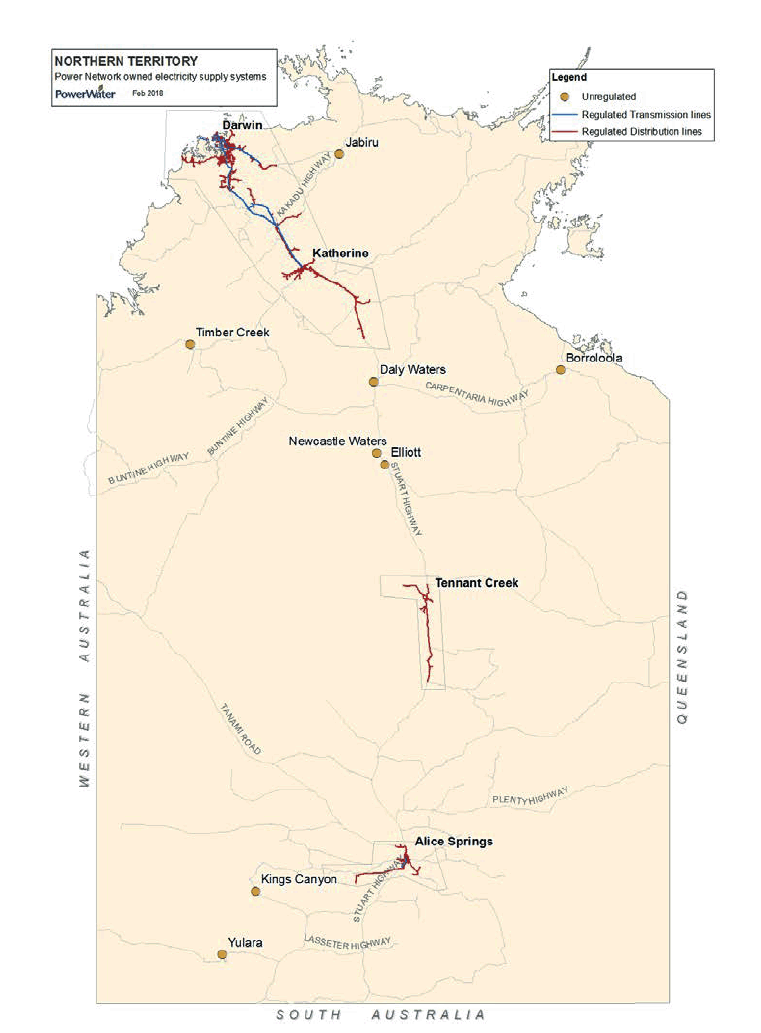
NT Electricity Grid Map

NT Electricity Grid Map (Click to enlarge)

The Renewable Crash Test Dummy Country is aiming to be using 82% renewable electricity by  2030, but instead of making sure this works on a small scale at any one of our remote microgrid locations, where electricity is expensive to start with, we thought we’d do the experiment on the whole nation instead.

So it is “sobering” to see how this fails at Alice Springs. If there was a place on Earth that is well suited to wind and solar power, it surely is Alice Springs which is 1,200 kilometers from the Northern Territory’s main electricity grid. Surrounded by a million square kilometers of largely uninhabited arid land, if we can’t plaster enough solar panels and windmills here to support a town of 25,000 people with no heavy industry to speak of, where can we?

Yet the bare truth is that solar energy provides just 13% of Alice Springs annual electricity, and fossil fuel based generation, they admit quietly near the bottom of an FAQ page, is, shhh, 87%. Only one in four houses has solar power, yet the grid is already overloaded when it peaks, and unstable when a cloud comes over and the whole towns solar power goes down. the

So the “news” that the ABC reports is that someone has a plan to push Alice Springs from 13% to 50% renewable energy by 2030.  Despite this daunting task, ponder that the ABC is excited today that one small, extremely sunny isolated location might manage to achieve a bit more than half the target we set for the whole nation by 2030, but only if we spend $120 million (and over 20 years?). This is called “Leading the Country” — where they fail to meet the targets before everyone else does?

When Victoria Ellis says “energy” below she means electricity.

By Victoria Ellis, ABC “News”

According to the Alice Springs Future Grid website, about a quarter of Alice Springs homes have solar panels, and over a year about 13 per cent of the town’s energy comes from solar, but if more solar energy is added without further planning, the small electricity grid could become unstable.

The Alice Springs Future Grid website says if solar panels across the town are generating a lot of power in the middle of the day and a cloud bank suddenly shadows them, their electricity production may drop more quickly than an alternative power source can be drawn upon, leading to a blackout.

Alice Springs Future Grid director Lyndon Freason said in today’s system, there is sometimes lots of solar being produced that is not used by the grid.

“It’s becoming increasingly difficult to efficiently absorb more renewables in the middle of the day when the sun is shining, without actually causing instability in the existing generation,” he said.

So the only problem with solar power is that there is either too much electricity or not enough, or it disappears when the clouds come over, needs constant back up, and it can’t stabilize the frequency, right? And then there is the duck curve. Look at the ramping rate required from 4 to 6pm:
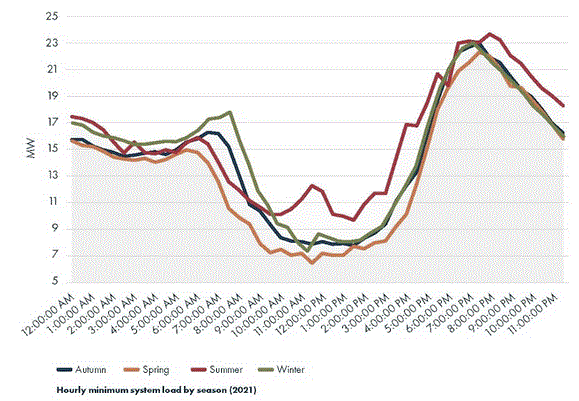
Solar power duck curve, Alice Springs. Graph.

The belly of the duck is the fall in the need for electricity at noon as solar peaks. The belly can’t be allowed to sink too far, because the gas/diesel power plant needs to keep running to keep the frequency stable.

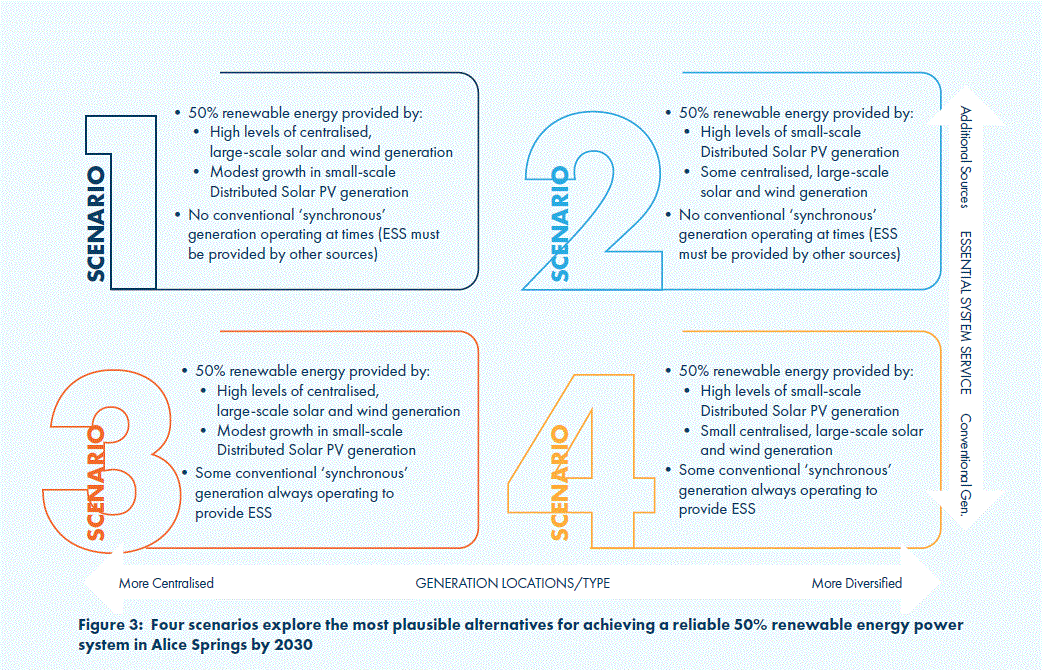
The “Roadmap” such as it is, is four scenarios with a bit more-or-less of this and that:

Click to enlarge (From the PDF)
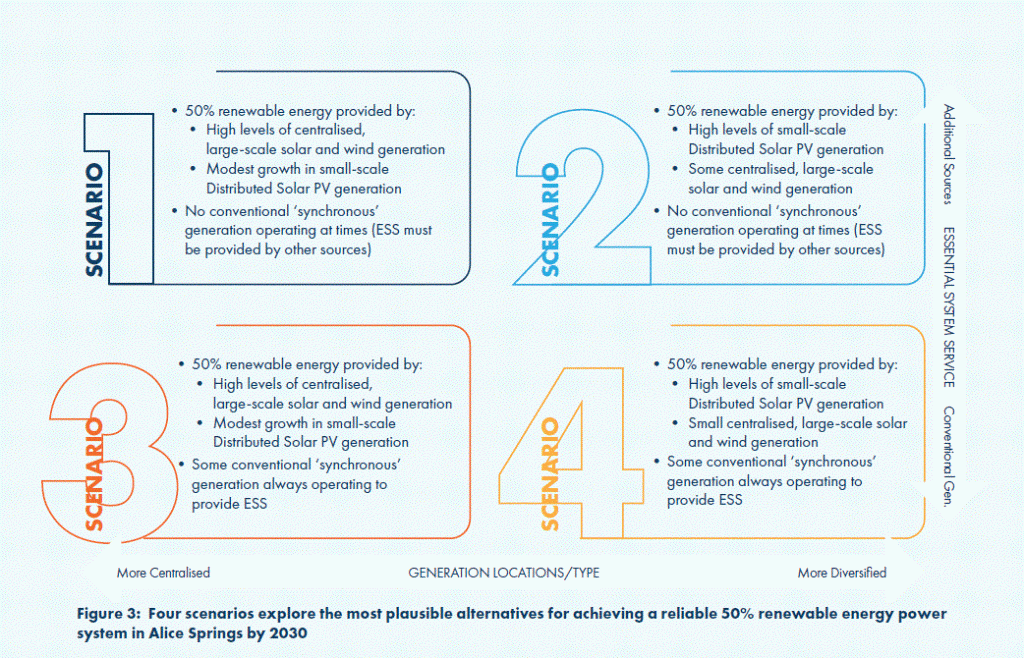
Roadmap Grid plan Alice Springs

Roadmap Grid plan Alice Springs

The costs, the costs:

I don’t know if anyone has mentioned that 2030 is not 20 years away:

Mr Cocking [CEO of Desert Knowledge Australia] estimated implementing one of the scenarios would cost about $150 million over 20 years.

“Ideally it would come from government, but most likely as well some private investment,” he said.

More detailed estimates (page 63) suggest the costs could be as high as $216 million, but there will theoretically be about $50 million in fuel savings.

It still works out as $6,000 per man, woman and child — which no one has to spend at all — because they just built the current diesel-gas power plant there in 2011 and upgraded it in 2018 at a cost of $75 million. Should we ask the people of Alice Springs if they’d rather have the money? For a family of four that’s $24,000. Might be nice?

But as a microcosm of a national transition the Alice Springs mini grid speaks volumes about how absurd the whole crusade is.

Currently when the wind and sun are asleep the town gets electricity from the Owen Springs Power Station which is a gas/diesel plant that can provide  80 megawatts whenever they need it.  There is also an old power station built in 1973 that is still operational and a 5MW Battery Energy Storage System (BESS). Proportional to the size of the Alice Springs grid, it is (or was) effectively the “biggest battery” in Australia when it was installed in 2018. It is used mainly for stability and emergency power when the clouds roll over so the gas plant can ramp up. If it were to be used mostly for storage, the $8 million battery would only last about 20 minutes, or maybe 40, tops. This doesn’t scale well to a nation of 27 million people.

For the record, a mini-Snowy 2.0 scheme is not possible in Alice Springs. There are some worthy hilly areas for sure, but annual total rainfall is barely 280mm or 11 inches, and quite random.

Don’t wash those solar panels?

Curiously, the tap water in Alice Springs is worse for the solar panels than the dust is:

Detailed studies have been conducted on this subject, concluding that dust does not have a significant impact on PV systems. This is perhaps surprising, but washing the panels with tap water in places where there is a high concentration of calcium (such as Alice Springs) can actually have a more negative effect than dust. The arrays at the DKA Solar Centre are washed once a year by a specialised company who use a reverse osmosis filtration system to treat their water before using it to wash the solar modules. ( from the FAQ.)

Those key statistics from the FAQ of the “Alice Springs Future Grid” (which is the current grid)

In the 2021‑22 reporting period, total conventional generation capacity was 122.6 MW and operational maximum demand was 48.6 MW, not including requirements for system redundancy. It is noteworthy, however, that while the Ron Goodin power station is aged, it remains available for system redundancy. No definitive retirement date has been announced.

Over recent years, more than 25% of the approximately 9,000 households in Alice Springs have installed DPV on their property rooftops.

The maximum output capacity of all residential DPV systems in Alice Springs is estimated to be 23 MW, and historical generation data suggests in the order of a 9% contribution to overall consumption. Fossil fuel-based generation produced 87% of annual volume and centralised Renewable Generation produced 4%.

See the FAQ for more.

0 out of 10 based on 0 rating

via JoNova

https://ift.tt/24WS6fE

May 2, 2024 at 03:55PM