Month: May 2024

Climate Obsession

Michael Mann has me blocked, but is using someone engaged in identity theft to slander other people and misrepresent my views.  This is not how a legitimate scientist would behave.

About Tony Heller

Just having fun

This entry was posted in Uncategorized. Bookmark the permalink.

via Real Climate Science

https://ift.tt/3QTCAuI

May 2, 2024 at 08:22AM

The G7’s Latest Absurdly Ambitious Climate Pronouncements

The recent G7 communiqué on climate, energy, and environment policy is laden with the typical rhetoric and ambitious declarations that have come to characterize such international missives. Yet, beneath the surface of urgent calls and reaffirmed commitments lies a web of unaddressed complexities and overly optimistic goals that warrant a closer, more skeptical examination.

The Triple Global Crisis: An Overarching Narrative

The G7 ministers open with a sweeping narrative about the “triple global crisis” of climate change, biodiversity loss, and pollution, further exacerbated by desertification, land, soil and ocean degradation, water scarcity, drought, and deforestation. They assert:

“We reiterate our concerns on the gravity and urgency arising from the interlinked and mutually reinforcing global crisis of climate change, biodiversity loss, and pollution as well as desertification, land, soil and ocean degradation and water scarcity, drought and deforestation which pose a global threat to sustainable development.”

This passage sets the stage for the G7’s ambitious agenda, framing these crises as cataclysmic and implying a direct linkage with human activity, particularly through emissions and environmental degradation. However, the complexity of these issues is significantly downplayed, and the narrative leans heavily on a presumption of consensus about the causes, trajectories, and solutions to these problems.

Unfeasible Goals and Lack of Clear Methodology

In addressing climate change, the G7’s goals are particularly lofty. They recommit to reaching greenhouse gas emissions net-zero by 2050, a target that has become a staple of international climate policy rhetoric. The communiqué states:

“We reaffirm our commitment to implement immediate, short- and medium-term concrete actions in this critical decade… including to reach greenhouse gas emissions net-zero by 2050 at the latest in order to keep a limit of 1.5°C temperature rise within reach.”

The practicality of such targets is laughable, considering the substantial gap between the current trajectory of national policies and the reductions needed to meet these goals. The plans rely heavily on yet-to-be-perfected technologies and massive socio-economic transformations that are fraught with their own sets of challenges and uncertainties.

The Economic and Social Implications of Green Policies

Economically, the shift toward a net-zero, circular, and climate-resilient economy entails profound changes in energy production, industry, and daily human activities. The G7 pledges to:

“Promote policies and measures including research and development of technologies for energy flexibility and storage, in particular for seasonal variability of energy consumption.”

The push towards renewable energy and the phasing out of fossil fuels, as outlined extensively in the communiqué, is not just a technological shift but also an economic one, impacting everything from energy prices to job markets in traditional sectors. The financial requirements for such a transition are immense, and the G7’s call for mobilizing financial resources from all sources underscores the anticipated economic burden.

Critical Voices and Alternative Views

Amidst these sweeping commitments, the voice of skepticism—that demands rigorous scientific scrutiny and cautious policy-making—is crucial. The G7’s reliance on projections and models necessitates a robust debate about the accuracy of these tools and the viability of their proposed solutions. As history has shown, large-scale policy shifts based on unverified predictive models can lead to unintended consequences that exacerbate the very problems they aim to solve.

Conclusion: A Call for Prudence and Realism

As the G7 advances its agenda, it is imperative that these policies are subject to continuous and rigorous scrutiny. The integration of stringent evaluation mechanisms and diverse perspectives from across scientific and economic spectrums will be essential.

via Watts Up With That?

https://ift.tt/dj4OGIw

May 2, 2024 at 08:03AM

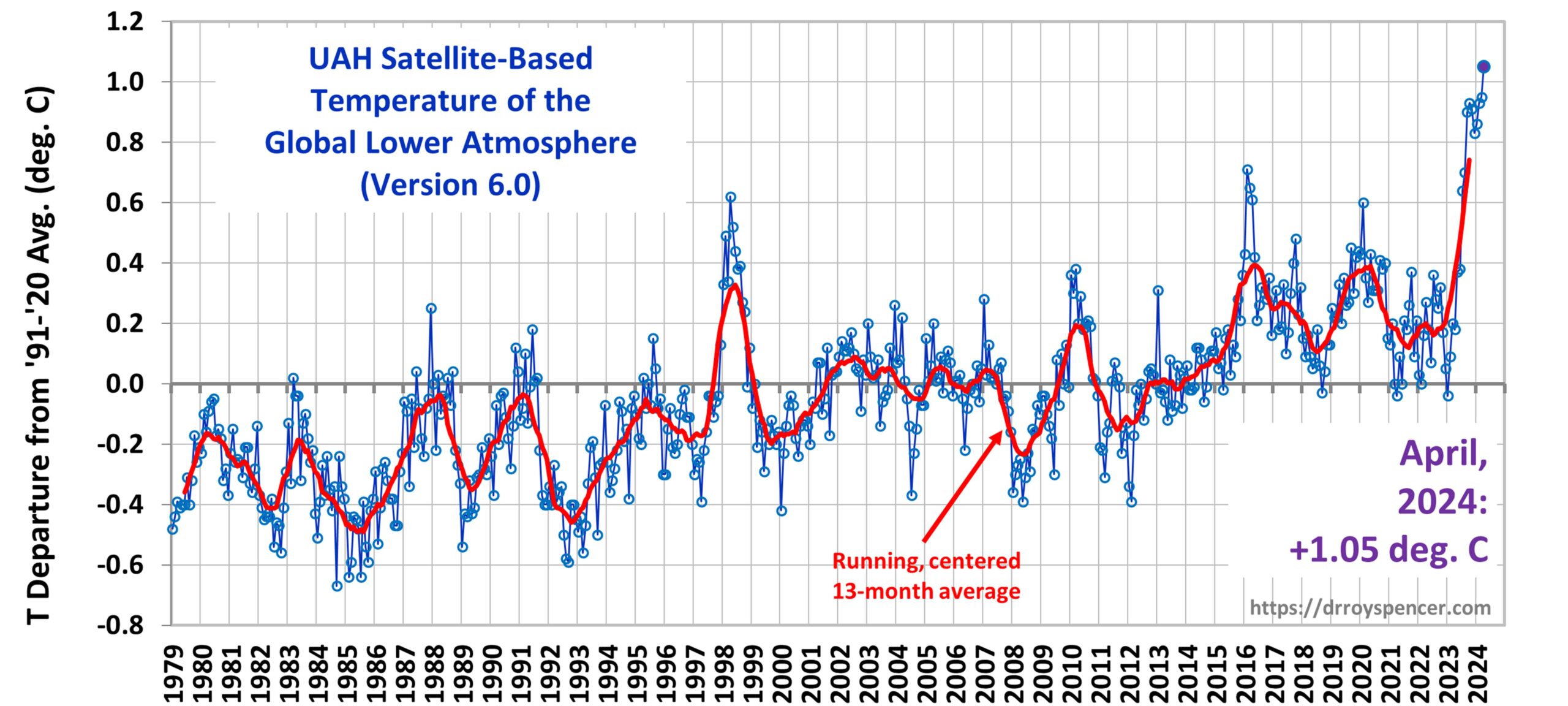
UAH Global Temperature Update for April, 2024: +1.05 deg. C

The Version 6 global average lower tropospheric temperature (LT) anomaly for April, 2024 was +1.05 deg. C departure from the 1991-2020 mean, up from the March, 2024 anomaly of +0.95 deg. C, and setting a new high monthly anomaly record for the 1979-2024 satellite period.

The linear warming trend since January, 1979 remains at +0.15 C/decade (+0.13 C/decade over the global-averaged oceans, and +0.20 C/decade over global-averaged land).

It should be noted that the CDAS surface temperature anomaly has been falling in recent months (+0.71, +0.60, +0.53, +0.52 deg. C over the last four months), while the satellite deep-layer atmospheric temperature has been rising. This is usually an indication of extra heat being lost by the surface to the deep-troposphere through convection, and is what is expected due to the waning El Nino event. I suspect next month’s tropospheric temperature will fall as a result.

The following table lists various regional LT departures from the 30-year (1991-2020) average for the last 16 months (record highs are in red):

YEAR MO GLOBE NHEM. SHEM. TROPIC USA48 ARCTIC AUST
2023 Jan -0.04 +0.05 -0.13 -0.38 +0.12 -0.12 -0.50
2023 Feb +0.09 +0.17 +0.00 -0.10 +0.68 -0.24 -0.11
2023 Mar +0.20 +0.24 +0.17 -0.13 -1.43 +0.17 +0.40
2023 Apr +0.18 +0.11 +0.26 -0.03 -0.37 +0.53 +0.21
2023 May +0.37 +0.30 +0.44 +0.40 +0.57 +0.66 -0.09
2023 June +0.38 +0.47 +0.29 +0.55 -0.35 +0.45 +0.07
2023 July +0.64 +0.73 +0.56 +0.88 +0.53 +0.91 +1.44
2023 Aug +0.70 +0.88 +0.51 +0.86 +0.94 +1.54 +1.25
2023 Sep +0.90 +0.94 +0.86 +0.93 +0.40 +1.13 +1.17
2023 Oct +0.93 +1.02 +0.83 +1.00 +0.99 +0.92 +0.63
2023 Nov +0.91 +1.01 +0.82 +1.03 +0.65 +1.16 +0.42
2023 Dec +0.83 +0.93 +0.73 +1.08 +1.26 +0.26 +0.85
2024 Jan +0.86 +1.06 +0.66 +1.27 -0.05 +0.40 +1.18
2024 Feb +0.93 +1.03 +0.83 +1.24 +1.36 +0.88 +1.07
2024 Mar +0.95 +1.02 +0.88 +1.34 +0.23 +1.10 +1.29
2024 Apr +1.05 +1.24 +0.85 +1.26 +1.02 +0.98 +0.48

The full UAH Global Temperature Report, along with the LT global gridpoint anomaly image for April, 2024, and a more detailed analysis by John Christy, should be available within the next several days here.

The monthly anomalies for various regions for the four deep layers we monitor from satellites will be available in the next several days:

Lower Troposphere:

http://vortex.nsstc.uah.edu/data/msu/v6.0/tlt/uahncdc_lt_6.0.txt

Mid-Troposphere:

http://vortex.nsstc.uah.edu/data/msu/v6.0/tmt/uahncdc_mt_6.0.txt

Tropopause:

http://vortex.nsstc.uah.edu/data/msu/v6.0/ttp/uahncdc_tp_6.0.txt

Lower Stratosphere:

http://vortex.nsstc.uah.edu/data/msu/v6.0/tls/uahncdc_ls_6.0.txt

via Roy Spencer, PhD.

https://ift.tt/cx13JHW

May 2, 2024 at 04:53AM

BBC weather map row heats up over confusing colours

By Paul Homewood

h/t Ian Magness


 image

image

The BBC has been criticised for the colour scale it uses to represent temperatures, with lows of 11C shown as yellow while 41C is depicted as dark red.

The broadcaster has triggered confusion among some viewers with its temperature contour map, which switches to orange when temperatures hit 13C.

The colour scheme was introduced in 2017, with the BBC at the time saying it was intended to help those with colour blindness.

Toby Young, the founder of website The Daily Sceptic, suggested that the BBC was “going a bit far”.

“How is it going to represent temperatures above 20C? Fireballs?” he said.

A weather forecast on Tuesday night showed most of the country yellow and orange for Wednesday when temperatures were predicted to hit as high as 20C.

One viewer wrote on social media that the system was “utterly farcical”.

“I’m not a massive conspiracy theorist but I have to agree with those who castigate the utterly ludicrous use of bright yellow and orange/red on the weather maps to indicate temperatures of 18/19 degrees!” the viewer wrote.

Another wrote that the BBC “need to give their heads a collective wobble”.

“Since when has 13C warranted yellow/orange on the weather map?!” the viewer wrote.

A BBC spokesman said: “The colours used now range from blue for the coldest temperatures through to red for the hottest temperatures as these colours are easier to see if you live with colour blindness.”

Last year, the broadcaster was forced to clarify its colour scheme after viewers suggested that it had increased the intensity of the map to raise alarm over increasing temperatures.

An image that went viral at the time contrasted a weather map from August 2003 showing temperatures up to 35C with an image from 2016 showing temperatures up to 33C.

https://www.telegraph.co.uk/news/2024/05/01/bbc-criticism-confusing-colours-on-weather-map/

via NOT A LOT OF PEOPLE KNOW THAT

https://ift.tt/tj8spkE

May 2, 2024 at 04:06AM