Month: May 2024

The Two Faces Of EVs: Brilliant In Town, Hopeless In The Fast Lane

By Paul Homewood


.

Neil Winton, regular contributor to this blog, has a new article on Forbes.

His comments on EV range are particularly pertinent:


 image

Electric vehicles are mainly overpriced city cars, fine for local use but hopeless if you plan a long trip on fast motorways.

Next-generation solid-state technology batteries promise to half the price, weight and cost, and double the range. But until solid-state arrives, and this seems unlikely in any great numbers until at least 2030, EVs will remain the unfinished article.

Meanwhile, European car buyers are being effectively gaslit by a lack of detailed information about the EVs they are being persuaded to buy. Not only is official range information often seriously exaggerated. An important negative is deliberately omitted; the fact that high but legal autoroute cruising slashes range by between 30 and 60%.

EV buyers need honest data which should include a rating of fast-lane performance.

ACEA, the European Automobile Manufacturers’ Association, known by its French acronym, was asked to comment on the quality of range data in general and the possibility of a motorway performance rating but declined to reply.

Full story here.

via NOT A LOT OF PEOPLE KNOW THAT

https://ift.tt/HhCArmy

May 29, 2024 at 03:32AM

UK set for ’50 days of rain’ in one of the wettest summers in over a hundred years (Or maybe driest!)

By Paul Homewood

.

h/t Mike Rennoldson


.

It’s the turn of the Leftwing Broadcasting Company to make a fool of itself:

.

 image

Forecasters are predicting a summer of persistent rain and wet weather for Brits, as global warming continues to result in more erratic conditions.

The Met Office has briefed the Government and transport chiefs to prepare for at least 50 days of rain in the next three months, leading to fears over further flooding in the UK and dashing any hopes of a warm British summer.

Last summer saw 40 days of rain, but the Met Office expects this summer to be even worse, jeopardising popular summer events such as Wimbledon, Trooping of the Colour, Royal Ascot and many festivals including Glastonbury.

To count as a rainy day, there must be a minimum of 2.5mm of rain in a 24 hour period.

The UK’s wettest ever summer in 1912 saw rainfall on more than 55 days.

https://www.lbc.co.uk/news/uk-set-for-50-days-of-rain-in-one-of-the-wettest-summers-in-over-a-hundred-years/

Maybe the Met Office’s right hand should have checked what its left hand was saying!

.

image

image

https://www.metoffice.gov.uk/services/government/contingency-planners/index

THE CHANCES OF A WET OR DRY SUMMER ARE FAIRLY BALANCED!

No doubt whether it’s wet, dry or average, they’ll blame it on global warming.

Meanwhile the media continues to shed whatever credibility it has left by publicising these daft claims, without bothering to do any factchecking of their own.

via NOT A LOT OF PEOPLE KNOW THAT

https://ift.tt/M3cgsTw

May 29, 2024 at 03:14AM

Electrical Sewage: Power Grid Slugs Householders For Costs of Managing Daily Solar Surge

The inability to control wind and solar output is the very definition of chaos. Domestic solar panels reach their maximum output around noon. At midnight, not so much. Call it all or nothing.

Dealing with the noonday surge has become the bane of grid managers and the grand disruptor of once orderly power markets.

The disorderly and chaotic delivery of rooftop solar has one operator in Australia fighting back, in an effort to recoup some of the costs associated with dealing with what has come to be known as ‘electrical sewage’ – as the team from Jo Nova outline below.

Solar power at midday is so useless, they plan to start charging homeowners for generating it
Jo Nova Blog
Jo Nova
16 May 2024

The glut in solar power in Australia is so big that next year solar panel owners in Sydney will have to pay 1.2c a kilowatt hour to offload their unwanted energy between 10am and 3pm. Nearly a million homes in Sydney have solar panels, but only 7% of them have batteries, which means basically, thousands of homes installed hi-tech generators that aren’t very useful. Worse, other homes were forced to pay part of the costs for them. The only winner was China.

Finally, a tiny part of the strangled free market is re-asserting itself, which might slow down future installations, or trick a few people into installing a $9,000 battery. Naturally this unpredictable rule change will hurt the poorest solar owners, but benefit those wealthy enough to afford a battery.

Solar panel owners slugged by Ausgrid for generating too much power
by Caitlin Fitzsimmons, Sydney Morning Herald

The biggest electricity distributor on the east coast plans to charge households with solar panels to export their electricity to the grid during the middle of the day.

Ausgrid will impose a penalty of 1.2¢ a kilowatt-hour for any electricity exported to the grid between 10am and 3pm above a free threshold that varies by month. During peak demand times, between 4pm and 9pm, Ausgrid would pay 2.3¢ an hour as a reward to customers exporting solar to the grid.

The tariff will be charged by Ausgrid and the retailer will decide how to package it. It is opt-in from July this year, and mandatory from July next year.

The Sydney Morning Herald naturally thinks this is backwards and unfair, and in a sense it is, homeowners were led up the garden path. No one was given realistic information before they purchased another useless panel. But where was The Sydney Morning Herald? — it was selling the garden path. If they interviewed a few skeptics they could have told the hapless homeowners that the forced transition was artificial, unmanageable, and the conditions were doomed to be “adjusted” sooner or later.

Solar power at noon is electrical sewage
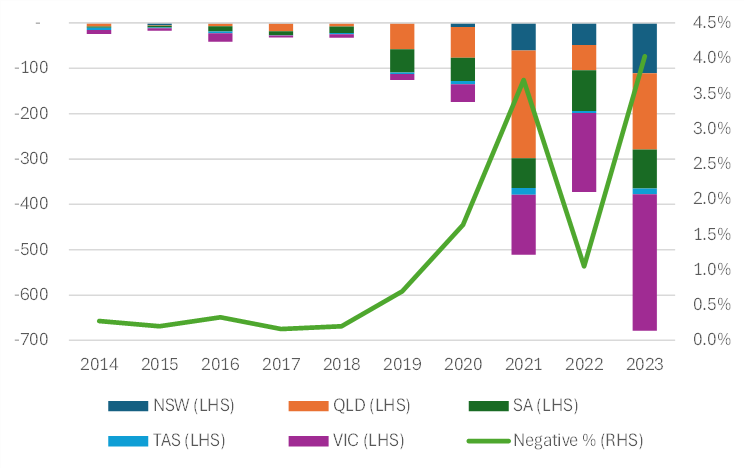
The wholesale market was trying to send the message. Negative spot prices show that solar is essentially a waste product at lunchtime which needs to be disposed off, a bit like electrical sewage.

Negative spot revenues didn’t really occur until we installed the last two million solar panels that we didn’t need. It is obviously a growing problem now, which suspiciously peaks in spring and summer and falls in winter months –matching the solar output profile by month.


https://www.energycouncil.com.au/analysis/negative-prices-and-revenues-in-the-nem-over-the-past-decade/

You might wonder why any generator would keep generating during a glut so bad they had to pay for every watt they generated. But it’s logical in a screwed market — the negative prices are close to the value of the “Renewable Energy Certificates” the government forces us all to pay to solar and wind operators.  So solar owners can produce a product the market essentially doesn’t want, but the government forces us to pay to make it profitable. See how this works?

The point of a free market is that stupid ideas are supposed to be free to lose their own money. That’s a signal to stop doing it.

And if there was some use for solar power at midday, negative prices would have found it. If there was an AI supercomputer that needed to sleep 18 hours a day and only work at lunchtime, the owners would have been beating down the door to get paid to use that solar juice. It didn’t happen.

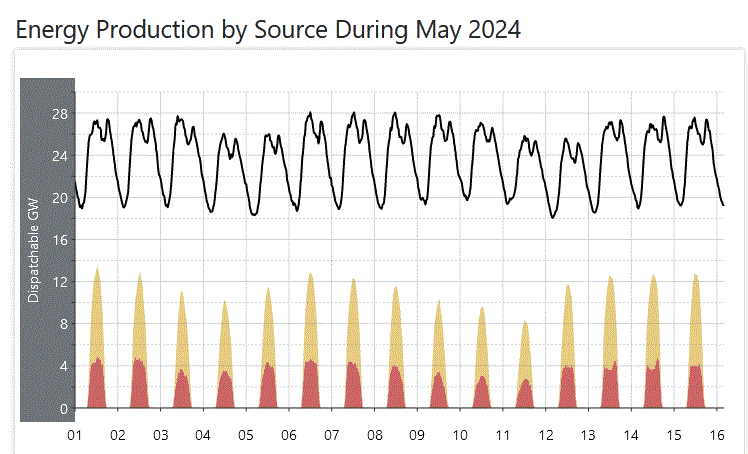
Here’s the solar power contribution to the NSW grid this month.


https://anero.id/energy/2024/may

During the solar spikes, hundreds of tons of exquisitely tuned infrastructure that could have kept running, just sits around and waits in case a cloud rolls over. And efficiency gained by solar is lost by the rest of the system.
Jo Nova Blog

via STOP THESE THINGS

https://ift.tt/IdjoJgf

May 29, 2024 at 02:30AM

The Fossil-fuel Era: Still Young

“Oil, gas, and coal are ascending despite determined government efforts to reverse energy progress. With criteria air pollutants on the wane and carbon dioxide (CO2) benefits laboratory-proven, the increasing sustainability of fossil fuels is evident.”

Each years brings record production of the three fossil fuels: oil, natural gas, and coal. Peak demand is not in sight–nor should it be in a world of rising population, the aspiring poor, and new ways to employ inanimate energy to improve living. But what about future supply to meet growing demand?

In most nations of the world, free-market energy plenty is held back by government intervention. Government ownership and operation of fossil fuels and related infrastructure impedes supply and demand. But fossil fuel plenty is very hard to hold back, and enough is produced to reasonably meet demand. Such is true in the United States despite two hundred impediments from the Biden Administration (“The U.S. now has 227 years of oil supply, 130 years of natural gas supply, and 485 years of coal supply”), and Canadian oil soldiers on despite the anti-energy policies of Prime Minister Justin Trudeau.

Mexico, a potential rival to Texas as a hydrocarbon capital of the world, is the sad story of resource socialization and nationalization in place of private ownership of the subsoil and above-ground open energy markets. This country’s bountiful hydrocarbons await liberation in a future decade or century.

North American Energy

The Institute for Energy Research (IER) has just released an update to its 2011 study, 2024 North American Energy Inventory. As more oil, gas, and coal is produced, more is discovered to be produced, the amazing (but not biblical) story of resource expansion from free-market resourceship. Some highlights follow:

North America has vast energy resources, including oil, natural gas, and coal. These resources are enough to meet the country’s needs for hundreds of years to come. The first edition of the North American Energy Inventory, released in 2011, challenged the myth of energy scarcity and demonstrated the abundance of energy resources in North America.

Since 2011, the U.S. has become the world’s top producer of both oil and natural gas, thanks in large measure to technology. This has led to lower energy prices, job creation, and environmental benefits. The U.S. now has 227 years of oil supply, 130 years of natural gas supply, and 485 years of coal supply.

Canada also has abundant energy resources, including the fourth-largest global quantity of oil reserves. Mexico, on the other hand, has seen its energy production and reserves decline in recent years due primarily to government policies.

The current administration has taken hundreds of actions to make it harder to produce oil, natural gas, and coal in the U.S. In addition to regulatory impediments, the oil, natural gas, and coal industries face other challenges, such as difficulty raising capital, anti-fossil fuel activism, and competition from subsidized renewable energy sources.

Benefits of Domestic Energy Production:

  • Abundant and reliable energy: The U.S. is the world’s largest producer of oil and natural gas,
    which provides a secure and reliable supply of energy for the country.
  • Lower prices: Oil prices have largely shrugged off events like Russia invading Ukraine and instability in the Middle East—activities that would have driven up oil prices a decade or two ago. U.S. oil production is key to this new stability, saving families money and making the U.S. more competitive in the global economy.
  • Job creation: The oil and gas industries support millions of jobs in the U.S., both directly and indirectly. These jobs are often well-paying and provide good benefits.
  • Environmental improvements: The U.S. has made significant progress in reducing air pollution
    in recent years, even as energy production has increased. This is due, in part, to improved
    pollution control technologies.

Final Comment

Oil, gas, and coal are ascending despite determined government efforts to reverse energy progress. With criteria air pollutants on the wane and carbon dioxide (CO2) benefits laboratory-proven, the increasing sustainability of fossil fuels is evident.

The fossil fuel era is very young in human history, having eclipsed the renewable energy era just several centuries ago. IER’s recent inventory study confirms the benefits of even a quasi-free market can do. Resourceship forever!

The post The Fossil-fuel Era: Still Young appeared first on Master Resource.

via Master Resource

https://ift.tt/0uDI4UT

May 29, 2024 at 12:11AM