Yet another freedom sapping international treaty committee of unelected apparatchiks.
A new ruling says countries – including NZ – must take action on climate change under the law of the sea
Published: May 24, 2024 6.13am AEST Karen Scott Professor in Law, University of Canterbury
In a significant development for small island nations threatened by rising seas, the International Tribunal for the Law of the Sea (ITLOS) has found greenhouse gases constitute marine pollution.
The tribunal handed down a unanimous advisory opinion this week in its first climate-related judgement. It declared countries must take measures to combat climate change in order to preserve the marine environment under the law of the sea.
…
Some institutions associated with UNCLOS, such as the International Maritime Organization, have taken steps to address climate impacts on the ocean. But countries have been reluctant to do so. They have often asserted the primary mandate regarding emissions reductions and climate adaptation lay with the UN Framework Convention on Climate Change (UNFCCC).
The tribunal’s advisory opinion confirmed, for the first time, that the 168 UNCLOS parties must address climate change and ocean acidification in order to comply with their obligations under the law of the sea.
First, ITLOS confirmed that greenhouse gas emissions and the heat generated by a warming climate meet the definition of “pollution” under Article 1(4) of UNCLOS. This is important because under Part XII of UNCLOS, states have obligations to prevent, control and mitigate pollution of the marine environment from any source.
Second, the tribunal confirmed the obligation under Article 194 of UNCLOS to prevent and control pollution applies to greenhouse gas emissions. This includes emissions already accumulated in the atmosphere. States therefore must take all necessary measures to address climate change pollution and ocean acidification.
What can I say? ITLOS have just earned themselves a place on the international treaty bonfire which we all hope will take place out the back of the White House in 2025.
The day to day impact, at first, is likely to be minimal. Nobody wants an end to shipping, in my opinion this is likely just part of the ongoing Pacific Island shakedown of anyone naive enough to give them handouts.
If cargo ships actually stopped operating, it would be an unimaginable economic and social disaster for the very island nations which brought the case.
So why bring the case? Pacific Islanders have had centuries of experience playing great powers off against each other, and manipulating international perceptions in ways which result in the islanders receiving money. Islanders are some of the smartest people on the planet, as you quickly learn if you have any islander friends. Thousands of years of brutal inter-island conflicts killed off all the stupid ancestors.
You would imagine a new requirement for net zero shipping might resurrect nuclear cargo ships, but any suggestion international shipping should go nuclear will be stomped by the very people who claim we need to reduce CO2 emissions. Greens rarely support “solutions” to an issue they claim is a planetary emergency, unless the solutions involve victimhood and embracing global communism.
In what shouldn’t even be news, scientists have discovered warmth and rising CO2 are beneficial to crops, whereas cold and falling CO2 lead to declines in crop production.
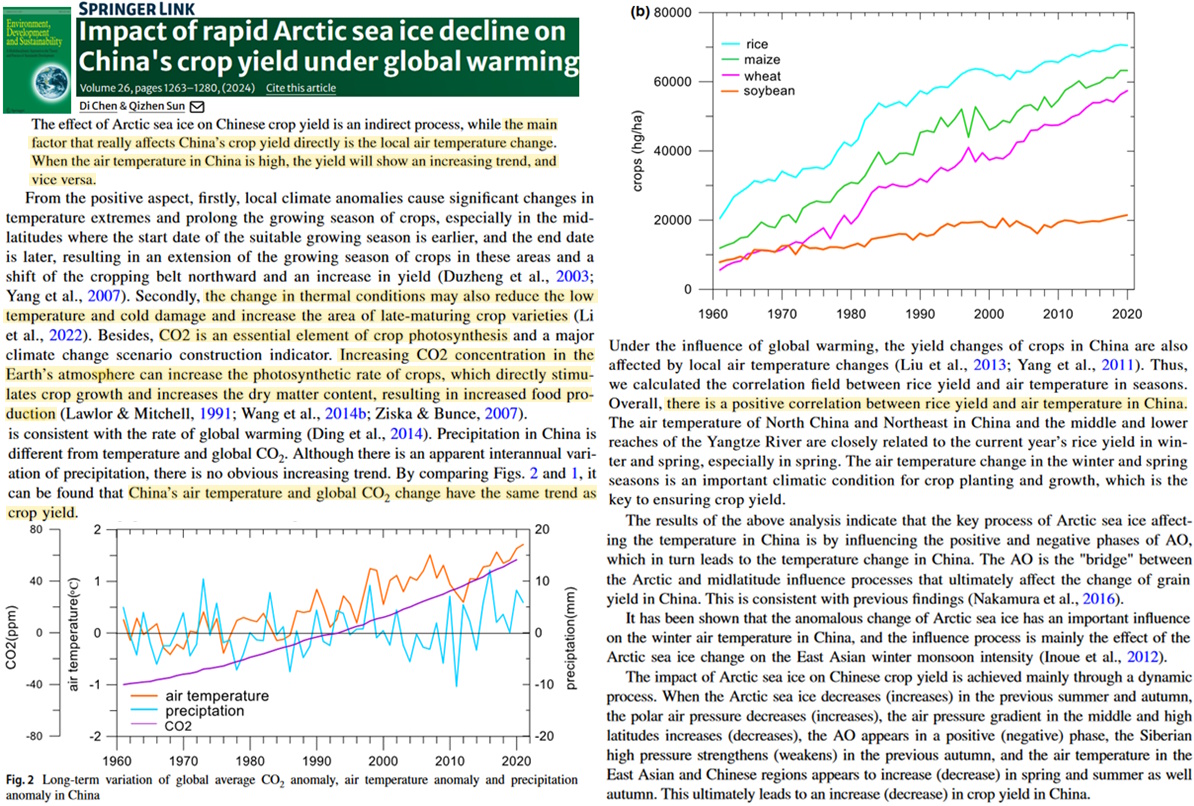
Scientists have determined the “main factor” directly improving post-1960 crop yields across China is a warming climate (Chen and Sun, 2024). Warming expands the growth area for late-maturing plant varieties, reduces damage from cold temperatures, and extends growing seasons.
The authors point to a link between warming, declining sea ice, the Arctic Oscillation, and East Asian winter monsoons. Then they extend these relationships to crop growth trends in China.
Rising CO2 and its photosynthesis enhancement is another factor driving China’s rising food production.
“The effect of Arctic sea ice on Chinese crop yield is an indirect process, while the main factor that really affects China’s crop yield directly is the local air temperature change. When the air temperature in China is high, the yield will show an increasing trend, and vice versa. [T]he change in thermal conditions may also reduce the low temperature and cold damage and increase the area of late-maturing crop varieties.”
“Besides, CO2 is an essential element of crop photosynthesis and a major climate change scenario construction indicator. Increasing CO2 concentration in the Earth’s atmosphere can increase the photosynthetic rate of crops, which directly stimulates crop growth and increases the dry matter content, resulting in increased food production.”
La Nina and warmer-than-average ocean temperatures are major drivers of tropical activity
NOAA’s GOES-16 satellite captured Hurricane Idalia approaching the western coast of Florida while Hurricane Franklin churned in the Atlantic Ocean at 5:01 p.m. EDT on August 29, 2023. (Image credit: NOAA Satellites)Download Image
RESOURCES
NOAA National Weather Service forecasters at the Climate Prediction Center predict above-normal hurricane activity in the Atlantic basin this year. NOAA’s outlook for the 2024 Atlantic hurricane season, which spans from June 1 to November 30, predicts an 85% chance of an above-normal season, a 10% chance of a near-normal season and a 5% chance of a below-normal season.
NOAA is forecasting a range of 17 to 25 total named storms (winds of 39 mph or higher). Of those, 8 to 13 are forecast to become hurricanes (winds of 74 mph or higher), including 4 to 7 major hurricanes (category 3, 4 or 5; with winds of 111 mph or higher). Forecasters have a 70% confidence in these ranges.
The upcoming Atlantic hurricane season is expected to have above-normal activity due to a confluence of factors, including near-record warm ocean temperatures in the Atlantic Ocean, development of La Nina conditions in the Pacific, reduced Atlantic trade winds and less wind shear, all of which tend to favor tropical storm formation.
A summary infographic showing hurricane season probability and numbers of named storms predicted from NOAA’s 2024 Atlantic Hurricane Season Outlook. (Image credit: NOAA)Download Image
“With another active hurricane season approaching, NOAA’s commitment to keeping every American informed with life-saving information is unwavering,” said NOAA Administrator Rick Spinrad, Ph.D. “AI-enabled language translations and a new depiction of inland wind threats in the forecast cone are just two examples of the proactive steps our agency is taking to meet our mission of saving lives and protecting property.”
“Severe weather and emergencies can happen at any moment, which is why individuals and communities need to be prepared today,” said FEMA Deputy Administrator Erik A. Hooks. “Already, we are seeing storms move across the country that can bring additional hazards like tornadoes, flooding and hail. Taking a proactive approach to our increasingly challenging climate landscape today can make a difference in how people can recover tomorrow.”
A summary graphic showing an alphabetical list of the 2024 Atlantic tropical cyclone names as selected by the World Meteorological Organization. The official start of the Atlantic hurricane season is June 1 and runs through November 30. (Image credit: NOAA)Download Image
As one of the strongest El Ninos ever observed nears its end, NOAA scientists predict a quick transition to La Nina conditions, which are conducive to Atlantic hurricane activity because La Nina tends to lessen wind shear in the tropics. At the same time, abundant oceanic heat content in the tropical Atlantic Ocean and Caribbean Sea creates more energy to fuel storm development.
This hurricane season also features the potential for an above-normal west African monsoon, which can produce African easterly waves that seed some of the strongest and longer-lived Atlantic storms. Finally, light trade winds allow hurricanes to grow in strength without the disruption of strong wind shear, and also minimize ocean cooling. Human-caused climate change is warming our ocean globally and in the Atlantic basin, and melting ice on land, leading to sea level rise, which increases the risk of storm surge. Sea level rise represents a clear human influence on the damage potential from a given hurricane.
Enhanced communications in store for 2024 season
NOAA will implement improvements to its forecast communications, decision support and storm recovery efforts this season. These include:
The National Hurricane Center (NHC) will expand its offering of Spanish language text products to include all Public Advisories, the Tropical Cyclone Discussion, the Tropical Cyclone Update and Key Messages in the Atlantic basin.
Beginning on or around August 15, NHC will start to issue an experimental version of the forecast cone graphic that includes a depiction of inland tropical storm and hurricane watches and warnings in effect for the continental U.S. Research indicates that the addition of inland watches and warnings to the cone graphic will help communicate inland hazards during tropical cyclone events without overcomplicating the current version of the graphic.
This season, the NHC will be able to issue U.S. tropical cyclone watches and warnings with regular or intermediate public advisories. This means that if updates to watches and warnings for storm surge or winds are needed, the NHC will be able to notify the public in an intermediate advisory instead of having to wait for the next full advisory issued every 6 hours.
New tools for hurricane analysis and forecasting this year
Two new forecast models developed by NOAA researchers will go into operation this season: The Modular Ocean Model or MOM6 will be added to the Hurricane Analysis and Forecast System to improve the representation of the key role the ocean plays in driving hurricane intensity. Another model, SDCON, will predict the probability of tropical cyclone rapid intensification.
NOAA’s new generation of Flood Inundation Mapping, made possible through President Biden’s Bipartisan Infrastructure Law, will provide information to emergency and water managers to prepare and respond to potential flooding and help local officials better prepare to protect people and infrastructure.
NOAA’s Weather Prediction Center, in partnership with the NHC, will issue an experimental rainfall graphic for the Caribbean and Central America during the 2024 hurricane season. This graphic provides forecast rainfall totals associated with a tropical cyclone or disturbance for a specified time period.
System upgrades in operation
NOAA will upgrade its observing systems critical in understanding and forecasting hurricanes. These projects will provide more observations of the ocean and atmosphere in the Caribbean, the Gulf of Mexico, on the U.S. East Coast and in the tropical Atlantic.
The CHAOS (Coordinated Hurricane Atmosphere-Ocean Sampling) research experiment aims to improve the understanding of air-sea interactions, providing sustained monitoring of key ocean features.
About NOAA seasonal outlooks
NOAA’s outlook is for overall seasonal activity and is not a landfall forecast. In addition to the Atlantic seasonal outlook, NOAA also issues seasonal hurricane outlooks for the eastern Pacific, central Pacific and western north Pacific hurricane basins.
NOAA’s Climate Prediction Center will update the 2024 Atlantic seasonal outlook in early August, prior to the historical peak of the season.
Climate, weather, and water affect all life on our ocean planet. NOAA’s mission is to understand and predict our changing environment, from the deep sea to outer space, and to manage and conserve America’s coastal and marine resources.
Coal is not the favorite “child” these days. It seems that almost the entire western political world has sworn to send coal to its grave. Not only have the United Nations and the IEA literally declared “war” on coal, but countless political, activist organizations and even leading financial institutions have pledged, if it had to be in their power, to immediately stop the usage of coal.
The reason for all of this is of course this “terrible” chemical element called carbon (number 6 on the periodic table). Please remember though that the same carbon is the 2nd most abundant element in the human body and it is a key building block for all life on Earth. By the way, carbon is not only essential because CO2 is plant food and plants grow best at 1.500 ppm of CO2 in the air (current atmospheric content is 420 ppm), CO2 is also a greenhouse gas, contributing to keeping our Earth temperature temperate and livable.
I have to mention that the prize for keeping Earth livable has to go to water, or better yet, water vapor, the most important and most abundant greenhouse gas. We all understand that increased greenhouse gas concentrations will contribute to slight warming, though only a few of us have learnt – including me only after studying it – that there are so-called saturation levels to consider which means that higher concentrations of any greenhouse gas have less and less impact on temperature changes (the warming impact logarithmically declines).
But today’s blog is not about globally measured temperature changes, its causes and its negative or positive impacts, but about coal and solar.
So why are coal and solar so closely interlinked? Why is it that solar panel manufacturing is impossible without coal? I always thought that coal is “only” important for electricity, contributing to 36% of global power demand, or over 8h of 24h every single day of the year. I always thought that coal is “only” required to produce all steel. Let us have a look at solar panel manufacturing, which is really about silicon production.
The vast majority of all energy required to make solar panels is consumed during silicon production, purification, and wafering. But first let’s talk about purity. 6N pure silicon means 99.9999% purity level, 11N pure silicon means 99.999999999% purity level, you get the point.
You may now have a first glimpse of the chemical and mechanical difficulty of making such a pure metal from a natural product.
In this blog post, you will see how important uninterrupted power supply is, especial for industrial processes such as silicon smelting. Obviously, this power comes from coal in China, and cannot come from wind or solar. Let’s dig deeper.
1. Metallurgical-grade silicon making and high purity quartz (HPQ)
Elemental silicon (Si) is not a naturally available element. Largely unchanged for over 100 years, silicon (Si) is produced by chemically reducing mined high purity quartz (SiO2) using carbon (C) in submerged-arc furnaces. The arc furnaces are each powered by up to 45 megawatts of electricity also to produce the heat required for the processes. As the mix of quartz stone and carbon heats, the carbon reacts with the oxygen in the quartz and forms CO gas, this is called silicon smelting. Consider it like iron ore (Fe2O3) being reduced using coke from coking coal (C) to make iron (Fe).
All simplified
Iron making: Fe2O3 + 3C + heat => 2Fe + 3CO
Silicon making (smelting): SiO2 + 2C + heat => Si + 2CO
This means that each ton of silicon roughly releases 5-6 tons of CO2 in this silicon smelting process alone.
High purity quartz sand (HPQ) is the feedstock for metallurgical-grade silicon. It is generally considered that the starting quality of feedstock for solar panels and semi-conductors is 99.95% silicon oxide (SiO2), with only <500 ppm of total impurities. Such HPQ is scarce and needs to be mined, processed, and of course transported before it is ready to be used for smelting (Chemical Research 2023 and Troszak).
The typical processing sequence for high-purity quartz includes:
(a) pre-treatment, which involves crushing, scrubbing, desliming, screening, and grinding;
(b) physical separation methods, including radiometric sorting, dense media separation, gravity separation, magnetic–electric separation, and flotation;
(c) chemical treatments, such as calcination-water quenching and leaching; and
(d) advanced treatments, encompassing chlorination, roasting and vacuum refining (Zhang et al 2023).
Estimates of the energy and therefore also CO2 footprint of silicon manufacturing diverge widely in the literature or “scientific community”. Though I believe we already understand that global silicon purification and solar panel manufacturing is dominated by China (Figure 1).
If you are interested to learn more about the physical and chemical characteristics of coal, please read the author’s newly published Coal Handbook available at your favourite book store.
2. Carbon sources for silicon making: Coal, petcoke, hardwood
Interesting is that various sources of carbon are used for the silicon smelting process. These carbon sources are derived largely from coal, petcoke (a byproduct of oil refining) and hardwood. Coal, to make coke, is the most important, but this coal must be of special quality, very low ash, high fixed carbon, with specific reactivity (tested using SINTEF tests), and of a specific size. This coal is rather scarce globally, with Colombia playing an important role. For more detail on silicon smelting please also see Troszak’s 2019, Burning coal and trees to make solar panels.
The mining of such coal is not only expensive, because it is scarce and requires large overburden removal, but also the coal processing (washing) requires energy and “wastes” resources. Once washed and ready, only a fraction of the coal consisting of specific sizing, usually 3-12mm can be used in the furnaces used for silicon smelting. The finer material has to be sold at lower values. Furthermore, to maintain the sizing, the coal should be shipped in bulker bags or sea containers so the sizing does not degrade with handling.
You can see why such special coal demands a large premium and a significant amount of energy for mining, processing/upgrading/sizing, and then of course transportation to the smelters (thanks also to Rob Boyd from New Zealand for his valuable input).
Hardwood is a remarkable one. Shredded hardwood must be mixed into the silicon smelter “pot” to allow the reactive gasses to circulate, so that the liquid silicon that forms, can settle to the bottom for tapping, and to allow the resulting CO (and other gasses) to escape the smelter “charge” safely (Troszak 2019). Woodchips provide a large surface area for the chemical reaction to take place more completely and at improved rates.
Hardwood helps to maintain a porous charge, thereby promoting gentle and uniform – instead of violent – gas venting. Woodchips help regulate smelting temperatures to keep the furnace burning smoothly on top, reducing conductivity, promoting deep electrode penetration, reducing dust, and help in preventing bridging, crusting, and agglomeration of the mix (Wartluft 1971).
Of course, aged hardwood trees are required to be burned to make woodchips. Hardwood is biomass that is extracted from nature but those trees, i.e. in the Brazilian Amazon, you may not be surprised, take more than a couple of years to grow.
Figure 2: The production of charcoal in a traditional manner in the forest
3.Solar-grade silicon (SoG-Si) making and wafering
For solar panel manufacturing to be complete, more is required. Metallurgical grade silicon (MG-Si) from the smelter, usually of 98% purity, does not meet the purity requirements of the photovoltaic industry, it must undergo two more energy-intensive processes before it can be made into solar cells and then into panels.
Firstly, the Siemens Process converts metallurgical grade silicon (MG-Si) from the smelter into polycrystalline silicon (called polysilicon) by using an extremely energy intensive process, a high-temperature vapor deposition process (Troszak 2019). The purity requirement for solar grade silicon (SoG-Si) is currently 9-11N (99.999999999%), a factor of 10.000 to 100.000 more pure compared to the 5-6N purity required for solar PV a decade ago and likey the basis for the solar panels on your roof (if you have some). In the Siemens process, silicon is crushed and mixed with hydrochlorous acid (HCl) to create Trichlorosilane gas (SiHCl3). This gas is heated and deposited onto very hot rods of polysilicon (1.150C) while the reaction chambers walls are cooled.
Each batch of polysilicon “rods” takes several days to grow, and a continuous, 24/7 supply of electricity to each reactor is essential to prevent a costly “run abort.” Polysilicon refineries depend on highly reliable conventional power grids, and usually have two incoming high-voltage supply feeds. (Sources Mariutti and Schernikau 2024, unpublished academic paper, Troszak 2019).
Secondly, the Czochralski Process turns the liquid silicon metal from the smelter and doping materials (gallium or phosphorous) into the silicon ingot, a large monocrystal, 20-30 cm diameter and 1-2 m in length. Next, the ingot is sawed into rectangular bricks, which are sliced into wafers using a diamond wire sawing process (Figures 3 and 4). This process requires several days, and uninterrupted 24/7 power supply. An ingot/wafer/cell plant can use more than 100 MWh additional energy per ton of incoming polysilicon, which is about 6 times as much as the original smelting of the silicon from ore.
Estimates of the energy and therefore CO2 footprint of silicon purification and wafering also diverge widely in the academic literature, mainly due to two reasons. On the one hand, there is no agreement on the estimated energy demand for these core processes. For example, solar grade silicon (SoG-Si) is the most energy-intensive step in the silicon purification process and should best be understood. Yet, SoG-Si inventories report an electricity demand ranging from 50 kWh/kg to 110 kWh/kg, which appears quite low.
On the other hand, secondary and pre-smelting processes are rarely included when considering the definition of an energy footprint, applicable to the average Chinese silicon industry. Currently, reporting used by governments for decision making, tend to be based on best-in-class plants, like in Europe or North America, which is far removed from reality.
Figure 3: Czochralski silicon ingot being pulled from melted polysilicon. Source: Siltronix, from Troszak 2019
4. Finalizing solar panel manufacturing
Once wafers are produced a few more steps are required before we have a ready-made solar panel. All of these steps require a significant amount of energy in addition to the raw materials required to build the factories and machines, the running of processes and operations, and the supply of electricity and heat required to perform these processes.
Wafer sawing: Silicon “bricks” are sliced into thin wafers for later manufacturing of solar cells
Solar cell and module production: requiring aluminum, glass, copper, plastic, rare earths, acids, and over 400 chemicals
Mounting structure supply: requiring aluminum or steel frames, cement foundation, etc.
Transportation: everything needs to be transported to the point of use i.e. in the US or Germany consuming at least oil products
I am not covering decommissioning and disposal of solar panels here. But it will suffice to mention that the average operational lifespan of the newest utility scale solar panels, is a fraction of the 20-25 years marketed in the media, proving to be more like less than 15 years. While older solar panels used to “live” longer, newer ones are optimized for the lowest raw materials and energy use, negatively impacting lifespan. Libra et al 2023 details that after about 10 years, serious failures of 1st tier (bankable) PV panels occur at an increasing rate.
It is obvious that decommissioning and disposal, and certainly any recycling, require again energy and actually also equipment made out of raw materials.
Figure 4: Czochralski process whole ingot (left), and brick and chords after sawing (right), crown and tail (upper right) Source: SVM from Troszak 2019
5. Coal and China
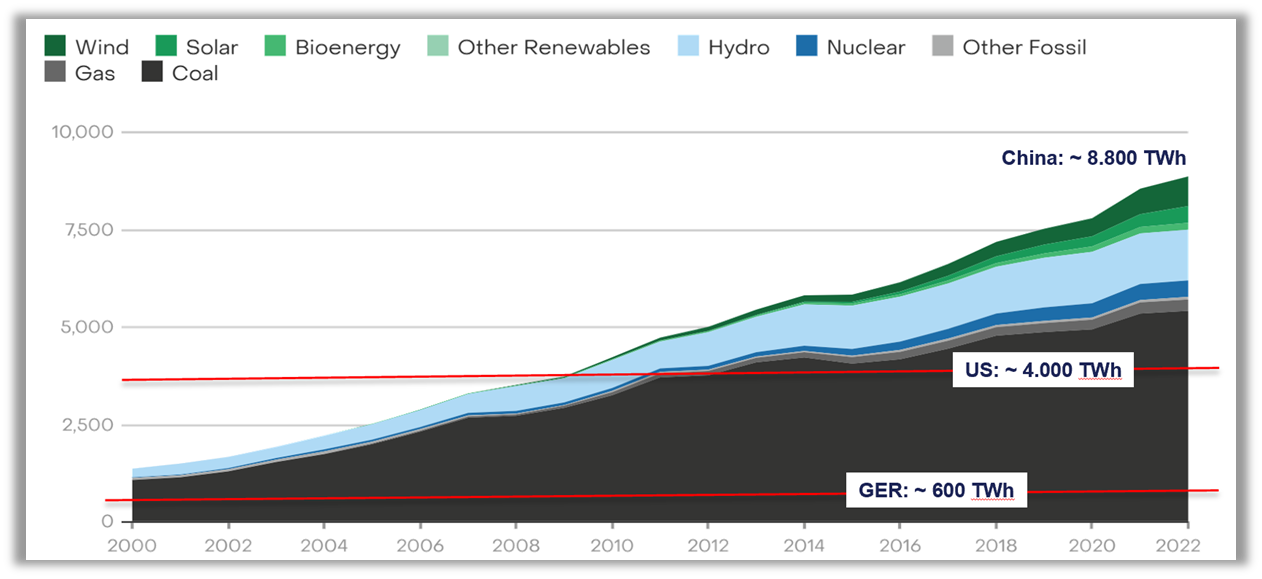
From this blog, you can now better see how important uninterrupted power and heat supply is especially for industrial processes such as silicon smelting. Obviously, this power comes from coal in China, and cannot come from wind or solar. Figure 5 illustrates how China increased its power consumption more than 5-fold in 20 years and how coal-fired power generation continues to grow with the economy. The large wind and solar installations can be seen as addition, rather than transition. For comparison, I added lines to illustrate the approximate electricity consumption of the US and Germany respectively.
Figure 5: Chinese electricity generation by sources compared to US and Germany. Source: Schernikau based on Ember, details here
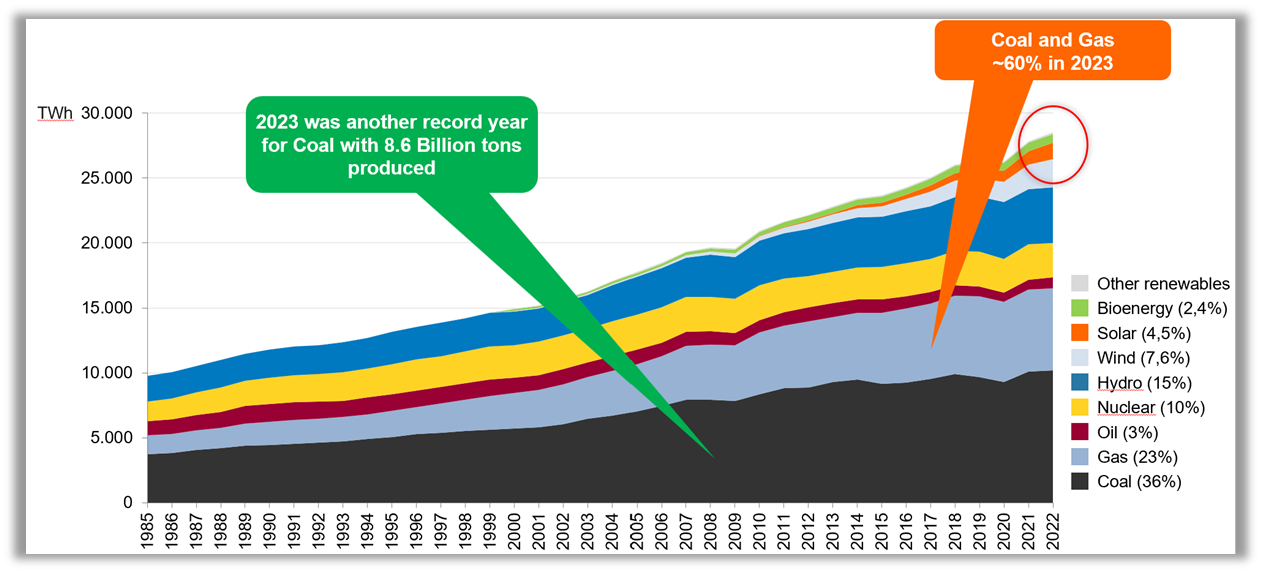
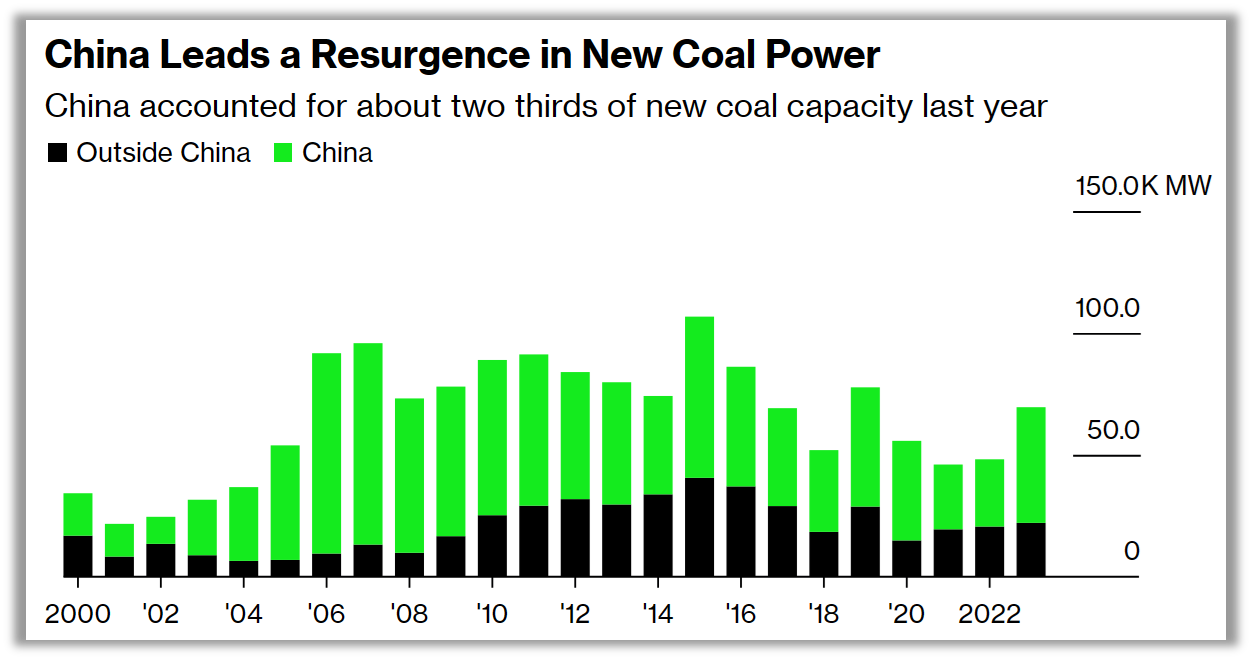
Global electricity generation is dominated by thermal power. Coal and gas alone account for about 60% (Figure 6). We understand that the world, and especially China (Figure 7), continues to build large coal power plants to provide reliable uninterrupted power and domestic and industrial heat. Wind and solar enthusiasts often underestimate the importance of inertia of rotational mass for the stability of our grids.
Coal consumption hit another record in 2023, globally (8,6 Bn tons) and in China (over 4 Bn tons). At the same time, China also led the global installation of new solar plants domestically in addition to selling its solar panels globally. 2023 and 2024 show another upswing of new coal power plant installations amounting to numbers surpassing 2018 levels (Figure 7).n
Total global installed capacity for electricity generation is probably around 8,6 TW (including coal, gas, nuclear, hydro, wind, solar, etc.), of which coal is about 2,1 TW. Thus, 25% installed capacity provide for 36% for actual power generation. Utilization of coal plants will continue decreasing as more wind and solar hits the grids, but the installed coal capacity is still required and has to grow along with peak power demand.
Figure 7: China coal power capacity additions. Source: BNEF, details here
6. Summary
Solar power and coal are closely interlinked. Today, there is not one single solar panel that can be produced without coal (or even oil and gas). The coal is required as a reducing agent for silicon making and as source for heat and electricity for the industrial process required to manufacture solar panels, not only in China. As unpopular as it may be, the world requires coal, even for the so called “energy transition”.
That is why I support investment in, not divestment from, coal technologies to make the production and utilization of coal as efficient as possible, not only to minimize its environmental impact, but also to keep costs low, which supports economic development and benefits in particular the less fortunate.
I hope this post helps you to understand my passion for coal and gives you a new insight into the “clean” world of solar power.
To learn more about how wind and solar work in our modern energy systems please read our recent book The Unpopular Truth… about Electricity and the Future of Energy available at your favorite book store.



 Iowa Climate Science Education