Bill payers are to fund a £30bn overhaul of the electricity network as the National Grid “rewires the nation” to hit net zero.
National Grid unveiled the investment as it prepares to build thousands of miles of new cables by 2030, to carry electricity from wind farms in Scotland or offshore to power-hungry cities mainly in England.
This overhaul will eventually cut greenhouse gas emissions – but will lead to thousands more pylons being built across Britain and extra charges on customers’ bills.
The announcement, planned for weeks, comes as net zero is expected to play a major role in the forthcoming general election campaign. Labour is seeking to decarbonise by 2030, but Rishi Sunak, the Prime Minister, has argued that this is too fast.
John Pettigrew, National Grid’s chief executive, announced the move alongside the company’s full year results for the year to March 2024, including another £30bn to be invested in the US.
He said: “We’re announcing today a new five-year financial framework. We will be investing £60bn in the five years to the end of March 2029 – that’s nearly double the level of investment of the past five years.
As the National Grid now admit this expenditure is inly needed to connect wind farms in Scotland and offshore to the market, surely they should be made to pay for it.
The wind and solar ‘industries’ are best explained by the fact that the players are always using someone else’s money. Namely yours, as taxpayers and power consumers.
The point is best illustrated by the idiotic nature of the enterprise. Expecting entirely wind-dependent and/or sunshine and weather-dependent generation sources to deliver power around-the-clock sounds stupid enough.
But certain efforts still have the ability to stand out head and shoulders above the rest.
Take the idea of floating solar panels on large expanses of water – such as the example below from India (or what’s left of them).
The state of Madhya Pradesh was (for a while) mighty proud of its enormous floating solar plant, situated on the Omkareshwar dam.
Then, after a little rough weather, not so much.
Que the embarrassed looks and consternation, as what was (briefly) the world’s largest floating solar plant was shredded and ground into a pile of aluminium and toxic polysilicon junk. Back to the drawing board, as they say.
Alternatively, India could just crack on with the construction of coal-fired nuclear power plants and ignore part-time power, altogether.
The World’s Largest Floating Solar Farm Wrecked by a Storm Just Before Launch
Watts Up With That?
Eric Worrall
9 May 2024
Who could have predicted acres of fragile floating structures would be vulnerable to bad weather?
Madhya Pradesh: Summer Storm Damages World’s Largest Floating Solar Plant at Omkareshwar Dam (Watch Video)
Indore: A summer storm on Tuesday damaged a floating solar plant at Madhya Pradesh’s Omkareshwar dam. The floating solar plant, situated in the backwater of the dam, is the biggest of its kind in the world. A joint venture between Madhya Pradesh Govt and National Hydroelectric Power Corporation (NHPC), the project was nearly completed and ready for its launch. A part of the project became operational last week.
The project near the village of Kelwa Khurd, aimed at generating 100 MW of electricity, with additional capacities of 88MW at Indawadi and 90 MW at Ekhand village. However, on Tuesday, summer storms with the speed of 50kmph hit the project and threw the solar panels all around the place. No employee was fortunately injured.
Anyone who has ever owned a boat, particular a large boat which gets left in the water, knows what a harsh environment the sea can be. Some kind of failure was inevitable. If it hadn’t been a storm, there are plenty of other things which could have gone wrong.
Greens keep telling us we can expect more frequent and extreme superstorms – so what is the point of building vulnerable floating structures?
Plastics tend to disintegrate under tropical sunlight, especially when in contact with water or water spray. Ultraviolet from the sun drives exotic chemical reactions, which leads to chemical breakdown.
Metal sitting in water is difficult to manage, even stainless steel is not immune to corrosion. All metal structures in contact with water need to be protected with sacrificial anodes or comparable protective measures. Electricity and metal are an especially bad combination, any electrical fault which causes a current to run through metal in contact with water can cause corrosion to occur thousands of times faster than normal.
Let us hope developers and politicians take the hint, and stop throwing our money at inherently flawed ideas like floating solar arrays. Watts Up With That?
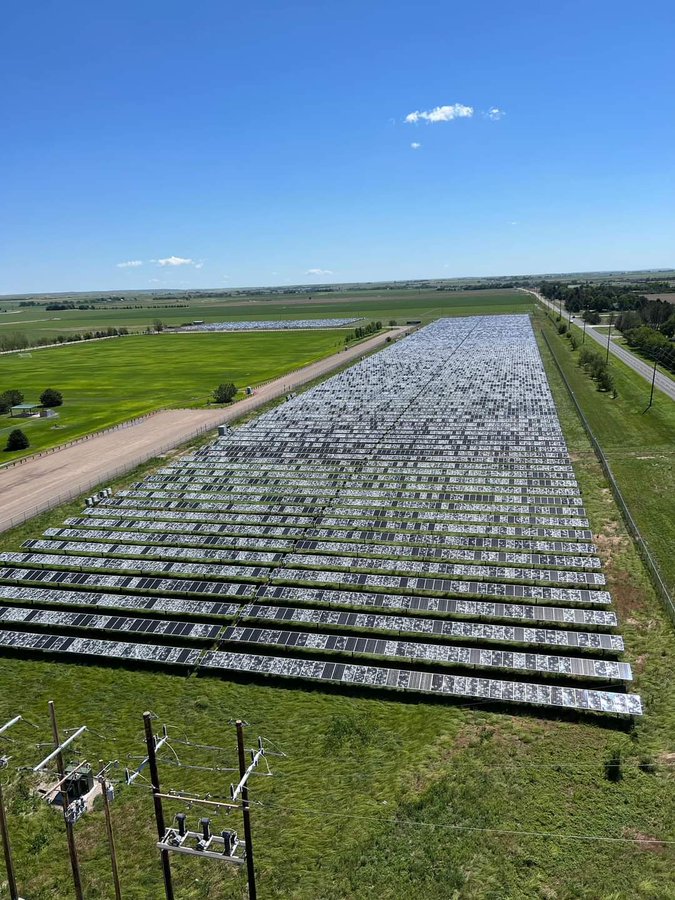
Oh, and they’re not that fond of hailstones, either ..




 Iowa Climate Science Education