Month: May 2024

Biden Games Gasoline Prices (election ahead?)

“The hypocrisy of the Biden administration taking credit for lower gasoline prices as the summer driving season begins by fulfilling a Congressional mandate is unsurprising.”

The Department of Energy announced Tuesday that it would begin selling the one million barrels of gasoline in the Northeast Gasoline Supply Reserve.  Bids for the supply are due May 28th with delivery expected by June 30th.  Bids will be accepted for lots of 100,000 barrels.  The supply represents 42 million gallons of gasoline and is held in commercial storage tanks in Maine and New Jersey. 

The sale was mandated by the omnibus Congressional spending bill (HR 2882) approved in late March with procedural hijinks by Senate Leader Chuck Schumer.  If you remember, it was during the final hours of the Friday before the week-long Congress’ Easter Recess that the House passed the legislation 286-134 providing funding to keep the government operating through its September 30 fiscal year-end.  The bill was passed over to the Senate which passed it in the early morning hours of Saturday and forwarded it to the White House for President Joe Biden’s signature that evening.  Importantly, more Democrats than Republicans in the House voted for the bill as more than 100 Republicans voted against it. 

We now have the amazing scenario where days before the start of the hurricane season, Democrats in Congress and Biden are willing to empty the gasoline reserve.  Energy Secretary Jennifer Granholm said in a statement, “By strategically releasing this reserve in between Memorial Day and July 4th, we are ensuring sufficient supply flows to the tri-state and northeast at a time hardworking Americans need it the most.”  How funny that the Biden administration is taking credit for helping consumers by following through on a Congressionally mandated action. 

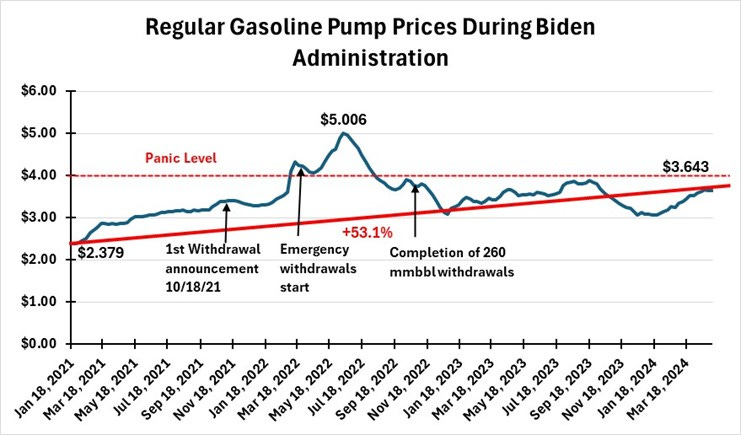
Recently, we wrote about our drive from Houston to Rhode Island.  In the article, we discussed gasoline prices and how they became more expensive as we headed north, primarily due to higher state taxes in the Northeast states.  We commented on Biden’s election problem with high gasoline prices and our expectation that he would repeat his 2022 move to tap the Strategic Petroleum Reserve to lower pump prices in the run-up to the November election.  He was successful, but as we showed in a chart, gasoline pump prices have increased 53% since Biden entered office.

Biden successfully pushed down gasoline prices by tapping the SPR in 2022.
The gasoline reserve was established in 2014, two years after Super Storm Sandy slammed the Northeast region and disrupted fuel supply availability sending gasoline prices soaring.  Some gasoline stations were without fuel for 30 days.  Having gasoline supplies pre-positioned in the region reduces the risk for consumers from future storm disruptions. 

East Coast states depend on Colonial Pipeline for 55% of their gasoline, diesel, and jet fuel supply.
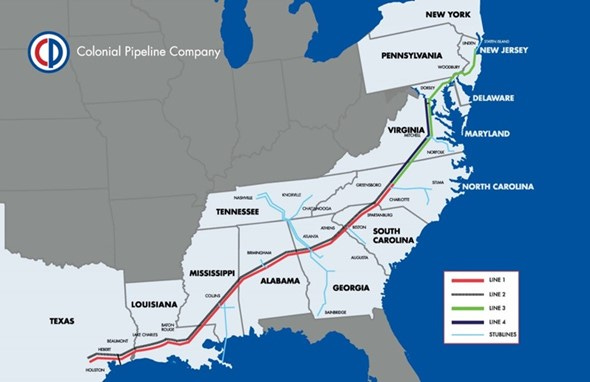
The vulnerability of the Northeast and Middle Atlantic states to fuel supply disruptions emerged on May 7, 2021, when the Colonial Pipeline was hit in a ransomware attack.  The pipeline, which originates in Houston and runs to New York, supplies the East Coast states with 55% of its petroleum fuels – gasoline, diesel, and jet fuel.  The pipeline was shut down to protect its operations and billing system.  Operations were slowly restarted after the ransom was paid. 

Fuel shortages occurred at gasoline stations amid panic buying as the pipeline shutdown extended for days.  By the fourth day, Alabama, Florida, Georgia, North Carolina, and South Carolina reported shortages.  Areas from northern South Carolina to southern Virginia were hardest hit, with 71% of gasoline stations running out of fuel in Charlotte on May 11th and 87% of stations out in Washington, D.C., on May 14th.  Average fuel prices rose to their highest point since 2014, reaching more than $3 a gallon.  Jet fuel availability caused several airlines operating from Charlotte to alter refueling arrangements including forced refueling stops for long-haul flights. 

Estimates are that the gasoline reserve sale will raise $125 million but, importantly, cut storage costs.  The Energy Department’s 2022 report on the SPR said it costs about $13 per barrel annually for operations and maintenance of the gasoline reserve compared with about 30 cents per barrel for crude oil in the SPR. 

The hypocrisy of the Biden administration taking credit for lower gasoline prices as the summer driving season begins by fulfilling a Congressional mandate is unsurprising.  We are also struck by how shortsighted Democrats are, especially those in the Northeast states who voted for the spending bill.  Their shortsightedness is laughable given the region’s energy risk from supply disruptions on the eve of the start of the hurricane season, which is predicted to be extremely active. 

—————–

Share Energy Musings

The post Biden Games Gasoline Prices (election ahead?) appeared first on Master Resource.

via Master Resource

https://ift.tt/z9WsPCS

May 23, 2024 at 01:01AM

The Mystery of the FBI raid on Mar-a-Lago and Crooked Ferriero

The FBI unit sent to raid the Trump’s residence had instructions to shoot under certain circumstances.

The raid was part of a phony investigation, reportedly triggered by the former NARA Director David Ferriero. In his government positions, Ferriero has perpetrated at least two huge crimes that received no media attention.

On behalf of NARA, he signed agreements with select Big Tech companies on those companies’ terms (TOS with minor changes). These agreements allowed those companies to deplatform the US at will, to decide who has access to US government accounts, and what the US can post. Of course, the Fox News-affiliated MySpace was not included.

As the New York Public Library Director, Ferriero helped Google  to scan millions of copyrighted books owned by the NYPL. The NYPL is part of the NYC government. This was a gift worth many $Billions, because Google used those books to improve its search engine beyond the reach of competition and to develop AI. This was part of the Google Books project, and some other state libraries were complicit, too. This was a grave violation of Article I, Section 8 of the Constitution: “The Congress shall have Power … To promote the Progress of Science and useful Arts, by securing for limited Times to Authors and Inventors the exclusive Right to their respective Writings and Discoveries;” Worse, the agreement between the NYPL and Google was de facto exclusive. Ferriero was appointed to his position by Obama in 2009.


via Science Defies Politics

https://ift.tt/ewfsBh6

May 23, 2024 at 12:22AM

More Behind the Sciences Billionaire Climate Machinations

From Government Accountability & Oversight

Original Title:

Window on the Bay State

Web Admin,

President Biden has nominated former Massachusetts Undersecretary of Energy and Climate Solutions, Judy Chang, to be a FERC Commissioner. Ms. Chang is possibly best well-known for a 2018 comment staking out the position that because New England would move away from natural gas within the next five years it was irresponsible to invest in pipelines. At the time—let alone six years later—that is an odd stance for anyone who aspires to serve in a body responsible for ensuring the development of abundant supplies of natural gas at reasonable prices. Related, FERC is most recently known for ‘doing an EPA,’ i.e., “unlawfully supporting climate goals that Congress never approved.”

With Massachusetts’ Office of Energy & Environmental Affairs, which Ms. Chang previously helmed, yet to move on a contemporary, similar request, GAO notes the Commonwealth’s Department of Public Utilities (DPU) has released some records which do open a window onto that office’s working relationship with a renewable energy trade group called Advanced Energy United.

AEU has recently been shown to be the matchmaker for Michael Bloomberg’s operation out of NYU, the State Energy and Environmental Impact Center, to place activist ‘staff’ in progressive PSC/PUC offices to advance their aligned ‘climate’ agenda’, just as it did in AG offices.

Screenshot

Advanced Energy United used to be called Advanced Energy Economy. A Tom Steyer Joint, per his counsel:

GAO looks forward to MA OEE releasing the requested public records.

via Watts Up With That?

https://ift.tt/nHBaACG

May 23, 2024 at 12:03AM

EPA’s Clean Power Plan Rule Prioritizes Net-Zero Over Grid Reliability

By Gabriella Hoffman Christian Palich

Coal and natural gas plants provide 60% of the U.S.’ affordable, reliable, and baseload power. In a time of increased electricity demand, America needs to double down on harnessing these sources—not abandon them.

The Environmental Protection Agency (EPA)’s recently finalized Clean Power Plan 2.0 (CPP) rule, however, takes the country in the wrong direction. Under this regulation, one that is arguably illegal, existing coal and new natural gas power plants will be mandated to install emissions control technologies that aren’t yet commercially viable. Plants that don’t comply risk permanent closure. This unrealistic mandate is advanced under the guise of reducing greenhouse gas emissions 90% by 2032.

The Biden administration should nix this rule altogether given its many drawbacks to the American economy, all of which come with no environmental gain and are based on dubious authority. If it doesn’t reverse course, a forthcoming Congressional resolution of disapproval and newly-filed lawsuits could stop overreach here.

The EPA’s limited authority over-regulating greenhouse gas emissions was affirmed in the landmark June 2022 West Virginia vs. EPA decision. That case challenged the original Obama-era Clean Power Plan, and the Supreme Court ruled the EPA lacked the statutory authority to regulate greenhouse gas emissions. No change has been made to grant the EPA more authority over greenhouse gasses.

Moreover, the Clean Air Act says the EPA must craft achievable emission limitations standards that have been “adequately demonstrated.” Yet, the Carbon Capture technology that would be relied upon under this rule has never been “adequately demonstrated” on the scale that EPA is attempting to require.

The EPA rule would lead to grid instability because operators will be forced to adopt intermittent, unreliable, and costly sources like wind and solar. According to the Department of Energy, wind is only reliable 33.5% of the year while solar is dependable for just 24.9% of the time. Wind energy generation decreased for the first time last year. The federal government reports wind generation hit maturity with slower recorded wind speeds, despite adding 6.2 gigawatts of new wind capacity. Solar energy also had a bad 2023 with over 100 companies going bankrupt and expensive electricity rates. Many planned solar plants, including those receiving Inflation Reduction Act subsidies, are predicted to be canceled this year due to price collapse and waning demand.

The North American Electric Reliability Corporation (NERC) warned in its December 2023 Long-Term Assessment report that rigid policies like CPP 2.0 “have the potential to influence generators” to close down their plants. The risk of massive electric reliability issues across the country is by no means a political talking point. In 2023, FERC Commissioner Danly stated in a hearing to the Senate Energy and Natural Resources Committee that “there is a looming reliability crisis in our electricity markets.” In that same hearing, Commissioner Christie said “The United States is heading for a very catastrophic situation in terms of reliability.” These are the experts sounding the alarm that we need more grid capacity from baseload sources, not intermittent ones, or we could face not just loss of commerce but a loss of human life.

CPP 2.0 promises to reduce greenhouse gas emissions by 90% by 2032 by mandating coal and natural gas plants install carbon capture and storage (CCS) or face closure. But the EPA is downplaying the nascent technology’s shortcomings.

CCS, as it stands, is expensive and will diminish coal and natural gas plant efficiency by at least 14%. Moreover, natural gas and coal plants retrofitted with first-generation carbon capture technology reportedly can expect a 50% and 70 to 80% increase in electricity costs, respectively.

In the U.S., we already have highly effective emissions technology that enables coal plants to run in an incredibly environmental way. For example, just look at how states that rely heavily on coal have almost none of the air quality issues of China or India. That’s because of our emissions control technologies.

Let’s call this rule out for what it really is: It’s a vehicle to punish coal country which has left the president’s party in droves over the last 20 years, in favor of radical environmental non-governmental organization (NGO) donors who are a major constituency of this administration.

The finalized Clean Power Plan 2.0 rule is a bad deal for American energy producers and consumers. Congress should immediately pull the plug on this rule.

Gabriella Hoffman is director of Independent Women’s Forum’s Center for Energy and Conservation (iwf.org/CEC) and host of the District of Conservation podcast.

Christian Palich is Vice President of Government & External Affairs at Eagle Forge Services Company, one of the nation’s largest coal producers and a board advisory member for IWF’s Center for Energy and Conservation.

This article was originally published by RealClearEnergy and made available via RealClearWire.

via Watts Up With That?

https://ift.tt/8PNRZf6

May 22, 2024 at 08:00PM