
The potential impact is damaging enough to be worth thinking about, perhaps even doing something about.
via CFACT
May 20, 2024 at 04:02AM
The potential impact is damaging enough to be worth thinking about, perhaps even doing something about.
via CFACT
May 20, 2024 at 04:02AM
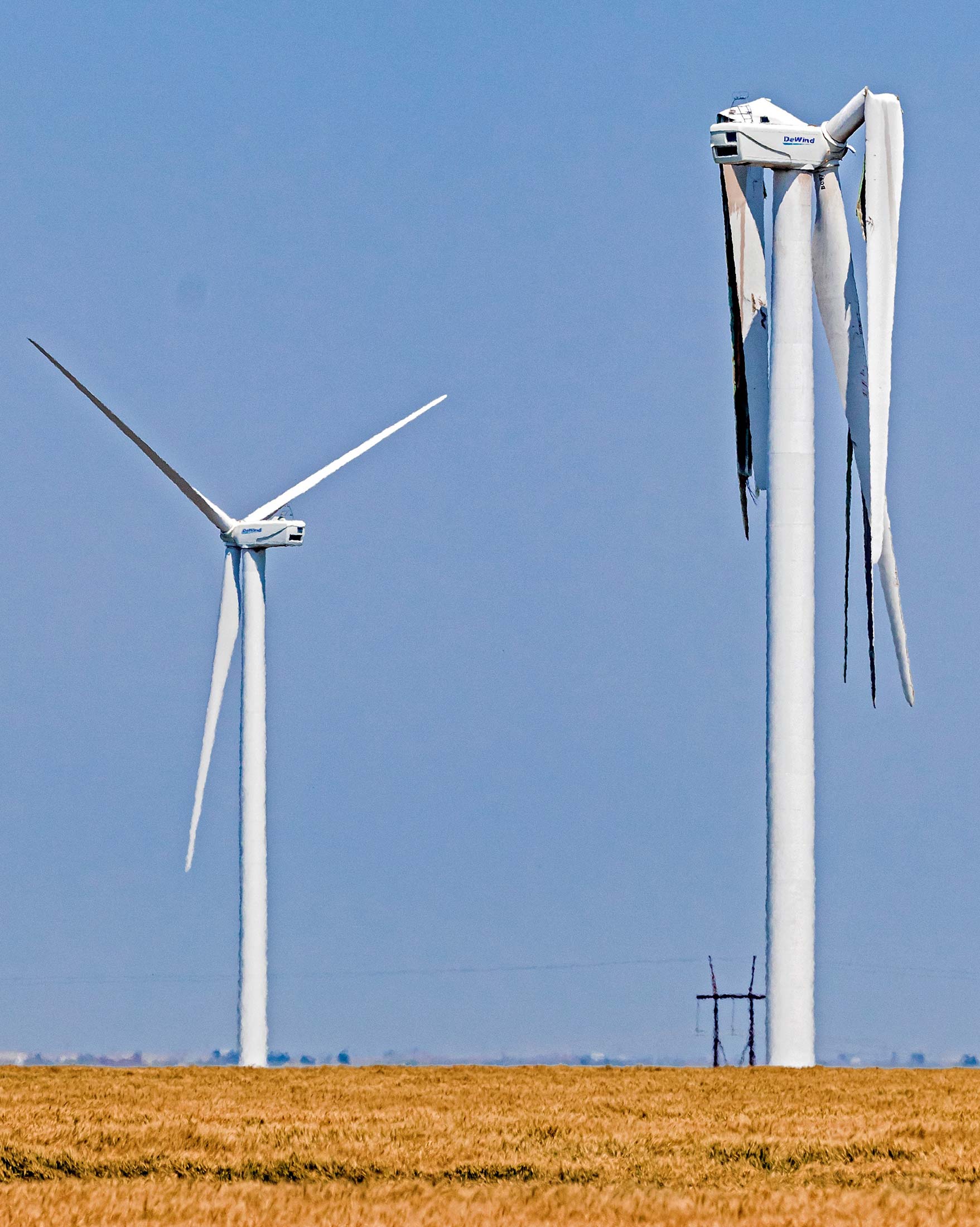
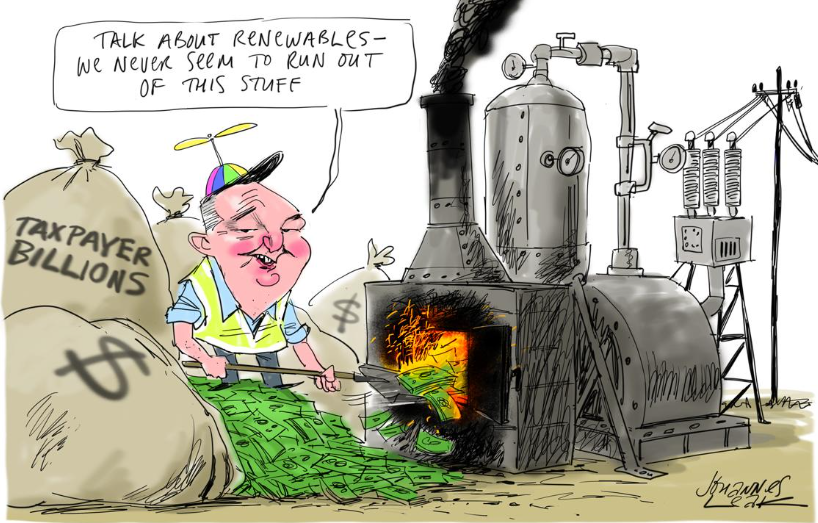
The staggering cost of carpeting the countryside with forests of wind turbines and seas of solar panels are ultimately borne by you: the unwitting taxpayer and power consumer.
There is no commercial value in wind and solar power because there is no demand for electricity that can’t be delivered as and when consumers need it. Hence the hundreds of billions of dollars in subsidies that are poured into the pockets of wind and solar outfits around the globe, every year. Strip away the subsidies and the wind and solar ‘industries’ would disappear in a heartbeat.
In Australia, the rent-seeking class have never had it so good: the left-wing of the Labor Party (in cahoots with the crazies that call themselves Greens) have delivered a Federal budget designed to enrich crony capitalists and impoverish everyone else.
Central to their grand 5-year-plan are even further gifts taxpayer’s cash to wind and solar outfits and a raft of other ‘infant industries’ [read enterprises which will never attract a nickel in private investors’ money without a government-guaranteed return – like so-called ‘green’ hydrogen].
None of what’s been put forward has a hope of improving this country’s economic prosperity. All of what’s on offer signals the annihilation of those remaining industries where energy costs count, as Alan Moran explains below.
Budget review: net zero cannibalises our prosperity
Spectator Australia
Alan Moran
16 May 2024
The public is receiving the Budget with a sense of bored irrelevance. People are pleased to see a $300 cut in their electricity bills, hoping that someone else is financing this, but eyes glaze over at the billions of dollars of taxpayer money with which the government promises to catapult the economy into the nirvana that is the green energy transition. And nobody seems concerned that spending is at its highest since the Hawke-Keating years of the early 1990s.
But the reality is this budget not only amplifies the already excessive government spending levels, but adds measures that aim to transform the economy by injecting unprecedented government control over business. Taxpayers will plough $22.7 billion into Labor’s Future Made in Australia agenda.
At best, this is wasteful but in reality, it is harmful since the funds are intended to combine with other regulatory measures in order to destroy the coal and gas energy generation facilities. These facilities were built up over decades to form the backbone of the nation’s once highly efficient low-cost power, important for homes and crucial for the production activities that determine our living standards. Energy-intensive smelting is already under special care and we are now seeing food manufacturers talking of moving their facilities offshore where energy and other costs are more welcoming.
The damage the policies cause is compounded by them, in the Treasurer’s words, helping to ‘unlock greater private investment’ in five priority areas. These he describes as green hydrogen, critical minerals, green metals, low carbon liquid fuels, and clean energy manufacturing. Belying any understanding of economic policy, the Treasurer claims that his policy settings avoid picking winners via direct subsidies and are instead ‘leaning on the tax system’ to support the target sectors; he adds ‘if the projects can’t stand up on their own and get into production, they don’t get taxpayer money’.
To the degree that the direct and indirect measures succeed, they bring about a double whammy. First, they cannibalise the available funds from activities that would otherwise maintain and raise living standards. And secondly, they divert them into expenditures that have the opposite effect.
Australian governments (and governments of some other developed nations) are forcing the economy along a non-commercial green path. We have seen such plans come to grief in some developing countries. Sri Lanka offered a trial run in 2021 when the green-left persuaded the government to ban fossil fuel-based fertilisers; that ended badly with plummeting crop production, 80 per cent food price increases and the President being forced to flee the country.
In the past, government policies that overrode commercial decisions did so by seeking to replicate well-documented overseas successes. Some, like the Soviet Union, seized income from producers and redirected it with limited and painful success into catch-up industry activities. Australia adopted import-substitution, infant industry policies; when these were reversed by the Hawke-Keating deregulatory reforms we experienced a surge in productivity and income levels
The present path differs from those of previous intervention eras, which though ending in failure were seeking to develop industry growth patterns along well-trodden paths. The Future Made in Australia programs are based on the government selecting particular technologies and using taxpayer funds to finance their development. They are therefore inherently riskier.
The public is receiving the Budget with a sense of bored irrelevance. People are pleased to see a $300 cut in their electricity bills, hoping that someone else is financing this, but eyes glaze over at the billions of dollars of taxpayer money with which the government promises to catapult the economy into the nirvana that is the green energy transition. And nobody seems concerned that spending is at its highest since the Hawke-Keating years of the early 1990s.
But the reality is this budget not only amplifies the already excessive government spending levels, but adds measures that aim to transform the economy by injecting unprecedented government control over business. Taxpayers will plough $22.7 billion into Labor’s Future Made in Australia agenda.
At best, this is wasteful but in reality, it is harmful since the funds are intended to combine with other regulatory measures in order to destroy the coal and gas energy generation facilities. These facilities were built up over decades to form the backbone of the nation’s once highly efficient low-cost power, important for homes and crucial for the production activities that determine our living standards. Energy-intensive smelting is already under special care and we are now seeing food manufacturers talking of moving their facilities offshore where energy and other costs are more welcoming.
The damage the policies cause is compounded by them, in the Treasurer’s words, helping to ‘unlock greater private investment’ in five priority areas. These he describes as green hydrogen, critical minerals, green metals, low carbon liquid fuels, and clean energy manufacturing. Belying any understanding of economic policy, the Treasurer claims that his policy settings avoid picking winners via direct subsidies and are instead ‘leaning on the tax system’ to support the target sectors; he adds ‘if the projects can’t stand up on their own and get into production, they don’t get taxpayer money’.
To the degree that the direct and indirect measures succeed, they bring about a double whammy. First, they cannibalise the available funds from activities that would otherwise maintain and raise living standards. And secondly, they divert them into expenditures that have the opposite effect.
Australian governments (and governments of some other developed nations) are forcing the economy along a non-commercial green path. We have seen such plans come to grief in some developing countries. Sri Lanka offered a trial run in 2021 when the green-left persuaded the government to ban fossil fuel-based fertilisers; that ended badly with plummeting crop production, 80 per cent food price increases and the President being forced to flee the country.
In the past, government policies that overrode commercial decisions did so by seeking to replicate well-documented overseas successes. Some, like the Soviet Union, seized income from producers and redirected it with limited and painful success into catch-up industry activities. Australia adopted import-substitution, infant industry policies; when these were reversed by the Hawke-Keating deregulatory reforms we experienced a surge in productivity and income levels
The present path differs from those of previous intervention eras, which though ending in failure were seeking to develop industry growth patterns along well-trodden paths. The Future Made in Australia programs are based on the government selecting particular technologies and using taxpayer funds to finance their development. They are therefore inherently riskier.
Their starting blocks are the existing forms of green energy: wind, solar, and batteries (and Snowy 2, the costs of which have ballooned from $2 billion to $20 billion with no end in sight). Although CSIRO and other government agencies proffer advice that renewable energy supplies are the cheapest forms of energy, their continued reliance on subsidies refutes this. The government in announcing its multiple support measures does not publicise the estimated total bill (in my estimates, $15.6 billion a year even before the latest props). At one time the budget papers had a compendium of the measures. But this was discontinued in 2011, when Tony Abbott as opposition leader was drawing attention to the cost, prompting Prime Minister Julia Gillard to famously maintain, in a highly choreographed statement, ‘There will be no carbon tax in a government I lead!’ That pledge was promptly reneged upon once she was re-elected with the support of the Greens.
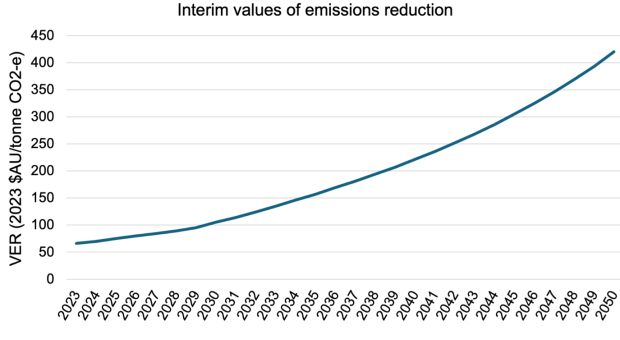
But some corners of the bureaucracy illuminate some of the costs. Thus, the Australian Energy Regulator (AER) has estimated the de facto carbon tax required over the years to 2050 to achieve the government’s Net Zero ambitions. The AER estimates a carbon tax rising to some $420 per tonne by 2050 will be needed. That amounts to a tenfold increase on the 2015 price of electricity (the last year before carbon-suppressing regulations forced closures of coal-fired electricity generators and the subsequent wholesale price increases).
The fact is that the ‘energy transition’ technologies do not work and probably will never work. Imposing them onto the economy will further increase costs and undermine reliability. At the very least this will reduce productivity and living standards with governments forced to adopt more and more ad hoc measures to prop up the most adversely affected industries and subsidise household bills. Hopefully one day – and soon – the madness will end.
Spectator Australia
via STOP THESE THINGS
May 20, 2024 at 02:30AM
Social media exchanges between free market and government energy/climate proponents are an excellent way to understand the arguments and politics and motivations of all involved. Here is a LinkedIn exchange of note, where I (and others) rebut a familiar ad hominem. In this case, one Thomas Ortman just … disappeared.
The exchange occurred with a post by Gavin Mooney, self-described “energy transition optimist,” here.
—————–
Geoffrey Lakings: what needs to be understood in regards to IER & their bias can be summarized in this one statement, “The Institute for Energy Research (IER) is a nonprofit ‘partner’ organization of the American Energy Alliance, which is a 501(c)(4) grassroots organization designed to communicate IER’s policies to voters. The groups are run by Tom Pyle, a former lobbyist for Koch Industries.”
Mark Rohrbacher: All non profits have their benefactors, Greenpeace, Tides Foundation, Rockefeller, etc. Is it really necessary for us to “tit for tat” Soros and company vs. “ The Koch Brothers”?
I am so sick of “green advocates” painting their opposition as “evil” or posting with a ulterior motive just because of the organization that they belong to. It’s repeated over and over on LinkedIn and cheapens the level of discourse.
Rob Bradley: Geoffrey S Lakings Classical liberal on the education and public policy advocacy sides. Pro consumer, taxpayer, freedom, and environment. What is your beef? Our several thousand supporters want to know.
The idea that wind, solar, and batteries are ecological and that government should override consenting adults with their energy choices put the burden of proof on you.
Thomas Ortman: Thank You Geoffrey S Lakings. This makes all the sense in the world having watched Rob Bradley tossing hand grenades into any clean energy/ clean tech discussion for years.
It was clear that there was a major bias, but I did not know the backstory.
Rob, we all have biases. Mine is strongly pro-climate and I am not paid to promote what I believe to be true and ethical. The difference is that you are clearly well informed on the subject and yet often toss out misinformation/disinformation which I find to be very disingenuous. It appears you take pleasure in tossing out an ounce of malcontent and generating five pounds of response. I suppose that as yours is a paid position, it would be reasonable to ask for you to declare your position and to come out in favor of *something*, ( as opposed to your constant brush fires with nothing constructive to offer).
If your bias/employer is to support oil and gas – fine, have sufficient integrity to claim as much. Then we can have an honest discussion regarding all of the critical areas that the O&G sector can provide critical and profitable contributions.
Rob Bradley: Thomas Ortman Wrong. You have reversed the causality. Beliefs first, funding last. And no, I do not carry the water for any company or industry but for consumers, taxpayers, freedom, and … the environment against wind, solar, and batteries.
I have been classical liberal since high school and through a corporate career where I challenged my Enron superiors who were pushing climate alarmism and promoting government subsidies for their wind and solar investments.
Read the emails here to judge for yourself. http://www.politicalcapitalism.org/enron/
Rob Bradley: Thomas Ortman Your business profile includes “Goal of expanding this base into related areas of … clean energy products, including; Solar Energy, Solid State Lighting, Energy, Energy Storage and Clean Technologies led to a merger with Voltabox of Texas, Inc.”
So note that I do not use ad hominem against you for your bread-and-butter. In fact, I never do so except in certain instances, such as the conflict of interest with Chris Tomlinson, business editorialist at the Houston Chronicle.
https://www.masterresource.org/houston-chronicle/tomlinson-houston-chronicle-confession/
The post Ad Hominem Backfire in the Energy/Climate Debate appeared first on Master Resource.
via Master Resource
May 20, 2024 at 02:24AM
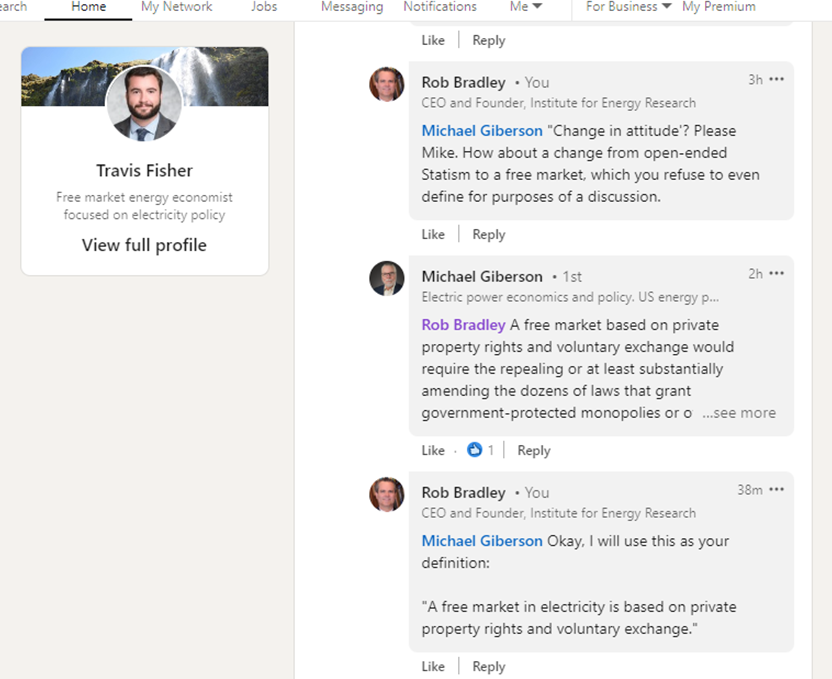
“A free market in electricity is based on private property rights and voluntary exchange.”
– Michael Giberson, May 19, 2024
It took me a few dozen tries, but the definition has come from a (not-so) free market electricity advocate. Maybe Lynne Kiesling, woman of system and “The Queen of Electricity Markets,” will be next.
Fake free marketeers at the Niskanen Center and at R Street Institute are a plague on sound public policy analysis regarding electricity and other climate/energy issues. (The sad case of Jerry Taylor of Cato and Niskanen is recounted here and here.)
Mike Giberson knows his energy stuff and was/is free market in many areas, except for electricity. Yes, he works around the edges to improve power “markets” using basic economics. But he is firmly in the camp of mandatory open access and central wholesale planning, with nary a thought to the free market alternative, which he very reluctantly (and finally!) defined above.
This is much to like about Mike. He corrects me in my specialty, the history of U.S. petroleum intervention. He has had notable free market moments, such as his rejoinder to the notion that the U.S. Department of Energy invented the fracking of natural gas from shale. On price gouging, he has been my guest at MasterResource. He reviewed Meredith Angwin’s book Shorting the Grid with a moment of candor:
By the end of the book, I could no longer shake the feeling she just might be right on the big thing. RTOs may be producing an increasingly fragile grid.”
Duh, one might say. But would Lynne Kiesling agree?
Consider his reporting on negative wind pricing at least as far back at 2008. Great stuff, but he downplayed the same in the ruined economics of thermal generation leading up to the Great Texas Blackout of February 2021, another story (here and here).
I disagree with Giberson on electricity policy, but it goes much deeper than this. The rules of classical liberal scholarship include taking opposing arguments seriously and being transparent. And focusing on opportunity cost, the most attractive option foregone. Mike, and Kiesling more so, have violated that in spades, preferring to be obscure and to disengage at the most important moments (ask Travis Fisher).
Only after a lot of effort have I gotten Giberson to admit to the simple definition of a free market in regards to electricity (which he contradicts in his work, it can now be said). I have applauded his admission that ISO/RTO’s are “a very regulated market.” And I do so now.
And I have rebutted his criticisms of me for being a stooge for oil and gas; and for sullying my reputation. A lot of hit-and-misses from him, in my opinion. This said, Giberson and I have debated wind/solar zoning versus private property rights with reasonable differences. (But why his defense of private property here and not with electrical transmission?)
But overall, the electricity program of Giberson (Kiesling) is Stealth Statism. As I once asked:
So will Michael Giberson and Lynne Kiesling ever consider the opportunity cost of their politicized electricity ‘market’? Will they consider a real free market that was at the center of the classical liberal debate before mandatory open access (etc.) came along? How much failure–and how far on the ‘road to serfdom’ does U.S. energy policy have to go before mid-course corrections?
All this said, much progress has been made with his definition, fresh from yesterday, that can be used as a benchmark for evaluating public policy positions in electricity. I hope Lynne Kiesling (who still refuses to provide a definition) approves.
The post Giberson Defines a Free Market in Electricity! appeared first on Master Resource.
via Master Resource
May 20, 2024 at 01:07AM
 Iowa Climate Science Education