Month: May 2024

Drax To Build Wood Power Cargo Ship

From NOT A LOT OF PEOPLE KNOW THAT

May 15, 2024

By Paul Homewood

h/t Philip Bratby

British power company Drax has drawn up plans for the world’s first wood-powered cargo ship, claiming that the controversial power source can help to cut greenhouse gas emissions from sea freight.

Drax, which operates a tree-burning power station in the UK, has signed a deal with three Japanese shipping companies to develop a “bioship” fuelled by wood chips instead of marine diesel. It hopes to see the first wood-fuelled cargo ship set sail by 2029.

The vessel would itself be used to ferry woodchips harvested by Drax from North American forests to new markets in Japan.

Drax and its Japanese partners said such ships would open the way to zero-emission shipping for many other cargoes.

However, the plan will infuriate many environmental groups who argue that cutting down forests for fuel is the wrong way to reach net zero.

Drax is best-known in the UK for its giant power station in Yorkshire, which last year generated around 6pc of the country’s electricity by burning 6.4m tonnes of wood – equivalent to 27 million trees – mostly imported from North America.

For comparison, the New Forest in Hampshire has around 46 million trees.

Drax and its supporters argue that wood is a sustainable energy source as trees can be grown to replace those cut down for fuel and the plants capture carbon while they are developing.

However, critics point out that trees grow much more slowly than the time it takes to use them for fuel, raising questions as to how sustainable they really are.

The UK Government supports the use of wood as a fuel and has given Drax subsidies for producing green energy, which amounted to £617m in 2022 and £587m in 2023.

In February, Drax chief executive Will Gardiner said he wanted to build more wood pellet plants in the US, doubling production to 8m tonnes by 2030.

Green campaigners said the plan was designed to exploit loopholes in carbon accounting rather than to save the planet.

Merry Dickinson of Axe Drax, which campaigns against the company’s plans to expand wood burning, said: “Burning wood pellets emits as much carbon as coal. This latest move is nothing more than another greenwashed scam from Drax.”

Sally Clark from Biofuelwatch said: “Using wood pellets to power ships will only lead to more climate-wrecking emissions, harm to wildlife and pollution of communities. If we are to avoid the worst impacts of climate breakdown, we need to protect and restore the world’s forests, not allow big polluters like Drax to send our futures up in smoke.”

https://www.telegraph.co.uk/business/2024/05/14/drax-power-ships-controversial-biomass-fuel-trees

Drax is already burning the equivalent of half the New Forest every year. Heaven knows how many more forests will be cut down to satisfy Will Gardiner’s lust for more wood pellets.

And as we already know, burning trees adds far more CO2 into the atmosphere than any other fossil fuel, in terms of the energy produced. The theory that trees will eventually grow back to replace them is highly dubious, as many come from virgin forests which may never regrow. Even if they do, it will take decades to offset the CO2 emitted from burning, by which time billions of other trees will also have been burnt.

Burning wood was of course man’s main source of energy for millennia; now we seem to be intent to regress to those days.

As for Drax, they are in a bit of a hole, being totally reliant on government subsidies. If these are stopped, they don’t have a viable business; hence their desperation to expand operations, regardless of the environmental destruction they will wrought.

via Watts Up With That?

https://ift.tt/GdA5LRi

May 16, 2024 at 12:03AM

Why the PROVE IT Act Would Result in Carbon Taxes

From ClimateREALISM

Guest post by Daren Bakst

The PROVE IT Act (S. 1863) is not a benign information collection bill on the carbon intensity of domestic and foreign goods. Instead, it would put in motion the creation of carbon taxes: a carbon tax on imported goods and a domestic carbon tax. It would also help the Biden administration as it works with the EU to impose carbon taxes on imported metals. Here’s why:

  • Congress has already demonstrated what will happen with PROVE IT Act information. Just over a year ago in the Inflation Reduction Act (IRA), which was a partisan reconciliation bill, Congress took information collected under the EPA’s greenhouse gas reporting program  to create a methane tax. The Senate passed the IRA on a 51-50 party-line vote with Vice President Kamala Harris casting the tiebreaker.
  • Many bill supporters have shown they would replicate what happened with the methane tax. In the Senate EPW Committee markup of the bill, all Committee Democrats voted to kill an amendment that would have helped block the future use of reconciliation to impose a carbon tax on imported goods or a domestic carbon tax based on PROVE IT Act information. Chairman Tom Carper (D-DE) opposed the amendment precisely because it “prohibits any revenue measure based on the greenhouse gas emissions associated with commodities or products.”
  • When PROVE IT Act supporters argue the bill is a way to hold foreign countries accountable, they reveal that the legislation is about more than information. Supporters, including lead sponsors Sens. Kevin Cramer (R-ND) and Chris Coons (D-DE), have argued that the PROVE IT Act is a way to hold other countries accountable for their emissions. Merely providing information cannot hold any country accountable. Their arguments are a tacit admission that the bill will be used to impose carbon taxes on imports, at a minimum.
  • Bill supporters openly acknowledge that the PROVE IT Act is intended to lead to more taxes. Many of the bill supporters are expressly admitting that the legislation will mean carbon taxes of some kind. Sen. Coons (D-DE) has said about the bill, “figuring out a fair process for imposing tariffs on countries that don’t have any transparency around their emissions is also going to be a complex part of any border carbon adjustment mechanism.” The European Union (EU) has created the first and only carbon border adjustment mechanism (CBAM) and it includes both a carbon tax on imports and a domestic carbon pricing scheme. Sen. Sheldon Whitehouse (D-RI) has said the bill will “help us construct a carbon border adjustment of our own.” Since 2021, about half of the sponsors of the PROVE IT Act have sponsored bills imposing carbon taxes on imports, with many of these bills also imposing domestic carbon taxes. Senator Coons, a lead sponsor of the PROVE IT Act and two co-sponsors, Sens. Whitehouse and Martin Heinrich (D-NM), sponsored the Clean Competition Act, which uses carbon intensity data to impose carbon taxes on imported goods and a domestic carbon tax.
  • The bill helps to collaborate with the EU on its harmful climate policy. Senator Cramer has repeatedly argued for working with the EU on climate policy. He wrote: “We have an opportunity to counter Putin’s playbook with a bold initiative consistent with European priorities… One aspect of that initiative could be a joint trade mechanism between the United States and the European Union that levels a common carbon fee on imported goods.” Instead of fighting and rejecting the EU’s disastrous climate policy, the PROVE IT Act embraces what the EU is doing. Many supporters advocate for a CBAM similar to the EU’s, and seek to create a “carbon club” of countries that join together to impose carbon taxes in some fashion.
  • The PROVE IT Act will help the Biden administration in its negotiations with the EU to tax the carbon intensity of metals. The Biden administration and EU are working on the Global Arrangement on Sustainable Steel and Aluminum that would impose taxes on imported metals based on their carbon intensity. This is part of the Biden administration’s broader plan as USTR explains to “use trade tools to decarbonize our economies.” The PROVE IT Act would legitimize these efforts and help the Biden administration reach an agreement with the EU on carbon taxes by pointing to this domestic effort to develop carbon taxes. It would also provide the Biden administration the data necessary to try and unilaterally impose carbon taxes on imports, such as under Section 232 of the Trade Expansion Action of 1974.
  • Creating a carbon tax on imported goods leads inexorably to a domestic carbon tax.1) To be part of a “carbon club” with the EU, as many bill supporters want, the US would logically need to have a system like the EU CBAM that includes a domestic carbon pricing mechanism. Not surprisingly, the PROVE IT Act helps to create the framework to implement an EU-type system.2) The US would sooner or later impose a domestic carbon tax if it imposes a carbon tax on imports. This is not simply due to trade law obligations but also because environmental groups and others would not stay silent as domestic industries failed to meet similar greenhouse gas reduction commitments. 3) The PROVE IT Act is a way to build a lobby for a carbon tax on imports that can then be used to secure a domestic carbon tax. Domestic manufacturers would oppose a domestic carbon tax absent a corresponding tax on imports to “level the playing field.” Therefore, the PROVE IT Act is a political solution for domestic carbon tax supporters: The bill will lead to carbon taxes on imports, which will lead to a domestic carbon tax.

Bottom line

The PROVE IT Act would make carbon taxes a reality. If legislators genuinely oppose carbon taxes, then why even take the risk of facilitating their enactment and implementation by building the administrative framework and lobbying base for such taxes? And this would be a huge risk given that many bill supporters would use the reconciliation process to impose carbon taxes once they have the PROVE IT Act information.

via Watts Up With That?

https://ift.tt/lfY7CRW

May 15, 2024 at 08:05PM

Your meat will be tainted with Gates’ vaccine! Bill Gates funds cow vaccine to reduce livestock ‘farts’ full of methane emissions to stop ‘climate change’

From CLIMATE DEPOT

By Marc Morano

https://www.axios.com/2024/05/10/arkeabio-cow-emissions-bill-gates

May 10, 2024 –
By Dan Primack & Ben Geman

ArkeaBio, a Boston developer of a vaccine to reduce livestock methane emissions, raised a $26.5 million in venture capital funding led by an investment fund founded by Bill Gates.

Why it matters: Caring about cow farts (or burps) has become a political punchline, but they’re estimated to create more than 5% of global greenhouse gasses.

Vaccines could be a relatively low-cost, scalable solution, particularly as food demand increases.

The science: Methane is much more potent than is carbon dioxide, in terms of its trapping atmospheric heat, although it also dissipates down faster.

The deal: Breakthrough Energy Ventures led the Series A round, and was joined by Grantham Foundation, AgriZeroNZ, Rabo Ventures, Overview Capital and The51 Food & AgTech Fund.

BEV previously funded ArkeaBio’s $12 million seed round.

The bottom line: The whole thing feels a little dystopian — giving animals injections so they cook the planet a little less before we cook some of them — but agribusiness sailed over the dystopian hurdle long ago.

via Watts Up With That?

https://ift.tt/M6wOWvP

May 15, 2024 at 04:05PM

Solar power at midday is so useless, they plan to start charging homeowners for generating it

By Jo Nova

The glut in solar power in Australia is so big that next year solar panel owners in Sydney will have to pay 1.2c a kilowatt hour to offload their unwanted energy between 10am and 3pm. Nearly a million homes in Sydney have solar panels, but only 7% of them have batteries, which means basically, thousands of homes installed hi-tech generators that aren’t very useful. Worse, other homes were forced to pay part of the costs for them. The only winner was China.

Finally, a tiny part of the strangled free market is re-asserting itself, which might slow down future installations, or trick a few people into installing a $9,000 battery. Naturally this unpredictable rule change will hurt the poorest solar owners, but benefit those wealthy enough to afford a battery.

by Caitlin Fitzsimmons, Sydney Morning Herald

The biggest electricity distributor on the east coast plans to charge households with solar panels to export their electricity to the grid during the middle of the day.

Ausgrid will impose a penalty of 1.2¢ a kilowatt-hour for any electricity exported to the grid between 10am and 3pm above a free threshold that varies by month. During peak demand times, between 4pm and 9pm, Ausgrid would pay 2.3¢ an hour as a reward to customers exporting solar to the grid.

The tariff will be charged by Ausgrid and the retailer will decide how to package it. It is opt-in from July this year, and mandatory from July next year.

The Sydney Morning Herald naturally thinks this is backwards and unfair, and in a sense it is, homeowners were led up the garden path. No one was given realistic information before they purchased another useless panel. But where was The Sydney Morning Herald? — it was selling the garden path. If they interviewed a few skeptics they could have told the hapless homeowners that the forced transition was artificial, unmanageable, and the conditions were doomed to be “adjusted” sooner or later.

Solar power at noon is electrical sewage

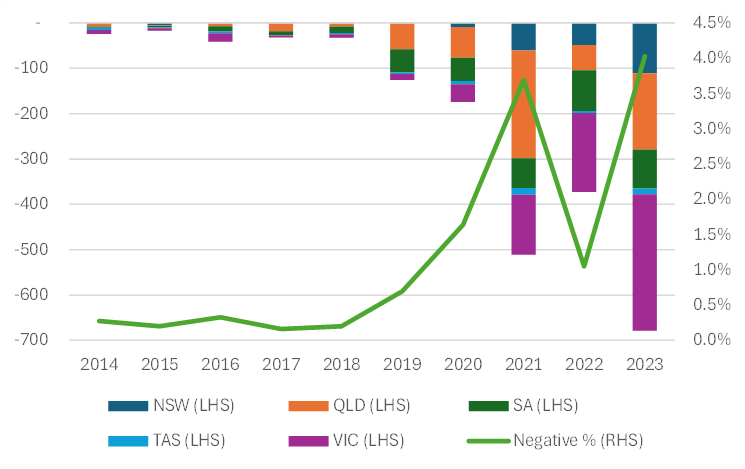
The wholesale market was trying to send the message. Negative spot prices show that solar is essentially a waste product at lunchtime which needs to be disposed off, a bit like electrical sewage.

Negative spot revenues didn’t really occur until we installed the last two million solar panels that we didn’t need. It is obviously a growing problem now, which suspiciously peaks in spring and summer and falls in winter months –matching the solar output profile by month.

You might wonder why any generator would keep generating during a glut so bad they had to pay for every watt they generated. But it’s logical in a screwed market — the negative prices are close to the value of the “Renewable Energy Certificates” the government forces us all to pay to solar and wind operators.  So solar owners can produce a product the market essentially doesn’t want, but the government forces us to pay to make it profitable. See how this works?

The point of a free market is that stupid ideas are supposed to be free to lose their own money. That’s a signal to stop doing it.

And if there was some use for solar power at midday, negative prices would have found it. If there was an AI supercomputer that needed to sleep 18 hours a day and only work at lunchtime, the owners would have been beating down the door to get paid to use that solar juice. It didn’t happen.

Here’s the solar power contribution to the NSW grid this month.


During the spikes hundreds of tons of exquisitely tuned infrastructure that could have kept running, just sits around and waits in case a cloud rolls over. And efficiency gained by solar is lost by the rest of the system.

h/t David of Cooyal in Oz


0 out of 10 based on 0 rating

via JoNova

https://ift.tt/UaLKYlk

May 15, 2024 at 03:34PM