
Gabriella welcomes meteorology student and rising climate thought leader, Chris Martz, onto the podcast this week. Listen to their wide-ranging conversation.
via CFACT
May 15, 2024 at 12:36PM
Gabriella welcomes meteorology student and rising climate thought leader, Chris Martz, onto the podcast this week. Listen to their wide-ranging conversation.
via CFACT
May 15, 2024 at 12:36PM
Ah, The Guardian, ever the beacon of balanced journalism, has outdone itself yet again. With a flourish of melodramatic despair, they’ve painted a portrait of Donald Trump as an eco-villain, brandishing policies like a black cape in a horror show of environmental doom. Let’s dive into their latest apocalyptic prophecy.
Donald Trump has vowed to immediately halt offshore wind energy projects “on day one” of a new term as US president, in his most explicit threat yet to the industry and the latest in a series of promises to undo key aspects of the transition to cleaner energy.
The drama unfolds with Trump, the presumed puppet master of planetary destruction, vowing to dismantle the beloved wind projects. Never mind that the industry might warrant a critical inspection of its impacts; The Guardian is more interested in framing this as an opening scene of a Shakespearean tragedy.
Trump repeated false accusations about wind projects as being lethal to whales during a rally on Saturday in Wildwood, a resort city on New Jersey’s coast, promising to stamp out an industry that has been enthusiastically backed by Joe Biden.
Here, Trump is almost comically vilified, conjuring images of dead whales washing up by the dozens, courtesy of those nefarious wind farms. The Guardian, in its infinite wisdom, assures us these claims are “false,” brushing aside any pesky nuances about the environmental cost of these structures.
“They destroy everything, they’re horrible, the most expensive energy there is,” Trump said of the wind turbines. “They ruin the environment, they kill the birds, they kill the whales.”
One can almost hear the ominous music swell as Trump lists the crimes of these whirling dervishes of doom. Of course, The Guardian couldn’t possibly entertain the thought that he might be exaggerating but not entirely fabricating. Instead, they prefer their villains cartoonish and their plots black and white.
And just when you thought it couldn’t get more theatrical:
McLeod said that there has been a concerted misinformation campaign, funded by oil and gas interests, to mislead voters. “Big oil is benefiting from all of this fear mongering,” she said.
The plot thickens with the introduction of Big Oil, the shadowy antagonist lurking behind the curtain. According to The Guardian’s script, anyone who questions the sanctity of wind power must be a marionette dancing on petroleum-coated strings.
Finally, Trump’s distaste for the Paris Agreement is presented not as a policy position but as a nefarious scheme to single-handedly warm the globe:
“In one of the most vivid illustrations of his stance towards the climate crisis, Trump removed the US from the Paris climate agreement during his first White House term.”
…
“The Paris climate accord does nothing to actually improve the environment here in the United States or globally,” Mandy Gunasekara, Trump’s former EPA chief of staff, told the Guardian in February.
In the world according to The Guardian, this statement is less a legitimate argument and more a declaration of war against Mother Earth, conveniently ignoring any substantive issues with the agreement.
In this latest piece The Guardian crafts a narrative so richly woven with bias that one could mistake it for a tapestry of fiction. Trump’s environmental policy positions, whether one agrees with them or not, deserve a platform for discussion rather than dismissal as the raving of a would-be planet plunderer.
So here’s to The Guardian, our tireless sentinel against the apocalypse, ever vigilant, ever fearful, ever entertaining. If journalism ever tires them, there’s always a spot open in Hollywood scriptwriting. Cheers to that!
via Watts Up With That?
May 15, 2024 at 12:08PM

The article here takes the climate alarm view, as usual with this source, and concludes that ‘risk assessments used by lenders are a boon for the oil and gas industry’. Oh dear! Maybe the fact that oil and gas are still in huge demand and tend to generate large profits, while renewables are expensive and require large subsidies, has something to do with it?
– – –
The financial sector is among the world’s most heavily regulated industries – and for good reason, says The Conversation.
Financial rules, which force banks to hold capital in reserve when making riskier investments, are designed to prevent financial crises. Other financial regulations, such as accounting rules, aim to provide investors with a credible valuation of their financial assets.
However, new research I conducted with my colleagues shows that some of these rules may have unintended consequences for the low-carbon transition.
Building the renewable power sources that will replace fossil fuels will require a lot of money (Talkshop comment – and a very long time, if ever). Much of this will come from banks, among other investors. But some financial regulations affect a bank’s behaviour and lending choices.
By analysing global accounting regulations using data on European banks, our team of researchers identified a structural bias in financial models which are required to assess and report risk.
We found that these models rely on historical information about the creditworthiness of firms to assess the risk of various investments. Alarmingly, they tend to judge carbon-intensive assets as less risky than lower carbon ones.
. . .
Low carbon v high carbon risk
We investigated whether models for assessing financial risk are inhibiting the transition from high-carbon economic activities, using data from the European Banking Authority (EBA).
We focused on the International Financial Reporting Standard accounting rules and their influence on which companies and sectors banks decide to lend to.
Risk assessments performed by banks on their investments directly affect their profitability. This in turn creates incentives for banks to lend to some activities over others.
Our analysis showed that the average estimate of risk among EU banks for high-carbon sectors of the economy was 1.8%, compared with 3.4% for low-carbon sectors (calculated as euros a bank expects to lose with each unit of lending).
. . .
Global policymakers are now having to face up to the challenge of meeting their carbon neutrality pledges, but our research suggests that the tools, models and regulations they use are not up to the task.
Full article here.
– – –
Image: Familiar sight in Texas [credit: StateImpact Texas]
via Tallbloke’s Talkshop
May 15, 2024 at 10:10AM
The suggested way of doing this would be a new, very fatal pandemic, so reports One America News (OAN)
Volcanologist and ultra-hysterical climate scientist Prof. Bill McGuire posted a comment on X: “If I am brutally honest, the only realistic way I see emissions falling as fast as they need to, to avoid catastrophic #climate breakdown, is the culling of the human population by a pandemic with a very high fatality rate.”
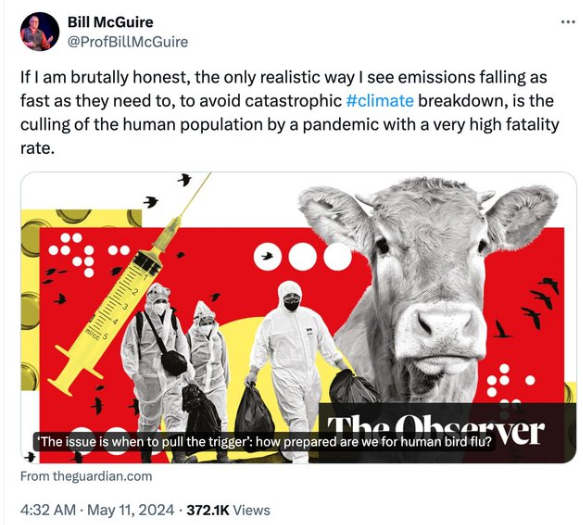
Reaction McGuire’s comment came swiftly and harshly, so much you that McGuire took down the callous comment, claiming he didn’t mean it and that readers misinterpreted the comment.
If anything, it tells us what kind of twisted fantasies are floating around in the heads of the members of the climate doomsday cult.
via NoTricksZone
May 15, 2024 at 10:07AM
 Iowa Climate Science Education