Month: June 2024

Vaclav Smil On The Two Cultures And Our “Fully Post-Factual World”

From Robert Bryce’s Substack

Robert Bryce

My emails with Smil on C.P. Snow’s 1959 essay, scientific illiteracy and innumeracy. Plus: Kotkin, Gurri, and Teixeira on the elites vs. the “normies”

In 1959, British novelist and physical chemist C.P. Snow gave a now-famous lecture called “The Two Cultures.” Snow argued that there was a growing disconnect between the culture of the sciences and the culture of the humanities and that bridging that gap was critical to understanding and addressing the world’s problems. Snow declared,

I believe the intellectual life of the whole of western society is increasingly being split into two polar groups… Literary intellectuals at one pole – at the other scientists, and as the most representative, the physical scientists. Between the two a gulf of mutual incomprehension.

Snow then underscored the general public’s lack of understanding of energy. As Snow put it:

A good many times I have been present at gatherings of people who, by the standards of the traditional culture, are thought highly educated and who have with considerable gusto been expressing their incredulity at the illiteracy of scientists. Once or twice I have been provoked and have asked the company how many of them could describe the Second Law of Thermodynamics. The response was cold: it was also negative. Yet I was asking something which is the scientific equivalent of: Have you read a work of Shakespeare’s?

Indeed, while most moderately cultured people will be familiar with the Bard’s A Comedy of Errors or The Merchant of Venice, the three laws of thermodynamics are considered by most people to be the domain of nerds and wonks. Snow cheekily described them: “You can’t win. You can’t break even. And you can’t quit the game.”(This Khan Academy explanation is a good primer.) For most people, fundamental physics seems too troublesome to learn. This apathy towards physics is matched, or possibly exceeded, by the lack of interest in mathematics. Indeed, innumeracy is rampant.

Snow’s seminal lecture matters today because the divides in our culture are widening. Yes, there’s a divide in the sciences. But that divide doesn’t explain why so many policymakers are being bamboozled by the alt-energy mirage that’s being promoted by the NGO-corporate-industrial-climate complex and their myriad allies in media and academia.

I have written about scientific illiteracy and innumeracy several times, including in my 2010 book, Power Hungry: The Myths of “Green” Energy And the Real Fuels of The Future. In that book, I cited my 2007 interview with Vaclav Smil about energy issues. I asked the Canadian author and polymath why Americans are so easily bamboozled by the rhetoric about alternative energy. He responded:

There has never been such a depth of scientific illiteracy and basic innumeracy as we see today. Without any physical, chemical, and biological fundamentals, and with equally poor understanding of basic economic forces, it is no wonder that people will believe anything. (Emphasis added.)

That 17-year-old interview comes to mind because last week, I published “Vaclav Smil Calls Bullshit On Net Zero.” That piece, which details Smil’s debunking of the net-zero silliness that is being flogged by the Biden administration, nearly two dozen states, and about 100 cities, has been among the most popular ones I’ve written here on Substack.

Share

After it was published, I emailed Smil a link to the piece. He immediately replied with a terse note: “Thanks, none of this really matters, this is a fully post-factual world.”

I emailed Smil back with these questions: To what do you attribute this post-factualism? Is it scientific illiteracy and innumeracy? Tribalism? Purposeful ignorance? I also asked about Snow’s 1959 lecture. He replied:

Yes, even your typical expert is near-utterly ignorant of basics (be they physics, chemistry, or biology) and very few people have actually internalized the difference between million and billion: hard to say which is worse, innumeracy probably.

He then cited Snow’s lecture:

All of this goes far, far beyond any two cultures, because now, on mass-scale, we have no particular culture: how else, when people check their mobile 244 [times] a day and spend 3 hours on YouTube and TikTok watching imbecilic videos. Goebbels would be stunned to see with what universal success his slogan of repeating a lie so often it becomes new truth has taken the global root, precisely because the soil is receptive: utterly brainless mass of mobile-bound individuals devoid of any historical perspective and of any kindergarten common-sense understanding.

I didn’t pose any more questions. (What’s left to ask?) While I agree with Smil about the general ignorance of basic science and the prevalence of innumeracy and imbecilic videos, there is another way to think about the two cultures and how the schism in our society has deepened over the past few decades. That schism helps explain, at least in part, the continuing popularity of Donald Trump and the anti-elite populism now sweeping Europe.

America’s most important cultural divide isn’t about left versus right, Biden versus Trump, or Democrat versus Republican. The most worrisome divide is the ever-widening gap between the rich and the poor. More specifically, it’s the enormous gap between the elites who dominate media, academia, NGOs, and politics, and the working class. Nowhere is that gap more evident than in the policies that promote alt-energy and net zero.

Every one of the climate policies being enacted by liberal states and the Biden administration screws the poor and the middle class, and in particular, the poor and middle-class folks who live in rural America. You name it — EV mandates, bans on natural gas stoves and heaters, strict emission cuts on power plants, lavish tax credits for Big Wind and Big Solar, or the latest FERC rule on high-voltage transmission — all of them are, in one way or another, regressive energy taxes that fuck the working class.

Many other writers are spotlighting this issue. Author and demographer Joel Kotkin has written extensively about the regressive energy policies being enacted by what he calls the “clerisy,” which he defines as “a group that makes its living largely in quasi-public institutions, notably universities, media, the non-profit world, and the upper bureaucracy.” While Kotkin, a fellow in urban studies at California’s Chapman University, says the clerisy isn’t unanimous in its politics, it “generally favors ever-increasing central control and regulation.” The most obvious place to see the climate clerisy at work is in California, where draconian decarbonization policies imposed by the administrative state are driving up housing and energy prices. The result of those regressive decisions are what California-based lawyer and civil rights activist Jennifer Hernandez has dubbed “Green Jim Crow.”

Last month, author and former CIA analyst Martin Gurri published an essay in The Free Press titled “The Revenge of the Normies.” Gurri focuses on the cultural gap between the “normies” and the “elites.” His assessment rhymes with Kotkin’s take:

On one side we find the normies: ordinary people who defend, naively, the historic principles of democracy such as freedom of speech and assembly, the separation of powers, etc. On the other side stand the elites, masters of the great institutions of wealth, knowledge, and power, who insist that extraordinary measures must be taken to save a depraved and self-destructive society from its own history and its own people…The normies want to get on with life. They want to work, get married, have children—boring stuff. That’s what normal means. The elites, for their part, wish to change everything: sex, the climate, our history, your automobile, your diet, even the straws with which you slurp your smoothie. (Emphasis added.)

Gurri continued, saying the normies “fight back by pouring into the streets in frighteningly large numbers and electing politicians loathed by the elites, like Donald Trump in the U.S. and Javier Milei in Argentina.”

Last year, Ruy Teixeira, a nonresident senior fellow at the American Enterprise Institute, identified the same elites-versus-working-class dynamic in a trenchant essay titled “The Working Class Isn’t Down With The Green Transition.” He explained:

Nothing defines the Democratic economic strategy more than a single-minded focus on fighting climate change — an “existential crisis” as Biden, other top Democrats and a galaxy of Democratic-leaning pundits have termed it…Democratic elites and activists are very, very committed to this approach and are willing to pay high costs to make it happen.

Teixeira cited a Monmouth poll that found “just one percent of working-class (noncollege) voters in an open-ended question identify climate change as the biggest concern facing their family.” And what about those EVs that Joe Biden’s EPA mandated last month? Teixeira cited a Gallup poll which found that “just 2% of working-class respondents say they currently own an electric vehicle and a mere 9% say they are ‘seriously considering’ purchasing one.”

Teixeira called the gap between Democratic elites and the working class the “Great Divide.” He concluded by saying, “Really, it’s madness. Biden needs to do more, not less, on moving the Democratic Party away from its obsession with renewables.”

There’s plenty more to write about the class divide over net zero, alt-energy, and the growing divide in American politics over climate policy. But if the clerisy and the elites in America want to understand what lies ahead if they continue their headlong rush to impose ever-more-regressive climate policies on voters, they only need to look at the latest elections in Europe. On Sunday, The Guardian published an article titled: “Green party losses in EU elections raise concerns over Green Deal.” The nut of the story:

In Germany, a core Green stronghold, the party’s vote share appears to have nearly halved since the last election in 2019. Exit polls suggested it fell 8.5 percentage points from 20.5% to 12%. In France, where the far right was leading and President Emmanuel Macron called snap elections, support for the Greens fell by the same amount. (Emphasis added.)

Meanwhile, the Associated Press called the parliamentary elections in France and Germany “stunning defeats to two of the bloc’s most important leaders: French President Emmanuel Macron and German Chancellor Olaf Scholz.” It added that their defeat “could well have an impact on the EU’s overall climate change policies, still the most progressive across the globe.”

I’m not predicting the outcome of the November election, but given the European elections, I won’t be surprised if Trump wins. If he does, it might be called the revenge of the normies.

Media Hits

  • Last week, I was on Jim Puplava’s “Financial Sense” podcast along with geometallurgist Simon Michaux. We discussed commodities, net zero, China’s dominance of critical metals, and why, as Simon claimed copper “may be the new gold.” I disagree with Simon’s take on peak oil, but he has deep knowledge of the mining sector and its challenges, particularly when it comes to producing more copper. You can watch it here.
  • Also, last week, I was on Chicago’s Morning Answer radio show with Dan Proft and Amy Jacobson to discuss my recent Substack on why environmentalism in America is dead. You can watch/listen here.

Please click that ♡ button. And please subscribe and share. Thanks y’all.

via Watts Up With That?

https://ift.tt/5cjtrFm

June 10, 2024 at 08:01PM

Nuclear Power Risk? Australia is Already Part of the Nuclear Age

Essay by Eric Worrall

Both hotels were near nuclear medicine facilities. The first hotel (peak 0.14 µSv / hour) was a holiday rental in an apartment complex where lots of doctors live. The second was a popular hotel just over the road from a major Brisbane tourist attraction. Neither pose a risk to health.

The following is a fun video I captured at the first hotel, on the Queensland Sunshine Coast. The detector is sitting on a plastic coffee table in front of the sofa inside the hotel room. All the windows were closed. 12+ counts per second produces an impressive radiation detector video

Despite the impressive looking count rate in the video above, none of the radiation levels I measured are anywhere near to being a health hazard. Oregon State University gives the maximum safe exposure level as 0.02 mSV / hour – over 140x the maximum level I measured in those hotels. There are plenty of inhabited places where the natural radiation level is higher than what I measured in those hotel rooms (using a Radiocode Scintillometer).

The following is from a month ago, but as the nuclear debate just flared up again in Australia, I thought it worth mentioning.

NUCLEAR POWER STATIONS ARE NOT APPROPRIATE FOR AUSTRALIA – AND NEVER WILL BE

10.05.24 BY CLIMATE COUNCIL

The prospect of nuclear power in Australia has been a topic of public debate since the 1950s. While Australia has never had a nuclear power station, we do have 33% of the world’s uranium deposits and we are the world’s third largest producer of it. Periodically, as with the changing of the seasons, various individuals appear in the media singing the virtues of nuclear energy – claiming it is the only option for clean and reliable electricity in Australia.

In fact, over one third of Australia’s electricity is already powered by renewables, and new initiatives like the Capacity Investment Scheme are set to push us towards 82% renewable energy by the end of this decade. While the move to clean energy is still not happening fast enough, it is underway and starting to speed up. We do not need distractions like nuclear to derail our progress now, so let’s set the record straight.

3. Nuclear power poses significant community, environmental, health and economic risks.

Radiation from major nuclear disasters, such as Chernobyl in 1986 and Fukushima in 2011, have impacted hundreds of thousands of people and contaminated vast areas that take decades to clean up. Even when a nuclear power station operates as intended, it creates a long-term and prohibitively expensive legacy of site remediation, fuel processing and radioactive waste storage.

4. Nuclear power is not renewable, and it is not safe.

Uranium is a finite resource just like coal, oil and gas. It needs to be mined and, just like mining coal, oil and gas, this carries serious safety concerns, including contaminating the environment with radioactive dust, radon gas, water-borne toxins, and increased levels of background radiation. On the other hand, energy generated from the sun and wind releases no pollutants into the air and is overwhelmingly considered to be safe. 

Read more: https://www.climatecouncil.org.au/nuclear-power-stations-are-not-appropriate-for-australia-and-probably-never-will-be/

Critics are right that you can’t have nuclear power without a slight increase in radiation. My point is we already have non-health threatening radiation hotspots scattered around Australian cities, Australia is already part of the nuclear age.

The slight radiation hotspots I measured in those hotels, they could have been nuclear medicine patients staying at the hotels, shedding a few radioactive skin cells, or mildly irradiating the plumbing system when they use the bathroom. It could just be the granite facing on the local buildings, contributing a completely natural boost to local background radiation. Or it could be the soil in those locations happened to contain a little more natural radiation than the surrounding areas, the adjacency to the medical facilities could have all been a big coincidence.

I didn’t deliberately book hotels next to nuclear radiation medical facilities – the hotels just happened to be convenient for the events I was attending. I only noticed the medical facilities after I started trying to figure out why the radiation levels in the hotels were slightly higher than the background level I measured a few miles away.

I did walk inside one of the facilities, see if it got any hotter when I got closer, but I didn’t see any identifiable gradient – the radiation actually dropped a little when I walked inside the facility. So whatever it was, it was well dispersed. But the radiation did drop away significantly after I travelled more than a mile from the facilities – so while my evidence is far from conclusive, in my mind it still seems possible that nuclear medicine was the source of the slight uptick in radiation in the places I stayed.

There is a big difference between a slight uptick in background count, and a globally significant nuclear catastrophe.

The other kind of radiation leak, the kind of leak which forces people to abandon their homes, modern reactors have containment buildings which keep all the problems inside the plant. The only time I ever heard of this failing was Fukushima, but Fukushima’s plant clearly wasn’t pressure resistant the way modern US style containment buildings are. Chernobyl didn’t have a proper containment building – which is why they had to build the “sarcophagus” after the Chernobyl reactor blew its top.

Australia does not have fault zones capable of producing a Fukushima scale Earthquake disaster. Nuclear power, with a proper pressure tested containment facility, is as close to completely safe as anything can be.

My main objection to Aussie opposition leader Peter Dutton’s nuclear programme plan is I don’t think the proposal on the table makes economic sense. Australia has vast quantities of coal – we should keep burning cheap coal to keep power bills down. And Dutton’s plan for siting nuclear plants on top of coal seams potentially endangers the value of those coal resources, if a low level release ever makes its way into the coal bed. I do not have any problem with nuclear itself.

My family stayed in those hotels with me, so I was completely at ease with the safety issue. My kid thought the expression on mum’s face was hilarious when I showed my wife the Scintillometer buzzing away on the table, like a scene from the TV series “Chernobyl”, but everything was fine after I reassured my wife, and presented the yummy chocolate bar I’d been saving for marital emergencies. After the initial surprise, and showing everyone a few radiation hazard sheets, it was all a big joke – a funny Facebook post which got a few more “wows” than normal from my friends.

The small spike which I labelled “Big solar flare” was a gamma ray spike pretty much everyone on Earth likely experienced during the spectacular Auroras many of us saw a month ago. I’m too close to the Equator to experience the full effects of interesting space weather – near the equator the atmosphere is thicker, and the topography of the Earth’s magnetic field provides more effective shielding. But if anyone was playing with a radiation detector in Antarctica, Southern Chile or Northern Canada, Scandinavia, Greenland, Siberia or Alaska during the big aurora event, I’d love to know what the measured gamma ray excursion was during the solar flare. And if following your high latitude aurora gamma ray exposure you turn green, grow huge muscles, and become one of my favourite superheroes, more power to you.

via Watts Up With That?

https://ift.tt/7gfCvwx

June 10, 2024 at 04:06PM

Declining Weather Disasters Prove Doomsters Wrong

A recent scientific study has confirmed that natural and climate-related disasters are declining during the 21st century. Getty Images/iStcokphoto

Benny Peiser makes the case in his NY Post article Despite climate-change hysterics, weather disasters have decreased.  Excerpts in italics with my bolds and added images.

A recent scientific study has confirmed what climate realists have been highlighting for some time: Natural and climate-related disasters have been declining rather than increasing during the 21st century.

In a paper published this year in one of the world’s leading journals on environmental hazards, Italian scientists Gianluca Alimonti and Luigi Mariani analyzed the number and temporal trends of natural disasters reported since 1900.

A 2015 study by 22 scientists from around the world found that cold kills over 17 times more people than heat. Thus the planet’s recent modest warming has been saving millions of lives.

Based on the best available data, the two scientists concluded the 21st century has seen “a decreasing trend [of natural disasters] to 2022” which is “characterized by a significant decline in number of events.”

The researchers emphasized that their conclusion “sits in marked contradiction to earlier analyses by UN bodies which predict an increasing number of natural disasters and impacts in concert with global warming.”

“Our analyses strongly refute this assertion,” they wrote.

For years, international agencies such as the UN Office for Disaster Risk Reduction, the Food and Agriculture Organization of the United Nations, the World Meteorological Organization and the International Red Cross have claimed that climate-related disasters are escalating.

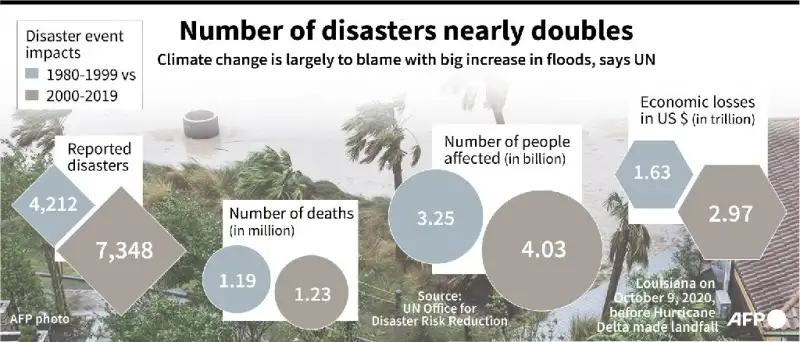
Floods lead a near doubling of disaster events from 1980 to 1999 compared to 2000 to 2019, according to a report by the UN Office for Disaster Risk Reduction.

“Weather disasters are striking the world four to five times more often and causing seven times more damage than in the 1970s,” the WMO reported in 2021.

Disaster and weather officials affiliated with the UN claim this dramatic rise is due to global warming: The changing climate, they say, is making weather disasters stronger and more frequent.

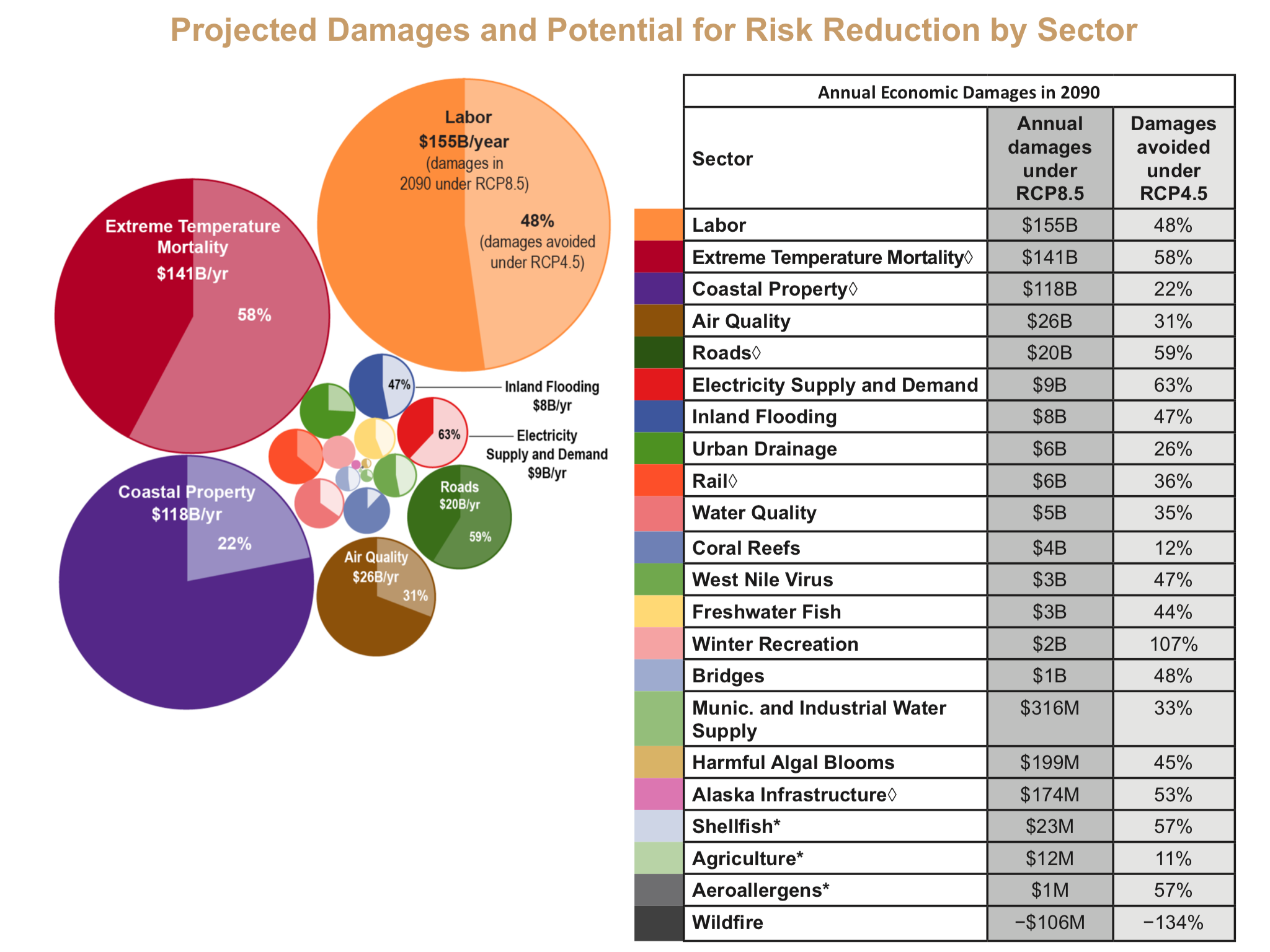
Fourth National Climate Assessment, Volume II: Impacts, Risks, and Adaptation in the United States.

The increased frequency of heat waves, droughts, flooding, winter storms, hurricanes, wildfires and other extreme weather events prove the negative impact of a warming world, according to various UN agencies and nongovernmental organizations.

Yet, as the actual data used by these organizations reveals, the last 20 years have in fact seen a significant decline in such events.

It turns out that climate alarmists have based their claims on a highly misleading comparison of disaster data of the late 20th and the early 21st centuries.

By their tally, the period from 1980 to 2000 saw about 4,200 natural disasters —with the number increasing sharply, to more than 8,000, during the first 20 years of this century.

This conclusion, however, is fatally flawed: It fails to take into account the huge increase in the global reporting of disasters engendered by the invention and rapid global dissemination of new communication technologies since the 1980s.

The arrival of the internet and other new communication tools has undoubtedly accelerated the reporting of disasters from all corners of the world — events that were significantly underreported in earlier decades.

As well, the number of people killed by natural and climate-related disasters has fallen steadily over the past 120 years — from 500,000 deaths per decade in the early 20th century down to less than 50,000 per decade in the last ten years.

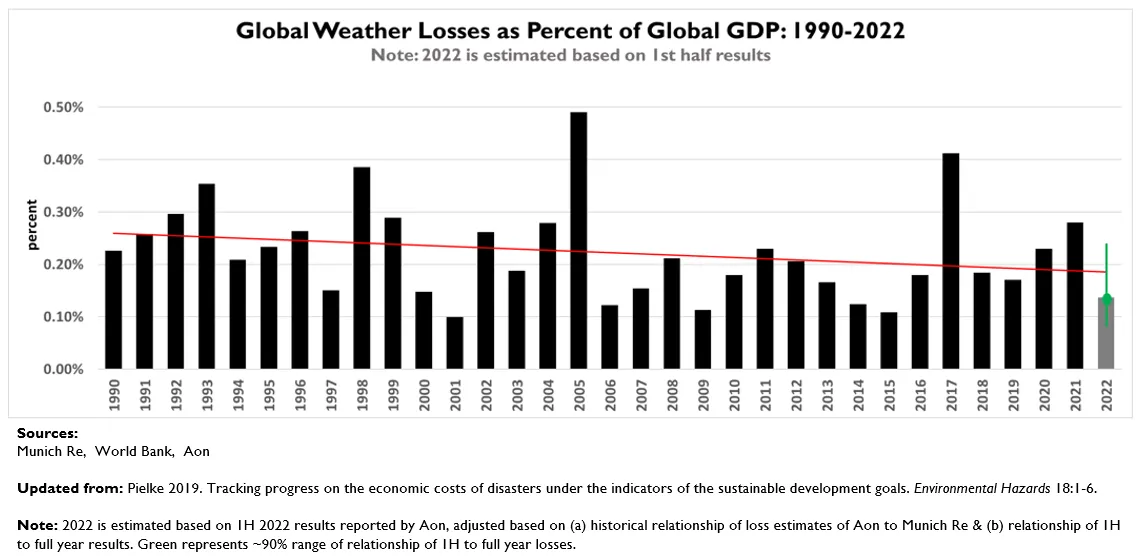
And, contrary to claims by NGOs and government officials, climate-related disaster losses have also declined as a percentage of global GDP during the last 30 years — from about 0.25% of GDP in 1990 to less than 0.20% in 2023.

The study by Alimonti and Mariani vindicates what we at the Global Warming Policy Foundation have been pointing out for a long time: Climate-related disasters are not on the rise, despite warming temperatures.

International agencies and the news media have hyped climate disasters for far too long, while ignoring the factual downward trend.

”First they ignore you, then they laugh at you, then they fight you, then you win,” as the saying goes.  UN agencies and NGOs have been misleading the public for years. It’s past time for the truth to win out.

Benny Peiser is the director of the London-based Global Warming Policy Foundation.


via Science Matters

https://ift.tt/Xpnv8ko

June 10, 2024 at 02:54PM

Watching the Watchers

The coastal road being eroded by climate change” says the BBC article. No ifs. No buts. Not simple ongoing erosion. Climate change is apparently unequivocally to blame for the fact that the B3191, known locally as Cleeve Hill, near Watchet in Somerset, was closed to traffic due to dangers from coastal erosion.

I’ve got to give it to the BBC – they’re clever. They push the climate change angle with a forthright headline, but apparently it’s not the BBC blaming climate change for the pending demise of this section of the B3191. Oh no indeed. It’s not them, it’s experts – in this case, “the independent firm Geckoella, which has been advising Somerset Council on what is happening on the West Somerset coastline.”

Dr [Andy] King [a director of Geckoella, during an interview with BBC Radio Somerset] laid the issue squarely with climate change, calling the rate of erosion there “unprecedented”.

He said the impact of climate change was not only the raised sea levels, but an increase in persistent rainfall in the area, meaning coastal erosion was getting worse.

That’s pretty definite. No need for a BBC fact-check or any investigation of such claims by BBC Verify? Of course not. So it’s down to me again. Here goes.

According to the website of Dr King’s organisation:

Like many UK coastal sites, the Watchet coastline is subject to continuous tidal erosion (with the 2nd largest tidal range in the world) and complex hydrological systems within the cliffs themselves. As a result, cliff subsidence, rock falls and landslides are a regular, and expected occurrence. Additionally, the effects of global climate change are expected to cause sea level rise, and accelerate coastal erosion processes in the future.

Which is rather different from the stark claim made in the BBC article. Here we learn that the effects of climate change are only an additional factor that is expected to accelerate existing coastal erosion processes in the future. There is no mention of the problem being caused by climate change now. Amusingly, though, Geockella’s website does treat us to a geological history lesson:

Looking in detail, the rocks at Watchet record a dynamic time in Somerset, and the Earth’s history. The red triassic rocks were laid down in a hot, semi-arid environment around 210 million years ago, during this time, Watchet was closer to the equator and part of the supercontinent Pangaea. The Triassic Period ended with a mass extinction, giving rise to the ‘age of the Dinosaurs’ in the Jurassic. The Jurassic rocks at Watchet were laid down in a marine environment as sea levels rose around 200 million years ago – these rocks contain abundant ammonites, crinoids, bivalves and fossil wood.

Now that’s what I call climate change!

What of the specific claims apparently made by Dr King during his radio interview? Well, Hinkley Point isn’t too far up the coast. The River Levels website tells us this:

The usual range of the Tide at Hinkley Point is between -5.38m and 6.46m. It has been between these levels for 90% of the time since monitoring began.

The typical recent level of the Tide at Hinkley Point over the past 12 months has been between -5.87m and 11.84m. It has been between these levels for at least 150 days in the past year.

The highest level ever recorded at the Tide at Hinkley Point is 7.45m, reached on Friday 3rd January 2014 at 8:00am.

Even better is the information regarding the Washford River, which actually flows through Watchet:

The usual range of the Washford River at Beggearn Huish is between 0.15m and 0.50m. It has been between these levels for 90% of the time since monitoring began.

The typical recent level of the Washford River at Beggearn Huish over the past 12 months has been between 0.17m and 0.59m. It has been between these levels for at least 150 days in the past year.

The highest level ever recorded at the Washford River at Beggearn Huish is 1.05m, reached on Thursday 7th December 2000 at 8:45pm.

And here’s a link to a chart for sea levels at Newlyn, supplied by the National Tidal and Sea Level Facility (NTSLF). It is, I think, of direct relevance, because it’s in the south west of England, and as the NTSLF website tells us, it (and Aberdeen) “have some of the longer data sets of hourly (or 15-minute) sea level data”. Please click on the link and look long and hard at the graph. If you can see an accelerating rate of sea level rise, please tell me in a comment below, because if there is such a trend, I can’t see it.

I will accept that this isn’t definitive, but it’s reasonably strong evidence that sea level rise isn’t accelerating on the Somerset coast. And given that sea levels have risen steadily as the world emerged from the Little Ice Age, only an accelerating rate of sea level rise would be evidence of current man-made climate change.

Well then, what of the “increase in persistent rainfall in the area” referred to by Dr King? The best I have been able to do here is to check the long-term data made available by the UK Met Office for Minehead, which is a short distance along the coast from Watchet. It may (or may not) be that “persistent” rainfall is increasing, but it is difficult to establish from the data. The information available from the Met Office is monthly and annual rainfall levels, and also average numbers of days (per month and annually) with rainfall at or above 1mm per day, which while better than nothing, doesn’t tell us much about “persistent” rainfall. I accept that in the south of England especially, a pretty wet year to 18 months have just been endured, but such a short time scale represents weather, not climate. For climatic trends, I have analysed the data over varying 30 year periods, namely 1961-90; 1971-2000; 1981-2010; and 1991-2020. Admittedly the data shows a slowly (certainly not dramatically) rising trend in the average number of days per annum when 1mm or rain fell – from 130.94 in the earliest period, to 141.44 in the latest period. Volumes increase over the same period from 840.72mm to 896.61mm, representing an increase of a little over 2” per annum over 40 years. How might that feed into claims of increasingly persistent rainfall? On a rough and ready basis, it might suggest that there has been no increase in rainfall persistence at all. If one assumes that the days of persistent rainfall are those when 1mm or more of rain falls, then allowing for the increase in the number of such days, the difference in daily rainfall on such days over the period is statistically insignificant, falling from 6.42mm to 6.40mm per day.

Although it wasn’t mentioned in the BBC article (and I assume therefore wasn’t mentioned either during Dr King’s radio interview) if there was an increase in storm numbers or intensity, that might be a valid reason to claim that the erosion at Watchet is being caused by climate change. However, I mention it only to dismiss it as an an argument, for as I mentioned in Whatever the Weather the annual Met Office reports on the UK’s weather continue to state categorically that no increase in storminess is being observed.

Geckoella’s work looks fascinating, and I wish them well. However, I don’t think Dr King’s claims relating to climate change at Watchet, as reported by the BBC, stack up. No doubt the BBC was delighted to have elicited the comments in it did during a local radio station interview, but I believe it was incumbent on them to dig a little deeper before proceeding with a sensationalist and alarmist headline that so far as I can see is not borne out by the facts.

via Climate Scepticism

https://ift.tt/vscIogP

June 10, 2024 at 02:35PM