
The public simply don’t believe the Met Office lies anymore;
via NOT A LOT OF PEOPLE KNOW THAT
June 8, 2024 at 01:21PM
The public simply don’t believe the Met Office lies anymore;
via NOT A LOT OF PEOPLE KNOW THAT
June 8, 2024 at 01:21PM
In October 2008, Parliament passed the Climate Change Act requiring the UK government to ensure that by 2050 ‘the net UK carbon account’ was reduced to a level at least 80% lower than that of 1990. (‘carbon account’ refers to CO2 emissions and ‘other targeted greenhouse gas emissions’.) Only five MPs voted against it. Then in 2019, by secondary legislation and without serious debate, Parliament increased the 80% reduction requirement to 100% – thereby creating the Net Zero policy.i
Unfortunately, it’s a policy that’s unachievable, potentially disastrous and in any case pointless – and, importantly, that’s the case even if it’s accepted that human carbon dioxide emissions are contributing to a rise in global temperature.
1. It’s unachievable.
Many vehicles and machines (used for example in mining, mineral processing, agriculture, construction, heavy transportation, commercial shipping and aviation, the military and emergency services) and products (for example cement (and concrete), high-grade steel, plastics – all needed for the construction of renewables – fertiliser, pharmaceuticals, anaesthetics, lubricants, solvents, paints, adhesives, insecticides, insulation, tyres and asphalt) essential to life and wellbeing require the combustion of fossil fuels or are made from oil derivatives; there are no easily deployable, commercially viable alternatives. Our civilisation is based on fossil fuels; something that’s unlikely to change for a long time.ii
Wind is the most effective source of renewable electricity in the U.K., but: (i) the substantial costs of building the huge numbers of turbines needed for Net Zero, (ii) the complex engineering and cost challenges of establishing a stable, reliable non-fossil fuel grid by 2035 (2030 for Labour) – not least the need to cope with a vast increase in high voltage grid capacity and local distribution, (iii) the enormous scale of what’s involved (immense amounts of space and of increasingly unavailable and expensive raw materials, such as so-called ‘rare earths’, required because, unlike fossil fuels, the ‘energy density’ of wind is so low), and (iv) the intermittency of renewable energy (see 2 below), make it unlikely that the UK will be able to generate sufficient electricity for current needs let alone for the mandated EVs and heat pumps plus industry’s energy requirements and other demands such as huge data centres and the extraordinary growth of artificial intelligence (AI).iii
In any case, the UK doesn’t have nearly enough skilled technical managers, electrical, heating and other engineers, electricians, plumbers, welders, mechanics and other tradespeople to do the multitude of tasks essential to achieve Net Zero – a problem worsened by political plans for massively increased house building.iv
‘Net Zero’ means that there has to be a balance between the amount of any greenhouse gas emissions produced and the amount removed from the atmosphere. That there’s no detailed, costed (or indeed any) plan for such removal, undermines the credibility of the project.
2. It would be socially and economically disastrous.
Neither of the main political parties’ all-renewable energy projects includes a fully costed engineering plan for the provision of comprehensive grid-scale back-up when there’s little or no wind or sun; a problem that’s exacerbated by the pending retirement of fossil fuel and nuclear power plants. Both parties are now talking of building new gas-fired power plants v – thereby undermining Net Zero – but they’ve not published any detail and it seems Labour intends to fit them with carbon capture and underground storage systems – again without a fully costed engineering plan. This issue is desperately important: without full back-up, electricity blackouts would be inevitable – ruining many businesses and causing dreadful problems for millions of people, including health consequences threatening everyone and in particular the poor and vulnerable.
Even more serious is the fact that, because there’s no coherent plan for the project’s delivery, little attention has been given to its overall cost. All that’s clear is that it would almost certainly be unaffordable: for example, a recent Office for Budget Responsibility projection of £1.4 trillion is probably too low vi – several trillion seems likely to be more accurate.vii The borrowing and taxes required for costs at this scale would destroy Britain’s credit standing and put an impossible burden onto millions of households and businesses.
Net Zero would have two other dire consequences:
(i) As China essentially controls the supply of key materials (for example, lithium, cobalt, aluminium, processed graphite and so-called rare earths) without which renewables cannot be manufactured, the UK would greatly increase its already damaging dependence on it, putting its energy and overall security at most serious risk.viii
(ii) The extensive mining and mineral processing operations required for renewables are already causing appalling environmental damage and dreadful human suffering throughout the world, affecting in particular fragile, unspoilt ecosystems and many of the world’s poorest and most vulnerable people; the continued pursuit of Net Zero would make all this far worse.ix
3. In any case it’s pointless.
For two reasons:
(i) It’s absurd to regard the closure of greenhouse gas (GHG) emitting plants in the UK and their ‘export’ mainly to SE Asian countries, commonly with poor environmental regulation and often powered by coal-fired electricity, as a positive step towards Net Zero. Yet efforts to ‘decarbonise’ the UK mean that’s what’s happening.
(ii) Most major non-Western countries – the source of over 75% of GHG emissions and home to 84% of humanity – don’t regard emission reduction as a priority and, either exempt (by international agreement) from or ignoring any obligation to reduce their emissions, are focused instead on economic and social development, poverty eradication and energy security. As a result, global emissions are increasing (by 62% since 1990) and are set to continue to increase for the foreseeable future. The UK is the source of less than 1% of global emissions – so any further emission reduction it may achieve cannot have any impact on the global position.x
In other words, the Net Zero policy means the UK is legally obliged to pursue an unachievable, disastrous and pointless policy – a policy that could result in Britain’s economic destruction.
Robin Guenier May 2024
Guenier is a retired, writer, speaker and business consultant. He was for twenty years chief executive of various high-tech companies, including the Central Computing and Telecommunications Agency reporting to the UK Cabinet Office. He was Executive Director of Taskforce 2000, founder chair of the medical online research company, MedixGlobal and a regular contributor to TV and radio.
End notes:
http://www.legislation.gov.uk/ukpga/2008/27/part/1/crossheading/the-target-for-2050
See Vaclav Smil’s important book, How the World Really Works: https://time.com/6175734/reliance-on-fossil-fuels/.
iii For a view of wind power’s many problems, see this: https://watt-logic.com/2023/06/14/wind-farm-costs/ This is also interesting: https://davidturver.substack.com/p/debunking-cheap-renewables-myth
iv A detailed Government report: https://assets.publishing.service.gov.uk/media/65855506fc07f3000d8d46bd/Employer_skills_survey_2022_research_report.pdf
vhttps://news.sky.com/story/uk-should-build-new-gas-fired-power-capacity-to-use-as-backup-government-says-despite-green-targets-13092730
vihttps://www.cityam.com/uk-fiscal-watchdog-puts-cost-of-reaching-net-zero-at-1-4trn/
vii In this presentation Michael Kelly, inaugural Prince Philip Professor of Technology at Cambridge and a Fellow of the Royal Society and the Royal Academy of Engineering, shows how the costs of Net Zero would amount to several trillion pounds: https://www.youtube.com/watch?v=NkImqOxMqvU
viiihttps://www.dw.com/en/the-eus-risky-dependency-on-critical-chinese-metals/a-61462687
ix There’s a wealth of data supporting this but arguably the most compelling and harrowing evidence is found in Siddharth Kara’s book Cobalt Red – about the horrors of cobalt mining in the Congo: https://us.macmillan.com/books/9781250284297/cobaltred
x This comprehensive analysis, based on an EU database, provides – re global greenhouse gas and CO2 emissions – detailed information by country from 1990 to 2022: https://edgar.jrc.ec.europa.eu/report_2023?vis=ghgtot#emissions_table
via Climate Scepticism
June 8, 2024 at 12:44PM
At the online Die Welt, science journalist Axel Bohanowski reports on: “How insurance companies and the media are misleading with weather disasters.”
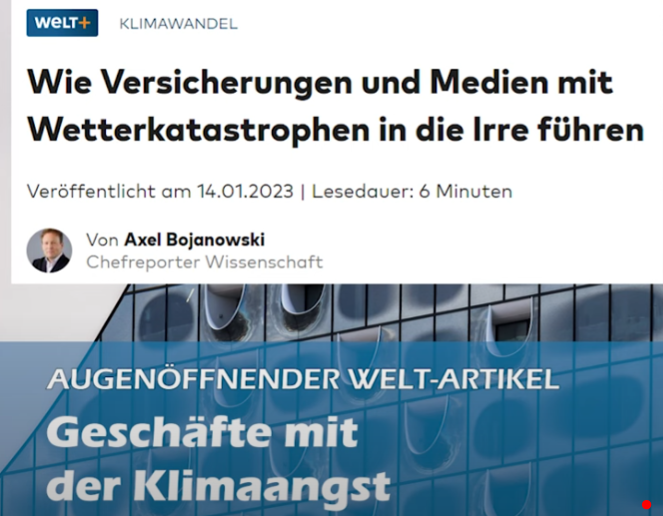
Image cropped here.
Hat-tip: Klimaschau here.
The rise in property damage often gets blamed on climate change, especially by click-baiting media and greedy insurance companies.
But Bojanowski says it’s misleading to blame climate change, noting: “Global economy has grown by more than 400 percent since 1990, and so there’s a correspondingly greater amount of property. Moreover, the global population has risen by 3 billion people since the 1980s, thus a weather event hits more people and residential areas than before and so more damage is caused.”
Other factors driving up the amount of damage is inflation. Bojanowski reports: “Studies have been showing for a long time that this not much increase in damage is left when increased property values and inflation get deducted from the weather damages.”
The Die Welt article also quotes Prof. Roger Pielke Jr. of the University of Colorado, who said: “There’s no indication that economic damage is increasing due to weather and climate catastrophes.”
When all factors get correctly taken into account, there in fact appears to even be a decrease in economic damage.
Bojanowski’s article has been online for over a year, yet no one has come out to rebut this good news.
It turns out that climate panic is good business for media and insurance companies, but it is not based on fact or real data. It’s more a scam than science. The climate catastrophe is nothing more than a lucrative business model.
Donate – choose an amount
via NoTricksZone
June 8, 2024 at 12:12PM
By Jim Steele
With a disproportionate focus on the greenhouse effect and fossil fuels, most people are totally unaware that the earth’s surface is cooled primarily by convection currents carrying warm buoyant air up and away. Indeed, with water vapor and CO2 making the lower 1000 meters of the atmosphere opaque to most escaping infrared, thus preventing radiative cooling, the earth’s surface only cools sufficiently via convection. All honest scientists know heatwaves are caused by suppressed convection.
Graphic A shows a typical heat dome resulting from a high-pressure system that causes sinking air that suppresses rising convection. Air sinking from the colder upper atmosphere is dry and thus maintains clear skies that increase solar heating. A warmer earth surface from climate change should cause rising air, so what causes sinking air?
In the tropics, the greatest warming happens around the equator and that draws in air from the northern and southern hemisphere. Where that surface air converges (aka Intertropical Convergence Zone) air is forced upwards. What goes up must come down, and to maintain balance the air sinks around 30 degrees north and south, forming high pressure systems over the desert latitudes (Hadley Circulation). Outside the tropics the main driver of high-pressure systems is the convergence of upper atmosphere winds in wavy jet streams.
As a kid we loved to play “crack the whip” when skating. A line of 4 or more kids had a single kid on one end stop, which caused the moving line to make an arc. The kid on the other end naturally speeds up to cover the arc’s bigger circumference and thus “whips” around. Likewise, the ridge of a wavy jet stream in the upper atmosphere causes air flow to speed up. When the air flow enters a trough, the air flow slows down. The fast-moving air mass then collides with the slow-moving air causing an upper air convergence that forces air downward generating a high-pressure system (graphics B & C). Similarly, anyplace where upper air currents converge will cause a high-pressure system. How intensive the resulting heat wave depends on how fast the high-pressure system moves eastward.

In the upper atmosphere, the winds of the jet stream average 80–140 miles per hour eastward. That steers the pressure systems of the lower atmosphere. Friction with earth’s surface reduces the speed of a pressure systems to about half the speed of the jet stream. As the jet stream moves over or around mountains, or moves between water and land, or cold air interacts with warm air, or interacts with other pressure systems, the jet stream may be forced to loop more north and south. That reduces the eastward steering speed of the jet stream which causes surface high-pressure systems to slow down or stall. In that case, a lingering high-pressure system will cause an intensifying heat wave.

The wavier jet stream over the northeast Pacific Ocean commonly generates a “blocking high” in that region (graphic D). That blocking high caused Canada’s record high temperatures during a heatwave that stalled over Lytton, British Columbia June 29, 2021. The wavier jet stream also causes frequent blocking highs over Greenland, which caused excessive melting during July 2021. Meteorologist studying heat waves have mapped out regions where blocking highs are most likely to form (graphic E). Combined with monitoring of the jet stream and interacting pressure systems, meteorologist can predict when and where a heat wave is likely to form.

Any warming of the earth’s surface from the greenhouse effect or any other cause, would cause air to rise, the exact opposite of how heat waves are formed. To blame heat waves on rising CO2, alarmists must use statistical attribution tricks. They simply claim higher global average temperatures make the heat wave hotter, even when the heat wave is centered over regions where the has been no local warming. Clearly there are lies, damn lies and statistics and most alarmist climate scientists know how to manipulate statistics.
via Watts Up With That?
June 8, 2024 at 12:04PM
 Iowa Climate Science Education