Taxpayers have paid seven billion dollars for seven electric charging stations, and RFK Jr. wants $12/gallon gas to force consumers into purchasing EV’s .
h/t observa; “… the online watchdog “considered this option (abandoning legal action) likely to achieve the most positive outcome for the online safety of all Australians, especially children”. …”
‘Dog whistle’: Regulator accuses Musk
Story by Nathan Schmidt
Australia’s eSafety commissioner Julie Inman Grant says she was subjected to death threats after taking up the fight against social media platform X and its owner Elon Musk.
“He issued a dog whistle to 181 million users around the globe which resulted in death threats directly to me and which resulted in doxxing of my family members, including my three children,” Ms Inman Grant told the ABC.
“With great power comes great responsibility and exercising that restraint in terms of targeting a regulator who is here to protect the citizens of Australia is really beyond the pale.
“But it is not surprising. This is his modus operandi. I will not be cowered but those threats.”
Earlier on Wednesday, Ms Inman Grant announced she had dropped the legal fight against X over its refusal to remove videos depicting a stabbing attack against a Sydney bishop.
The eSafety Commission was attempting to force X to remove videos of footage of an alleged terror attack in which Bishop Mar Mari Emmanuel was stabbed during a live-streamed sermon.
…
Ms Grant said the online watchdog “considered this option (abandoning legal action) likely to achieve the most positive outcome for the online safety of all Australians, especially children”.
Thank you again Elon Musk for standing up to this outrageous attack on global freedom of speech.
And just to show there are no hard feelings Aussie eSafety commissioner Julie Inman Grant, if you ever publish a whacky Mary Poppins disinformation singalong like former US Disinformation Governance Board head Nina Jankowicz, you can be assured WUWT will publish it.
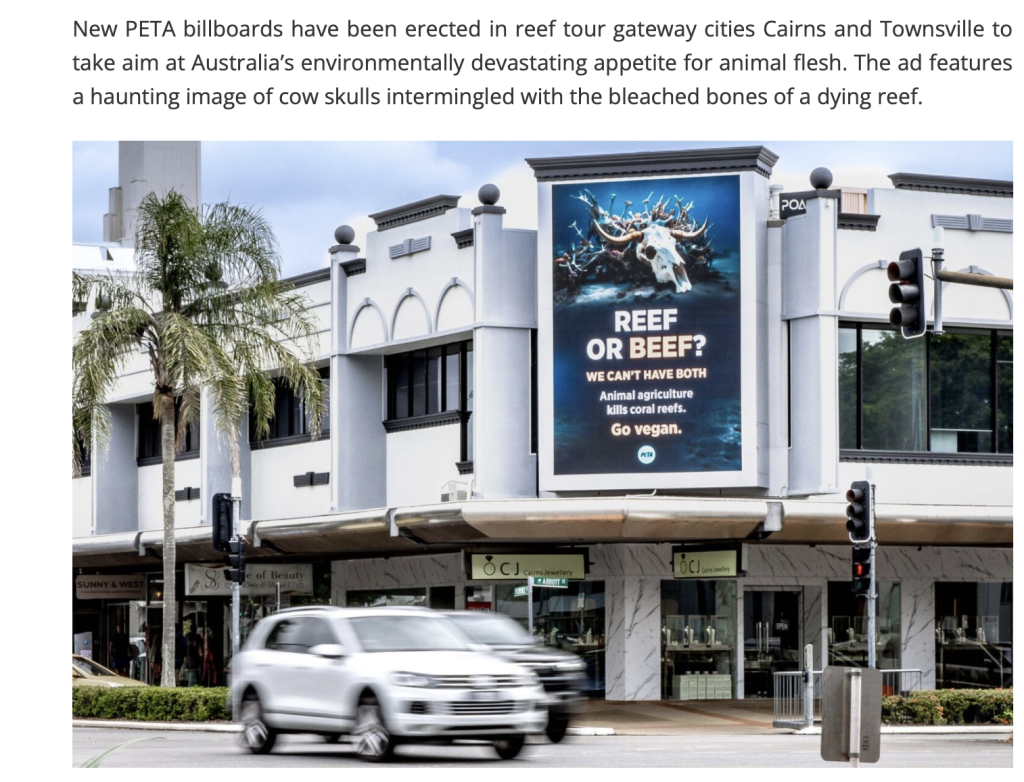
Misinformation abounds when it comes to the environment – and what makes it tick, especially at the Great Barrier Reef. There is this mantra, this insisting from some that there is no impact from agriculture – while there is this mantra, this insisting from the mainstream institutions and most recently a Peta campaign that agriculture is killing the same Great Barrier Reef.
Never have I heard anyone mention in the same breath the fishes of the Yongala historic shipwreck and its proximity to the ‘highest exposure levels’ of nutrients and sediments attributed to agricultural runoff.
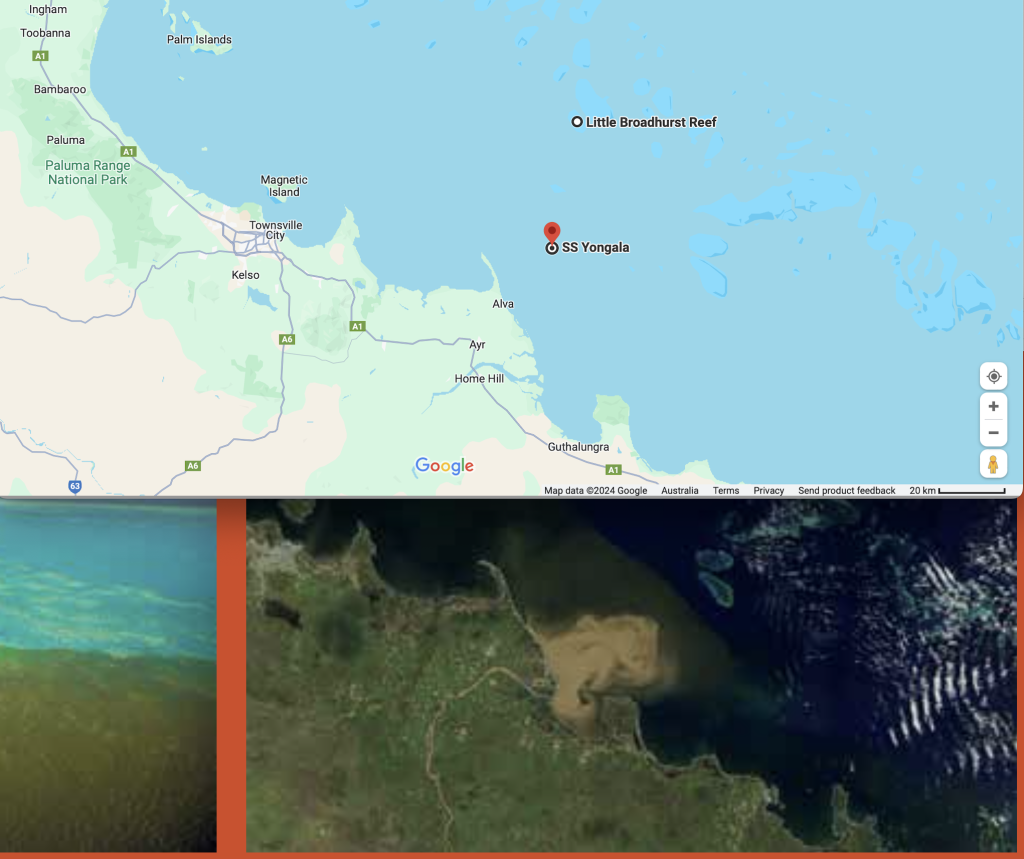
In the most recent ‘Great Barrier Reef Outlook Report’ (2019) there is a focus on the Burdekin River, and how the coral reefs in this region to the south of Townsville are suffering terribly because of agricultural runoff with specific mention of Stanley and Darley Reef. Even closer to the mouth of the Burdekin River, in fact in the direct path of river flood plumes, is the Yongala – regularly listed as one of the best dive sites in the world.
Google map showing location of the SS Yongala wreck and below that part of page 53 from the Outlook Report showing the same region inundated by a flood plume.
According to information at the AquaProDive website, the wreck of the SS Yongala is considered one of the best wreck dives in the world and arguably a must-see dive if coming to Australia. The same website explains that the wreck is in a remote location, which is just not true.
The Yongala Shipwreck is a 110m long former steel passenger and freight steamer which sank during a cyclone on March 23rd, 1911, with the loss of all 122 people aboard. It was not until 1958 that the wreck was first dived and due to its remote location, it has remained mostly untouched. The wreck begins 15m below the surface and extends down to 30m. Since it is the only large reef structure in the region, a huge variety of marine life gathers at the wreck creating Australia’s best dive site. She lies on her Starboard (left) side.
The Yongala sunk not far from the mainland, and not far from the mouth of the Burdekin River that drains a catchment replete with sugarcane and beef cattle.
It is arguably one of the ten best dive sites in the world, known not for its reliably good visibility but rather its super-sized marine life.
The wreck of the S.S. Yongala is a truly spectacular dive. Some claim it to be one of the top ten dives in the world. The Yongala’s size, structural integrity and proximity to Townsville alone make it exceptional locally, but it is unique because of the fish community that makes the Yongala its home base. The sheer abundance, variety and large size of predators (especially snappers, cods and trevallies) is extraordinary on the Great Barrier Reef. I have seen nothing like it elsewhere …
I am quoting from the foreword of a technical report by the Australian Institute of Marine Science and the Queensland Department of Environment and Heritage. The joint study measured the uniqueness of the Yongala fish community by comparison to similar shoals in the area. It also shows the attachment of fish to the wreck by documenting the stability of fish numbers and composition over a significant period.
I’ve never seen such a large turtle. I knew Queensland groupers were large, but seriously, at the Yongala. Māori wrasse they are big fish, and the Māori wrasse I saw at the Yongala a month ago today was longer and stockier than me.
I’m not advocated for more runoff with nutrients and sediment into the waters of the Great Barrier Reef. But I am drawing attention to the paradox that is the SS Yongala wreck.
ADDITIONAL INFORMATION
That report is ‘Fishes of the Yongala’ by Hamish A Malcolm et al. 1999
“Some tough choices were made to narrow this list down to 11, but we believe these sites offer the best diving in the world – all within Queensland’s borders…. And first listed is the Yongala
Peta billboard – and if someone would like to get in touch with Peta and find out if anyone at the organisation has ever visited the Great Barrier Reef. I would be happy to take them to the Yongala.
A compelling work of fiction which a lot of people took way too seriously is “prescient” – has the Guardian finally said something we can agree with?
The Day After Tomorrow at 20: a strangely prescient ecological warning
The disaster flick is riddled with inaccuracies, cliches and gusts of machismo. But with its global climate catastrophe, it feels more relevant than ever
Lauren Collee Wed 5 Jun 2024 01.00 AEST
In the winter of 2013, a breakdown in the polar vortex allowed freezing cold air to escape southwards towards the North American continent. As ice storms, tornadoes and blizzards swept across the US, Donald Trump tweeted. “I’m in Los Angeles and it’s freezing,” he wrote. “Global warming is a total, and very expensive, hoax!”
…
The film, 2004’s summer box office hit, was lampooned by critics and scientists alike. Members of an internet chatroom allegedly paid the paleoclimatologist William Hyde $100 to see it. “This movie is to climate science what Frankenstein is to heart surgery,” he concluded.
Nevertheless, a series of studies showed that the film did sway public opinion about the climate crisis. Twenty years after its release, it remains a unique specimen: a climate disaster blockbuster that adheres to all the tenets of the genre, while also explicitly attributing its carnage to the greenhouse effect.
…
Like every disaster film, The Day After Tomorrow is riddled with inaccuracies, cliches and strange displays of machismo (in one scene, Gyllenhaal battles wolves on a frozen ghost ship). But, if anything, the film’s absurdity feels closer to our reality in 2024 than it did in 2004. After all, we live in the age of climate surrealism – it is generally understood that things are going to get weirder as they get worse. Today is the day after tomorrow, we mutter to ourselves, as we read about ancient anthrax-infested reindeer carcasses defrosting in the Arctic Circle.
I really enjoyed “The Day After Tomorrow” when it first came out, and still watch it occasionally. It has a racy plot, interesting characters, sacrifice, heroism and some smoking hot intelligent women.
I’m a big fan of actor Denis Quaid, who played the science hero. In my opinion Quaid one of the most underrated actors in Hollywood. Quaid’s outspoken support for President Trump is just icing on the cake.
Even worse for “The Day After Tomorrow” believers, the Younger Dryas meltwater influx theory, which was the cause of the abrupt cooling in the movie, appears to have fallen out of favour.
Evaluating the link between the sulfur-rich Laacher See volcanic eruption and the Younger Dryas climate anomaly
James U. L. Baldini,Richard J. Brown,and Natasha Mawdsley
Abstract
The Younger Dryas is considered the archetypal millennial-scale climate change event, and identifying its cause is fundamental for thoroughly understanding climate systematics during deglaciations. However, the mechanisms responsible for its initiation remain elusive, and both of the most researched triggers (a meltwater pulse or a bolide impact) are controversial. Here, we consider the problem from a different perspective and explore a hypothesis that Younger Dryas climate shifts were catalysed by the unusually sulfur-rich 12.880 ± 0.040 ka BP eruption of the Laacher See volcano (Germany). We use the most recent chronology for the GISP2 ice core ion dataset from the Greenland ice sheet to identify a large volcanic sulfur spike coincident with both the Laacher See eruption and the onset of Younger Dryas-related cooling in Greenland (i.e. the most recent abrupt Greenland millennial-scale cooling event, the Greenland Stadial 1, GS-1). Previously published lake sediment and stalagmite records confirm that the eruption’s timing was indistinguishable from the onset of cooling across the North Atlantic but that it preceded westerly wind repositioning over central Europe by ∼ 200 years. We suggest that the initial short-lived volcanic sulfate aerosol cooling was amplified by ocean circulation shifts and/or sea ice expansion, gradually cooling the North Atlantic region and incrementally shifting the midlatitude westerlies to the south. The aerosol-related cooling probably only lasted 1–3 years, and the majority of Younger Dryas-related cooling may have been due to the sea-ice–ocean circulation positive feedback, which was particularly effective during the intermediate ice volume conditions characteristic of ∼ 13 ka BP. We conclude that the large and sulfur-rich Laacher See eruption should be considered a viable trigger for the Younger Dryas. However, future studies should prioritise climate modelling of high-latitude volcanism during deglacial boundary conditions in order to test the hypothesis proposed here.
“The Day After Tomorrow” was a great movie, a climate disaster blockbuster which even skeptics can enjoy. But the only thing prescient about “The Day After Tomorrow” is how a bunch of greens getting excited about a work of fiction when the movie was first released foreshadowed today’s mainstream climate activism.

 Iowa Climate Science Education