Month: June 2024

Author Of New Paper: No AMOC Collapse…”Should Dissuade People From Climate Doomism”

The ice sheet and the Atlantic overturning circulation (AMOC): No Alarm
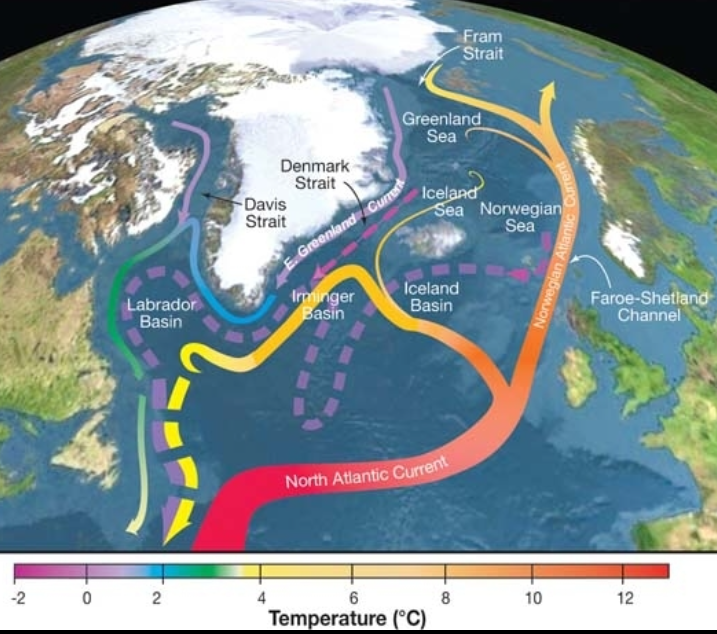
AMOC. Source: Woods Hole

By Frank Bosse

We hear it over and again: the melting ice in Greenland due to warming will soon lead to a collapse of the AMOC, making it difficult for it to “restart”.

The salt content in the north is critical because the salt-rich tropical water cools down and sinks due to the higher salt content, which is the “pump” that makes circulation possible in the first place. It also transports very large amounts of heat into the North Atlantic.

Scenarios  have been published that calculate a drastic cooling of the greater area (especially Europe) around it if the AMOC is “switched off”. The “Day after Tomorrow” scenario.

A more recent summary of these “tipping point” assumptions comes from Prof. Rahmstorf. It refers to reconstructed phases of such collapses, especially during “Heinrich Events” in the last ice age. At that time, large quantities of icebergs advanced far to the south, where they melted and thus probably brought the AMOC to a standstill through sweetening.

New paper finds no alarm

A completely new paper sheds light on these events in detail and reconstructs the freshwater inputs very precisely. A very detailed discussion can be found here.

It finds a decisive difference in the situation during the last ice age and the present: whereas at that time the ice entered the Atlantic primarily in the form of icebergs from the large continental ice sheets, in the present it is Greenland – the island supplies the lion’s share of the freshwater. This has consequences: as the glaciers continue to melt and retreat further inland, fewer and fewer icebergs are released and more and more liquid water is released. This has a major impact on the AMOC. Icebergs are much more “effective”. They briefly freeze the surrounding surface seawater, which leads to warming of the water below, as ice insulates against temperature loss to the (cold) atmosphere. Due to the large mass of the icebergs, they also travel much further south before they melt and finally disappear, leading to much larger-scale sweetening.

The paper concludes that the iceberg discharges from Greenland will not last long enough to drive the AMOC into collapse. Another reason for this is that it was much weaker in ice ages than at present anyway. The lead author of the study is quoted as saying:

This is good climate news that will hopefully dissuade people from climate doomism.”

So whoever reads something about the “soon to dry up North Atlantic Current” and the catastrophic effects in the future: The current piece in “Science” files this under doomsday fantasies (“doomism”).

Donate – choose an amount

via NoTricksZone

https://ift.tt/51Ly64b

June 5, 2024 at 11:23AM

Rethinking the sun’s cycles: New physical model reinforces planetary hypothesis – HZDR research


Another advance for solar-planetary theory. Some of the previous research of the HZDR group was mentioned in this Talkshop post last year. Our JEV (Jupiter-Earth-Venus) chart shown here covers 90 mean solar cycles, using the tropical orbit periods of the planets (verified on Arnholm’s solar simulator software). One point where we disagree slightly with Stefani’s HZDR group is the idea that the 193-year cycle they find is the de Vries cycle. We think not, because the de Vries cycle has a mean of 208.5~ years as Ian Wilson’s PRP paper on JEV theory explained, and other researchers have also found a similar period (say 205-210 years).
– – –
Press release 27 May 2024: Researchers at the Helmholtz-Zentrum Dresden-Rossendorf (HZDR) and the University of Latvia have posited the first comprehensive physical explanation for the sun’s various activity cycles.

It identifies vortex-shaped currents on the sun, known as Rossby waves, as mediators between the tidal influences of Venus, Earth as well as Jupiter and the sun’s magnetic activity.

The researchers thus present a consistent model for solar cycles of different lengths – and another strong argument to support the previously controversial planetary hypothesis.

The results have now been published in the journal Solar Physics (DOI:10.1007/s11207-024-02295-x).

Although the sun, being near to us, is the best researched star, many questions about its physics have not yet been completely answered. These include the rhythmic fluctuations in solar activity. The most famous of these is that, on average, the sun reaches a radiation maximum every eleven years – which experts refer to as the Schwabe cycle. This cycle of activity occurs because the sun’s magnetic field changes during this period and eventually reverses polarity. This, in itself, is not unusual for a star – if it weren’t for the fact that the Schwabe cycle is remarkably stable.

The Schwabe cycle is overlaid by other, less obvious fluctuations in activity ranging from a few hundred days to several hundred years, each named after their discoverers. Although there have already been various attempts to explain these cycles and mathematical calculations, there is still no comprehensive physical model.

Planets set the beat
For some years, Dr. Frank Stefani of HZDR’s Institute of Fluid Dynamics has been an advocate of the “planetary hypothesis” because it is clear that the planets’ gravity exerts a tidal effect on the sun, similar to that of the moon on the Earth.

This effect is strongest every 11.07 years: whenever the three planets Venus, Earth and Jupiter are aligned with the sun in a particularly striking line, comparable to a spring tide on Earth when there is a new or full moon. This coincides conspicuously with the Schwabe cycle.

The sun’s magnetic field is formed by complex movements of the electrically conducting plasma inside the sun. “You can think of it like a gigantic dynamo. While this solar dynamo generates an approximately 11-year activity cycle in its own right, we think the planets’ influence then intervenes in the workings of this dynamo, repeatedly giving it a little push and thus forcing the unusually stable 11.07-year rhythm on the sun,” Stefani explains.

Several years ago, he and his colleagues discovered strong evidence of a clocked process of this kind in the available observation data. They were also able to correlate various solar cycles with the movement of the planets just using mathematical methods. At first, however, the correlation could not be sufficiently explained physically.

Rossby waves on the sun act as intermediaries
“We have now found the underlying physical mechanism. We know how much energy is required to synchronize the dynamo, and we know that this energy can be transferred to the sun by so-called Rossby waves. The great thing is that we can now not only explain the Schwabe cycle and longer solar cycles but also the shorter Rieger cycles that we hadn’t even considered previously,” says Stefani.
. . .
Does this mean the question as to whether the sun follows the planets’ beat has finally been answered? Stefani says, “We’ll probably only be 100 percent certain when we have more data. But the arguments in favor of a process clocked by the planets are now very strong.”

Full source here.

via Tallbloke’s Talkshop

https://ift.tt/Mxn5tZz

June 5, 2024 at 10:00AM

Hockey Match

Earth was much warmer 5,000 years ago when atmospheric CO2 levels were lower – so people whose income depends on climate alarmism had to rewrite history.

About Tony Heller

Just having fun

This entry was posted in Uncategorized. Bookmark the permalink.

via Real Climate Science

https://ift.tt/IdrUFCx

June 5, 2024 at 09:43AM

BREAKING: The First Domino Falls on EV Mandates in Virginia

For Immediate Release: June 5, 2024
Contacts: Office of the Governor: Christian Martinez, Christian.Martinez@governor.virginia.gov

Governor Glenn Youngkin and Attorney General Jason Miyares: Virginia Will Exit California Electric Vehicle Mandate at End of Year

RICHMOND, VA – Governor Youngkin today announced the end of the California electric vehicle mandate in Virginia, effective at the end of 2024 when California’s current regulations expire. An official opinion from Attorney General Jason Miyares in response to a request by the Governor and Senate Republican Leader Ryan McDougle confirms that Virginia is not required to comply with expansive new mandates adopted by the unelected California Air Resources Board (CARB) set to take effect January 1, 2025.  

“Once again, Virginia is declaring independence – this time from a misguided electric vehicle mandate imposed by unelected leaders nearly 3,000 miles away from the Commonwealth,” said Governor Glenn Youngkin. “The idea that government should tell people what kind of car they can or can’t purchase is fundamentally wrong. Virginians deserve the freedom to choose which vehicles best fit the needs of their families and businesses. The law is clear, and I am proud to announce Virginians will no longer be forced to live under this out-of-touch policy.” 

“Today, I’ve issued an official Attorney General Opinion that confirms that Virginians are no longer legally bound to follow the emission standards of California,” said Attorney General Jason Miyares. “EV mandates like California’s are unworkable and out of touch with reality, and thankfully the law does not bind us to their regulations. California does not control which cars Virginians buy and any thoughts that automobile manufacturers should face millions of dollars in civil penalties rather than allowing our citizens to choose their own vehicles is completely absurd.”  

In 2021, the Virginia General Assembly passed legislation authorizing Virginia’s Air Board to adopt California’s “Advanced Clean Cars I” regulation pursuant to Section 177 of the federal Clean Air Act. The California Air Resources Board (CARB) recently adopted “Advanced Clean Cars II,” set to take effect January 1, 2025, which would require 100% of new cars sold in Model Year 2035 to be electric vehicles. An opinion from Attorney General Jason Miyares confirms the law, as written, does not require Virginia to follow ACC II. Therefore, the Commonwealth will follow federal emissions standards on January 1, 2025. 

“Throughout CARB’s ‘Advanced Clean Cars II’ regulation are references to California Governor Gavin Newsom’s executive orders and the unique environmental circumstances facing California. Virginia’s laws should not be determined by California politicians. Instead, our laws should be decided by Virginians who are elected to serve Virginia and address issues that face our Commonwealth, not a state nearly 3,000 miles away,” said Senator Ryan McDougle, who co-patroned legislation to repeal CARB’s mandate during this year’s legislative session along with Senator Richard Stuart, Senator John McGuire, Delegate Lee Ware, Delegate Tony Wilt, and Delegate Buddy Fowler. 

Under Advanced Clean Cars II, beginning in Model Year 2026, 35% of the new cars sold would have been required to be electric vehicles, moving up to 100% in 2035. If an auto manufacturer sells a standard automobile out of compliance with California’s mandate, they may be required to pay a fine upwards of $20,000 per vehicle sold. Given that EVs only amounted to 9% of vehicles sold in Virginia in 2023, application of the misguided mandates could have resulted in hundreds of millions of dollars in penalties. Virginia auto consumers and dealers could be forced to bear these costs. Not only would this leave auto dealers with less money to pay staff, offer raises, and grow their businesses, it could force many small auto dealers to permanently close their doors. 

The Attorney General’s opinion can be found here

A formal memo from Secretary of Natural and Historic Resources Travis Voyles to regulated entities and the Department of Environmental Quality can be found here.  

# # #

Source: Governor Glenn Youngkin | Governor.Virginia.gov

via Watts Up With That?

https://ift.tt/ZJR6DCt

June 5, 2024 at 09:32AM