Month: June 2024

Half Of German E-Car Buyers Regret Their Purchase or Lease!

From the NoTricksZone

By P Gosselin on

Many Germans regret their purchase or lease of an e-car and Germans overall are increasingly unwilling to consider them. 

Citing an article published in the online Merkur.de, Blackout News reports: “Half of German e-car owners regret their purchase or lease”.

Apparently German e-car owners are disappointed due especially to “rising electricity prices”.

Recently we reported here that the German e-car industry was “a crisis headed for a catastrophe” and that sales were plummeting.

Q1 2024, EV sales declined some 14.1% compared to Q1 of 2023.

e-car targets now a fantasy

Meanwhile sales of conventional engine cars have risen strongly over the same period. According to Blackout News, the share of electric cars sold from the entire automobile mix was just 12.2 percent. and new e-car registrations in the current year are “down significantly”.

Customers overall remain wary of e-cars and no sales boost is in sight. This means Germany will fall far short of its electric car targets.

According to Renate Köcher from the Allensbach Institute for Public Opinion Research: “In the long-term trend, e-mobility has always been in the minority, but now we have reached a new low.”

via Watts Up With That?

https://ift.tt/PfQBJYa

June 5, 2024 at 04:03AM

Is 3.0 Really Greater Than 0.85?

According to the BBC, we now live in a world of misinformation and fake news, in which fake experts and denialists peddle anti-science conspiracies that endanger us all. This has led to the establishment of fact-checking, in which the so-called denialist claims are seemingly debunked by self-appointed arbiters of the truth. To illustrate how these fact-checks often work in practice, I offer you the following fictional account of how the BBC Verify team might deal with one particularly interesting online talking point that is currently gaining traction. In keeping with fact-checking tradition, we start with a clear declaration of the ‘misinformation’ to be debunked:

One of the most recent of false narratives to appear on the internet has been the assertion that 3.0 is greater than 0.85, a view favoured by climate change deniers, seemingly based solely upon a rudimentary understanding of mathematics gained at a very early stage in their education. But is it really true that a number such as 3.0 can be said to be greater than 0.85? In the simplistic world of the fake expert, the answer would be yes, but in the world of climate change risk management, in which the vast majority of the world’s scientists are in agreement, a much more nuanced and context-driven reality emerges.

The problem with the naïve pseudo-mathematics of the climate change denier is that it often fails to understand the true importance of the numbers concerned, but it is only when this importance is taken into account that reliable statements can be made regarding magnitude. The fake experts will point out that when the units are the same, the numbers are directly comparable. But that is where the misdirection is introduced. Using the same units is only part of the issue. And nowhere is this more apparent than in the recent and rapidly spreading online conspiracy theory that 3.0 is greater than 0.85. To get to the bottom of the matter we consulted our specialist disinformation specialists team to find out where this false narrative is coming from and why it is fake news. This is what they had to say:

This particularly damaging example of misinformation seems to have started with the publication of a study that showed how climate models have predicted that climate change will lead to a 0.85 metre rise in sea level within the next century for the South Eastern city of Jakarta.”

But is this particular 0.85 actually equal to 0.85? Well, according to our fact-checkers, the answer seems to be ‘probably’.

According to the models, the figure of 0.85m is the most likely extent of the sea level rise, but the models contain a lot of uncertainties. Accordingly, the value of 0.85 is just a guess. Furthermore, it is based upon a premised 5oC warming relative to 1870, which is far from certain. However, it is a very worrying figure, and that is what is important.

Yes, but how does this explain why some deniers have wrongly come to the conclusion that 3.0 is greater than this figure?

Well, if we were dealing with an even greater level of global warming, the models would indeed predict an even greater sea level rise, possibly even 3 metres or more. In such circumstances 3.0 would certainly be greater than 0.85 because that would be an even more worrying impact of climate change. But that is not where this particular 3.0 has come from. This 3.0 is due to the fact that the city of Jakarta has already sunk by over 3 metres in the last 100 years due to subsidence (with 2.5 of that happening in the last decade). And the rate of subsidence is accelerating, so another 100 years may very well result in a further 3 metres of subsidence at the very least.

But surely that is a lot more worrying than a 0.85 metre sea-level rise and so this 3.0 is more worrying, and hence it is surely greater than 0.85.

Well, you might think so but you would be applying the naïve mathematics of the climate change denier. That is not how climate risk mathematics works because, according to experts, “sinking land reinforces the problem of climate change-driven sea-level rise“. For something to be a reinforcing factor it cannot, by definition, be of greater magnitude than the factor it is reinforcing. If it were, then the reinforcing would be the other way round. And since a land drop of 1 metre is equivalent to a sea-level rise of 1 metre, the only way in which the subsidiary role of subsidence can be explained is by recognising that 3.0 is actually less than 0.85, despite appearances.

So is this all about climate change deniers yet again failing to understand how the scientific method works?

Certainly. And it is a classic case of facts being taken out of context to prove a point. It may be a fact that in disciplines such as civil engineering 3.0 is always greater than 0.85, but that doesn’t mean that the same can be said in climate science, where a huge scientific consensus exists to tell us that sea-level rise due to climate change is the greatest threat faced by coastal cities. Insisting on retaining the narrow (and quite frankly irrelevant) mathematical sense in which 3.0 is greater than 0.85, is tantamount to denying the scientific consensus, and is just typical of the logical flaws employed by the denier. To the layperson, such arguments may appear convincing but to anyone steeped in climate science the claim that 3.0 is greater than 0.85 just doesn’t make any sense because that would mean that subsidence is a greater problem than climate change-driven sea-level rise, which according to nearly every scientist in the world isn’t true. That is why, when the BBC reported on this problem it was keen to stress that subsidence only represents a ‘bigger immediate problem’. In the long term, subsidence is still only reinforcing the problem.”

Are there any other numbers that climate change deniers are pushing as being greater than 0.85?

Yes. Shanghai and New Orleans had both subsided by more than 2 metres in the 20th century, leading climate change deniers to falsely conclude that such cities are more at risk from simply sinking into the sea over the next hundred years than they are from being overwhelmed by a posited 0.85 metre sea-level rise. They also argue that since Shanghai has obviously adapted to its historical 2 metre subsidence without too much fuss and bother, it should also be able to adapt to a 0.85 metres sea-level rise. Once again, these arguments only make superficial sense due to an insistence on sticking to the inappropriate belief that 2.0 is greater than 0.85, thereby denying the consensus within climate science that climate change-driven sea-level rise poses the greatest risk. In fact, there are a host of numbers that have been falsely deemed to be greater than 0.85 based on the likelihood that the majority of coastal cities in the world will, under their own weight, subside by a figure significantly greater than the magnitude of sea-level rise predicted by climate models (albeit, only greater in that consensus-denying mathematical sense beloved of denialists).

So there you have it. The science is clear. Climate change will lead to inundation of coastal cities due to sea-level rise unless we immediately abandon fossil fuels. Any suggestion that coastal cities are going to sink anyway, leading to far greater inundations than are predicted by climate models, is a false narrative spread by climate change deniers employing mathematical trickery that fails to take into account the existence of a scientific consensus.

The science is settled. Numbers are just denialist talking points. Consider yourself debunked.

Further Reading:

You may wish to read this for an account of ‘climate reductionism’ and the problems facing Jakarta. The false narrative that subsidence is merely a reinforcing factor is clearly impeding Jakarta from dealing with its flooding problems.

For the standard, approved narrative, in which the scale of the subsidence problem is downplayed and framed as a reinforcing rather than principal factor, you may wish to read what ClimateCheck has to say on the matter.

via Climate Scepticism

https://ift.tt/gN9RqcT

June 5, 2024 at 03:21AM

Rolls-Royce Treatment: Britain Backs Small Modular Nuclear Power Plants

Always on, ever reliable nuclear power represents THE existential threat to chaotically intermittent wind and solar. And those profiting from the greatest economic and environmental fraud of all time, know it and fear it. Hence the uptick in hysterical propaganda being fed to and through the MSM about the cost, dangers, risks and blah, blah, blah about nuclear power.

Trouble for the wind and solar cult is that they can never deliver on time and under budget. And they can never, ever compete the generation sources that operate around-the-clock, whatever the weather. Which explains their open hostility to nuclear power plants of any shape and size. Including Small Modular Reactors (SMRs).

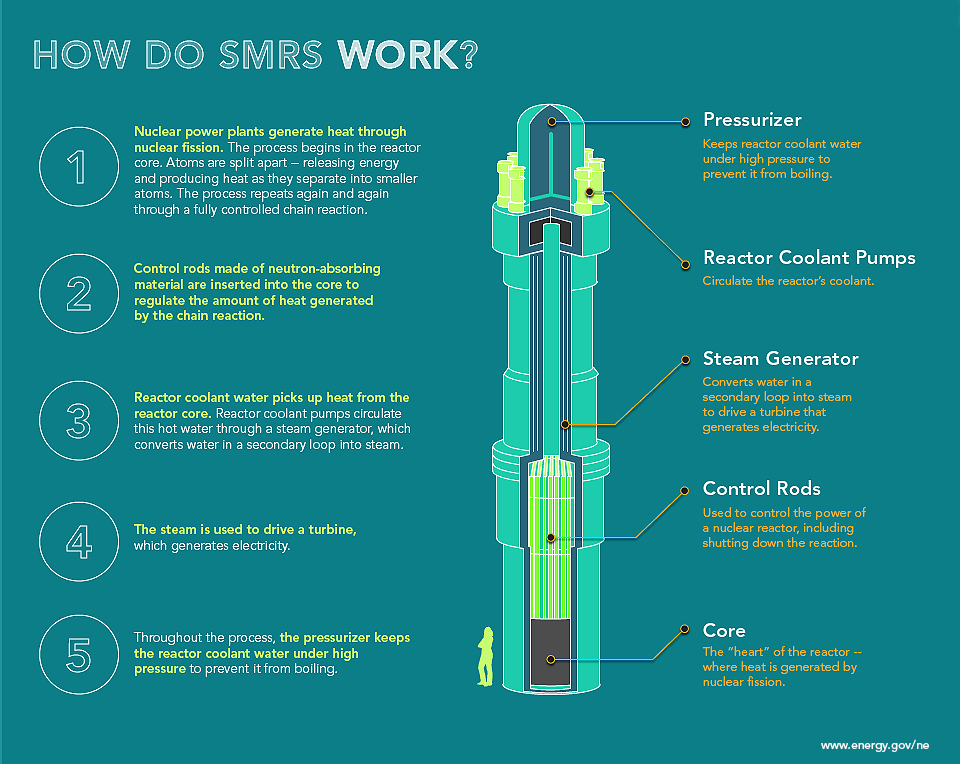
Listen to the wind and sun cult and you’d think that Small Modular Nuclear Reactors are a work of far-fetched Science Fiction. The reality is that some 200 small nuclear reactors are presently powering 160 ships and submarines all around the world, and have been for decades.

The Brits evidently understand the obvious benefits of SMRs, with Rolls-Royce lining up to perfect their manufacturing techniques with help from Sheffield University, as this piece from Matt Oliver outlines below.

Rolls-Royce signs £15m deal to test mini-nuclear reactors in Sheffield
The Telegraph
Matt Oliver
20 May 2024

Rolls-Royce has signed a £15m deal with Sheffield University to trial manufacturing techniques for small modular reactors (SMRs), in the latest step towards making cheap nuclear power a reality.

Under the agreement, the engineering giant will make the first working prototypes of SMR modules at the university’s Advanced Manufacturing Research Centre.

It will then seek to work out efficient and repeatable processes that will let the company produce them in large numbers.

The investment was welcomed by Claire Coutinho, the Energy Secretary, who said: “Small Modular Reactors are the future of nuclear technology, and key to quadrupling the UK’s nuclear capacity by 2050 as part of the biggest expansion in 70 years.

“This multi-million-pound SMR manufacturing facility will be fantastic for Sheffield – making the Steel City once again the home to world-leading industry.”

SMRs will be assembled from hundreds of factory-made modules, which will be transported to sites and then put together “like Lego bricks”.

The initial phase of the Sheffield University deal will see Rolls spend £2.7m on producing three prototype modules by the end of this year.

If that work is successful, the company will spend more than £15m making prototypes of each of the 15 types of modules that will be needed throughout a finished SMR.

Victoria Scott, chief manufacturing engineering at Rolls-Royce SMR, said: “Our investment in setting up this facility and building prototype modules is another significant milestone for our business.”

Professor Koen Lamberts, president and vice-chancellor of the University of Sheffield, said: “We are very proud that Rolls-Royce SMR has chosen to base its module development facility at our Advanced Manufacturing Research Centre.”

Oliver Coppard, South Yorkshire’s mayor, said: “This announcement cements South Yorkshire’s position as the leading place to build small modular reactors, a cutting-edge technology which will be a key part of the global transition to clean energy.”

SMRs are seen as potential game-changers for the nuclear industry because of their modular construction.

In theory, this means they should be quicker to build than traditional, large-scale nuclear power plants and significantly cheaper as well – providing efficiency throughout production at scale.

Rolls has previously said each SMR should cost about £2bn and will generate about 470 megawatts (MW) of electricity.

For comparison, Hinkley Point C is currently forecast to cost as much as £35bn and will deliver 3.3 gigawatts of power.

On current budgets and forecasts, it suggests every 100MWs of power generated by an SMR would be delivered at less than half the cost of equivalent power coming from Hinkley.

However, the technology remains untested, with no SMRs in operation anywhere in the world. [Except for hundreds in ships and subs sailing all around the World]

The trial of manufacturing techniques in Sheffield comes as Rolls weighs up potential locations for a future factory that will make SMR modules.

It had drawn up a shortlist of locations that includes the International Advanced Manufacturing Park on the outskirts of Sunderland, Teesworks in Redcar and the Gateway industrial park in Deeside, Wales.

Originally, the company had also intended to build a heavy pressure vessels factory as well, which would supply another crucial part for its SMRs.

But the Telegraph revealed last month that this plan had now been scrapped, owing to delays in a UK government SMR design competition.

The competition – first announced by the Government in 2015 – has been repeatedly pushed back, with the winners now not expected to be revealed until summer at the earliest.

It means Rolls will now buy the heavy pressure vessels for its SMRs from a third-party supplier.

The company has also not ruled out reviving its plan for a heavy pressure vessel factory at some point in the future, if it builds up a healthy pipeline of orders.
The Telegraph

Silent, safe and reliable power generation – thanks to small nuclear reactors.

via STOP THESE THINGS

https://ift.tt/iG0jlqD

June 5, 2024 at 02:35AM

Challenging a “Free-Market” Congressman in 1979 (early criticisms of public utility regulation)

Ed. Note: When I was in a bank training program in Houston in 1979 (age 24), I wrote a letter to Senator Phil Gramm very critical of his stance on federal railroad regulation. I picked up the ringing phone a few workdays later to the words ‘This is Phil Gramm…’ Shocking! So with adrenalin going, I answered his letter back to me with an in-depth explanation of my view, which Murray Rothbard published in The Libertarian Forum, July – August, 1980. This was one of my earliest publications and first thoughts on public utility regulation (which have changed little in the last 45 years).

Introduction: Murray N. Rothbard

When Professor Dr. W. Phillip Gramm, an eloquent and hard-hitting champion of free-market economics, was elected to Congress from the 6th district of Texas, many people thought that Congressman “Phil” Gramm (as he was promptly renamed) would be a mighty force for liberty and the rollback of the State.  But this seems to be the season for libertarian sellout, and Representative Gramm has been anything but. 

When Gramm managed to gut a powerful drive for railroad deregulation in order to subsidize Texas coal producers, Texas businessman, Austrian economist, and libertarian, Robert Bradley, Jr., took him to task.  There followed the full reply of Congressman Gramm and the eloquent rebuttal of Rob Bradley.  One of the most interesting aspects of Congressman Gramm’s self-serving reply is that he is taking the now standard line of libertarian sellout: I of course am for complete liberty, but …” 

The “but” in this case, as in most others, is that some people and some businesses might have to suffer in the short-run if liberty, or in this case total railroad deregulation, is to be achieved.  Those people living off the public trough, living off the taxpayers and consumers, are going to be temporarily discomfited.  The question then is?  Are we going to postpone getting liberty into parasitically in the style to which they have been accustomed? Or are we going to press on for the cause of liberty and prosperity regardless of inconveniences? 

Liberty is not always a rose garden – especially for the existing ruling class and those living off the State.  The political temptation is to forget principles, and this is what congressman Gramm has done, perhaps helping to scuttle railroad deregulation altogether.  These are the eternal temptations of politics: to abandon principle for the politically expedient; that is, to continue the politicians own perks in office.

Gramm Response

Dear Mr. Bradley,

Thank you for writing to let me know of your dissatisfaction with my vote in support of Congressman Eckhardt’s amendment to the Rail Act of 1980.

As an economist who is firmly committed to competition and free trade, I can understand your view that Congressman Eckhardt’s proposed amendment would be anti-competitive and would continue the federal over-regulation of the railroad industry that has crippled that industry. However, the Rail Act raises questions that are more complex than simply whether regulation is desirable or undesirable, a question about which you and I would have few disagreements.

The present condition of this nation’s railroads results from market forces and government regulations that have their roots in the 1920’s when mass production of automobiles first began to threaten the railroads’ domination of transportation in this country.  If we are to again have a vital rail industry, as I believe we must, Congress must act carefully to begin reintroducing competition in the railroad industry while preventing cold water shock treatments that could cause destructive market perturbabtions. 

In particular, the coal producers in Texas and neighboring states have become dependent of rail transportation provided at artificially low rates. Many of these producers have no options other than to ship coal on a single available rail line because competition exists neither from other rail lines nor from other modes of transportation. 

To give the railroads excessive freedom to raise rail rates to such “captive” shippers would create massive dislocations in the coal industry, dislocations that would reverberate throughout the economy of Texas and the economies of states that depend on Texas coal. 

I supported Congressman Eckhardt’s amendment and I will support similar efforts that may be introduced when the House reconvenes July 21 because I believe these efforts provide constructive progress toward complete deregulation of the railroad industry while preventing short-term problems that would benefit neither the railroads nor the shippers who depend on the railroads. 

I appreciate having the opportunity to represent you and other Texans in Congress.  If I can be of service to you, please contact me.

Yours respectfully, Phil Gramm, Member of Congress

Bradley Rejoinder

Dear Dr. Gramm:

I thank you for the explanatory letter dated July 16.  Your letter certainly had a better tone than mine, but I am very sensitive about economists-turned-politicians, i.e., those who know better, selling out the market in favor of personal goals. Perhaps you can avoid this criticism since the “Chicago School” brand of market economics, from the writings of its founder, Henry Simons, to its doyen, Milton Friedman, has stressed instances of “market failure” and government “correction” as you claim is the case concerning railroad deregulation. However, many economists of this persuasion – Harold Demsetz [1] for one – have in recent years abandoned this textbook view in favor of the unhampered market. Some of the cogent arguments that have changed their minds I will attempt to present below.

As I understand your position, you wish to avoid the “cold water shock treatments” of total deregulation of the railroads by retaining the Interstate Commerce Commission’s power to regulate rail rates. This stance has your support since “coal producers in Texas and neighboring states have become dependent on rail transportation provided at artificially low rates” as have the electric utilities and their consumers, and to allow a location monopolist rate freedom would “create massive dislocations” for both the producers and ultimate consumers of the coal. 

Further, I have learned from a recent Houston Post article that you, along with fellow Representative Jim Wright, are proposing government loan guarantees for a new railroad to operate in the Powder River Basin to “increase” competition. [2]

Before I embark on a critique of the regulation your support, I ask how you can boast of “constructive progress toward complete deregulation” when the basic business decision of rate setting is left in the hands of bureaucrats?  According to the Post article cited above, proponents of deregulation bill will have to be “gutted”.  And, certainly, if you wish to launch a “private” railroad with government subsidy, the entire industry will that much more be in the hands of the State.

A number of eminent free market economists have brought forth an impressive case against government regulation of “natural monopolies” which I bring to your attention.

First of all there exists no scientific procedure of discovering what the “right” price should be.  Or in Kirzner’ words: “…what is the likelihood that government officials, with the best of intentions, will know what imposed prices, say, might evoke the ‘correct’ desired actions by market participants?’” [3] After all what is “right” for the railroad company, given its costs, capital requirements and risk, may not be “right” for the producers and consumers of the coal.  For, conceding the subjective nature of value, only the market process can balance – in a non-haphazard manner – the forces of supply and demand.  Summarizes Mises:

Prices are a market phenomenon. They are generated by the market process and are the pith of the market economy. There is no such thing as prices outside of the market. Prices cannot be constructed synthetically, as it were. They are the resultant of a certain constellation of market data, of actions and reactions of the members of a market society. [4]

Therefore, if the “right” price cannot be found, then the decided upon price from a market standpoint is either too high – thus punishing the consumers and producers of coal – or too low – thus undermining the capital requirements of the railroad.  In the latter case, this could mean higher future railroad rates from capital disrepair.

Computing an “average rate of return” for the railroad to add to its cost is not an escape in this regard.  There is nothing normal about the disequilibrium phenomenon of profits and nothing homogeneous about returns industry to industry and firm to firm with industries. And the cost side of the “cost plus” equation is not objective but subjective as James Buchanan has recently taught the profession, further muddling the government allowable price calculation. [5]

But let us step back and realize that Godlike creatures and value-free econometricians are not in charge of such price determination, as if they could find the “best” price in the situation. The forces at work are bureaucrats and special interest lobbyists – persons having judgment-distorting elements such as personal biases, emotional tendencies, political favoritism, career biases and corruption avenues. And certainly the entire lobbying and testimonial effort is a cost for all parties involved, parties who believe they can costlessly cheapen the market price of railroad services.

So, in all, not only do we see that scientifically a bureaucracy cannot find the “right” price, but the worst forces will be at work to decide such a price. So much for the textbook correction of market “failure”, in spite of the history of bureaucratic and ICC pricing.

Another line of argument against your position has been receiving wide attention in recent years, specifically since Kirzner’s 1975 Competition and Entrepreneurship.  His argument demonstrates the fundamental weakness of equilibrium neoclassical theory in judging market “failure” or “imperfection” – from which you textbook reasoning is derived. The argument is that the government regulation of prices retards the consumer benefits that in the absence of such regulation would accrue from uninhibited entrepreneurship.  (In equilibrium, of course, the entrepreneur does not exist.) 

This is true since, as Kirzner puts it, “nothing in the course of the regulatory process suggests a tendency for as yet unperceived opportunities of resource allocation improvement to be discovered.” [6] To be more specific, in any “cost plus” regulatory environment, entrepreneurial alertness to new methods to minimize costs and service innovations to maximize revenue is stifled though, of course, not entirely eliminated as under socialism.  This is very much a cost for the coal parties that economists cannot ignore.

The third line of argument is one you have undoubtedly taught many times in your academic career: the problem of non-market pricing on resource allocation in general.  The “artificially low price” you admit exists creates an overutilization of coal and underutilization of coal and transportation substitutes (such as nuclear power and pipeline fuels).  These are further costs or your regulatory stand.

In all, the above drawbacks of regulation counter the supposed “massive relocations” of deregulation.  In sum, they offer a supportable case for the free market unless (1) an economist rests his case on the first approximations of equilibrium theory to the exclusion of the real world of disequilibrium and bureaucratic realities or (2) a politician rests his case on the special interests of his district. But utilitarian arguments pro and con aside, are you, Dr. Gramm, a true lover of liberty? Do you support the market only when you are convinced it will produce “umpteen more bathtubs: as Murray Rothbard puts it?

To end this open letter, unless you can convince me that:

  • Bureaucratic pricing is “costless” and a better alternative to market pricing;
  • Entrepreneurship – particularly in the cost minimization sense – is not inhibited by price regulation;
  • Resource allocation is satisfactory with an “artificially low” price;
  • Ultimate deregulation, your alleged goal, is helped by continued regulation; and
  • The market and individual freedom to exchange on non-coercive terms are not to be valued for their own sake; then,

I – and all true free market economists and libertarians, many of whom will read this letter – call on you to renounce your claim as “an economist who is firmly committed to competition and free trade”.  Having repudiated this noble claim, you, I am sure, will continue to do fine in the political arena. However, future historians will remember you as not only destroying legislation that would have been a rare victory for the market in this day and age, but as one of the many who destroyed the market economy in the twentieth century. 

Revise your stand immediately and use your influence to tilt the close vote toward passage! The legislature, after all, is still in session. And please, write me such a letter if I were to ever put politics and personal gain over liberty!

Sincerely yours, Rob Bradley, Jr.

Footnotes:

  1. For example, see his “Why Regulate Utilities?” in Yale Brozen, ed., The Competitive Economy (Morristown, J. J.; General Learning Press.  1975) for sophisticated arguments explaining competition with so-called location monopoly instances.
  2. “House’s OK of rail decontrol amendment may spell end of measure of this session”, The Houston Post, July 25, 1980, 1-A.
  3. Kirzner, “The Perils of Regulation: A Market-Process Approach”, Law and Economics Center Occasional Paper, The University of Miami (1978), p. 15.
  4. Mises, Human Action (New Haven: Yale University Press, 1949), p. 395.
  5. See Buchanan’s Cost and Choice (Chicago: Markham, 1969).
  6. Kirzner, op. cit., p. 16.

The post Challenging a “Free-Market” Congressman in 1979 (early criticisms of public utility regulation) appeared first on Master Resource.

via Master Resource

https://ift.tt/M80JjIP

June 5, 2024 at 01:09AM