Month: June 2024

The Claim ‘Exxon Knew’ Their Products Induced ‘Catastrophic Climate Impacts’ In The 1970s Is Bunk

In the 1970s and 1980s ExxonMobil did not know that their reports would be so wrongly misinterpreted in the 2010s.

Since 2015, when “investigative journalists” uncovered reports written in the late 1970s by ExxonMobil’s Science Advisor J.P. Black, it has been a common talking point in alarmist circles to insist that “Exxon Knew” about the looming climate catastrophe imposed by continuing to use their petroleum products.

“ExxonMobil had known that burning fossil fuels would lead to potentially catastrophic climate impacts as early as the late 1970s.”ExxonKnew.org

Exxon disputed climate findings for years. Its scientists knew better.

The accusation is that Exxon was pushing their products knowing full well – with certainty – how much damage they caused.

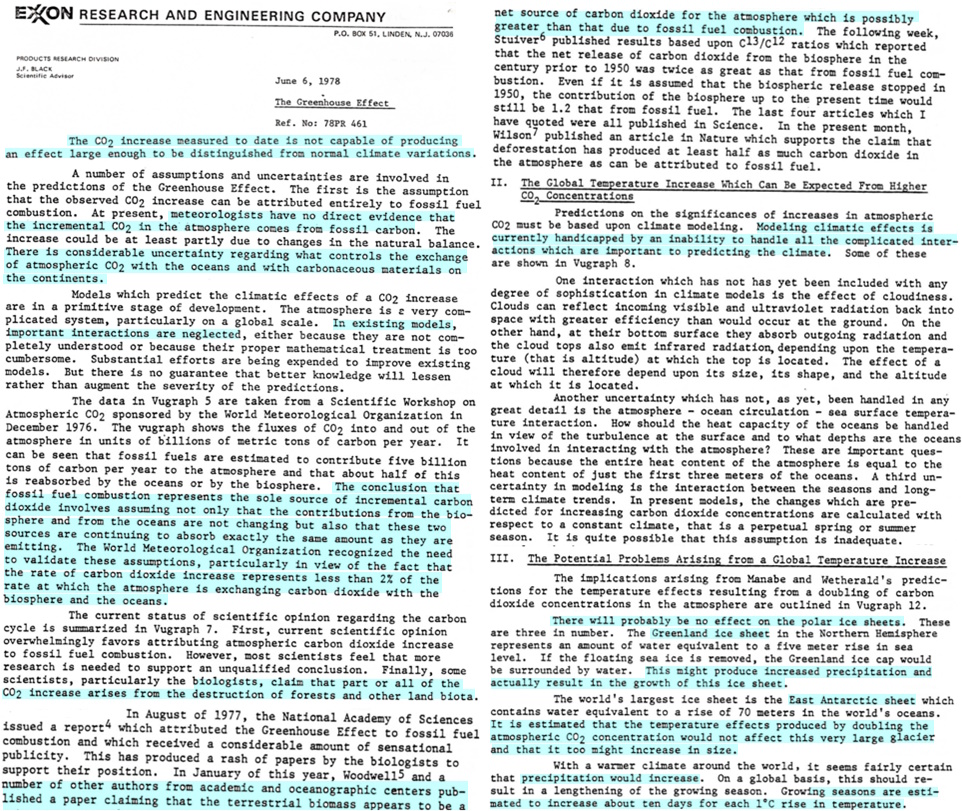
Exx0nMobil 1977 Report

But if one were to actually read these internally published scientific reviews, it would be difficult to find even a hint of this definitive certainty pertaining to the science of climate change in the 1970s.

In the most notorious 1977 review (the written report was published in 1978), J.P. Black emphasized there is considerable uncertainty whether the increase in CO2 was all or even mostly due to fossil fuels. The fundamental claim that fossil fuels drive CO2 level changes was still considered a never-validated assumption, as nature may contribute more to CO2 increases than human  fossil fuel emissions do.

“The CO2 increase measured to date is not capable of producing an effect large enough to be distinguished from normal climate variations.”

“A number of assumptions and uncertainties are involved in the predictions of the Greenhouse Effect. At present, meteorologists have no direct evidence that the incremental CO2 in the atmosphere comes from fossil carbon.”

“There is considerable uncertainty regarding what controls the exchange of atmospheric CO2 with the oceans and with carbonated materials on the continents.”

“The conclusion that fossil fuel combustion represents the sole source of incremental carbon dioxide involves assuming not only that the contributions from the biosphere and from the oceans are not changing but also that these two sources are continuing to absorb exactly the same amount as they are emitting. The World Meteorological Organization recognized the need to validate these assumptions…”

“…biologists claim that part or all of the CO2 increase arises from the destruction of forests and other land biota.”

“…a number of other authors from academic and oceanographic centers published a paper claiming that the terrestrial biomass appears to be a net source of carbon dioxide for the atmosphere which is possibly greater than that due to fossil fuel combustion.”

Image Source: Black, 1977 (ExxonMobil Science Advisor)

The report also says that if the globe warms as predicted by models of doubling the CO2 concentration:

“…there will probably be no effect on the polar ice sheets.”

The Greenland ice sheet will experience “increased precipitation and actually result in the growth of this ice sheet.”

For East Antarctica’s ice sheet, doubled CO2 “would not affect this very large glacier and…it too might increase in size.”

Climate models are “primitive” and incapable of handling important aspects of climate.

“Modeling climatic effects is currently handicapped by an inability to handle all the complicated interactions which are important to predicting the climate. In existing models, important interactions are neglected.”

And there are benefits of a warmer climate around the world.

In a warmer world, “precipitation would increase. On a global scale, this should result in the lengthening of the growing season. Growing seasons are expected to increase about ten days for every 1°C increase in temperature.

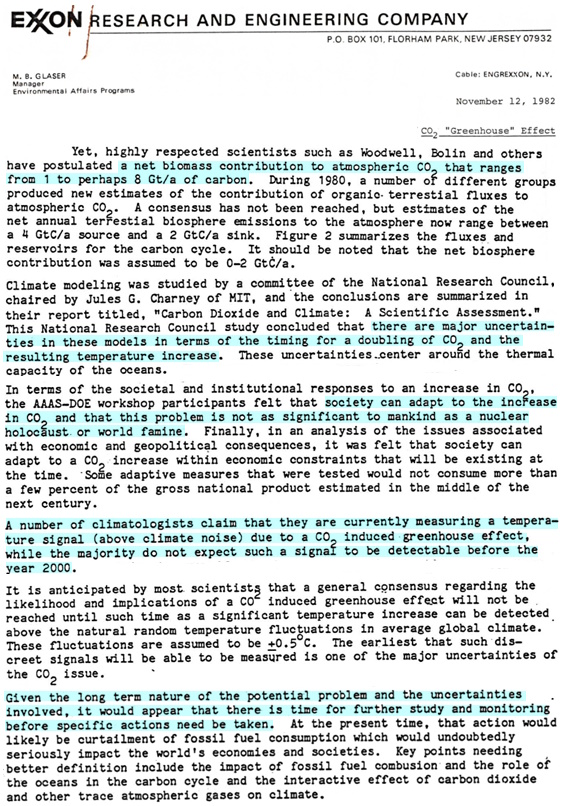
Exx0nMobil 1982 Report

The 1982 ExxonMobil report continued to express uncertainty about the origins of the CO2 increase, saying nature may be a net source of CO2 to the atmosphere.

There was also no consensus on the detection of a CO2-induced temperature warming, as a majority of climatologists at the time thought CO2’s impacts would not be detectable until 2000.

“A number of climatologists claim that they are currently measuring a temperature signal (above climate noise) due to a CO2 induced greenhouse effect, while the majority do not expect such a signal to be detectable before the year 2000.”

And most importantly, Exxon still did not know climate catastrophe was the inevitable consequence of using petroleum products in the 1980s. They suggested otherwise, saying we can adapt to the changes. The consequences of fossil fuel burning are uncertain and in need of further study. No “specific actions” need be taken until we learn more.

“…society can adapt to the increase in CO2 and this problem is not as significant to mankind as nuclear holocaust or world famine.”

“Given the long term nature of the potential problem and the uncertainties involved, it would appear that there is time for further study and monitoring before specific actions need be taken.”

Image Source: Glazer, 1982 (ExxonMobil Manager, Environmental Affairs)

via NoTricksZone

https://ift.tt/X476ZIs

June 4, 2024 at 12:54AM

‘Climate Justice’ Now Requires Edinburgh City Council to Ban Ads Tempting Locals to Go on a Cruise

From the DAILY SCEPTIC

by Chris Morrison

Tom Nelson, the producer of the social media blockbuster Climate: The Movie, often tweets in reply to woke Net Zero nonsense: “It’s not about the climate, is it?” Edinburgh City Council is to ban adverts for cruise ships, airports, airlines and internal combustion engine cars. “It is just basic common sense that if the council is serious about its commitment to climate justice, we cannot allow council advertising space to be used to promote fossil fuel companies,” said Ben Parker, a councillor for the Scottish Greens, who is reported to have spearheaded the policy. Curiously missing from the banned list are medicines and plastics, along with other common products such as clothing, food preservatives, cleaning products and soft contact lenses. Together with countless other useful and essential items in widespread use, they are all derived from hydrocarbons, courtesy of oil and gas.

It’s not about the climate, is it?

The ban echoes similar advertisement crackdowns by local councils in Sheffield, Bristol, Cambridgeshire, Coventry, Liverpool and Somerset. The Financial Times notes that Edinburgh is committed to becoming a Net Zero city within barely more than five years.

Interestingly, all the councils who are moving to deprive their ratepayers of large amounts of advertising revenue, except Coventry, are signed up to the billionaire-funded UK100. This green operation targeting local authorities was founded by Polly Billington, a former BBC reporter and aide to Labour’s Net Zero fanatic Ed Miliband. Its main backer is the European Climate Foundation (ECF), a front funding operation for many of the largest names in climate activism. These include Bloomberg Philanthropies, the vehicle used by Michael Bloomberg to promote banning oil and gas production, and the Children’s Investment Fund, promoting the charitable good works of hedge fund manager Sir Christopher Hohn, former paymaster of eco vandals Extinction Rebellion. Other billionaire funders of ECF include names that crop up regularly in the promotion of Net Zero global collectivisation including Hewlett, IKEA, KR, Grantham and Rockefeller. One of five board members of UK100 is Madeline Carroll, described as a communication and campaigning specialist for ECF.

Local councils around the U.K. have signed up to a UK100 pledge, which commits them to “acting sooner than the Government’s goal” and making substantial progress towards Net Zero in the next decade. “We are closer to the people who live and work in our communities, so we have a better understanding of their needs,” says UK100, a debatable proposition given who is funding this waffle. “This means we can collaborate with them to build consensus for the solutions we need to transition to a Net Zero society that delivers multiple benefits and is fair, just and works for everyone.” Try telling that to the less affluent car owners forced off the roads in London by Mayor Sadiq Khan’s punch-down Ulez policy, backed by the notorious statistical construct of saving 4,000 lives a year. Khan is the current chair of C40, a group of 100 city mayors striving for similar goals as UK100, and backed by substantial grassroots donations from concerned citizens – no just joking, it’s backed by Michael Bloomberg and Sir Christopher Hohn.

Meanwhile, applications are currently being solicited for a three weekend, all expenses paid, residential course for elected officials at UK100’s Climate Leadership Academy later this year. Here, the officials will be groomed, or in UK100’s words given a “unique coaching opportunity”, to develop their political skills, knowledge and confidence “to become leading climate pioneers in local government”. Rather oddly, UK100 says it particularly encourages applications in Wales and Scotland, where you’d think that bonkers Labour/SNP/Greens Net Zero policies are already pretty advanced. There is a promise that ‘graduates’ of the course will have the opportunity “to act as spokespeople for UK100 in national advocacy initiatives”.

It is clear that all this green advocacy is being heavily funded by global billionaires carefully curating the agenda in the mainstream media, as well as academia and in political circles. Removing hydrocarbons in just a few years from human society is insanity on steroids, and support is starting to wane across the world as the full implications of the policy become clear. But it remains popular with the controlling elite who are clearly committed to a process of world de-industrialisation under the guise of a scientifically unproven climate emergency.

One of the outfits campaigning for the Edinburgh ban, notes the FT, was Adfree Cities, a “volunteer group” lobbying for the reduction of “harmful adverts”. According to its web site, Adfree Cities is a network of bodies challenging corporate outdoor advertising and reclaiming public space for art, community and nature. Another interpretation might be removing the rights of a citizen to promote lawful products in favour of plastering public spaces with hideous Banksy-inspired illegal graffiti. According to Adfree Cities, advertising impacts us in many conscious and unconscious ways, “damaging our environment and wellbeing”. Of course, all of this juvenile attention-seeking requires outside funding and in this case it is supplied by the Joseph Rowntree Charitable Trust.

This Left-wing money mountain sprays funding across a large numbers of activist groups, including operations claiming climate motives. Among recent beneficiaries is Climate Outreach which received £157,112 for work on climate change and migration, DeSmog which was helped with £157,257 to run its farcical ‘blacklist’ of sceptical scientists and writers, Faith for Climate, which was given a £170,000 grant for its Faiths for Climate Justice project, Fossil Free Pride given £164,500 to help sever ties between “queer culture and the fossil fuel industry”, and People and Planet which received a handsome £355,931 for climate justice.

It’s not about the climate, is it?

Chris Morrison is the Daily Sceptic’s Environment Editor.

via Watts Up With That?

https://ift.tt/8jkt2dZ

June 4, 2024 at 12:05AM

AI Takes Top Spot – Climate Change in 4th Place at This Year’s Bilderberg Meeting

This year’s meeting of the masters of the world put AI related topics in the first 2 places.

70TH BILDERBERG MEETING

70th Bilderberg Meeting to take place 30 May – 2 June in Madrid, Spain

MADRID, 30 May 2024 – The 70th Bilderberg Meeting will take place from 30 May – 2 June 2024 in Madrid, Spain. As ever, a diverse group of political leaders and experts from industry, finance, academia, labour and the media has been invited. The list of participants is available on bilderbergmeetings.org.

The key topics for discussion this year are:

  • State of AI
  • AI Safety
  • Changing Faces of Biology
  • Climate
  • Future of Warfare 
  • Geopolitical Landscape 
  • Europe’s Economic Challenges
  • US Economic Challenges
  • US Political Landscape
  • Ukraine and the World
  • Middle East
  • China
  • Russia

Founded in 1954, the Bilderberg Meeting is an annual conference designed to foster dialogue between Europe and North America. Every year, between 120-140 political leaders and experts from industry, finance, labour, academia and the media are invited to take part in the Meeting. About two thirds of the participants come from Europe and the rest from North America; approximately a quarter from politics and government and the rest from other fields.
The Bilderberg Meeting is a forum for informal discussions about major issues. The meetings are held under the Chatham House Rule, which states that participants are free to use the information received, but neither the identity nor the affiliation of the speaker(s) nor any other participant may be revealed.
Thanks to the private nature of the Meeting, the participants take part as individuals rather than in any official capacity, and hence are not bound by the conventions of their office or by pre-agreed positions. As such, they can take time to listen, reflect and gather insights. There is no detailed agenda, no resolutions are proposed, no votes are taken, and no policy statements are issued.

Media contact: media[@]bilderbergmeetings.org

Read more: https://bilderbergmeetings.org/press/press-release/press-release

The Bilderberg meetings are a big deal. According to Breitbart, “… A 2023 study from Lukas Kantor of Prague’s Charles University found that at least 133 politicians were elevated to positions of power after attending a Bilderberg Meeting, including former U.S. President Bill Clinton, ex-German Chancellor Angela Merkel, and current French President Emmanuel Macron. …”

Obviously this might be because the movers and shakers at Bilderberg are particularly clever at spotting politicians who are about to be promoted to positions of power.

AI was also top of the list in 2023. In 2022 climate change beat AI, because AI wasn’t mentioned. In 2021 climate change was in the top 3. I tried looking back to find a meeting where climate change first made top of the list, but I got bored looking – if anyone else has the patience to give it a try, wayback machine has Bilderberg website snapshots going back to 2010.

via Watts Up With That?

https://ift.tt/xw04v6C

June 3, 2024 at 08:07PM

Fooled On Climate and Energy by UN Lobbyists

John McLean PhD

Most people probably believe that the IPCC and UNFCCC are honest UN agencies with great integrity. In effect, the IPCC as a lobbying co-ordinator and publiciser, and the UNFCCC as taking the IPCC’s lobbying and trying to pressure governments into political decisions, with both agencies using the might of the UN’s media machine to further their aims.

The IPCC describes its role as … “to assess … information relevant to understanding the scientific basis of risk of human-induced climate change, its potential impacts and options for adaptation and mitigation.”

The outcome of this is that we have a lobbyist organisation with a single focus, in this case man-made climate change rather than the larger picture of why the climate might be changing.

Lobbying organisations often make distorted or deceptive claims, and fail to mention other important information.  The IPCC is no exception; its reports have the characteristics of dishonest lobbying:

  • Claiming the issue is very important

The latest IPCC report says that the 2011-2020 average global temperature was just 1.1 °C above the 1850-1900 average global temperature, which if we take the middle of each period is over 140 years.   That’s less than 0.8 °C/century, which is no threat whatsoever (and is arguable exaggerated).  The evidence that there is a threat is weak to non-existent.

  • Falsely claiming to have thoroughly assessed the relevant literature

There’s no evidence that IPCC reports assess the relevant literature in any way other than whether it supports the IPCC’s basic premise of human-induced climate change. We see this in, to give just two examples, the “hockey stick” temperature graph, cited eight times in the IPCC’s 2001 report but proven false by MacIntyre and McKittrick a few years later, and in its second report (1995) citing an unpublished paper, written mainly by authors of the IPCC’s report, that was widely criticised when it was finally published.

  • Ignoring material that undermines the lobbyists’ claims …

The IPCC ignores papers that find that natural forces play a major part in climate change and, by implication, that the human influence is small.  These are important findings regards the risks associated with human-induced climate because they indicate that the risk is negligible.[1]

  • … and cherry-picking material that supports them

For example, the IPCC’s sixth report (AR6, 2021) cited a single paper that implied that there had been an increasing trend in US hurricanes and ignored eight other papers that found there was no increase.[2]

  • Failing to verify data fundamental to the lobbying

The IPCC admitted this in a response to my comments when I reviewed the IPCC’s 2013 report. My 3017 PhD thesis and my 2018 audit of the HadCRUT4 temperature dataset revealed more than 70 problems. This implies that earlier, highly influential, IPCC reports were based on false temperature data.

  • Ignoring the potential benefits of what the lobbyists are against

The IPCC reports contain very little discussion of the multiple benefits of warming.  These include reducing the number of fatalities from extreme cold, increasing the area of land suitable for agriculture and boosting the growth of vegetation.

  • Using unproven methods to support one’s claims

The IPCC cites many studies that used climate models to do one or more of the following

  • Estimate past temperatures
  • Estimate the human influence on temperatures
  • Predict future temperatures (ceased in the fifth IPCC report after repeated failures)

No climate models have been formally validated (i.e., proven correct in a range of situations) and the record of models is poor.  Worse, most climate models used in the IPCC’s 2013 report exaggerated the warming during 1998-2012[3], and the latest generation of climate models, the CMIP6 set, produce a wider range of output than the earlier CMIP5 models.[4]

  • Presenting false or distorted science

IPCC reports habitually present false or distorted science.  The concept of Global Warming Potential (GWP) is false both because it considers each gas in isolation rather than mixed with others as they are in the atmosphere.  Sometimes in combination those gases already absorb 100% of the infrared radiation at a given wavelength, so adding more of those gases can’t absorb more. 

The IPCC reports also false claim that greenhouse gases trap energy but all they do is slow the the energy’s escape into space and the energy budget diagrams in each IPCC report misleadingly over-simplify what happens in the atmosphere and have little value.

  • Making false claims about the accuracy and applicability of certain data

IPCC reports imply that the global average pre-industrial temperature in known to fractions of a degree but only four weather stations, all in Europe, recorded the temperature before the start of the Industrial Revolution. In a similar fashion, the reports have implied that rings from just a few trees are accurate guides to the northern hemisphere average temperature.

  • Making false claims about the strength of one’s “evidence”

Many IPCC reports claim to have multiple lines of evidence for man-made warming but those lines of evidence are a mixture of the facile (e.g., that warming has occurred), claims based on the output of climate models, instances of correlations that by themselves don’t prove cause or are just speculation.

  • Implying that the material it cites is the truth

The IPCC reports cite findings made in reports, books and published papers (sometimes single papers) as if they were proven truths. A remarkable number of scientific papers make findings that cannot be replicated and some, probably only a small proportion, are withdrawn/retracted.[5]

After the main text of the reports have been drafted and refined via the review process, the IPCC presents government representatives with a draft Summary for Policymakers (SPM), written by selected authors of chapters of the main text.  These representatives, some of which might know little about the subject, negotiate the wording of the SPM within the framework presented to it, and eventually formally approval the document[6].  Governments would find it difficult to reject IPCC claims after their representatives have been coerced into approving the document.

About this time the UNFCCC exaggerates the IPCC’s claims even further by talking about “the threat of climate change”, urgent action being required and there being a “climate emergency”.  None of this is true but the UNFCCC pressure governments into acceding to demands for international agreements such as the Paris Climate Agreement and Net Zero. 

Lobbying is easy when the opposition is greatly handicapped.  Both the IPCC and UNFCCC use the huge United Nations media machine to spread their claims around the world in a multitude of languages.   Papers that present counter-arguments and counter-claims to the IPCC’s reports don’t have that level of reach and don’t have a similar ability to plant stories in the local media.  These alternative views struggle for exposure and are probably rarely seen by governments or the public.

Governments have been pressured into funding climate research that supports IPCC beliefs and supporting, via subsidies to certain bodies, the UNFCCC’s baseless push towards renewable energy and Net Zero.

The IPCC probably learnt to lobby from one of its co-sponsor UN agencies, the UNEP. From 1975 to 1992, across a period that saw several contentious environmental issues, the UNEP was headed by microbiologist Mustafa Tolba.  He is on record as saying that the success of one of the UNEP’s lobbying exercises could be attributed to

  • A core group of countries that wanted the ban
  • Strong personalities – scientists and others – endorsing the claims and ban
  • Mobilising public opinion, and that opinion pressuring governments into action

(The second and third points are particularly relevant to IPCC and UNFCCC lobbying.)

But what happened with the contentious issues that the UNEP lobbied hard for during Tolba’s reign?

  • Its claim in the 1970s that acid rain was killing trees was proven false everywhere except for a small and very heavily polluted region of eastern Europe.
  • Its lobbying to discourage the use of DDT, as a prelude to an outright ban, probably caused about 20 million people to die from malaria[7].  Only a last-minute effort by over 300 doctors, who pointed out that DDT was a cheap and effective countermeasure against malaria, prevented that ban being put in place.
  • Its claim, based on a single scientific paper, that CFCs were damaging the ozone layer seems highly unlikely.  After almost 30 years and billions of dollars spent switching to alternatives, there’s no sign that the ozone hole is shrinking.  Many scientists have pointed out that the occurrence and magnitude of the hole are inconsistent with the UNEP’s claims[8].

The UNEP’s lobbying of false claims has entrenched certain information so deeply in the minds of the public and governments that counter-claims are very rarely considered.  Even now some branches of the media are still supporting the UNEP’s beliefs and in doing so, manipulating public opinion.

On each matter the UNEP jumped to conclusions long before scientists had properly investigated the subjects, then forced those assumptions onto the world.  The establishment of the IPCC was also driven by assumptions and conclusions before scientists had the chance to consider all the issues and potential causes of warming.  (The IPCC was created, in part, as a consequence of the warming in the 1980’s but the sudden increase in El Nino events after 1977 can explain that warming.)

UN Secretary-General Guterres could be described as a strong personality who endorses the lobbying claims of the IPCC and UNFCCC.  His recent nonsense about the Earth boiling is just wild exaggeration that’s inconsistent with the IPCC’s statement of about 1.1 degrees C warming in about 140 years.

Unfortunately, Guterres been joined by various so-called scientists who are lobbying perhaps not so much for the IPCC as to protect their incomes and reputations.

Ultimately the scare about man-made warming is not based on science but on lobbying by the IPCC and UNFCCC, and flawed lobbying at that.  The Paris Climate Agreement and the push for Net Zero, and the associated issues like forcing electric vehicles onto us all, are very weak on scientific justification but the result of lobbying that manipulates global media outlets and pressures governments.

*****


[1] Roger Pielke Jr. makes a similar point when he says “The IPCC is supposed to review the scientific literature. All of it – that means including more than just a subset of studies which its authors wish to use to construct a narrative. It also means that the IPCC can’t ignore the research of those who its authors may find inconvenient.” (see https://rogerpielkejr.substack.com/p/misinformation-in-the-ipcc )

[2] As above

[3] IPCC AR5 2013, WGI SPM, p5 and in synthesis report p SYR-6p

[4] see IPCC AR6, Fig 3.4 p435., Also, several comparisons of models and the equivalent data from observations have been made, especially by John Christy and Roy Spencer.  For one of Spencer’s most recent comparisons, see https://www.heritage.org/environment/report/global-warming-observations-vs-climate-models

[5] See http://retractionwatch.com/ where a database search with subject field “(ENV) Climate Change” returns 131 items

[6] Those representatives were given just one hour to read the final draft of the SPM for the Working Group I component of IPCC report AR6 before voting for its approval. See https://www.ipcc.ch/site/assets/uploads/2022/09/FINAL-REPT-P-54.pdf p 2

[7] I have seen estimates of 8 million and 40 million, plus a number between these two extremes, so I’ve taken an approximate middle value.  In 2006, the WHO declared DDT to be safe if the basic guidelines were followed and the number of deaths plummeted (see article in the UNEP’s magazine for Africa,  https://www.unep.org/resources/report/africa-environment-outlook-2-our-environment-our-wealth .

[8] See “New clues to ozone depletion”, online at http://www.physorg.com/news104666673.html as well as https://newsblaze.com/thoughts/opinions/scientists-disprove-theory-of-cfc-link-to-ozone-depletion_38964/ , http://pubs.acs.org/doi/abs/10.1021/jp067660w and  http://www.science.uwaterloo.ca/~qblu/Lu-2009PRL.pdf

via Watts Up With That?

https://ift.tt/65atFvY

June 3, 2024 at 04:05PM