
Tony comes straight to the point in this short video showing how the facts are at odds with the scaremongering coming from the UN:
Looking For Their Lost Keys (youtube.com)
via climate science
June 3, 2024 at 03:45PM
Tony comes straight to the point in this short video showing how the facts are at odds with the scaremongering coming from the UN:
Looking For Their Lost Keys (youtube.com)
via climate science
June 3, 2024 at 03:45PM
 The advertising proverb says it all: “The large print giveth, and the small print taketh away.”

Unfortunately, climate science is rife with this. A research announcement is released and the same text appears in media articles everywhere, the only difference being who can attach the scariest headline. One list of things claimed to be caused by global warming numbers 883, including many head scratchers. By 2012, the warmlist at numberwatch.co.uk had the better part of a thousand links to claims
of disaster linked to “climate change.” The author of the website stopped adding links because the
project was taking too much time.

WWF claims “The rapid loss of species we are seeing today is estimated by experts to be between 1,000 and 10,000 times higher than the natural extinction rate. MSNBC laments the “fact” that 100,000 species of flora and fauna will no longer be with us by next Christmas. And yet, WWF also estimates the number of identified unique species to be between 1.4 to 1.8 million, an uncertainty of 400,000. As someone said, “Anytime extinctions are claimed, ask for the names.” The debunking is done in detail here:
Now an article published in the Australian does the fine print analysis regarding extreme weather events. Logic leaves ‘The Science’ of climate in the dust Thanks to John Ray for providing the text at his blog, excerpts in italics with my bolds and added images.
It is the gag order of the pseudo eco-scholar: “The Science is settled.” This is not science as we once understood it. In that discipline something could be proved false through observation and experiment. No, this is “The Science”: science as deity.
In the 20th century Karl Popper transformed the philosophy of science around the idea of falsifiability, saying: “It must be possible for an empirical scientific system to be refuted by experience.”
The first rule in Popper’s The Logic of Scientific Discovery is: “The game of science is, in principle, without end. He who decides one day that scientific statements do not call for any further test, and that they can be regarded as finally verified, retires from the game.”
So, you can spend a lifetime counting white swans, but find one black one and the thesis that all swans are white is destroyed. The black swan event happened when Europeans first encountered the impossible animal in Australia.
Prove one assumption wrong and a whole set of conclusions collapses. The Science is not real science. It is a set of beliefs, a faith. Those who demand we agree it’s settled are no different from a Catholic bishop declaring: “Roma locuta est; causa finita est” – Rome has spoken; the cause is finished.
The zealots who invoke The Science as a gag order have never read the research or wilfully ignore its infuriating uncertainty. This uncountably large group includes battalions of politicians, academics, activists, journalists and a few dozen billionaire energy-hobbyist carpetbaggers.
Take the deeply entrenched belief that global warming is causing more extreme weather. This is so ubiquitous as to be unquestioned. It is an article of faith and there is almost no weather event nowadays that does not come with a blizzard of declarations it is proof of climate change.
Among myriad examples, let’s pick Tropical Cyclone Jasper, which hit far north Queensland in December. It dumped a massive amount of rain and none of what follows denies the fact it caused great damage and suffering. In its wake the Red Cross released an Instagram video declaring “Disasters like Ex-Tropical Cyclone Jasper in Far North Queensland are happening more often due to climate change”. Greenpeace called it a “frightening portent of what’s to come under climate change”. The Climate Council warned “climate change is making (tropical cyclones) more destructive”.
None of this is true.
If The Science of global warming has a bible then surely it must be the Intergovernmental Panel on Climate Change (IPCC) report Climate Change 2021: The Physical Science Basis. It is the latest accumulation of all the best research and it runs to a mind-numbing 2391 pages.

Cyclones
On page 1586 it says: “(Tropical cyclone) landfall frequency over Australia shows a decreasing trend in Eastern Australia since the 1800s, as well as in other parts of Australia since 1982. A paleoclimate proxy reconstruction shows that recent levels of (tropical cyclone) interactions along parts of the Australian coastline are the lowest in the past 550-1500 years.”
Pause on that. Not only does observation show there are fewer cyclones since the industrial revolution began belching extra carbon dioxide into the atmosphere, there is evidence to suggest cyclone activity in Australia is at its lowest ebb since the days of the Tang dynasty and the decline of the Western Roman Empire.
The CSIRO echoes that finding in its State of the Climate Report 2022 and adds: “The trend in cyclone intensity in the Australian region is harder to quantify than cyclone frequency, due to uncertainties in estimating the intensity of individual cyclones and the relatively small number of intense cyclones.”
Droughts
What of droughts? The IPCC finds southwestern Australia has been drying out since the 1950s and there is evidence that the length of droughts in southeastern Australia has “increased significantly”. But it says “the Millennium drought in eastern Australia was not unusual in the context of natural variability reconstructed over the past millennium” and concludes “there is currently low confidence that recent droughts in eastern Australia can be clearly attributed to human influence” (p1089).
In summary, on page 1663, it says there is low confidence in observed trends, or projected changes, to droughts in central and eastern Australia as the climate warms. In northern Australia there is medium confidence of a “decrease in the frequency and intensity of meteorological droughts”. So, more rain for the Top End then.
The report notes the major drivers of drought in Australia as well-known natural climate events: “During the last millennium, the combined effect of a positive (Indian Ocean Dipole) and El Nino conditions have caused severe droughts over Australia” (p1104).
Bushfires
What of bushfires? “Extreme conditions, like the 2019 Australian bushfires and African flooding, have been associated with strong positive (Indian Ocean Dipole) conditions” (p1104).
And, in case you were wondering, “There is no evidence of a trend in the Indian Ocean Dipole mode and associated anthropogenic forcing” and “The amplitude of the El Nino–Southern Oscillation variability has increased since 1950 but there is no clear evidence of human influence” (p1104).
World is Warming But Not in Crisis
Let’s be clear. There is plenty of evidence in the IPCC report demonstrating the climate is changing, that the world and Australia are getting warmer, and that industrial activity has played a part in forcing some of it. We should take that seriously. In response Australia should do its proportionate share in cutting greenhouse gas emissions without destroying our local ecology or impoverishing the nation.
But here is the good news: we are not facing a climate Armageddon. Again, this is not just my view but one shared by British professor Jim Skea, who was appointed chairman of the IPCC last year.
“The world won’t end if it warms by more than 1.5 degrees,” Skea told German weekly magazine Der Spiegel last year. “It will however be a more dangerous world. Countries will struggle with many problems, there will be social tensions.

Skea worries the zealots are doing their cause a grave disservice. “If you constantly communicate the message that we are all doomed to extinction, then that paralyses people and prevents them from taking the necessary steps to get a grip on climate change,” he said.
What it is also designed to do is scare people out of questioning absurd statements and bad policies.
Here there is another assault on reason by ideologues. In this game of witch burning, questioning a policy response to global warming is evidence of the crime of climate change denial. Their argument can be expressed as a syllogism.
Premise 1: Climate change is real.
Premise 2: Renewable energy combats climate change.
Conclusion: Therefore, to question renewable energy is to deny climate change.
This is the logical fallacy of a false dichotomy; it ignores the possibility of neutrality or nuance.
But logic, like science, has long since departed
in this debate. This is all about faith.
On this blog, Science Matters, several posts address specific misleading and exaggerated claims made in the media:
Lawrence Lab Report: Proof of Global Warming?

IPCC the Worst Offender
But the IPCC Assessment Reports display the worst abuse of headline claims denied by statements in the details. The headlines are in the Summary for Policy Makers (SPM) while scientists write the details in the Working Group reports, in particular WGII.
We see again a familiar pattern in the latest AR5 round of IPCC releases. As previously, the SPM features alarming statements, which are then second-guessed (undermined) by the actual science imbedded in the report details.
Example Ocean Acidification
For example, I looked at the topic of ocean acidification and fish productivity. The SPM asserts on Page 17 that fish habitats and production will fall and that ocean acidification threatens marine ecosystems.
“Open-ocean net primary production is projected to redistribute and, by 2100, fall globally under all RCP scenarios. Climate change adds to the threats of over-fishing and other non-climatic stressors, thus complicating marine management regimes (high confidence).” Pg 17 SPM
“For medium- to high-emission scenarios (RCP4.5, 6.0, and 8.5), ocean acidification poses substantial risks to marine ecosystems, especially polar ecosystems and coral reefs, associated with impacts on the physiology, behavior, and population dynamics of individual species from phytoplankton to animals (medium to high confidence).” Pg 17 SPM
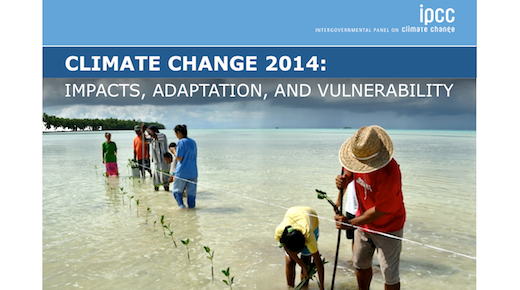
WGII Report, Chapter 6 covers Ocean Systems. There we find more nuance and objectivity:
“Few field observations conducted in the last decade demonstrate biotic responses attributable to anthropogenic ocean acidification” pg 4
“Due to contradictory observations there is currently uncertainty about the future trends of major upwelling systems and how their drivers (enhanced productivity, acidification, and hypoxia) will shape ecosystem characteristics (low confidence).” Pg 5
“Both acclimatization and adaptation will shift sensitivity thresholds but the capacity and limits of species to acclimatize or adapt remain largely unknown” Pg 23
“Production, growth, and recruitment of most but not all non-calcifying
seaweeds also increased at CO2 levels from 700 to 900 µatm Pg 25
“Contributions of anthropogenic ocean acidification to climate-induced alterations in the field have rarely been established and are limited to observations in individual species” Pg. 27
“To date, very few ecosystem-level changes in the field have been attributed to anthropogenic or local ocean acidification.” Pg 39
Ocean Chemistry on the Record
Contrast the IPCC headlines with the the Senate Testimony of John T. Everett, in which he said:
“There is no reliable observational evidence of negative trends that can be traced definitively to lowered pH of the water. . . Papers that herald findings that show negative impacts need to be dismissed if they used acids rather than CO2 to reduce alkalinity, if they simulated CO2 values beyond triple those of today, while not reporting results at concentrations of half, present, double and triple, or as pointed out in several studies, they did not investigate adaptations over many generations.”
“In the oceans, major climate warming and cooling and pH (ocean pH about 8.1) changes are a fact of life, whether it is over a few years as in an El Niño, over decades as in the Pacific Decadal Oscillation or the North Atlantic Oscillation, or over a few hours as a burst of upwelling (pH about 7.59-7.8) appears or a storm brings acidic rainwater (pH about 4-6) into an estuary.”
http://www.epw.senate.gov/public/index.cfm?FuseAction=Files.View&FileStore_id=db302137-13f6-40cc-8968-3c9aac133b16
Conclusion
Many know of the Latin phrase “caveat emptor,” meaning “Let the buyer beware”.
When it comes to climate science, remember also “caveat lector”–”Let the reader beware”.
via Science Matters
June 3, 2024 at 03:12PM

Article: ‘Since observational measurements started, blocking in the Arctic has increased, as has Arctic warming.’ When researchers investigated ‘they found a stunning correlation’. No mention of greenhouse gases in the study.
– – –
A team of scientists led by François Lapointe, a research associate at the University of Massachusetts Amherst, has combined paleoclimatic data from the last 2,000 years with powerful computer modeling and in-the-field research on lake sediments and tree rings to show that an understudied phenomenon, known as atmospheric blocking, has long influenced temperature swings in the Arctic.
As temperatures warm due to climate change, claims EurekAlert, atmospheric blocking will help drive ever-wilder weather events. [Talkshop comment – routine alarmist hype].
The study focused on the Norwegian Arctic archipelago, Svalbard, at the edge of the Arctic Ocean, and was published in Nature Communications.
It is well known that the Arctic is warming faster than the global average, a phenomenon known as Arctic Amplification. But, since 1991, Svalbard has experienced a warming trend that is double the Arctic-wide rise in temperature.
Consequently, the archipelago has been experiencing massive loss of ice, extreme rainfall events and landslides. “We wanted to know why Svalbard has been warming so much faster than the rest of the Arctic,” says Raymond Bradley, Distinguished Professor at UMass Amherst and co-author of the study, “and to figure out whether or not these trends would continue.”
To do so, they turned to lake sediments from Lake Linné, on the west coast of Svalbard, to help them reconstruct warm and wet conditions during the past 2,000 years.
What makes this lake unique is the presence of instruments that have been deployed since 2012 by UMass Amherst alumnus and co-author, Michael Retelle, currently professor of earth and climate sciences at Bates College. These instruments track the precise timing of sediment entering the lake each year. Sediment pours into the lake during the increasingly frequent freak rainstorms.
Lapointe and his team looked at the calcium levels in Lake Linné’s sediments. Because much of the eastern terrain surrounding the lake is composed of carbonate-rich soil, intense rain events mean that carbonate washes into the lake, settles into the sediment on the lake bottom, and can be measured in sediment cores as a record of rainfall stretching back approximately 2,000 years.
When Lapointe and his colleagues compared all these historic and contemporary observations to the meteorological record, they found a stunning correlation.
“The biggest rain and warming events of the past are all linked to atmospheric blocking over Scandinavia and the Ural Mountains. Atmospheric blocking is when a high-pressure system, with air rotating clockwise around it, stalls over a particular region—in this case northern Scandinavia. In tandem with this high-pressure system, rain events in Svalbard are also often associated with a low-pressure system that settles in over Greenland, which rotates counter-clockwise,” Lapointe says.
The two systems spin like a pair of intermeshed gears, drawing warmer, moister air up from the mid-Atlantic Ocean into the Arctic, leading to downpours of rain in Svalbard. Since observational measurements started, blocking in the Arctic has increased, as has Arctic warming.
Full article here.
– – –
Image: Svalbard map [credit: theoceanadventure.com]
via Tallbloke’s Talkshop
June 3, 2024 at 01:06PM
By Paul Homewood
Roger Pielke Jr has long challenged the fraudulent “billion dollar” disaster disinformation campaign.
Now he has gone one step further with this peer reviewed paper:

For more than two decades, the U.S. National Oceanic and Atmospheric Administration (NOAA) has published a count of weather-related disasters in the United States that it estimates have exceeded one billion dollars (inflation adjusted) in each calendar year starting in 1980. The dataset is widely cited and applied in research, assessment and invoked to justify policy in federal agencies, Congress and by the U.S. President. This paper performs an evaluation of the dataset under criteria of procedure and substance defined under NOAA’s Information Quality and Scientific Integrity policies. The evaluation finds that the “billion dollar disaster” dataset falls short of meeting these criteria. Thus, public claims promoted by NOAA associated with the dataset and its significance are flawed and at times misleading. Specifically, NOAA incorrectly claims that for some types of extreme weather, the dataset demonstrates detection and attribution of changes on climate timescales. Similarly flawed are NOAA’s claims that increasing annual counts of billion dollar disasters are in part a consequence of human caused climate change. NOAA’s claims to have achieved detection and attribution are not supported by any scientific analysis that it has performed. Given the importance and influence of the dataset in science and policy, NOAA should act quickly to address this scientific integrity shortfall.
https://www.nature.com/articles/s44304-024-00011-0
Roger has also written an explanatory post here.
via NOT A LOT OF PEOPLE KNOW THAT
June 3, 2024 at 12:09PM
 Iowa Climate Science Education