Month: June 2024

Book Review: Quantised Accelerations by Mike McCulloch

A week ago, I came across this meme on the internet.

The history of physics.
Aristotle said a bunch of stuff that was wrong. Galileo and Newton fixed things up. Then Einstein broke everything again. Now, we’ve basically got it all worked out, except for small stuff, big stuff, hot stuff, cold stuff, fast stuff, heavy stuff, dark stuff, turbulence, and the concept of time.

Then Dr Mike McCulloch sent me a copy of his new book ‘Quantised Accelerations’ to review, and having read it, the meme needs important updates. This paradigm busting book has been seven years in the pipeline, and it really does deliver a reformulation and reinvigoration of physics as a whole, not just one specialised corner. Correcting Newtonian dynamics and superceding general relativity is a big deal!

Dr McCulloch’s Quantised Inertia theory demonstrates that the stars we thought were going round the edge of galaxies faster than they should be, aren’t, and the dark matter which we thought was needed to keep them gravitationally bound, isn’t. It turns out that very slowly accelerating stars have less inertia, which means the visible matter in galaxies is sufficient to keep them bound at the velocity they’re observed to be moving. In the QI theory, inertia isn’t an attribute intrinsic to objects, as Newton thought. Instead, it’s due to the interaction of the objects acceleration rate, Unruh radiation moving at the speed of light and the differential in the distances to the horizons fore and aft of the accelerating object.

Newton’s Force = Mass x Acceleration, F=ma gets a tiny modification which has no effect at terrestrial accelerations, but affects the inertial mass of the many very slowly accelerating objects out there in the universe we’ve only recently become able to measure accurately. The principle QI equation looks like this:

ħ is the reduced Planck constant, c is the speed of light, lP is the Planck length and Θ is the diameter of the observable universe.

Notice that this equation contains no ‘tuned variable’. It is what it is. It gets one chance to get whatever it’s trying to do right, and it does.

The same elegantly simple equation can also be applied to predict the motion of wide binary pairs, star clusters, oddities such as Hoag’s object, and crucially, the Alpha Centauri system, which is well observed, nearby, and reachable within a couple of decades using one of QI’s amazing practical applications; propellantless thrust. More on that later, but since Dr Mike has also applied his QI principles to derive the gravitational constant from the same universal attributes, we should summarize where we’ve got so far:

By dealing with anomalously fast stuff (stars), we’ve got rid of the unpleasantly unobservable dark stuff (DM), while eliminating the constant for heavy stuff (G), by relating the fastest stuff (c) to the biggest stuff (Universal diameter). Alongside this principle theme, in the book, Mike McCulloch outlines around 50 other anomalous problems our current physics can’t solve. While showing how his QI theory predicts many of them, he covers small stuff, such as nanometre scale cavities which could theoretically form self thrusting surfaces or ‘floating bricks’. Cold stuff, the possibility of fusion occurring without the need for huge tokamaks, but at the 25,900K temperature QI predicts the 28nm crack in a palladium bar to reach while fusing deuterons. Hot stuff!

On the subject of big cold stuff and turbulence or resonance, QI predicts the maximum wavelength of the Unruh radiation in the early universe, and Dr Mike attempts to relate subharmonics of that wavelength (λn = λ0, λ0/2, λ0/3, λ0/4…) to the peaks in the Cosmic Microwave Background. This isn’t very successful, but I think our research into resonant ratios in planetary systems here at Tallbloke’s Talkshop can help.

QI theory successfully predicts the magnitude of the anomalous thrust observed in capacitors from fundamental theory. This ‘Biefield-Brown’ effect has been observed since the 1920s although no-one knew why it occurred, and it has now been extensively tested in multiple laboratories around the world. The empirical measurements have been collected and collated by Dr Mike in a submitted paper which shows that the results agree well with QI theoretical predictions. He dubs his own version the ‘Horizon drive’. Sadly, a space test attempted last year failed when the cubesat carrying the experiment lost power before the thruster could be tested, but the companies involved plan to try again soon.

A full chapter of ‘Quantised Accelerations’ is devoted to the design and spaceflight plan for a space-probe using stacked QI Horizon drives to reach Proxima Centauri in a calculated flight time of 15 years. Not bad, considering current technology would take 50,000 years to get there. Thrust developed by the 1.7W power input would be 6N. It doesn’t sound much, but since the craft needs no heavy propellant, it’s enough to accelerate to a velocity of half-lightspeed over the course of a few years.

Throughout ‘Quantised Accelerations’, Mike McCulloch emphasises the value of sticking to the empirical scientific method, such as Ernst Mach’s insistence on the measurability of quantities. QI is compatible with special relativity, but general relativity is made obsolete. In any case, QI successfully predicts the bending of light passing stars with simple algebra and without the need for tensor calculus or non-observable bent space. The reason QI calculations can be so elegantly simple and self contained, is that it treats motion as relative to the objects directly involved, and doesn’t need a tuneable external field variable as it’s nearest competitor theory MoND does.

The final item on our meme’s bucket list of unsolved physics problems is the concept of time. In his introduction to QI in chapter 6.1, Dr Mike adopts a proto-Cartesian process to understand the building blocks of the cosmos from first principles, ‘I blink, therefore I am’. At the quantum level, in the simplest possible systems, time can only be counted by the occurrence of discrete events. When nothing happens, time is ‘skipped’. Time is an emergent phenomenon, which only becomes a more regular metric as the population of perceiving entities increases.

I certainly hope the number of perceiving entities deciding to be curious about this groundbreaking new physics increases, because following a period of navel gazing stagnation in a physics enmeshed in its own computer aided complexity, we need fresh ideas. Mike McCulloch is asking for help to discover and develop the lifetimes worth of novel and applicable results that can flow from QI.

Quantised Accelerations can be pre-ordered here for July 15th delivery.

via Tallbloke’s Talkshop

https://ift.tt/2NaVjAz

June 25, 2024 at 10:47AM

2024 Update: Fossil Fuels ≠ Global Warming

gas in hands

Previous posts addressed the claim that fossil fuels are driving global warming. This post updates that analysis with the latest (2023) numbers from Energy Institute and compares World Fossil Fuel Consumption (WFFC) with three estimates of Global Mean Temperature (GMT). More on both these variables below. Note: Previously these same statistics were hosted by BP.

WFFC

2023 statistics are now available from Energy Institute for international consumption of Primary Energy sources. Statistical Review of World Energy. 

The reporting categories are:
Oil
Natural Gas
Coal
Nuclear
Hydro
Renewables (other than hydro)

Note:  Energy Institute began last year to use Exajoules to replace MToe (Million Tonnes of oil equivalents.) It is logical to use an energy metric which is independent of the fuel source. OTOH renewable advocates have no doubt pressured EI to stop using oil as the baseline since their dream is a world without fossil fuel energy.

From BP conversion table 1 exajoule (EJ) = 1 quintillion joules (1 x 10^18). Oil products vary from 41.6 to 49.4 tonnes per gigajoule (10^9 joules).  Comparing this annual report with previous years shows that global Primary Energy (PE) in MToe is roughly 24 times the same amount in Exajoules.  The conversion factor at the macro level varies from year to year depending on the fuel mix. The graphs below use the new metric.

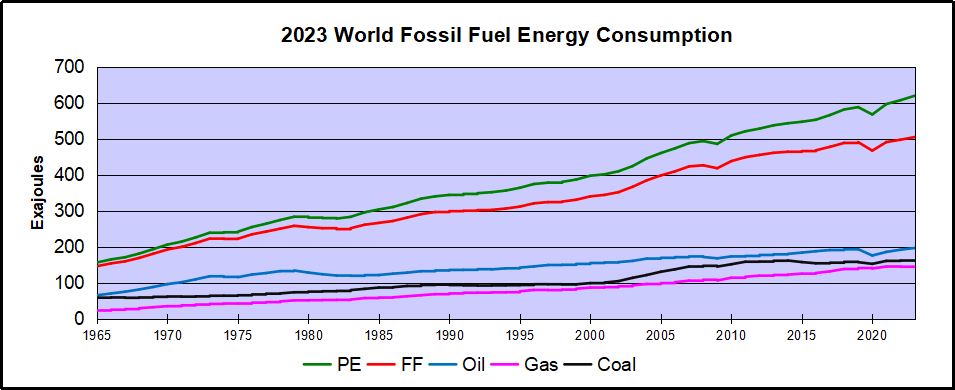
This analysis combines the first three, Oil, Gas, and Coal for total fossil fuel consumption world wide (WFFC).  The chart below shows the patterns for WFFC compared to world consumption of Primary Energy from 1965 through 2023.

The graph shows that global Primary Energy (PE) consumption from all sources has grown continuously over nearly 6 decades. Since 1965  oil, gas and coal (FF, sometimes termed “Thermal”) averaged 88% of PE consumed, ranging from 93% in 1965 to 82% in 2023.  Note that in 2020, PE dropped 21 EJ (4%) below 2019 consumption, then increased 31 EJ in 2021.  WFFC for 2020 dropped 24 EJ (5%), then in 2021 gained back 26 EJ to slightly exceed 2019 WFFC consumption. For the 59 year period, all net changes were increases from previous years and were:

Oil 203%
Gas 536%
Coal 182%
WFFC 246%
PE 297%
Global Mean Temperatures

Everyone acknowledges that GMT is a fiction since temperature is an intrinsic property of objects, and varies dramatically over time and over the surface of the earth. No place on earth determines “average” temperature for the globe. Yet for the purpose of detecting change in temperature, major climate data sets estimate GMT and report anomalies from it.

UAH record consists of satellite era global temperature estimates for the lower troposphere, a layer of air from 0 to 4km above the surface. HadSST estimates sea surface temperatures from oceans covering 71% of the planet. HadCRUT combines HadSST estimates with records from land stations whose elevations range up to 6km above sea level.

Both GISS LOTI (land and ocean) and HadCRUT4 (land and ocean) use 14.0 Celsius as the climate normal, so I will add that number back into the anomalies. This is done not claiming any validity other than to achieve a reasonable measure of magnitude regarding the observed fluctuations.[Note: HadCRUT4 was discontinued after 2021 in favor of HadCRUT5.]

No doubt global sea surface temperatures are typically higher than 14C, more like 17 or 18C, and of course warmer in the tropics and colder at higher latitudes. Likewise, the lapse rate in the atmosphere means that air temperatures both from satellites and elevated land stations will range colder than 14C. Still, that climate normal is a generally accepted indicator of GMT.

Correlations of GMT and WFFC

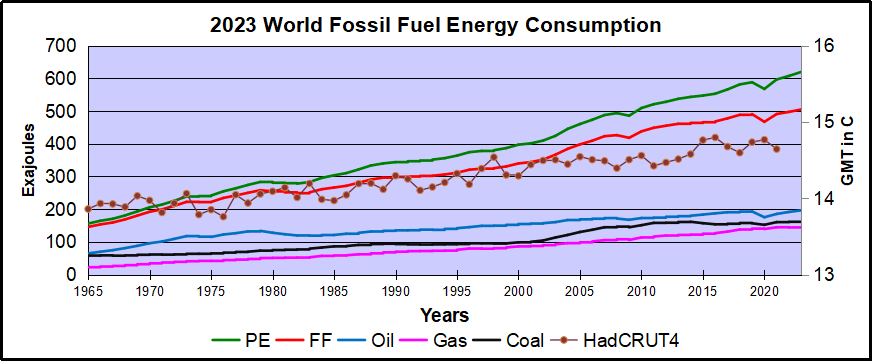
The next graph compares WFFC to GMT estimates over the decades from 1965 to 2023 from HadCRUT4, which includes HadSST4.

Since 1965 the increase in fossil fuel consumption is dramatic and monotonic, steadily increasing by 239% from 146 to 494 exajoules.  Meanwhile the GMT record from Hadcrut shows multiple ups and downs with an accumulated rise of 0.8C over 56 years, 6% of the starting value.

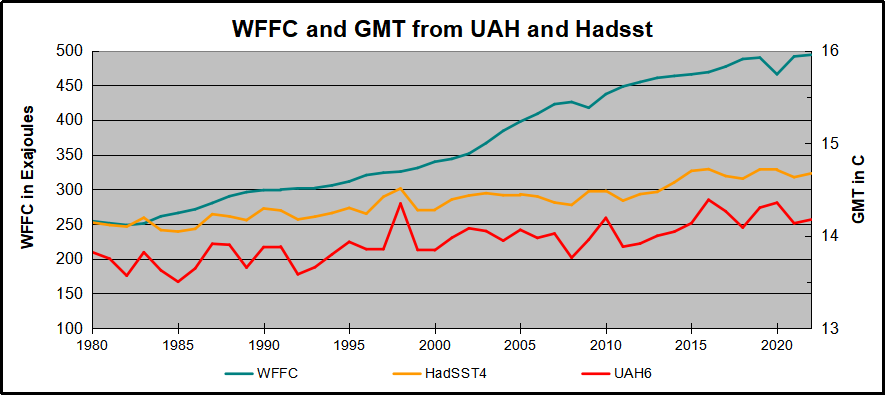
The graph below compares WFFC to GMT estimates from UAH6, and HadSST4 for the satellite era from 1980 to 2022, a period of 43 years.

In the satellite era WFFC has increased at a compounded rate of 1.5% per year, for a total increase of 97% since 1979. At the same time, SST warming amounted to 0.76C, or 5% of the starting value.  UAH warming was 0.85C, or 6% up from 1979.  The temperature compounded rate of change is 0.1% per year, an order of magnitude less than WFFC.  Even more obvious is the 1998 El Nino peak and flat GMT since.

Summary

The climate alarmist/activist claim is straight forward: Burning fossil fuels makes measured temperatures warmer. The Paris Accord further asserts that by reducing human use of fossil fuels, further warming can be prevented.  Those claims do not bear up under scrutiny.

It is enough for simple minds to see that two time series are both rising and to think that one must be causing the other. But both scientific and legal methods assert causation only when the two variables are both strongly and consistently aligned. The above shows a weak and inconsistent linkage between WFFC and GMT.

Going further back in history shows even weaker correlation between fossil fuels consumption and global temperature estimates:

wfc-vs-sat

Figure 5.1. Comparative dynamics of the World Fuel Consumption (WFC) and Global Surface Air Temperature Anomaly (ΔT), 1861-2000. The thin dashed line represents annual ΔT, the bold line—its 13-year smoothing, and the line constructed from rectangles—WFC (in millions of tons of nominal fuel) (Klyashtorin and Lyubushin, 2003). Source: Frolov et al. 2009

In legal terms, as long as there is another equally or more likely explanation for the set of facts, the claimed causation is unproven. The more likely explanation is that global temperatures vary due to oceanic and solar cycles. The proof is clearly and thoroughly set forward in the post Quantifying Natural Climate Change.

Footnote: CO2 Concentrations Compared to WFFC

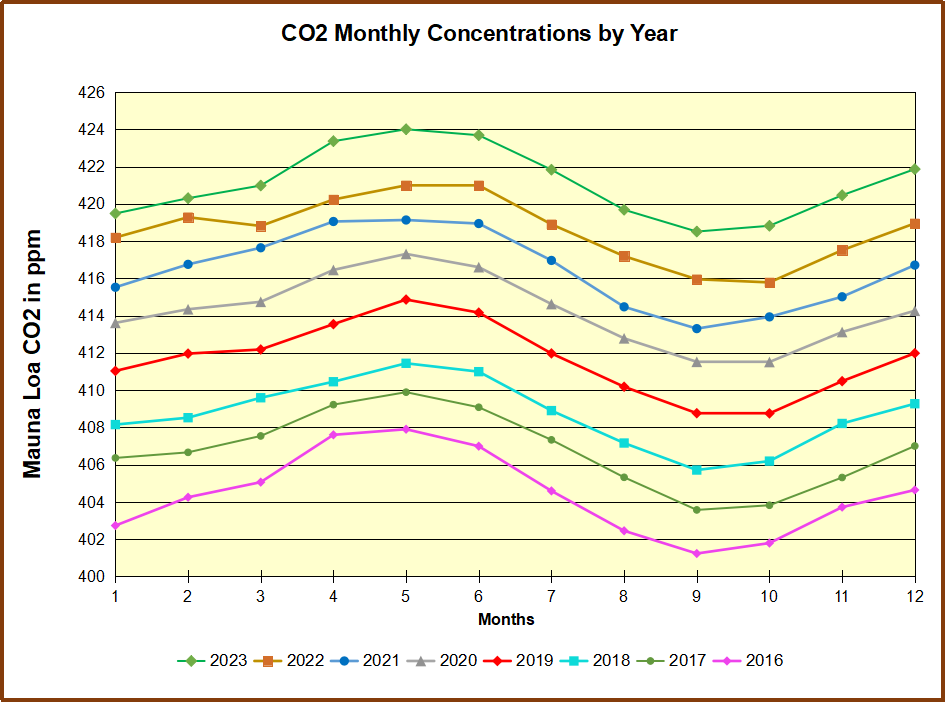
Contrary to claims that rising atmospheric CO2 consists of fossil fuel emissions, consider the Mauna Loa CO2 observations in recent years.


Despite the drop in 2020 WFFC, atmospheric CO2 continued to rise steadily, demonstrating that natural sources and sinks drive the amount of CO2 in the air.

See also: Nature Erases Pulses of Human CO2 Emissions

Temps Cause CO2 Changes, Not the Reverse

via Science Matters

https://ift.tt/ViAcJZW

June 25, 2024 at 10:41AM

Wednesday

4 out of 10 based on 1 rating

via JoNova

https://ift.tt/OJBrQuX

June 25, 2024 at 10:13AM

Watch Craig Rucker report on climate from Vienna

Talking climate reality on the Steve Gruber Show.

via CFACT

https://ift.tt/iaV4vf2

June 25, 2024 at 10:13AM