Month: June 2024

Marine cloud brightening models show unexpected consequences of geoengineering


Unexpected as in undesirable. Another so-called climate solution gets a big question mark. Playing Russian roulette with a complex system that’s not well understood can only ever be a recipe for trouble somewhere, whether potential or actual.

A combined team of Earth scientists and climate specialists at the University of California San Diego and the National Center for Atmospheric Research has found via modeling that geoengineering projects such as marine cloud brightening can have unexpected and sometimes harmful consequences, says Phys.org.

In their study, published in the journal Nature Climate Change, the group designed models to predict what might happen if large-scale marine cloud brightening projects were undertaken in two major regions in the western United States.

Prior research has shown that unless greenhouse gas emissions are reduced and a way is found to reduce the amount of greenhouse gasses already in the atmosphere, dramatic climate changes will result. [Talkshop comment – other research shows nothing of the sort].

In recent years, scientists have found it unlikely that such goals will be met and have been looking for other solutions.

One proposed solution is geoengineering to reduce the amount of heat that makes its way into the atmosphere. One such approach is called marine cloud brightening (MCB), which involves injecting massive amounts of sea salt into the lower atmosphere to serve as tiny mirrors, bouncing heat and light from the sun back out into space.

For this new study, the researchers investigated how this might work for one part of the world and to model the potential impacts.

The work involved configuring established climate models to show what would happen if artificial stratocumulus clouds were created under two different scenarios, both over the North Pacific: one over the temperate latitudes and the other over sub-tropical waters. Under both scenarios, the artificial clouds were generated and maintained for nine months every year for 30 years.

The researchers found that the artificial clouds would reduce temperatures in the western U.S., primarily California—reducing risk of dangerously high temperatures by as much as 55%. But they also found the same clouds would reduce rainfall amounts, both in the U.S. and other parts of the world.

Full article here.
– – –
Image: Game of chance [credit: Wikipedia]

via Tallbloke’s Talkshop

https://ift.tt/ThzRbsM

June 25, 2024 at 08:53AM

EP 444: Hunting, Shooting Sports Approval Decreases + Nuclear Energy

In Episode 444 of District of Conservation, Gabriella discusses a new CAHSS/Responsive Management study showing a slight decline of approval for hunting and shooting sports and why nuclear energy must be catalyzed. Tune in to learn more! SHOW NOTES Americans’ Attitudes Toward Hunting and Sport Shooting Report Identifies Decline America Needs to Supercharge Nuclear Energy […]

via CFACT

https://ift.tt/l4UP9Ty

June 25, 2024 at 08:12AM

New York’s Energy Transition Guru Responds To Basic Questions

From the MANHATTAN CONTRARIAN

Francis Menton

The people pushing the “energy transition” in New York and elsewhere claim a foundation in science, but proceed with religious fervor. A key element of the playbook is never to engage with people asking legitimate questions, who are generally dismissed out of hand as “deniers.” But every so often one of the team will break the code of silence, thus giving us some insight into the thought process behind the campaign to transform our energy supply.

In New York, the most important academic guru behind the Climate Act and energy transition is a Cornell professor named Robert Howarth. Howarth is a professor of Ecology and Environmental Biology. Based on that background, he would seem to have nothing to offer on the subject of the engineering of an electrical grid. But Howarth has a burning desire to save the planet, and he has read some work by trendy Stanford professor Mark Jacobson, and has become convinced that putting together a zero-carbon electricity grid is no problem. Despite his total lack of relevant expertise in grid engineering, he has somehow gotten the ear of the New York State legislature and bureaucracies on that subject.

Meanwhile, another guy named Richard Ellenbogen has become a principal gadfly annoying the people like Howarth who are pushing the transition. Ellenbogen has a BA and a degree in electrical engineering, both from Cornell, and runs a manufacturing company in Westchester County that has made some fairly extraordinary efforts to use renewable energy. Unlike Howarth, Ellenbogen actually knows what he is talking about on issue of the engineering of the electrical grid. Ellenbogen has also taken on challenging the New York energy transition mandates as something of a personal passion. He submits formal comments on regulatory dockets every chance he gets, and also tries to engage those pushing the transition in rational discussion. Among those he has tried to engage is Howarth.

A couple of days ago Ellenbogen forwarded to an email list that includes me an exchange that he had just had with Howarth and some of Howarth’s Cornell colleagues. Ellenbogen had basically posed some fundamental questions about how this is all supposed to work. I thought readers might find the responses of Howarth and his acolyte entertaining.

From a June 20 email from Ellenbogen to Howarth:

[T]he facts on the ground are saying that there is a major problem with this process and it is only going to get worse as the utility rates rise and NY residents rebel as the residents of Ontario Canada did, as the residents of the EU are currently doing, and as the downstate NY residents are starting to do. . . . In  a college science project where supply chains, funding, labor, land, the state of technology, and public opinion are not issues that have to be considered, the CLCPA will work.  However, in the real world those are issues and they are going to sink the CLCPA. . . .  

Here is the heart of Howarth’s response, also dated June 20:

I am always very happy to engage with anyone who comes to a discussion with an open mind, and who is truly interested in objective information. Your insulting insinuations, though, hardly invite further discussion. I am not likely to write to you again or further respond. But if you truly are interested in the topic, I suggest you read Mark Jacobson’s excellent books, the 2020 “100% Clean, Renewable Energy and Storage for Everything” and the 2023 “No Miracles Needed.”

So it looks like that is as much of a response as Howarth will ever give. However, Ellenbogen had also sent a copy of his email (and a prior one) to one Bethany Ojalehto Mays, of something called “Cornell on Fire,” which appears to be some kind of consortium of Cornell-associated climate activist groups who take inspiration from Howarth (although Howarth is not formally a part of them). Ms. Mays provided a much longer response. Here are some key excerpts (from two different Mays emails, one of June 18 and the other of June 20):

  • I suspect we can all agree that (1) no one can afford the costs of irreversible climate breakdown; (2) any costs to current stakeholders must be weighed against costs to future generations of life; (3) there is a real and urgent need to change our lifestyles and “business as usual”; and (4) the climate crisis is such that there is “no nonradical future” . . . .
  • Another set of questions concerns a resiliency analysis, which must not only account for the fact that the grid will struggle to provide peak power during 3 consecutive 90-degree days in Downstate NY (as you point out), but also that our past, present, and future assumptions about unlimited access to energy and peak power supply have created those increasingly frequent and excessive heat waves. Will we respond to present heat waves in a way that only guarantees more cruel heat waves for future beings? Given the challenges you lay out so clearly, Cornell on Fire has emphasized the need to reduce energy use: why is the grid unquestioningly delivering luxury consumption and approving constant expansion, for instance, rather than ensuring that we have clean energy to meet basic needs first . . . .
  • Many of these problems come down to a reassessment of business-as-usual: For instance, you point out that electrification of all homes and personal vehicles will strain the grid. So why are we still relying on the personal vehicle model of business-as-usual? Why not take this moment to shift en masse to public transit and dramatically curb the use of personal vehicles? Why not convert existing housing to multi-family housing that makes much better use of existing resources and doesn’t waste energy heating/cooling thousands of square feet per (rich) person?
  • As you point out, delivering existing demand would entail formidable technical challenges, like “a solar [array] that would have to be at least 20 times the size of our roof.” To us, this suggests that current demand is unsustainable. Why aren’t we asking the more fundamental question: how can our society radically simplify and reduce energy demand, in order to have a hope of transitioning to renewables in time?
  • “A vast majority of the residents of NY State are just trying to get by and pay their day to day bills.” We think that this points to fundamental problems with our capitalist system. We also note that the carbon footprint of the most affluent sectors of society is enormous, and could be dramatically reduced without risking those who are living day to day.

And then, of course, there is this post-script at the end of Ms. Mays’s email:

Ithaca and Cornell lie on the traditional and contemporary homelands of the Gayogo̱hó꞉nǫ’ People (the Cayuga Nation). Land acknowledgements are only the first step toward reparations, restorative justice, and recognition.

Bottom line: other than a direction to go read Jacobson’s (discredited) work, there is no particular concern about whether the grid will or will not work after the elimination of fossil fuels. Instead, the main idea is to punish the people for their sins of luxury and overuse of energy. Somehow I don’t think that many New Yorkers understood that this is what they were voting for.

via Watts Up With That?

https://ift.tt/PyU5r73

June 25, 2024 at 08:04AM

Wildfires Getting Worse, Even When They’re Not!

By Paul Homewood


When the facts do not support the theory, ignore the facts!

.

 image

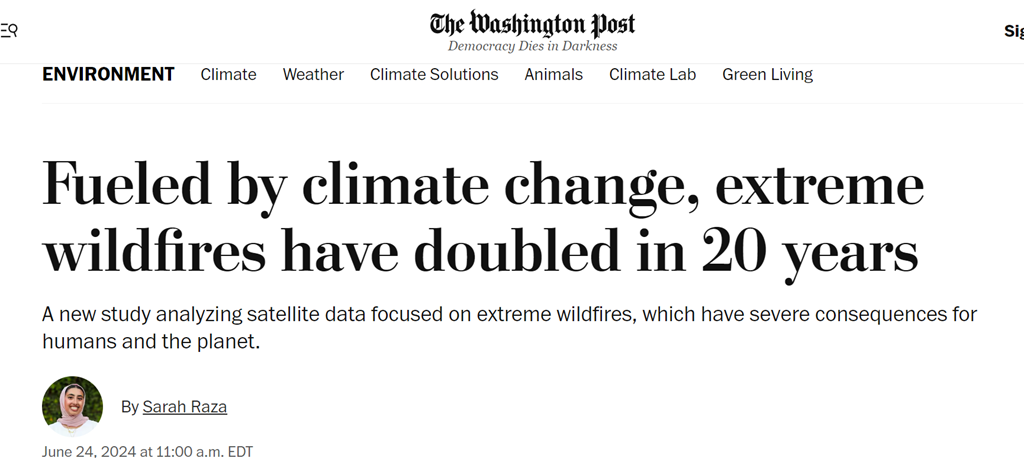
The frequency and magnitude of extreme wildfires around the globe has doubled in the past two decades due to climate change, according to a study released Monday.

The analysis, published in the journal “Nature Ecology & Evolution,” focused on massive blazes that release vast amounts of energy from the volume of organic matter burned. Researchers pointed to the historic Australia fires of 2019 and 2020 as an example of blazes that were “unprecedented in their scale and intensity.” The six most extreme fire years have occurred since 2017, the study found.

“It’s absolutely in keeping with what climate change is doing to fire weather around the world,” said lead author Calum Cunningham, a postdoctoral research fellow at the University of Tasmania in Australia. “Climate change is making fire weather more extreme and more frequent in a lot of the world.”

Though previous research found a decrease in the area burned globally by wildfires this century, the new study found that extreme wildfire events have increased 2.2-fold since 2003. Extreme wildfires have severe ecological and societal impacts, leading to deaths and biomass loss while emitting high levels of carbon. According to the study, burn severity, which is a measure of these impacts, has increased in more regions than it has decreased.

Cunningham said the research began as a response to climate skeptics who challenged whether there is a growing fire crisis if area burned globally is in decline. Despite the uptick in media coverage surrounding wildfires, he said there was not yet scientific literature to demonstrate that extreme events are changing.

“We’ve had this paradox where the amount of burning on Earth is declining … and yet we are having fires that are more extreme, more damaging,” said Stephen Pyne, fire historian and emeritus professor at Arizona State University. “How do we reconcile these two?”

Cunningham and his team analyzed data from orbiting NASA satellites, which collected four fire measurements per day over 21 years. The results astounded him.

“I was expecting to see increases, but the rate of the increases surprised and alarmed me because we’re only looking at quite a short period of time,” he said.

John Abatzoglou, a fire researcher at the University of California at Merced, said the focus on extreme fires is critical because they tend to supersede local fire mitigation efforts.

“When we have these hot, highly energetic fires, those are the sort of fires that are very difficult for fire suppression to have the ability to control and stop,” he said.

According to the study, as nighttime temperatures increase, wildfire intensity now continues to stay strong through overnight hours. This poses a problem for firefighters who rely on that window for a break in the blaze, retired firefighter and author Bobbie Scopa said.

“This kind of confirms what we’ve been observing, that the fire intensity is not dying down at night like we used to depend on,” said Scopa, who began firefighting in 1974.

“Rarely did we have 100,000-acre fires 20 years ago,” she added. “But now, it’s not uncommon.”

Extreme wildfires have disproportionately increased in certain regions: North America, Australia, Oceania and the Mediterranean. Researchers especially saw wildfires increase in conifer and boreal forests, which are primarily in North America and Russia. In temperate conifer forests, extreme wildfires have increased 11-fold, accompanied by a sevenfold increase in boreal forests.

“Climate change is not something off in the future,” Cunningham said. “It’s happening before our very eyes. This is the manifestation of the reshaping of the climate we are doing.”

https://www.washingtonpost.com/climate-environment/2024/06/24/extreme-wildfires-increased-study/

When anybody claims they can detect a climate change signal over just 20 years, they can usually be dismissed as working to an agenda.

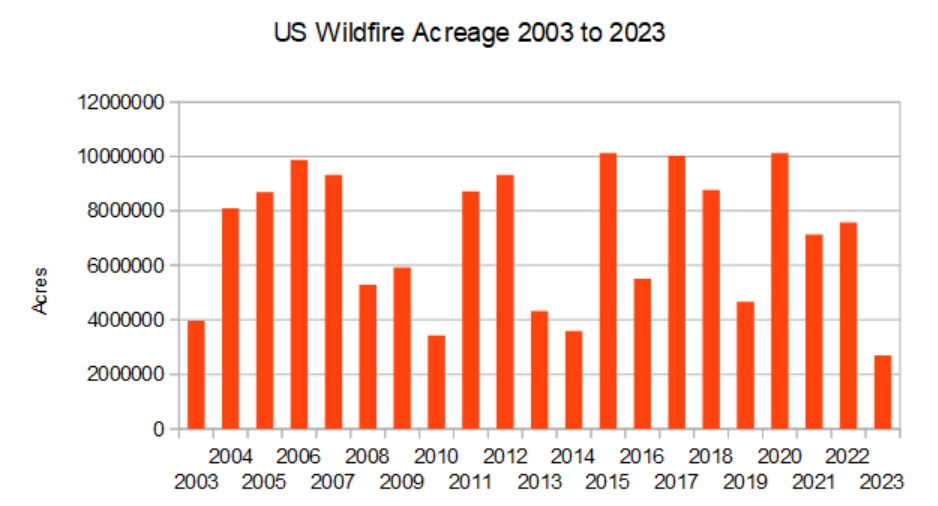
But let’s check out how their theory compares to the actual data in the US, which they claim is disproportionately affected. Straightaway we see that wildfire acreage has not increased since 2003, which would be the logical conclusion of their theory:

image

https://www.nifc.gov/fire-information/statistics/wildfires

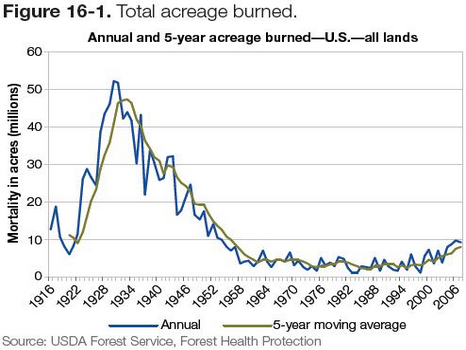
Secondly the study fails to recognise the fact that US wildfires used to burn far greater areas prior to the beginning of systematic fire suppression after the Second World War:


image

 https://web.archive.org/web/20140913135647/http://www.fs.fed.us:80/research/sustain/criteria-indicators/indicators/indicator-316.php

Forestry experts are clear that this suppression led to, and still leads to, a build up of undergrowth and dead wood which invariably turns normal fires into supercharged ones. Ignoring this elephant in the room and declaring that climate change is responsible for whatever trends there are is not good science.

We can also examine the official fire data for the Mediterranean region, another which is claimed to be disproportionately affected.

https://notalotofpeopleknowthat.wordpress.com/wp-content/uploads/2024/05/image-29.png

https://notalotofpeopleknowthat.wordpress.com/2024/05/08/bbc-lies-about-mediterranean-wildfires-exposed/

Again there is clearly no evidence of any increasing trend in the last two decades.

There is something wrong with a theory that is not supported by the facts.

via NOT A LOT OF PEOPLE KNOW THAT

https://ift.tt/5zYeQXH

June 25, 2024 at 06:32AM