Month: June 2024

There’s Big Money In Flight Turbulence!!

By Paul Homewood


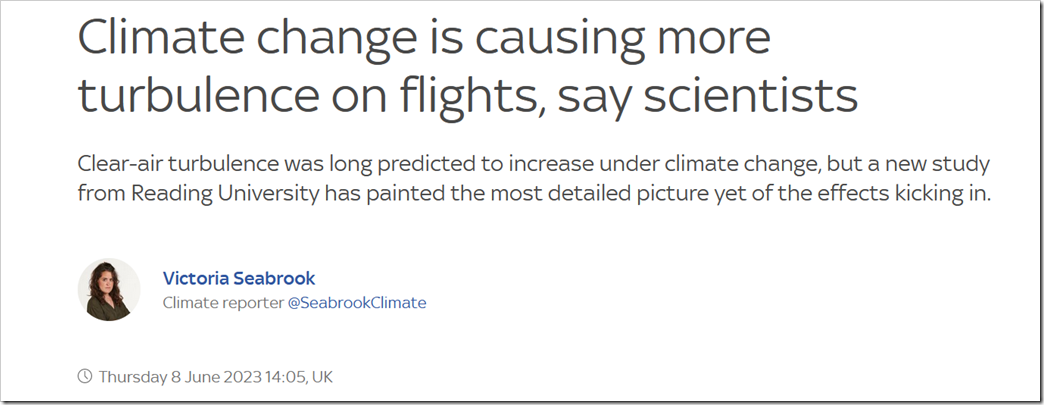
There’s big money in air turbulence!


image

https://news.sky.com/story/climate-change-is-causing-more-turbulence-on-flights-say-scientists-12898743

image

https://agupubs.onlinelibrary.wiley.com/doi/10.1029/2023GL103814

Professor Paul Williams, who has written several studies claiming that air turbulence is getting worse because of climate change, was rather put out when his work was exposed as shoddy, junk science by Paul Burgess on GB News the other week.

Burgess simply presented the actual data from the FAA, which quite clearly showed there had been no increase in flight turbulence incidents since 1989, despite what Williams’ computer models said. According to Williams, GB News should not have even invited Burgess on the show, and certainly not given viewers the actual facts. He even labelled the latter as far-right and a supporter of the BNP!

Some might say he complaineth too much!

It turns out though that there is an awful lot of grant money hanging on Williams’ theories and models, for both himself and Reading University!

Between 2009 and 2014, Reading University received £466,448 in grant funding from the Royal Society:

.

image

https://orcid.org/0000-0002-9713-9820

image

https://app.dimensions.ai/details/grant/grant.4457791

.

2014 to 2017 brought another £273K, also specifically for turbulence research:

.

image

https://app.dimensions.ai/details/grant/grant.4457632

.

And currently there’s an even bigger pot of cash from the NERC, to be shared around Williams, his cronies and Universities:

.

.image

https://app.dimensions.ai/details/grant/grant.9972312

These research grants are hugely important to universities and staff.

I wonder whether the grants would have dried up if Williams’ studies showed turbulence was not getting worse after all?

via NOT A LOT OF PEOPLE KNOW THAT

https://ift.tt/KQwmVJC

June 14, 2024 at 11:38AM

ClimateTV – Live at 1PM ET – Heatwave Alarm Season is Here – Same Old Climate Claims, Different Year

Yes, it’s that time again kids, panic the American people over heat waves by blaming them on climate change.

This past week several news outlets talked about the “Western Heat Wave” and tried to link it to “climate change.” Climate Central was the source of most of these stories with a press release that said:

“Between June 5-7, much of the Western United States, Mexico, and Eastern Canada are poised to experience a period of unusually hot conditions made much more likely because of human-caused climate change. During this period, over 229 million people across North America will experience extreme heat made at least three times more likely because of human-caused climate change.”

We see this every year, and we’ll see it again this year as the feckless media regurgitates the heatwave hype. We will tackle this subject, as well as go over the Crazy Climate News of the Week. Tune in LIVE for the stream at 1 p.m. ET (noon CT) to watch the show and leave your own questions in the chat with host Anthony Watts, along with panelists H. Sterling Burnett and Linnea Lueken.

Watch LIVE here

via Watts Up With That?

https://ift.tt/SRWPvrG

June 14, 2024 at 11:32AM

Fossil Fuels Remain The Future. VW To Invest 60 Billion Euros In Combustion Engines!

In a surprising move, Volkswagen announced it plans to invest 60 billion euros in the development of new combustion engines as confidence in electric mobility plummets in Germany and elsewhere.

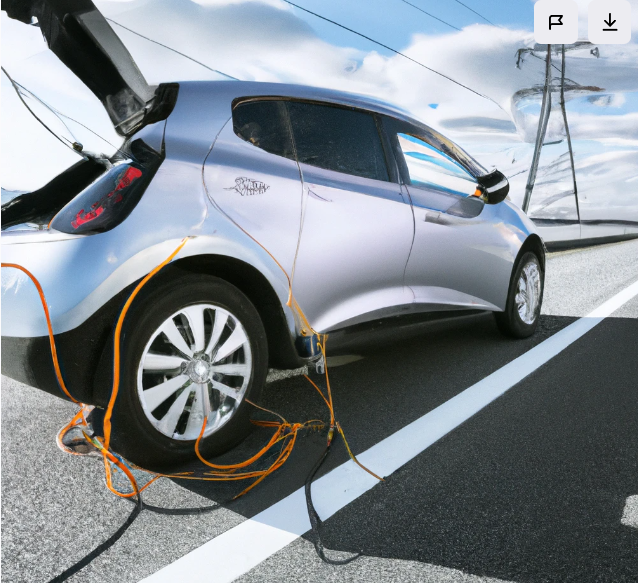
Chat GPT AI generated image

Strategy adjustment

“This change in strategy shows that the transition to electromobility is progressing more slowly than expected,” reports Germany’s Blackout News here. “Just last year, Volkswagen assumed that electric cars would account for 80 percent of annual sales in Europe by the end of the decade. However, the lukewarm reception for its own ID models is forcing the company to adjust its strategy.” Also see (motor1: 07.06.24).

As German sales of electric vehicles fall way short of government targets due to their unpopularity and high costs, manufacturers are seeing the writing on the wall: Electric mobility still has a long way to go. 

Reality check

Originally, the Wolfsburg-Germany based VW planned to invest 180 billion euros only for the next generation of electric vehicles, but now it also plans to invest 60 billion euros for internal combustion engine development. 

“The future is electric, but the past is not over yet. It is a third and it will remain a third.” Arno Antlitz, Chief Financial Officer and Chief Operating Officer of the Volkswagen Group.

Electric mobility gets postponed 

The announcement underscores the importance of internal combustion engines in the future, despite declarations from the media and governments claiming they would disappear over the next 1 or 2 decades.

Volkswagen said in 2022 it would sell only electric cars by 2033. This obviously is not not longer the case.

Other luxury VW brands like Bugatti, Lamborghini and Bentley are also focusing on continuing the combustion engine, but steering towards synthetic, alternative fuels.

Blackout News also reports, “Ford no longer believes it will be all-electric in Europe by 2030. Aston Martin has also decided to build cars with combustion engines into the next decade.”

What’s behind the sudden swing back to combustion engines and the growing aversion to electric cars?

As the recent European election results starkly show, customers are tired of being told what to buy and what rules to follow. Germany’s Green Party lost nearly half its voter base in last Sunday’s EU election. Moreover, China’s ability to produce electric cars cheaply is being increasingly viewed as a threat.

“The electric offensive from China is worrying established car manufacturers,” comments Blackout News. “Car manufacturers must react flexibly and invest in both electric and conventional technologies. This is the only way they can meet market and regulatory requirements.”


via NoTricksZone

https://ift.tt/avOMX3R

June 14, 2024 at 10:29AM

The world is using more oil, coal and gas than ever before and will use more. Net Zero is dead

By Paul Homewood


h/t Philip Bratby


.

image

A recent flurry of forecasts offers us a range of different views on what’s happening to the global demand for, and use of, crude oil. One thing seems to be clear, however: the chances of net zero carbon emissions in the near term – ie, by 2050 – are basically zero.

The year so far has been a bit of a rollercoaster ride in this realm of uncertainty, with projections and forecasts more volatile than the market itself. Crude prices have remained relatively strong despite various occurrences across Europe and the Middle East that would have resulted in major upsets in decades past.

One major point of consensus related to global oil demand growth is the expectation that it will continue to be robust, driven by a combination of factors including economic recovery, increased travel, and surging industrial activity in non-OECD nations.

The only major body not seeing continued, massive growth is the International Energy Agency (IEA), which revised its numbers this week to predict that crude demand will rise by just 1 million barrels per day (bpd) next year and will (at last!) peak “towards the end of this decade” at 106 million bpd, up from 102 million at the moment. The IEA expects this growth to be led by non-OECD countries, particularly China and India. The IEA and others have highlighted the importance of these regions in driving global oil demand.

The IEA, which is funded by 31 industrialized nations through a dues structure, says that it believes growth in demand from India, China and elsewhere will be gradually outweighed by the expected rollout of electric vehicles and other green technologies. However, one should note that the agency has been shifting for a long time from being an analytical organisation to being essentially a green campaigning one, and its forecasts nowadays are as much attempts to influence markets as to genuinely predict them.

In contrast to the IEA, the US Energy Information Administration (EIA) raised its 2024 global oil demand growth forecast to 1.1 million barrels per day, up from its previous estimate of 900,000 bpd. This revision is based on expectations for travel and tourism in the second half of the year. EIA projects even stronger demand growth for 2025 of 1.5 mbpd, again clashing with the IEA which sees just 1 mbpd that year, with non-OECD countries accounting for most of the growth. The US federal agency also raised its projection for crude prices to rise to an average of $87/barrel in Q4 2024 based on the rising demand.

Goldman Sachs has an even more optimistic view of the market, expecting global oil demand to grow by 1.25 million bpd in 2024. The bank cites robust growth in jet fuel, petrochemical-driven LPG and naphtha, and gasoline and diesel demand as key drivers of this growth. Goldman analysts expect strong demand for transportation fuels will lead oil prices to average a robust $86 across the second half of the year.

The Organization of the Petroleum Exporting Countries (OPEC) held firm to the most optimistic demand growth outlook, again refusing to amend its initial forecast for 2.25 mbpd of growth for 2024. OPEC also expects strong global oil demand growth in 2025, with a projected increase of 1.85 mbpd. The organization has noted that the OECD is expected to grow by 0.1 mbpd, while demand in the non-OECD is forecast to increase by 1.7 mbpd.

“Globally, the services sector maintains a stable momentum,” OPEC said. “It is projected to be the main contributor to the economic growth dynamic in the second half of 2024, particularly supported by travel and tourism, with a consequent positive impact on oil demand.”

https://www.telegraph.co.uk/news/2024/06/14/oil-coal-gas-demand-forecasts-net-zero-dead/

Blackmon’s comments about the IEA are spot on. They never really were an independent authority, but now all they are interested in is propaganda.

via NOT A LOT OF PEOPLE KNOW THAT

https://ift.tt/4ArlEeg

June 14, 2024 at 09:57AM