Month: June 2024

End All Energy Subsidies Now! (Ronald Reagan remembered)

“We have long discovered that nothing lasts longer than a temporary government program.” (- Ronald Reagan)

In the 1970s – fifty years ago now – The Energy Crisis jolted the U.S. economy, causing shortages and long lines at gas stations. In response, various federal energy policies and programs were passed. And as the decades passed, layer-upon-layer of new federal energy programs and regulations were added, then extended and expanded.

The energy crisis is decades past, and technology advances in oil and natural gas drilling have yielded booming supplies, allowing the U.S. to become a major oil and natural gas exporter. So maybe it is time (or past time) to “push the button” to end the dense and expensive thicket of federal energy market interventions (including subsidies and mandates for wind, solar, ethanol, electric vehicles, plus fuel economy standards).

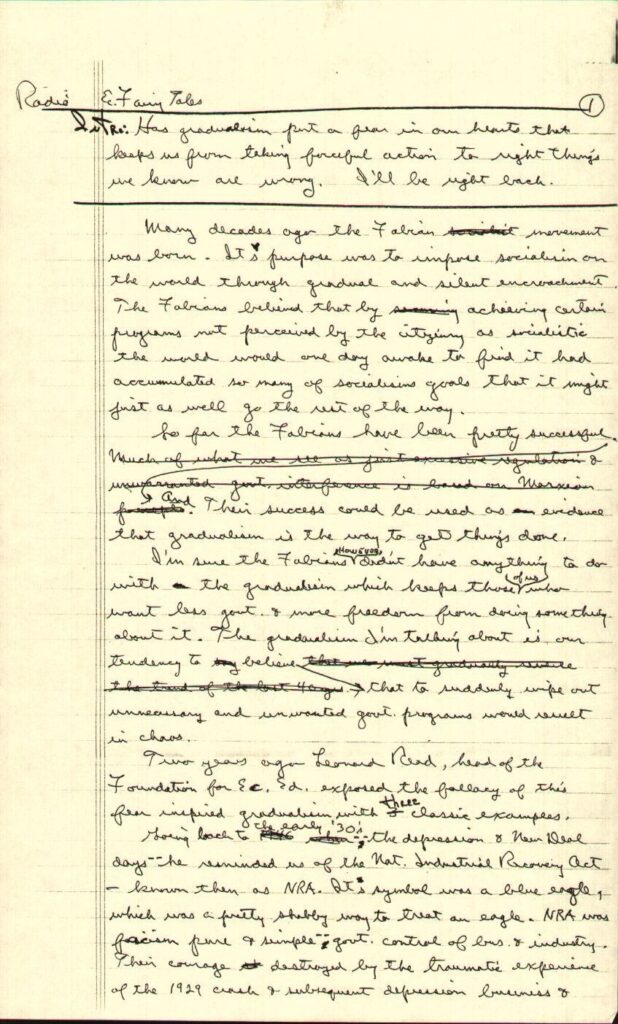
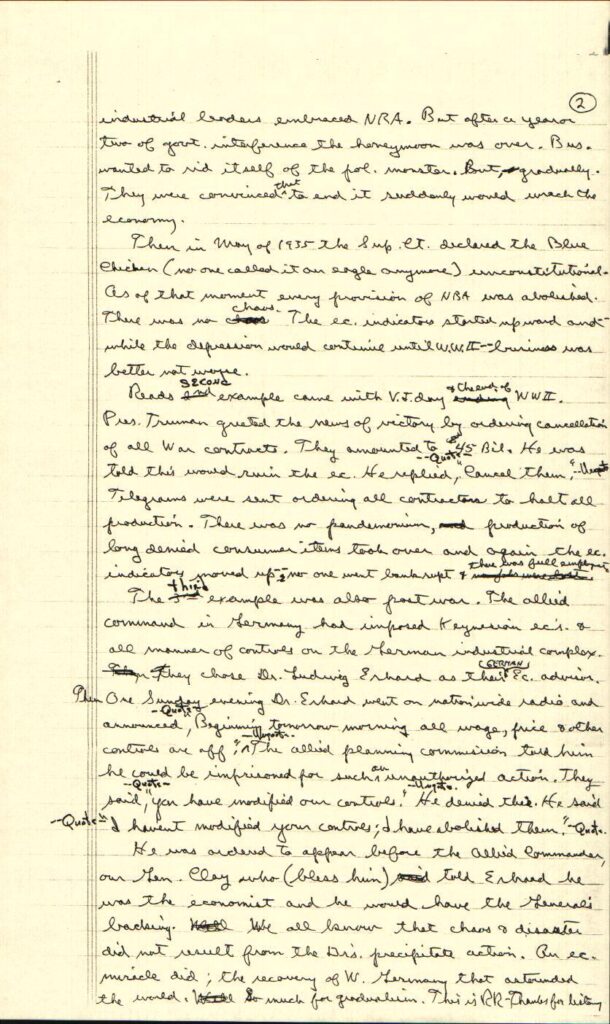
Ronald Reagan, before he ran for President, had a popular radio program featuring three-minute addresses on key public policy issues. Some of these were written by speechwriters, and others Reagan wrote himself. Below are the two pages, in Reagan’s handwriting, of Economic Fairy Tales.

Drawing from an article by Foundation for Economic Education founder Leonard Read, Reagan offered three historical example of major federal programs that were quickly abolished, against the wishes of government and business advisors.

Chaos and economic downturns were predicted if these programs were ended too quickly. But instead, economic adjustments were rapid and ending these failed programs helped and healed the economy. Click here for the audio for Economic Fairy Tales.

If alive today, Leonard Read and Ronald Reagan would advocate these same reforms for current U.S. energy policies. Push the button!

Note: See here in regard to 15 extensions of the ‘temporary’ solar Investment Tax Credit (ITC), and here in regard to 14 extensions of the ‘temporary’ wind Production Tax Credit (PTC).

————————————-
Could national high school debaters run a Ronald Reagan/Leonard Read push-the-button affirmative? We can’t undo the past but we can, debaters can, lift the dead hand of the state from today’s Constitutional republic. (Called “legislative fiat” in debate.)

Even business leaders can be fearful of dramatical policy changes proposed by “radical” reformers. If voters could push a button to sunset all federal energy policies by the end of 2024, would they? And if voters (i.e. debate judges) would, politicians could as well.

For anyone fearful of economic dislocation or natural security concerns from ending current energy policies, no problem. Congress could simply reinstate energy policies and programs deemed “critical.”

Subsidies and tax reductions for fossil fuel industry would also sunset, but, again, Congress could vote to renew these or any other subsidies thought essential.

—————————
After serving as governor of California but before running for president, Ronald Reagan recorded over a thousand radio broadcasts, most focused on reducing the size and scope of government:

Highly recommended, though this collection doesn’t include Economic Fairy Tales

Reagan gave 1,027 of these addresses to an audience of 20 to 30 million listeners each week, interrupted only by his initial run for the White House in 1976. A researcher visiting the Reagan Library found that the former governor wrote at least 679 of the commentaries in longhand on yellow legal pads. The manuscripts are currently archived at the Ronald Reagan Presidential Library in California.Ronald Reagan Radio Broadcasts (1976-1979), (National Registry, 2007)

Researchers found the yellow legal pages with Economic Fairy Tales in Reagan’s handwriting, including edits (see images above). In Economic Fairy Tales (link to MP3 audio), three historical episodes are given, drawn from an essay by Leonard Read, founder and then president of the Foundation for Economic Education.

The post End All Energy Subsidies Now! (Ronald Reagan remembered) appeared first on Master Resource.

via Master Resource

https://ift.tt/xiAfola

June 13, 2024 at 01:11AM

The Wall Street Journal’s Left Turn on Climate Change Is Unjustified, the ‘Finer Things in Life’ Are Widely Available

From CLIMATE REALISM

By H. Sterling Burnett

The Wall Street Journal (WSJ) published an article, titled “Climate Change Is Coming for the Finer Things in Life,” claiming that by causing “wonky weather,” climate change is disrupting crop production for a variety of crops. This story is false on two counts: First, there is no evidence climate change is causing wonky weather or changing weather trends at all; second, the yields and production of each of the crops discussed in the story have grown dramatically during the recent period of modest warming regularly setting records. If anything, climate change has resulted in more grapes (and wine), olives (and olive oil), coffee, and cocoa.

“As the world warms, extreme weather is disrupting the production of some of life’s great comforts—wine, olive oil, coffee, and cocoa,” Jon Emont writes for the WSJ. “Some of these crops are concentrated in one or two regions, which means wonky weather in one part of the world can have a dizzying impact on global prices.”

Real-world data presented in Climate at a Glance, show drought, heatwaves, floods, tropical cyclones, and wildfires, or a variety of other extreme weather events or impacts have not become “wonky.” Such events are no more frequent, powerful, or unpredictable than they have been in the past. And, plants and pollinators are doing well. So, except for the normal ups and downs farmers have always experienced historically nothing strange is happening weather wise. Hundreds of post on Climate Realism confirm that weather trends have not worsened and crop growth has increased, including for the crops and the regions discussed by the WSJ, such as Vietnam and West Africa.

Concerning the crops discussed, agricultural production has always been more or less at the mercy of the weather. So olive production and associated olive oil might decline be down for a year or two, same with grapes and wine, coffee, and cocoa, but to make the case that climate change is causing a decline one must look at long-term trends, One or two year’s weather does not proof of climate change make.

Let’s look at crop data to discern what trends exist, if any, something neither Emont nor WSJ did. The U.N. Food and Agriculture Organization maintains a database of global agricultural production and it shows that each of the crops and products discussed by Emont in his misguided WSJ post have repeatedly set new records for yield and production over the past thirty years of climate change. Between 1990 and 2022, the most recent year for which data is available, FAO data show, that olive production increased approximately 138 percent, and yields increased by about 61 percent. Over the same time period, olives set new production records 11 times, with the most recent record set in 2018, with the second highest production year coming in 2020. Olive yields set records eight times since 1990. Although not all olives are used to make olive oil, olive oil trends are similar. Between 1990 and 2021, the last year of FAO data, olive oil production grew by a little over 124 percent. (See the graphic below)

As dozens of Climate Realism posts have shown before, what’s true of olives is true of grapes, cocoa, and coffee as well.

Concerning cocoa and coffee, since 1990:

  • Cocoa bean production just set its latest record high as recently as 2022;
  • World cocoa bean production has increased 132 percent;
  • West African cocoa bean production has increased 167 percent;
  • World coffee production set its latest record high in 2020;
  • World coffee production has increased 77 percent.

Data shows grape and wine production have increased dramatically since 1990 as well, as detailed in Climate Realism articles, here, here, and here, for example.

Emont and the WSJ tried to hoodwink readers by ignoring production and yield data and using instead price data on these crops as a proxy for availability. It is certainly true price of grapes/wine, olives/olive oil, cocoa/chocolate, and coffee have risen dramatically in recent years, but not due to shortfalls in supply, rather they have been affected by high inflation and supply chain issues as almost every other good and service has been. Inflation has driven sharp price increases in of almost every good and service since 2021. Indeed, rather than climate change President Joe Biden’s climate and energy policies, and the energy and climate policies of other countries, bear a large part of the blame for higher food prices by increasing the price of fossil fuels, which are critical to the fertilizers, pesticides, and transportation fuel used to plant, grow, harvest, and deliver crops to the market.

Nest time, Emont and WSJ, if you want to warn of climate change driven impending product shortages, you should first check to see whether the products in question are actually in short supply. If they are in one year, you should see if such shortfalls are part of an extended trend. Prices are driven by a lot of things. I am unaware of any instance where climate change has caused price spikes. Recent price increases have been driven by government policies not climate change and have nothing to do with crop availability.

via Watts Up With That?

https://ift.tt/LNoZGcw

June 13, 2024 at 12:02AM

Net Zero Averted Temperature Increase

From the CO2 COALITION

R. Lindzen, W. Happer, and W. A. van Wijngaarden

Many people are surprised by how little warming would be averted from adoption of net zero policies. For example, if the United States achieved net zero emissions of carbon dioxide by the year 2050, only a few hundredths of a degree Celsius of warming would be averted. This could barely be detected by our best instruments.  The fundamental reason is that warming by atmospheric carbon dioxide is heavily “saturated,” with each additional ton of atmospheric carbon dioxide producing less warming than the previous ton.

Abstract:

Using feedback-free estimates of the warming by increased atmospheric carbon dioxide (CO2) and observed rates of increase, we estimate that if the United States (U.S.) eliminated net CO2 emissions by the year 2050, this would avert a warming of 0.0084 ◦C (0.015 ◦F), which is below our ability to accurately measure. If the entire world forced net zero CO2 emissions by the year 2050, a warming of only 0.070 ◦C (0.13 ◦F) would be averted. If one assumes that the warming is a factor of 4 larger because of positive feedbacks, as asserted by the Intergovernmental Panel on Climate Change (IPCC), the warming averted by a net zero U.S. policy would still be very small, 0.034 ◦C (0.061 ◦F). For worldwide net zero emissions by 2050 and the 4-times larger IPCC climate sensitivity, the averted warming would be 0.28 ◦C (0.50 ◦F).

Read the entire short paper here:

via Watts Up With That?

https://ift.tt/2ojxkDi

June 12, 2024 at 08:02PM

Net Zero Intelligence

Wind power is inherently unreliable and requires full backup from reliable energy sources. The UK has some of the highest electricity rates in the world, because their politicians believe their own lies.

About Tony Heller

Just having fun

This entry was posted in Uncategorized. Bookmark the permalink.

via Real Climate Science

https://ift.tt/Wj0kMBy

June 12, 2024 at 04:35PM