
Related links: AP article
via JunkScience.com
August 6, 2024 at 02:28AM
The answer is clearly explained in the following article:
https://ift.tt/GWLscUd
via climate science
August 6, 2024 at 01:44AM
“Alaska’s Comprehensive Sustainable Energy Action Plan is a kleptocracy plan. The people behind this are taking advantage of decades of hard work of Alaskans who can no longer believe that wise, ethical, logical, civic minded people are at the helm (they are not). We the people must speak up.”
It is formally called “Meeting the requirements of the Priority Climate Action Plan for EPA’s Climate Pollution Reduction Grant Program,” and Alaska’s slim green lobby is winning at the expense of the state’s indigenous resources and natural wealth. A bright light on this alien takeover can stop the takeover, however.
Background
Life is full of letdowns for conservatives in Alaska under the concerted efforts of Governor Dunleavy. Honoring a promise to abide by the United Nations Sustainable Development Goals (Alaska Standard), his administration submitted the State of Alaska’s Priority Sustainable Energy Action Plan (PSEAP) plan to the EPA in March of 2024. This is the initial plan required to access Climate Pollution Reduction Grant (CPRG) funds brought to us by the Inflation Reduction Act.
On July 22, 2024, the EPA proclaimed, “EPA has announced selected applications to receive over $4.3 billion in Climate Pollution Reduction Grants to implement community-driven solutions that tackle the climate crisis, reduce air pollution, advance environmental justice, and accelerate America’s clean energy transition.”
Led by the Alaska Department of Environmental Conservation (DEC), the non-partisan nonprofit Alaska Municipal League will “conduct the greenhouse gas emissions inventory [produced by Constellation Energy, “a leader in the clean energy transition”], collaborate with Tribal governments conducting their parallel planning efforts, facilitate stakeholder engagement, and produce the PSEAP and CSEAP.”
The CSEAP, Comprehensive Sustainable Energy Action Plan, is phase two of the plan with the report stating, “the State recognizes that a more substantial undertaking is ahead, in producing the Comprehensive Climate Action Plan (CCAP) over the coming year, and that this effort will require more detailed analysis and thorough review of opportunities for climate pollution reduction.”
Forty-five states now have climate action plans. States opting to keep the Climate Industrial Complex at bay were Florida, Iowa, Kentucky, South Dakota and Wyoming.
Why Alaska?
Alaska has miniscule emissions, as in less than one tenth of one percent of the the total U.S. [1] Put simply, this plan is about how we need to react to ostensibly lower our carbon footprint as if that is a valid concern at all with the report stating
Ultimately, nearly every currently available federal grant opportunity includes reference to the need for projects to advance carbon reduction. The State will evaluate individual opportunities alongside CPRG investments to leverage to the greatest extent possible.
Statewide GHG emissions are tabulated, and it is no surprise that industrial emissions from natural gas and transportation emissions from jet fuel are at the top of the list. Alarmingly, there is still not a lack of desire in the voting public to address inflation and reduce federal debt to challenge the many tentacles of the climate industrial complex’s degrowth agenda.
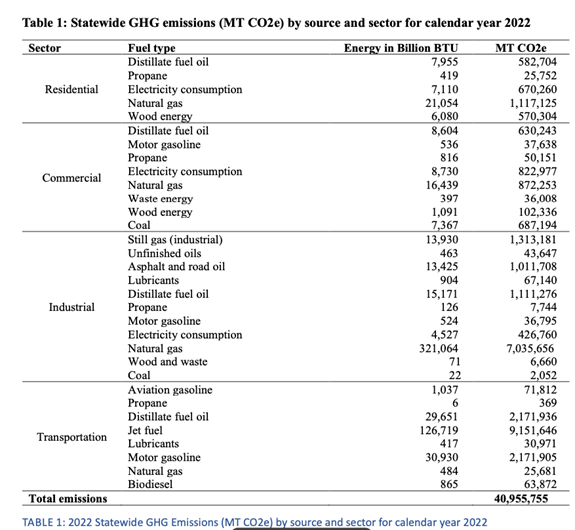
Emission Strategies
Preliminary emissions reduction strategies include weatherization assistance, accelerating “beneficial electrification” by way of heat pumps, solid waste methane capture, electric vehicle supply equipment installation program, a “Solar for all” program for $100M, and augmentation of the existing Renewable energy fund for another $100M.
Also included is carbon capture, use and sequestration. Making reference to the Carbon Offset Program, passed by the Alaska Legislature in 2023, the direct metric listed is the “number of in-development and accredited carbon removal projects on state lands” and a secondary measure metric is the “construction of electric vehicle charging stations.”
Carbon credit programs are bogus with the largest accredited and world leading certifier, Verra, being in the hot seat for over 90% of their offset credits being largely worthless. Verra and Anew, both World Economic Forum partners, were invited to Juneau for expert testimony on the carbon offset legislation. The legislature was notified of Verra’s fraudulent practices during public testimony on the bill, but it passed 58-2.
Goals
Goals of the plan include leveraging federal funding for an “impactful transformation,” delivering “equitable benefits,” “significantly diversifying power generation” and in its aim to reduce its carbon footprint, “the state is focusing on key sectors like transportation and energy production that contribute significantly to emissions.”
Objectives of the plan, 17 total, include:
Coincidentally, three of these key objectives also happened to be Governor Dunleavy’s priority “energy” bills for 2024. These bills were passed this legislative session, after the PSEAP was submitted to the EPA.
Sneaking It Through
The central planners are not at all concerned with what the public has to say about these plans. Public comment was not taken on this plan. , as mentioned in the Plan Elements and Key Takeaways:
The PSEAP is a preliminary analysis of the potential for climate pollution reduction in Alaska, and corresponding mitigation measures. DEC expects a more thorough review as part of the comprehensive planning process, including a robust stakeholder engagement and public consultation.
The plan goes on to state that plans for future engagement are listed in another section, section VII, and within is not a single reference to public comment although they will “complete a benefits analysis for the full geographic scope and population covered by the plan.” How very nice of them.
A key word count found the following:
“Sustainability”
The Governor loves to use this word. It’s best application is to the economic system that provides the most to the most, free-market capitalism, while providing for environmental protection via private property rights (see here). But as a code word to Green New Deal plans, it means governmental command-and-control.
“Sustainability” is the new and perfect word to advance the unconstitutional United Nations global “sustainable” development goals (SDGs). According to the American Policy Center, it is a trigger word to get us to voluntarily surrender our liberties to government control, and as seen in the billions of dollars being dangled over states to comply with the climate goals, that is no stretch.
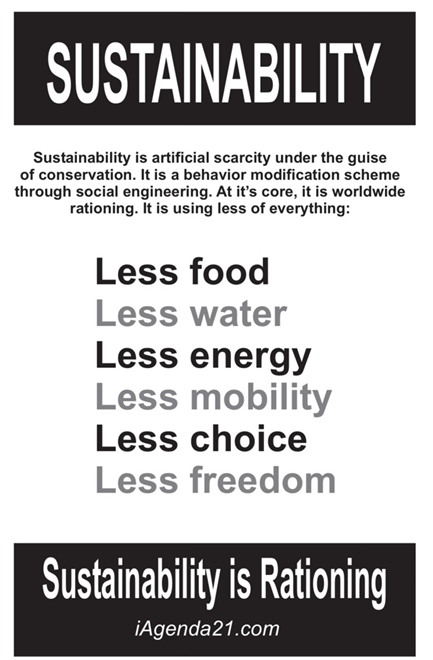
Sustainability in today’s world and in the vast majority of corporate plans is the establishment for a new governance and is really just a signal to our overlords that we are willing and on board with their plans to fulfill the SDGs – and the only way to do that is by rationing and degrowth.
SDG Goal 1: End poverty in all its forms everywhere. This simply means redistribution. Everyone will be equally poor. Less of everything for everyone (except the elite).
SDG Goal 7: Affordable and clean energy for all.
On the energy side of things, we are systematically being reduced to unreliable energy commonly known as windmills and solar panels. You couldn’t possibly supply energy for everyone using sources that supply less energy, so the result will be less energy for all, using more of your earnings to give you less through debt and inflation.
When thinking about what is really meant by the term sustainability and where we go from here, the rule of thumb is climate change overrules all other considerations. Politicians, bureaucrats, and corporate pirates have inserted the word “sustainability” into every state and corporate function possible. In its well-crafted game to subvert the representative republic, this relegates Alaska and the United States Constitution into a subunit of the United Nations.
CSEP: Next Steps
The Comprehensive Sustainable Energy Action Plan concludes:
The State of Alaska anticipates moving quickly from the PSEAP to the CSEAP, recognizing that the comprehensive planning process will provide an opportunity to move forward with more granularity of GHG emissions and corresponding mitigation measures.”
As this report is only preliminary, State authorities will be moving forward with emissions sector workshops with the outputs including “establishing sector greenhouse gas emissions reductions targets and the identification of additional and refined greenhouse gas reduction measures.” The detailed CSEAP with specific targets for emissions reductions is required for the State to remain eligible for federal climate funding.
With interested “stakeholders” undefined and prioritized within the plan, it is not clear how the State will incorporate the public into the input process. With more and more local municipalities adopting Climate Action Plans, the public participation check box may well already be marked.
Alaska’s Comprehensive Sustainable Energy Action Plan isn’t an energy plan but a kleptocracy plan. The people behind this are taking advantage of decades of hard work of Alaskans who can no longer believe that wise, ethical, logical, civic minded people are at the helm (they are not).
The new guard are counting on us to do nothing. But we must show up and speak up. They must know that we know what they are doing. Recall the words of Aleksandr Solzhenitsyn:
We know that they are lying, they know that they are lying, they even know that we know they are lying, we also know that they know we know they are lying too, they of course know that we certainly know they know we know they are lying too as well, but they are still lying. In our country, the lie has become not just a moral category, but the pillar industry of this country.
Now you know.
———————–
[1] Alaska’s total of 41 million metric tons of CO2 release in 2022 compares to the U.S. total of 6,343 mm tons, or less than one tenth of one percent (0.0065). Globally, Alaska represents about one hundred of one percent of the total (36,100 mm tons).
The post State of Alaska’s “Priority Climate Plan” (EPA bribe = trouble) appeared first on Master Resource.
via Master Resource
August 6, 2024 at 01:05AM
The headline of this post is the same headline as appears in today’s New York Daily News as a big banner spanning pages 26 and 27 of the print edition, which are the main op-ed pages. Those two pages then contain two op-eds taking opposite positions on the future of New York’s Climate Leadership and Community Protection Act of 2019, which the Daily News refers to as the “Climate Statute.” The column on page 26 is by Emily Gallagher and Kim Fraczek, with the headline “Getting to affordable, clean energy solutions.” On page 27 the headline is “We have to rethink the state’s climate act”; the by-line is Jane Menton. Both pieces are behind the Daily News’s paywall, although it appears that you can get through it by paying them $1 for an introductory subscription. In my case, when I found out that Jane’s piece was running I went out and splurged $3.50 for the print version.
Comparison of the two pieces will provide a look into the quality of the debate going on in New York over the supposed energy transition.
Both op-eds start by noting the recent news in New York that State officials have publicly recognized that the upcoming 2030 deadlines set out in the Climate Act are not going to be met. The two articles then take opposite views as to what should happen next. As indicated by the headline, Jane’s piece argues that “we have to rethink” the Climate Act. The view of Gallagher and Fraczek is that we need to double down.
I’ll start by describing Jane’s piece. The arguments in the piece will be familiar to regular readers here. But first I should mention that despite the by-line Jane only had a small role in writing the piece. The main author was Roger Caiazza, the Pragmatic Environmentalist of New York. Roger and I (along with Richard Ellenbogen) have recently collaborated on a Report on the unworkability of the Climate Act, described in my post here, and we have also been working partly together and partly on our own, and partly with Jane, to get op-eds published discussing these ideas. Roger initially wrote and submitted this piece as an op-ed to the Daily News, but at first they declined to run it on the ground that they had recently published another piece by Roger. Then they asked if Roger could re-submit the piece over a different by-line. Jane volunteered, and Roger graciously agreed to forego the credit. (It’s a good thing that I did not volunteer. So far I have a 100% rejection rate for various op-eds that I have submitted to our local papers including The New York Times, Wall Street Journal and New York Post.). So the piece ultimately ran with only minor changes from what Roger had written.
The basic point of the Jane/Roger piece is that New York is not meeting the mandates of the Climate Act because providing the required electricity from renewable sources simply cannot be done. The piece cites three recent Reports from the Public Service Commission, from the New York Independent System Operator, and from the New York State Comptroller, all setting forth the insurmountable obstacles.
From the Jane/Roger op-ed:
The glaring problem here? These [DEFR] technologies simply do not exist yet on a commercial scale, and certainly will not be available to fulfill the purpose of substituting for slow to implement renewable energy sources.
And the conclusion:
Taken as a whole, these reports, from three official and credible sources, suggest that there will be insurmountable reliability risks for the Climate Act transition. It is time for a reevaluation.
Now let’s look at the other side. The people writing for the other side are Emily Gallagher and Kim Fraczek. Ms. Gallagher is a State Assemblymember from the Greenpoint neighborhood of Brooklyn (a relatively affluent area just across the river from Manhattan), while Ms. Fraczek is Director of a climate/energy advocacy group called the Sane Energy Project.
If you think that these two might actually address the question of how the proposed energy transition is supposed to work from an engineering standpoint, don’t kid yourself. Instead, the gist is to accuse the existing utilities of “racism” in operation of their system and of spewing toxicity to poison the people. Excerpt:
The governor must act now to regain New York’s position as a climate leader. . . . Our climate law was passed to ensure inclusivity in a historically racist energy system. National Grid [the gas utility in Brooklyn], thus, has admittedly left disadvantaged communities out of its equation. . . . The governor must debunk National Grid’s explanation for outsized utility bill hikes and act to forestall the company’s proposed rate increases.
Where will the power come from for the energy transition? Here is the proposal of Gallagher and Fraczek:
[S]ince the private market is failing us, the governor . . . has an opportunity to direct the New York Power Authority, the largest state public power utility in America providing some of the lowest-cost electricity in the nation, to build 15 gigawatts of renewable energy by 2030 and shutting down the peaker power plants that run on toxic fracked gas.
But how about the problem that wind and solar only provide part-time power that does not match customer demand? How about the need for a DEFR? No mention of those things here. The conclusion:
[W]e should invest in cost-effective, energy-efficient upgrades. By transitioning away from expensive and potentially dangerous gas systems rooted in 19th-century technology, we can create healthier, more comfortable living spaces for all.
This is the quality of the thinking that we are dealing with.
I guess I give the Daily News — generally a left-wing paper — credit for publishing the Jane/Caiazza piece. But so far, the Gallagher/Fraczek argument is what gets you elected in Brooklyn. The question is whether those people can be awakened before the blackouts hit.
via Watts Up With That?
August 6, 2024 at 12:00AM
 Iowa Climate Science Education